
 By Culture Expert
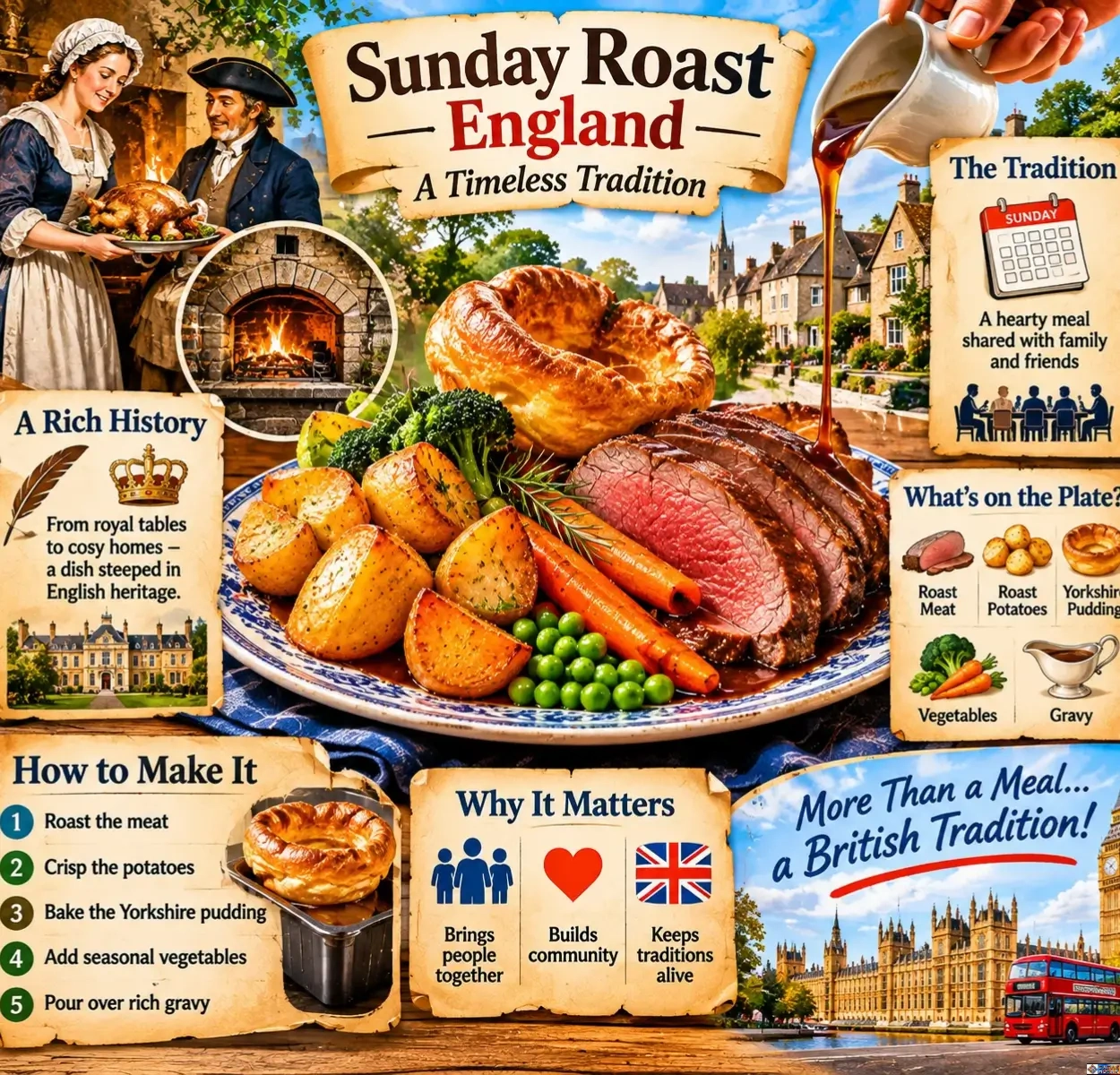
A Sunday roast England style is roast meat, roast potatoes, a Yorkshire pudding, gravy, and two or three vegetables, served in the middle of the day on a Sunday.
Beef is the classic, but chicken, lamb, and pork are all fair game. The tradition is old, a little muddled in its origins, and still alive in homes and pubs across the country.
Below you’ll find the history, the anatomy of the plate, where to eat one, and a full method for cooking it yourself without panic.
The Sunday Lunch Problem Nobody Admits To
Here’s the thing. Everyone loves the idea of a Sunday roast. Fewer people love the reality: five dishes finishing at five different times, a joint that’s grey outside and raw in the middle, potatoes that go soft instead of crisp, and a Yorkshire pudding that comes out of the oven looking like a sad little coaster.
I think that’s why the meal has such a hold on people. It’s hard. It asks for planning, a bit of nerve and a hot kitchen on a day when you’d rather be doing nothing. And when it works, it’s the best plate of food in the English repertoire.
This guide is for both camps. If you’re curious about the Sunday roast England has been serving up for centuries, the history and cultural story comes first. If you want to cook one this weekend, jump to the recipe section. The full tradition is also covered on Sunday roast England at Wikipedia, and we’ve written a companion piece, How did the Sunday roast tradition start?, if the origin story hooks you. At Culture Mosaic we care about food as memory as much as food as fuel, and few meals carry as much memory as this one.
What Is the Tradition of Sunday Roast in the UK?
It’s a weekly ritual. One big, slow-cooked meal, eaten together, usually late morning to mid-afternoon on a Sunday. Families gather. Pubs fill up. The smell of fat and rosemary leaks out of kitchen windows.
The food matters, but the pattern matters more. Sunday was the one day many people had off, so it was the one day a household could cook for hours and sit down together. That’s the quiet engine behind the whole thing, and it’s why so many people in England still treat the meal as a small act of belonging. If you’re interested in how meals shape community, our piece on food rituals in different cultures and our look at dining rituals show how common that instinct is around the world.
How Did the Sunday Roast Tradition Start?
Honest answer: nobody can point to a single date. Anyone who says otherwise is selling you a tidy story.
What we do know is this. Roasting meat in front of an open fire was a mark of prosperity in England for a very long time, and beef became tied up with national pride. In 1731 the playwright Henry Fielding wrote a song called The Roast Beef of Old England, and in 1748 the painter William Hogarth used the same phrase as the title of a satirical picture of a joint of beef being carried through Calais.
By then, roast beef had become shorthand for English plenty, and for a bit of smugness about the French. (The French returned the favour: les rosbifs is still a nickname for the English. You can read more on the other side of the Channel in our history of French culinary traditions.)
The Sunday part is where the folklore creeps in. The popular version says that families put a joint in the oven before church and came home to a finished meal, using the slow, falling heat. Many working households also relied on local bakehouses, taking their dish there to cook. It’s a lovely story, and parts of it are well documented, but treat the exact origins as a blend of habit, religion and economics rather than one clean moment.
The cooking vessels themselves tell a story too. Our guide to ancestral cookware history traces how pots and tins shaped what people could cook, and the humble roasting tin is a big part of that.
What Is in a Traditional English Sunday Roast?
This is the traditional Sunday roast England expects to see on a plate. Argue about the details all you like. The core doesn’t move.
The traditional English roast dinner is a balance of rich and sharp, soft and crisp. The fat and gravy do the heavy lifting. The sauce is there to cut through it. If your plate is all beige, you’ve missed the point.
The Classic Pairings
The English Sunday roast trimmings follow a logic. Each sauce answers something about the meat.
- Beef: horseradish sauce and English mustard. Heat against richness.
- Lamb: mint sauce, or redcurrant jelly. Sweet and sharp against a fatty meat.
- Pork: apple sauce, with crackling and sage and onion stuffing. Acidity for the fat.
- Chicken: bread sauce, bacon, stuffing and a bit of cranberry if you’re feeling festive.
I have a firm view here. Bread sauce is the most underrated thing on the table. It looks like wallpaper paste, it smells of cloves and warm milk, and it’s quietly wonderful.
Is Sunday Roast Lunch or Dinner? What Time Is Sunday Roast in England?
Both, depending on who you ask and where you were raised. In plenty of English homes the midday meal is “dinner” and the evening one is “tea” or “supper”, so “Sunday dinner” and “Sunday lunch” are the same event under two names.
As for timing, a Sunday roast England household typically sits down somewhere between about 1pm and 3pm. Pubs commonly serve from around noon and carry on into the late afternoon, and many run out of the best cuts early, so booking ahead isn’t fussiness. It’s survival.
Sunday Roast England vs the American Version
People search for the American Sunday roast, and it’s worth clearing up. The nearest American cousin is the pot roast or the “Sunday dinner” of the American South: a slow-cooked cut served with vegetables and gravy, often after church. The spirit overlaps. The mechanics differ.
If you’re curious about the other side of the Atlantic, we cover it in USA famous dishes.
The Mosaic Twist: How Modern Britain Cooks Its Roast
This is the part I like best, and it’s the part many food guides skip.
The Sunday roast isn’t a museum piece. It keeps changing, because the people eating it keep changing. Britain’s Caribbean, South Asian and East Asian communities have all folded the roast into their own tables, and the results are among the most interesting food in the country.
Think of a roast chicken rubbed with jerk seasoning and served with rice and peas alongside the usual potatoes. Think of a masala-spiced leg of lamb, or roast potatoes tossed with chilli and cumin. Think of pork belly glazed with soy, honey and five-spice beside a perfectly standard Yorkshire pudding. None of this is a betrayal. It’s the same logic (a long, slow, shared Sunday meal) wearing different clothes. Our feature on African diaspora food culture explores how that kind of blending happens, and the story of silk road spices in British food shows that English cooking has been borrowing spice for centuries.
My view, and I’ll plant a flag: the best Sunday roast is the one that tastes like the people at the table. Purity is overrated.
Where to Find the Best Pub Sunday Roast in England
The pub Sunday roast England is its own institution. Carveries, gastropubs, village locals, grand old coaching inns. All of them do it differently.
Rather than hand you a list that will be out of date by next season, here’s how I’d judge a pub roast, whether you’re searching for the best Sunday roast England has to offer or just the best pub Sunday roast UK wide near your hotel.
- Look at the potatoes first. Glassy, crunchy edges and a soft middle mean someone cares. Pale and rubbery means a microwave was involved.
- Check the Yorkshire. It should be tall, with a crisp rim and a hollow centre. A flat disc is a warning.
- Ask where the meat comes from. Pubs proud of a roast tend to say so on the menu.
- Book. Seriously. The good ones sell out.
- Trust the gravy. If it tastes of stock cube and salt, the rest probably does too.
For Sunday roast London specifically, the city has everything from old riverside pubs to modern restaurants, and Sunday roast England restaurants outside the capital are just as worth chasing. Cross-check any shortlist against recent reviews and the pub’s own website before you set out, because kitchens, chefs and opening hours change.
A wildcard for the adventurous: skip the beef and try a vegetarian or nut roast at a pub that clearly puts effort into it. The good ones are a revelation, and the gravy usually does more of the talking.
How to Make a Sunday Roast: Beef, Chicken, Lamb or Pork
Now the useful bit. A British Sunday roast recipe isn’t one recipe. It’s five or six recipes finishing together. Take it one piece at a time and it’s far less frightening than it looks.
Choosing Your Meat
| Meat | Best for | Oven Temperature | Rough Timing | Internal Temp | Rest |
|---|---|---|---|---|---|
| 🥩 Beef (rib or topside, ~2kg) | Classic centrepiece |
220°C (200°C fan) for 20 min, then 180°C (160°C fan) | ~15 min per 500g for rare, 20 min for medium (after initial blast) |
50°C rare 55–60°C med | 30–40 min |
| 🍗 Chicken (about 1.8kg) | Easiest, forgiving | 190°C (170°C fan) | ~20 min per 500g, plus 20 min extra | 75°C (thigh) | 20 min |
| 🍖 Lamb (leg, about 2kg) | Fragrant, special | 190°C (170°C fan) | ~20 min per 500g, plus 20 min for medium |
60°C med 70°C well | 30 min |
| 🥓 Pork (loin/shoulder w/ skin) | Crackling lovers |
230°C (210°C fan) for 25 min, then 180°C (160°C fan) | ~30 min per 500g (after initial blast) | 75°C | 20–30 min |
These are guides, not gospel. Ovens lie. Joints vary. Buy a probe thermometer. It’s the single best twenty pounds you can spend on Sunday cooking.
Pro tips for the meat:
- Take it out of the fridge an hour before roasting so it cooks evenly.
- Always rest it, loosely covered in foil. Cut it too early and the juices run onto the board instead of staying in the meat.
- For pork, dry the skin completely, score it, rub it with salt, and don’t baste it. That’s how you get crackling that actually crackles.
Roast Potatoes: Crisp Outside, Fluffy Inside
This is where Sundays are won and lost.
- Use a floury variety such as Maris Piper or King Edward. Allow about 250g per person.
- Peel and cut into large, even chunks.
- Boil in salted water for 8 to 10 minutes, until the edges are just starting to soften.
- Drain, then leave them in the colander to steam dry for 5 minutes.
- Shake the colander firmly. You want fluffy, scuffed-up edges, because those edges become the crunch.
- Meanwhile, get your fat smoking hot in a roasting tin in a 200°C fan oven. Goose fat, beef dripping or a good vegetable oil all work.
- Tip the potatoes in carefully, turn them in the fat, and roast for 45 to 60 minutes, turning once halfway.
Pro tip: don’t overcrowd the tin. Crowded potatoes steam. Give them room and they roast.
If you’re curious about how fat and richness shape flavour, our piece on heritage European butter varieties is a good side read for the buttery end of the spectrum.
Yorkshire Pudding That Actually Rises
The earliest known recipe for a pudding of this kind appeared in 1737 as a “dripping pudding”, and Hannah Glasse gave it the name Yorkshire pudding in her 1747 book The Art of Cookery Made Plain and Easy. It was originally served before the meat, with gravy, to take the edge off hunger. Some families in the north of England still serve it that way, and I rather like the idea.
Makes 12 small puddings.
- 140g plain flour
- 4 eggs
- 200ml milk
- A pinch of salt
- Vegetable oil or beef dripping for the tin
- Whisk the flour, eggs, milk and salt into a smooth batter. Rest it for at least 30 minutes, longer if you can.
- Put a little oil into each hole of a 12-hole tin and heat the tin in a 230°C (210°C fan) oven until the fat is smoking.
- Pour the batter in quickly, filling each hole about halfway.
- Bake for 20 to 25 minutes without opening the door. Not once. Not even a peek.
Pro tips: hot fat and a rested batter are the whole secret. Cold tin, lazy puddings. And yes, 2008 brought a famous claim from the Royal Society of Chemistry that a proper Yorkshire pudding should be at least four inches tall. Take that as a friendly challenge rather than a rule.
A weird but traditional alternative: serve a Yorkshire pudding afterwards, with golden syrup or jam. In some households it was once a pudding course in its own right, and it’s much nicer than it sounds.
Proper Gravy From Pan Drippings
Good gravy is a tiny act of rescue. You take the browned, sticky mess at the bottom of the tin and turn it into the best thing on the plate.
- Lift the meat out to rest. Pour off most of the fat, leaving about 2 tablespoons and all the dark sediment.
- Put the tin on the hob over a medium heat. Stir in 2 tablespoons of plain flour and cook for a minute, scraping up everything stuck to the bottom.
- Gradually whisk in about 500ml of hot stock (and a splash of vegetable cooking water if you like).
- Add a splash of red wine, port or a spoonful of redcurrant jelly if you want depth.
- Simmer for 8 to 10 minutes, then strain for a smooth finish. Taste and adjust.
Pro tip: the deep, savoury note in a good gravy is basically umami, and it comes from browned bits. If you want to see how cooks across the world chase that flavour, read about ancestral umami techniques.
Two Vegetables Worth Making
Roasted carrots and parsnips. Halve them lengthways, toss with a little oil and salt, and roast at 200°C (180°C fan) for 30 to 40 minutes until caramelised at the edges. A drizzle of honey in the last 10 minutes is a nice touch, though I’d say it’s optional. I’d leave it off carrots and keep it for the parsnips.
Steamed greens. Savoy cabbage, kale or spring greens, steamed for 4 to 6 minutes until bright and just tender. Finish with butter and black pepper. Simple and exactly right.
Wildcard: char hispi cabbage in a hot pan until blackened at the edges, then toss it in anchovy butter. It’s not remotely traditional. It’s also the thing people will ask about afterwards.
How to Time Everything (A Plan for Serving at 2pm)
This is the part that frightens people, so here’s a worked example for a 2kg joint of beef. Adjust for your meat using the table above.
| Time | What to do |
|---|---|
| 10:30 | Take the beef out of the fridge. Make the Yorkshire batter and leave it to rest. |
| 11:30 | Oven on at 220°C (200°C fan). Beef in. |
| 11:50 | Turn the oven down to 180°C (160°C fan). Peel and parboil the potatoes. |
| 12:15 | Potatoes into the hot fat. Back into the oven. |
| 12:30 | Carrots and parsnips in. |
| 1:00 | Beef out, covered, to rest. Turn the oven up to 230°C (210°C fan). Put the Yorkshire tin in to heat. |
| 1:10 | Make the gravy in the beef tin on the hob. |
| 1:15 | Yorkshire batter into the hot tin, back into the oven. |
| 1:35 | Steam the greens. Warm the plates. |
| 1:40 | Yorkshires out. Carve the beef. |
| 2:00 | Sit down. |
The real trick is that the meat’s resting time is your oven’s free time. That’s when the hottest, fastest things (the Yorkshires) get their turn. Once you see that, the whole meal clicks into place.
What Makes a Great Roast, and Why It Matters
The long cooking and the shared table are the heart of this meal. Slow technique, handed down, practised and quietly adjusted, is the same thread running through everything we cover in heritage cooking techniques and traditional recipes from around the world. And the way the smell of a Sunday kitchen can pull you straight back to being seven years old is exactly what we mean by somatic food memory.
A roast dinner is a small lesson in patience. You can’t rush it. You can only set it up well and let it do its work.
Five Frequently Asked Questions
What is the tradition of Sunday roast in the UK?
It’s a weekly meal built around roast meat, roast potatoes, Yorkshire pudding, gravy and vegetables, eaten together on a Sunday, usually in the early or mid afternoon. It grew out of the habit of using Sunday, a day of rest for many, to cook and share one large meal. Beef became the symbol of the tradition, but chicken, lamb and pork are all common. Today it’s as much about gathering people as it is about the food.
What is in a traditional English Sunday roast?
A roasted joint or bird, roast potatoes, a Yorkshire pudding, gravy made from the roasting juices, and two or three vegetables such as carrots, parsnips and greens. Each meat has its own sauce: horseradish with beef, mint with lamb, apple sauce with pork and bread sauce with chicken. Stuffing, usually sage and onion, joins chicken and pork.
How did the Sunday roast tradition start?
There’s no single, certain origin. Roast beef was tied to English identity by the 1700s, as songs and paintings of the period show, and the habit of putting a joint in the oven before church and eating it on returning is a widely told part of the story. Treat the full origin as a gradual development shaped by religion, working life and cooking technology rather than one decision on one day. For more, see our article on the Sunday roast tradition.
Is Sunday roast lunch or dinner?
Both, depending on region and family habit. In many parts of England the midday meal is called dinner, so “Sunday dinner” and “Sunday lunch” often describe the same meal. It’s usually served between about 1pm and 3pm at home, and pubs commonly serve from around noon into the late afternoon.
What time is Sunday roast in England?
Most households eat somewhere between 1pm and 3pm, and many pubs serve from midday until the late afternoon or until they sell out. If you want a good table at a popular pub, book ahead and aim for the earlier end of the window, since the best cuts can run out.
Sources
- Wikipedia contributors, “Sunday roast”, Wikipedia.
- Wikipedia contributors, “Yorkshire pudding”, Wikipedia.
- Henry Fielding, The Grub-Street Opera (1731), which includes the song “The Roast Beef of Old England”.
- William Hogarth, O the Roast Beef of Old England (“The Gate of Calais”) (1748), held in the Tate collection.
- Hannah Glasse, The Art of Cookery Made Plain and Easy (1747), the first printed use of the name “Yorkshire pudding”.
- The Whole Duty of a Woman (1737), which contains an early recipe for a dripping pudding.
- Royal Society of Chemistry, 2008 statement on the height of a Yorkshire pudding.
- Food Standards Agency, guidance on safe cooking temperatures for meat and poultry.