
 By Culture Expert
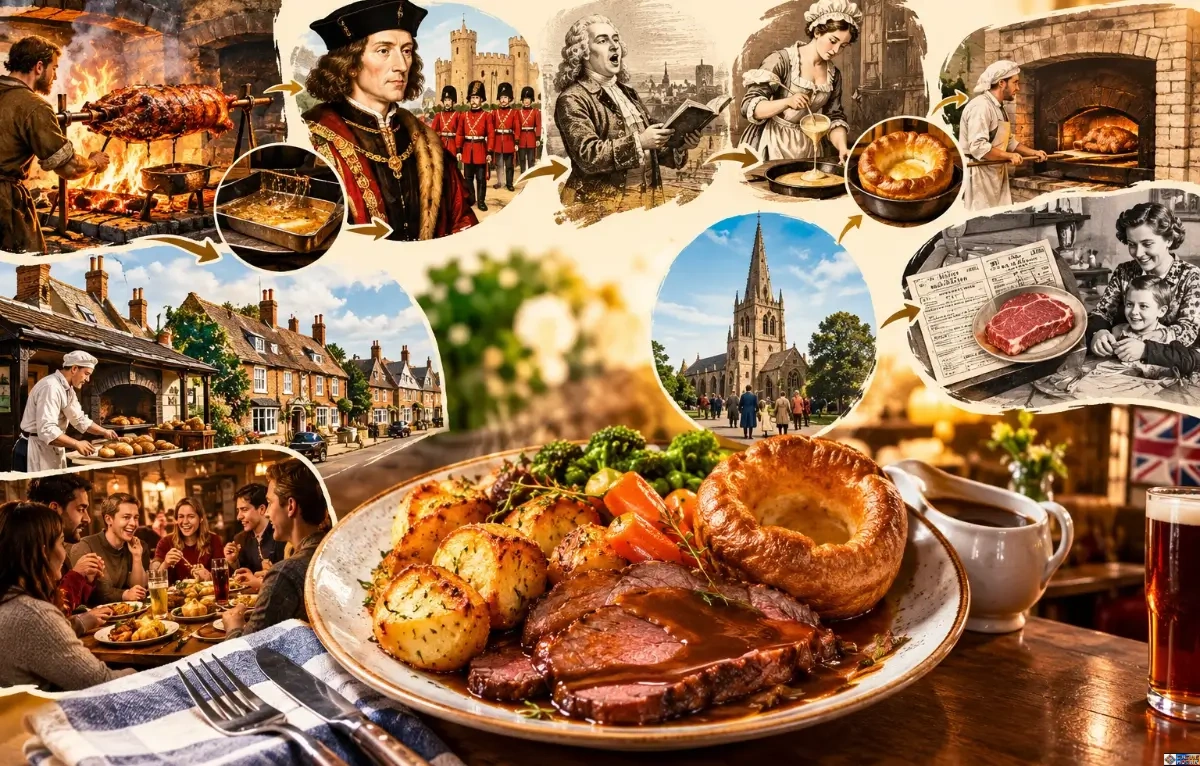
Quick Summary: Nobody invented the Sunday roast on a particular day. It grew out of three older habits: Sunday as the one day for church and a proper meal, meat cooked in front of an open fire, and a stubborn English pride in roast beef that had taken hold by the 1700s. Yorkshire pudding arrived in print in the 1730s and 1740s. Village and town bakehouses, then wartime rationing, then the pub, did the rest. The tidy story about Henry VII’s guards in 1485 is charming. I don’t think the evidence supports it.
You’ve sat at that table. Steam on the window, gravy going cold because someone is still talking, a roast potato being fought over with a fork. And somewhere between the second helping and the washing-up, you may have wondered why on earth the whole country does this on the same day.
The honest answer is messier than the one in most listicles. So here is the real trail, with the myths marked as myths.
So, How Did the Sunday Roast Tradition Start in England?
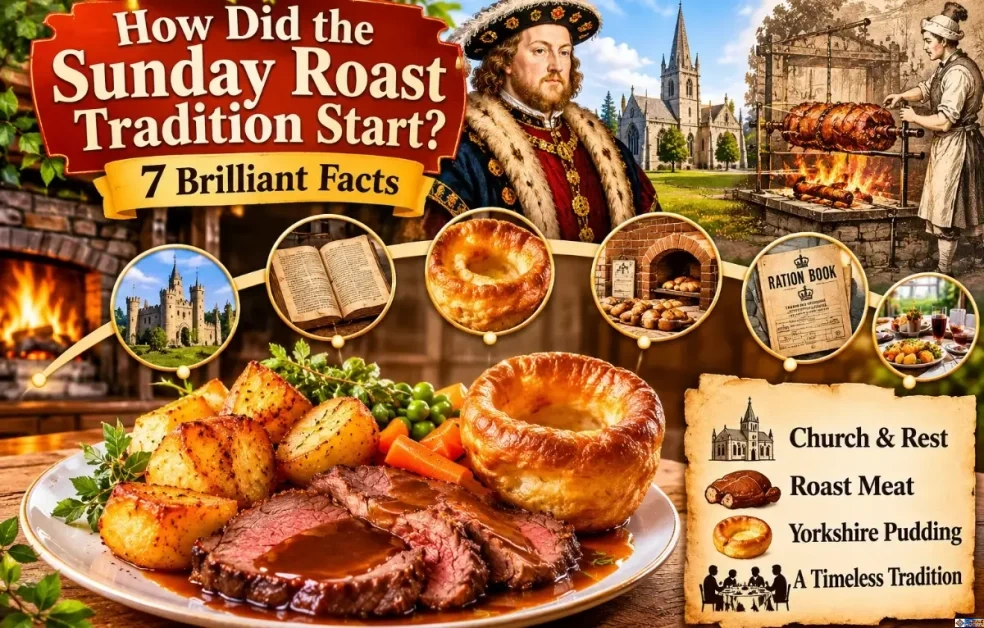
Short version: slowly, and from the bottom up as much as the top down.
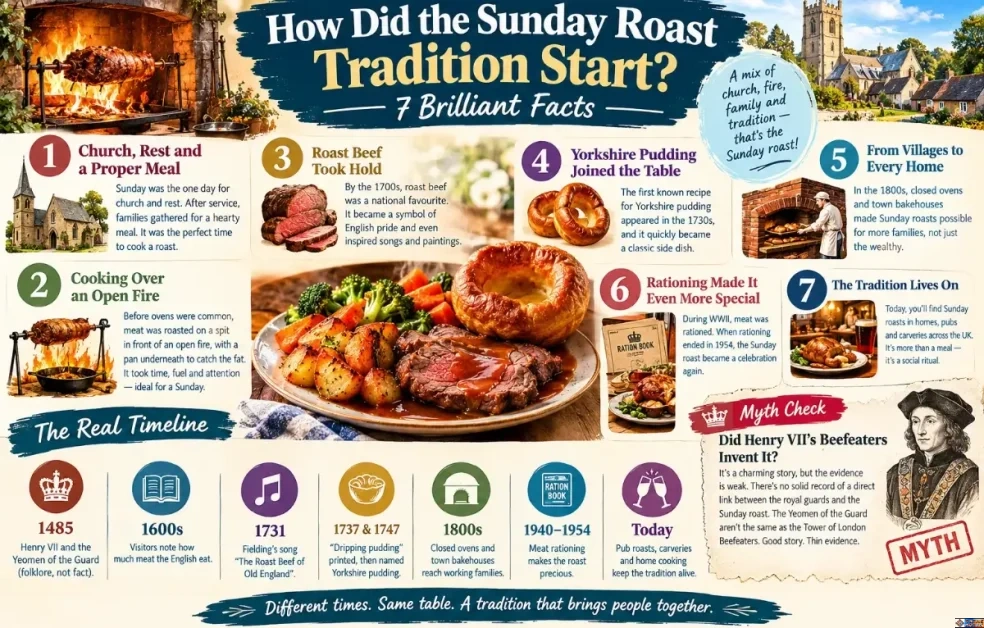
Before ovens were common in ordinary homes, “roast” meant something specific. Meat turned on a spit in front of an open fire, with a pan underneath to catch the fat. It took hours. It needed fuel, attention and a household with something worth roasting. Sunday, as the day of worship and rest, was the obvious moment to spend all three.
That is the seed. Everything else is accretion.
Myth Check: Did Henry VII’s Beefeaters Invent It?
The story goes like this. In 1485 Henry VII created the Yeomen of the Guard, they feasted on roast beef after Sunday service, and the habit trickled outward. You will find it repeated on Wikipedia and a hundred food blogs. For a quick outline, the encyclopedia entry on How did the Sunday roast tradition start? is a fair place to begin.
I’d treat it with caution. The nickname “Beefeater” is real and old. A direct line from a royal guardroom to your gran’s kitchen is not something I can find in a dated source. And the Yeomen of the Guard are not the same body as the Yeoman Warders at the Tower of London, who are the ones tourists call Beefeaters. Good story. Thin evidence.
Before the Oven: Fire, Spit and Dripping Pan
Here’s the part that changes how you see Yorkshire pudding. Meat on a spit drips. Cooks put a pan underneath. And in that pan, someone eventually poured batter.
That is cooking with fire as a system, not a trick. If you like this kind of kitchen archaeology, our piece on Heritage Cooking Techniques follows the same thread across other cuisines, and the history of ancestral cookware shows how the pots and pans themselves shaped what people could eat.
Technically, what most of us do today is baking in an enclosed oven, not roasting. The word stuck anyway. Language is lazy like that.
Why Sunday? Church, Rest and the One Proper Meal
For centuries the week was hard and the table was plain. Meat was expensive. Fast days, Fridays and Lent especially, kept it off many plates. Sunday was different: work paused, the household dressed, people went to church, and afterwards the family sat down together.
It makes sense to me that the biggest meal landed on the one day with the time to cook it and the people to share it. If you want to see how other cultures bind food to the calendar, Food Rituals in Different Cultures and our look at Dining Rituals make good company.
Roast Beef and Rebellion: The Eighteenth Century
By the 1700s roast beef had become a political symbol. Fielding’s 1731 song celebrated it. In 1748 William Hogarth painted O the Roast Beef of Old England (also called The Gate of Calais), a swipe at French food and French absolutism, with a hunk of English beef carried in triumph past hungry French soldiers.
This matters because it turned a meal into an identity. Food that stands for “us” tends to outlive fashion.
The Yorkshire Pudding Paper Trail
The earliest printed recipe I know of appears in The Whole Duty of a Woman (1737) under the name “a dripping pudding.” Hannah Glasse then gave the dish its regional name in The Art of Cookery Made Plain and Easy (1747), instructing cooks to bake the batter beneath the meat so the juices ran into it.
There’s a popular claim that the pudding was served first, with gravy, to fill people up so they ate less of the expensive meat. It’s repeated everywhere. I haven’t seen firm period proof, so I’d file it under plausible, not proven.
The Bakehouse Years: How Ordinary Families Pulled It Off
Most homes in the nineteenth century had no oven fit for a large joint. Accounts of working-class life describe families carrying their meat, often in a tin with potatoes, to the local baker, who used the heat left in the oven after the morning’s bread. A small payment, a ticket, a walk home with dinner wrapped in a cloth.
That is where I think the tradition became truly national. Not on grand tables, but in streets where the whole row ate roughly the same thing at roughly the same hour.
Leftovers mattered too. Cold meat on Monday, bubble and squeak with the vegetables. Nothing wasted.
War, Rationing and the Modern Table
Meat rationing began in 1940 and ended in July 1954. For fourteen years a proper joint was something you saved for and shared out carefully. When restrictions lifted, the Sunday roast came back with weight. It had gone from habit to something close to a promise.
The pub eventually took over some of the work, and the carvery turned the meal into a day out. Not everyone likes carveries. I’ll say it plainly: a good home roast beats a tired one, but a good pub roast beats a stressed host.
Food and feeling are tangled together here, which is the subject of our piece on Somatic Food Memory.
What Is a Sunday Roast? The Anatomy of the Plate
A Sunday roast is a main meal built around roasted meat, served with roast potatoes, vegetables, Yorkshire pudding (usually, though not always) and gravy. The pairings are fairly fixed:
Vegetarian roasts, nut roasts and whole roasted cauliflower now sit comfortably alongside them. The dripping that crisps the potatoes is a flavour in itself, though butter-lovers should look at our guide to Heritage European Butter Varieties for a different route to richness.
An English Sunday Roast Recipe (Simple Chicken Version)
This is a basic, forgiving method, not a restaurant one.
Chicken (serves 4–6): Take a 1.8 kg bird out of the fridge an hour ahead. Season well, add butter or oil, and roast at 200°C (180°C fan) for about 20 minutes per 500 g plus 20 minutes. Check that the juices run clear with no pink meat. Rest it for 20 minutes under foil.
Roast potatoes: Peel 1 kg of floury potatoes (Maris Piper is the usual), parboil for 8–10 minutes, drain and shake hard to roughen the edges. Tip into hot fat at 220°C (200°C fan) and roast for 45–55 minutes, turning once.
Yorkshire puddings: Whisk 140 g plain flour, 4 eggs and 200 ml milk with a pinch of salt. Rest for 30 minutes. Heat a little fat in each hole of a 12-hole tin until smoking, pour in the batter, and bake at 220°C (200°C fan) for 20–25 minutes. Don’t open the door early.
Gravy: Pour off most of the fat, stir a spoonful of flour into the roasting tin juices, add stock, and simmer until glossy.
Keeping the Tradition Going
Three ordinary ideas first. Cook one roast a month if weekly feels like too much. Let someone else carve. Ask a guest to bring a side.
And one strange one: hold a roast swap, where neighbours trade a portion of whatever they cooked. It sounds odd until you remember the bakehouse street.
Five Questions People Keep Asking
Is Sunday roast lunch or dinner?
Both, depending on who you ask. In much of northern England and parts of the Midlands, the midday meal is called dinner, so Sunday dinner is eaten around one or two o’clock. Elsewhere people say Sunday lunch for the same plate at the same time. Some families push it to the late afternoon. The label changes. The meal doesn’t.
Do British people eat Sunday roast every Sunday?
Not all of them, and I won’t invent a percentage. Plenty of households still treat it as a weekly fixture. Others cook it monthly, or eat it at a pub, or skip it entirely for work, diet, culture or budget reasons. It remains a widely recognised national meal rather than a universal habit.
Is a Sunday roast unhealthy?
It depends on the plate. A roast with lean meat, plenty of vegetables and moderate gravy can sit within the NHS Eatwell Guide’s advice. Extra fat, salty gravy, big portions of roast potatoes and a heavy hand with pudding push it the other way. Like most meals, the proportions matter more than the name.
Is Sunday roast a thing in America?
In spirit, yes. Many American households, especially in the South, have their own Sunday dinner after church, with roast chicken, pot roast or ham. It is not the same ritual, and the Yorkshire pudding is rare. British expats and diaspora communities often keep the English version alive, a pattern echoed in our look at African diaspora food culture.
What’s the difference between Sunday roast and Christmas dinner?
Mostly the centrepiece and the trimmings. While a Sunday roast typically features beef, lamb, pork, or chicken served with Yorkshire pudding and gravy on a weekly or occasional basis, Christmas dinner is a once-a-year feast centered around turkey (or goose/ham) served with pigs in blankets, stuffing, cranberry sauce, and Christmas pudding. The Christmas version is, in a sense, the Sunday roast dressed up for the occasion.
Sources
- Brears, Peter. Cooking and Dining in Tudor and Early Stuart England. Prospect Books, 2015.
- Fielding, Henry. The Roast Beef of Old England (song from The Grub-Street Opera), 1731.
- Glasse, Hannah. The Art of Cookery Made Plain and Easy. London, 1747.
- Hogarth, William. O the Roast Beef of Old England (The Gate of Calais), 1748. Tate collection.
- Rogers, Ben. Beef and Liberty: Roast Beef, John Bull and the English Nation. Chatto & Windus, 2003.
- Spencer, Colin. British Food: An Extraordinary Thousand Years of History. Grub Street, 2002.
- The Whole Duty of a Woman. London, 1737.
- Historic Royal Palaces. Yeoman Warders at the Tower of London (hrp.org.uk).
- UK National Archives. Meat rationing in Britain, 1940–1954 (nationalarchives.gov.uk).
- Food Standards Agency. Cooking chicken safely (food.gov.uk).
- NHS. The Eatwell Guide (nhs.uk).
- Wikipedia. How did the Sunday roast tradition start?