
 By Dr. Marcus Hale
QUICK SUMMARY
Ancient Egyptian burial customs were built on one core belief: death was not an ending, but a doorway. To pass through safely, a body had to be preserved through mummification, protected inside a tomb stocked with grave goods, and honored through essential rituals like the Opening of the Mouth ceremony. While wealthy elites received elaborate embalming and richly painted tombs, the vast majority of ordinary Egyptians were simply wrapped in linen and buried in the hot desert sand, which naturally desiccated and preserved their bodies.
In the modern era, technology has transformed how we uncover these ancient secrets. Non-invasive CT scanning allows researchers and Egyptologists to digitally unwrap mummies like Tutankhamun without disturbing their physical remains. This cutting-edge science reveals critical details about ancient health, familial lineages, physical trauma, and potential causes of death that were never recorded in historical texts.
I’ve spent a long time reading excavation reports and museum catalogues on this subject, and the thing that still catches me off guard is the gap between the myth and the mess. Popular culture gives us gold masks and cursed tombs. The archaeological record gives us something messier and, I think, far more interesting: a civilisation working out, over three thousand years, how to argue with death.
1. Why Ancient Egyptians Buried the Dead With So Much Care
Here’s the problem most articles skip past: burial customs weren’t decoration. They were insurance. Ancient Egyptians believed a person had several linked elements — the ka (life force), the ba (personality), and the akh (the transfigured spirit that could exist in the afterlife). For the akh to survive, the body had to remain recognisable, the name had to be preserved, and the tomb had to function as a kind of life-support system stocked with food, clothing and tools.
That belief shaped everyday behaviour long before death arrived. If you want the fuller picture of how Egyptians actually lived — what they ate, how they worked, how households were organised — I’ve laid out the full breakdown in what was everyday life in ancient Egypt. Burial customs only make sense against that backdrop. People weren’t preparing for a vague afterlife. They were preparing to keep living, just somewhere else.
The empathy point here is simple: losing someone is hard in any century. Egyptian funerary religion gave grieving families a job to do — a checklist of rituals, offerings and preparations — at a moment when doing nothing would have been unbearable. That’s not so different from why modern funeral customs exist at all.
2. How Egyptian Mummification Actually Worked, Step by Step
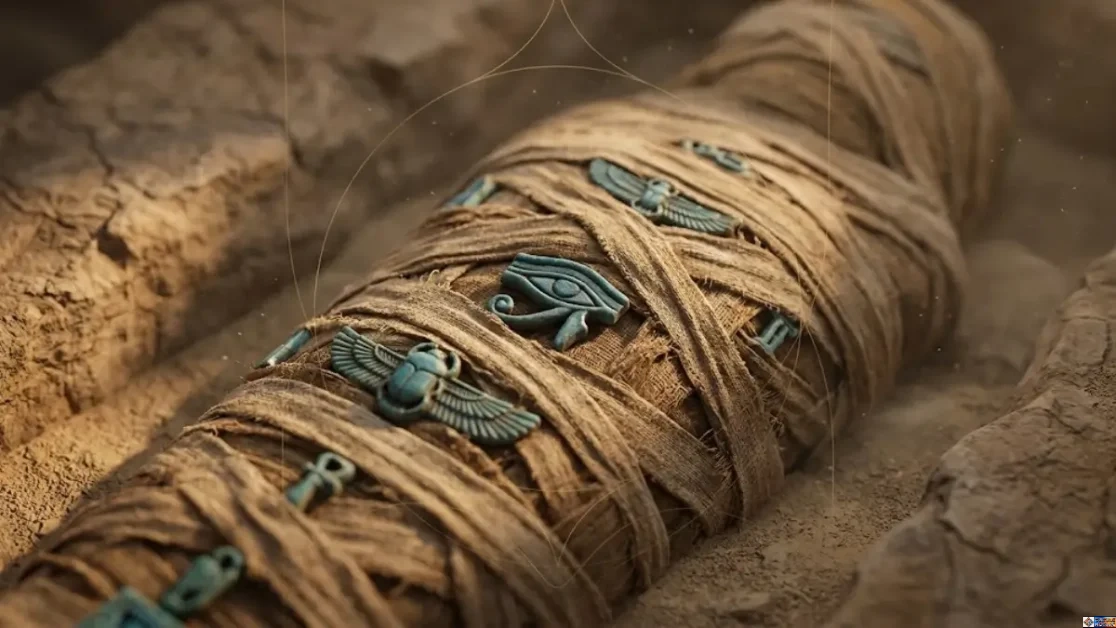
Egyptian mummification science developed over centuries, but by the New Kingdom (roughly 1550–1070 BCE), embalmers had a fairly standardised process. Here’s the Egyptian burial process step by step, as reconstructed by Egyptologists from tomb paintings, embalmers’ caches and the Greek historian Herodotus, writing around 450 BCE:
- Purification. The body was washed with wine and Nile water.
- Organ removal. The brain was extracted through the nose with a hooked tool and discarded — Egyptians didn’t rate its importance. The liver, lungs, stomach and intestines were removed through a small incision and preserved separately in canopic jars. The heart was left in place, believed to hold a person’s memory and moral record for weighing in the afterlife.
- Desiccation. The body was packed inside and out with natron, a naturally occurring salt mixture, and left for around 40 days to draw out all moisture.
- Treatment and stuffing. Once dried, the body cavity was packed with linen, sawdust or resin-soaked cloth to restore shape.
- Wrapping. The body was wrapped in hundreds of metres of linen bandages, often with protective amulets tucked between layers, over roughly 15 days.
- Ritual and burial. The wrapped mummy underwent the Opening of the Mouth ceremony, symbolically restoring the senses, before being sealed in its coffin and tomb.
The Ancient Egyptian Burial Process: A 70-Day Timeline
- Day 0: Purification — Washing the body with Nile water and palm wine.
- Days 1–3: Organ Removal & Canopic Jars — Removing internal organs to be placed in separate jars (leaving the heart).
- Days 4–43 (40 Days): Desiccation in Natron — Packing the body in natron salt to completely dry it out.
- Days 44–47: Treatment & Stuffing — Treating the skin with oils and resins, and stuffing the body cavity to restore shape.
- Days 48–62 (15 Days): Wrapping in Linen — Carefully wrapping the body in hundreds of meters of linen strips and amulets.
- Days 63–70: Ritual & Burial — Performing the Opening of the Mouth ceremony and sealing the sarcophagus inside the tomb.
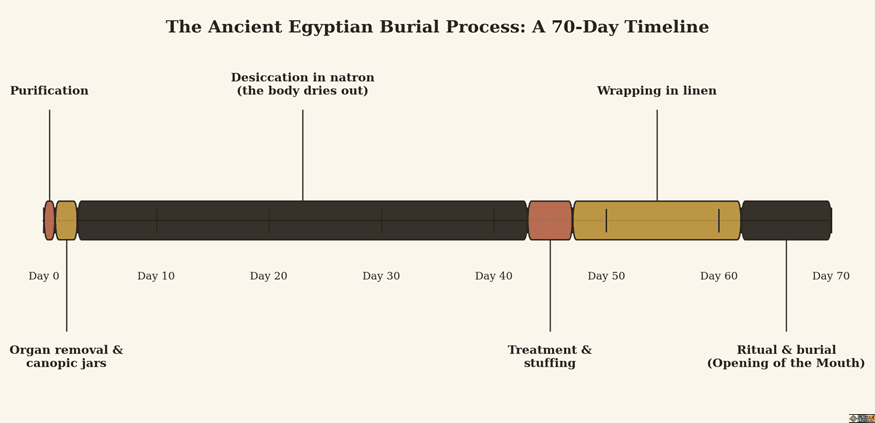
The whole process ran close to 70 days from death to burial. For a deeper look at how these preservation methods evolved and what materials embalmers actually used, I’ve covered the chemistry and technique in Ancient Egyptian Mummies Preservation Techniques. And if the word “mummy” itself has ever struck you as an odd choice, the answer is more mundane than you’d guess — it traces to a Persian and Arabic word for bitumen, because early European traders assumed the blackened preserved bodies were coated in tar. I go into that etymology properly in What Is Mummy in History?
3. What Did Mummification Smell Like?
Nobody puts this in the textbooks, but it’s one of the questions people actually search for, and it deserves a straight answer: unpleasant, then increasingly less so. The early stages — organ removal and the first days of natron packing — would have smelled of blood, bile and decomposition, even with rapid desiccation. Embalmers worked with resins, myrrh, frankincense and cedar oil partly for religious reasons and partly, frankly, because those scents masked what was underneath.
By the time a body was fully wrapped, the dominant smell would have shifted to something closer to a spice merchant’s stall — resinous, waxy, and faintly sweet from the natron salts. Residue analysis on mummy wrappings published by chemists at the University of Bristol and University of Tübingen has actually identified the specific balms used on different mummies, right down to sourcing some resins from as far as South or Southeast Asia — evidence of trade networks far wider than anyone assumed.
4. Where the Dead Were Laid to Rest: Tombs, Pits and the Valley of the Kings
The earliest ancient Egyptian burial ground wasn’t a monument at all — it was a shallow pit in the desert sand. Predynastic Egyptians, before 3100 BCE, buried their dead in a crouched position directly in the hot, dry sand, which naturally desiccated bodies without any embalming at all. Some of the best-preserved natural mummies in the world, including the famous “Gebelein Man” in the British Museum, come from exactly this simple method.
As Egyptian society organised into a state, burial architecture escalated fast. Early dynastic elites used mastabas — flat-roofed rectangular structures over an underground burial chamber. By the Old Kingdom, that idea scaled up into the pyramids at Giza and Saqqara. By the New Kingdom, pharaohs abandoned pyramids altogether in favour of hidden, rock-cut tombs in the Valley of the Kings near Thebes, precisely to deter the tomb robbery that had plagued earlier, more visible monuments. I’ve traced exactly where mummification and organised burial first took hold, and how the practice spread from there, in Where Were Ancient Egyptian Mummies First Buried?
Table 1: How Burial Customs Changed by Social Class
5. What Grave Goods Reveal About Egyptian Belief in the Afterlife
Grave goods weren’t sentimental keepsakes. They were equipment. Tutankhamun’s tomb, discovered by Howard Carter in 1922, held over 5,000 objects — chariots, board games, furniture, food, weapons and jewellery — because the young king was expected to need all of it on the other side. Poorer burials held scaled-down versions of the same logic: pottery, a few tools, perhaps a single amulet.
Shabti figures are one of the more overlooked grave goods, and one of the most telling. These small statuettes were inscribed with spells obligating them to perform manual labour on the deceased’s behalf in the afterlife — essentially, magical stand-in workers, so the dead wouldn’t have to farm the Field of Reeds themselves. Wealthier tombs sometimes held over 400 shabtis, one for every day of the year plus overseers. If tomb construction and its hidden engineering interest you, I’ve covered the architecture and the deliberate traps built to foil robbers in Secrets of the Mummy’s Tomb
6. Burial Practices for the Poor: What Most Egyptians Actually Got
This is the part popular history tends to skip, and it matters: ancient Egyptian burial practices for the poor looked almost nothing like what appears in documentaries. The overwhelming majority of Egyptians were farmers, labourers and craftspeople who couldn’t afford professional embalming, a stone sarcophagus or a decorated tomb chapel. Their reality was simpler, and arguably more moving for it.
A typical poor burial involved wrapping the body in simple linen or reed matting and interring it in a shallow pit in a communal desert cemetery, sometimes alongside a few personal possessions — a favourite bowl, a string of beads, a small clay figurine. The hot, arid sand did the preservation work that expensive natron and resin did for the wealthy, which is part of why so many naturally mummified bodies from ordinary Egyptians have survived intact for thousands of years, in some cases better preserved than elaborately embalmed royal mummies. Belief in the afterlife wasn’t reserved for the rich. It was a universal expectation; only the scale of preparation for it was unequal.
7. Famous Mummies From Ancient Egypt — and What CT Scans Reveal
Famous mummies from ancient Egypt tend to fall into two categories: the ones everyone recognises by name, and the ones CT scanning has quietly made famous among researchers. Tutankhamun remains the obvious headline case. A 2010 study led by Zahi Hawass, using CT imaging and DNA analysis on his mummy and those of his relatives, established that his parents were likely full siblings, identified the strain of malaria in his blood, and found evidence of a bone disorder and a badly broken leg — all of which reshaped the theory of how he died. I’ve laid out that full investigation in How Did King Tut Die and Why
CT scanning mummies has become standard practice at UK institutions too. Manchester Museum’s KNH Centre for Biomedical Egyptology has scanned dozens of mummies in its collection without unwrapping a single one, identifying ages at death, evidence of arthritis and dental disease, and even a case of what appears to be a healed skull fracture. The British Museum has done the same with its “Gebelein Man” and several Late Period mummies, producing interactive digital reveals that let visitors see through the wrappings layer by layer.
Most mummies aren’t nearly as old as people assume — a common misconception worth correcting directly, since it’s one of the most-searched questions on the topic. Predynastic natural mummies can be over 5,000 years old, but the bulk of well-known royal mummies date to the New Kingdom, meaning roughly 3,300 to 3,500 years old, not the 6,000-plus years some sources casually claim. I’ve broken down the actual age ranges by dynasty and period in How Old Are Most Egyptian Mummies?
Table 2: How Tomb Types Evolved Over Time
8. Death, Family and Controversy: What the Records Actually Show
A few of the most-searched questions about ancient Egypt sit right at the edge of burial customs, and I think they deserve honest answers rather than being quietly avoided.
Royal sibling marriage was real, and it was primarily a political and religious tool rather than a general Egyptian practice. Pharaohs married sisters or half-sisters mainly to keep royal succession and divine lineage concentrated within the family, echoing the mythological marriage of the gods Osiris and Isis. It was not the norm among ordinary Egyptians, whose marriage records show relatively little of it. The consequence for the royal line, though, was measurable: Hawass’s 2010 study found signs of inherited conditions in Tutankhamun consistent with generations of close-kin marriage within his immediate family.
What happened to King Tut’s wife is one of archaeology’s genuinely unresolved mysteries. Ankhesenamun, his half-sister and queen, disappears from the historical record after his death around 1323 BCE. A fragmentary letter, possibly written by her, appears in Hittite archives requesting a foreign prince as a husband to avoid marrying a commoner — a request that ended badly for the prince involved. No confirmed tomb or mummy for Ankhesenamun has ever been identified, which keeps her fate a genuinely open question rather than a settled fact dressed up as one.
On sexuality, the evidence is thinner than modern debates sometimes suggest, but it isn’t silent. The tomb of Niankhkhnum and Khnumhotep, two male royal manicurists from the Fifth Dynasty, shows the pair depicted in poses typically reserved for married couples, including an embrace usually shown between husband and wife. Egyptologists remain divided on whether this depicts a romantic and possibly sexual relationship or an unusually close platonic or ritual kinship — the ambiguity is real, not a modern imposition, and I’d be doing the record a disservice to claim more certainty than currently exists either way.
9. Ancient Egyptian Burial Customs KS2: Teaching the Story Simply
For UK primary schools working through the KS2 history curriculum, ancient Egyptian burial customs are usually the topic that gets children genuinely excited about history for the first time — and for good reason. The trick, in my view, is resisting the urge to sanitise it into something bloodless. Children respond to the real details: the 70-day process, the reason the heart stayed in the body, the idea that a pharaoh’s tomb was packed like a very elaborate suitcase for a trip nobody could describe. Museum-based learning helps enormously here; both the British Museum and Manchester Museum run dedicated KS2 sessions built around real mummification objects and canopic jars, which does more for retention than any worksheet.
Frequently Asked Questions
What did mummification smell like?
In the early stages, unpleasant — blood, bile and decomposition were unavoidable during organ removal and initial drying. As the process progressed, resins like myrrh, frankincense and cedar oil dominated, giving a fully wrapped mummy a scent closer to spice and wax than decay. Residue analysis on preserved wrappings has confirmed exactly which resins were used, and some were imported from remarkably far away.
Why was inbreeding so common in ancient Egypt?
It was largely restricted to the royal family and driven by religious and political logic, not general Egyptian custom. Pharaohs married close relatives to preserve divine bloodlines and secure succession, mirroring the sibling marriage of Osiris and Isis in Egyptian mythology. DNA analysis of Tutankhamun’s family shows the health consequences of that concentrated lineage within the royal line specifically.
What happened to King Tut’s wife when he died?
Ankhesenamun vanishes from the historical record shortly after Tutankhamun’s death. Hittite archive letters suggest she sought a foreign husband to avoid a forced marriage to a non-royal successor, but no tomb or mummy identified as hers has ever been found, leaving her fate unresolved.
Was homosexuality accepted in ancient Egypt?
The evidence is genuinely ambiguous rather than clearly supportive or dismissive. The Fifth Dynasty tomb of Niankhkhnum and Khnumhotep depicts two men in marital-style poses, which some Egyptologists read as evidence of a romantic relationship and others read as an unusually close platonic bond. No definitive legal or religious position on same-sex relationships survives from the period.
How long did the full Egyptian burial process actually take?
Roughly 70 days from death to entombment for a fully mummified body — about 40 days for desiccation with natron, followed by around 15 days of wrapping, plus time for ritual preparation and the funeral itself. Poorer, non-mummified burials in sand pits happened far faster, often within days.
A Final Thought
What strikes me most, after all this, isn’t the gold or the curses. It’s the ordinariness underneath the spectacle — a farmer’s family wrapping a body in linen with the same seriousness a pharaoh’s embalmers brought to natron and resin, both acting on the same belief that a name and a body, kept intact, meant a person hadn’t really gone anywhere. If you want to keep exploring this world beyond burial, what was everyday life in ancient Egypt is the natural next stop, and Culture Mosaic covers plenty more of it.
Sources
- Wikipedia — Ancient Egyptian funerary practices
https://en.wikipedia.org/wiki/Ancient_Egyptian_funerary_practices
- British Museum — Egyptian mummies collection notes and Gebelein Man records
- Hawass, Z. et al. (2010), “Ancestry and Pathology in King Tutankhamun’s Family,” Journal of the American Medical Association
- Manchester Museum, KNH Centre for Biomedical Egyptology — mummy CT scanning research
- University of Bristol / University of Tübingen — mummification balm residue analysis research
- Herodotus, The Histories, Book II (c. 450 BCE)