
 By Dr. Marcus Hale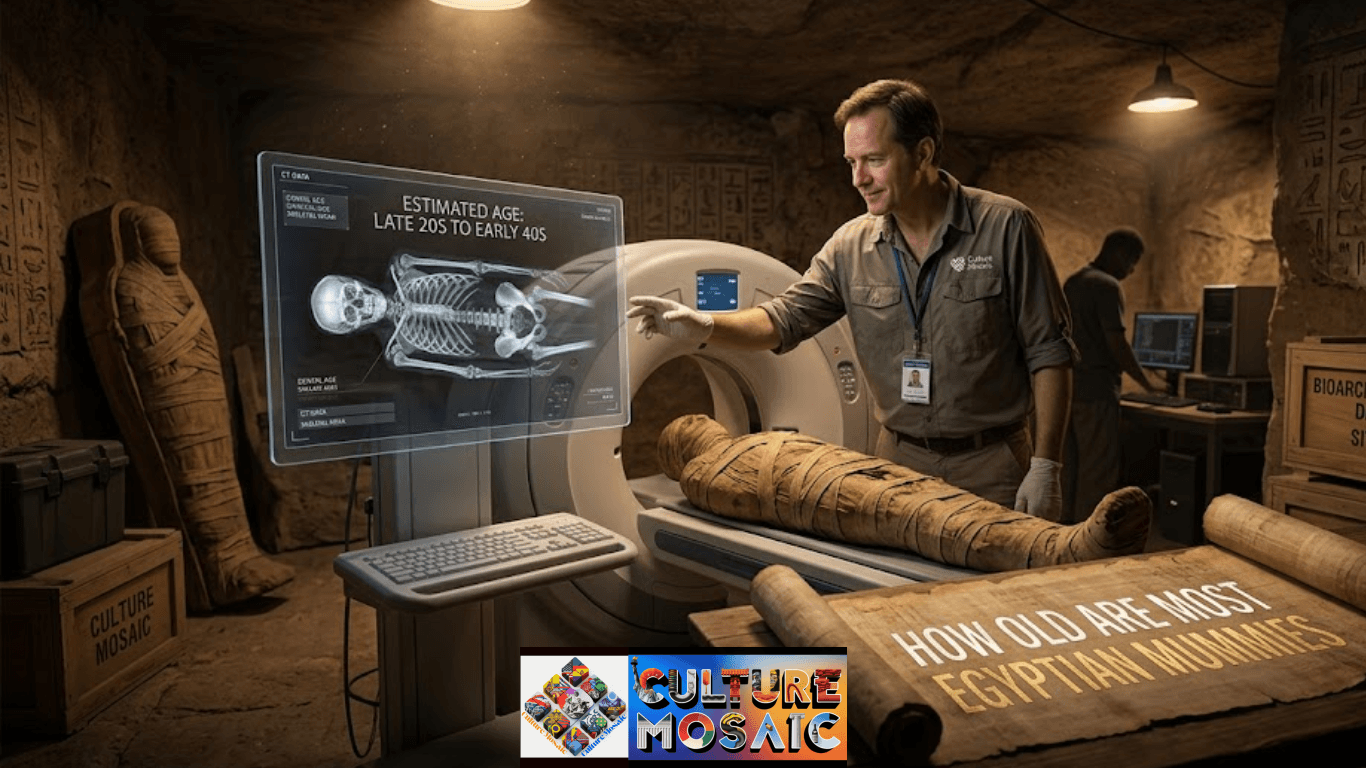
I have spent more than twenty years with my hands, quite literally, inside Egypt’s past.
I have stood over CT scanners at 2 a.m. watching the skeleton of a three-thousand-year-old priest resolve on a screen, bone by bone. And I can tell you the question I get asked more than any other—at conferences, in emails, from strangers at dinner parties—is this one: How old are most Egyptian mummies? People assume the answer is simple. It is not. The real answer is far stranger, and sadder, than most people expect.
1. The Problem: We Picture Mummies All Wrong
Popular culture has done us a disservice. Hollywood gives us shuffling, ancient kings: wrapped, cursed, always old, and always powerful. Museums reinforce this visual bias. The gold mask gets the spotlight, yet that famous mask belonged to a teenager. Visitors walk through gallery after gallery assuming every linen-wrapped body once belonged to a wizened elder who lived a long, ceremonial life.
That assumption is wrong, and it matters. It shapes how people misread the archaeological evidence sitting right in front of them. It flattens a complex civilization of farmers, weavers, scribes, and children into a single static image of Tutankhamun’s burial mask. When the truth surfaces in a headline about a mummy’s actual age, it lands as a shock rather than as the well-documented scientific fact it has been for decades.
2. A Shift in Perspective
I do not blame anyone for getting this wrong. I got it wrong too as a student, before I spent a season logging bone density and dental wear on human remains in a storage facility outside Luxor.
Nobody teaches you in school that ancient Egyptian life expectancy at birth likely sat somewhere in the twenties to thirties, dragged down hard by high infant and child mortality rates. Nobody tells you that a massive share of the preserved bodies we study today are not kings at all, but babies, toddlers, and young mothers who died in childbirth.
It is a disorienting fact. You shift from imagining an ancient society of long-lived sages to picturing something closer to a village graveyard filled mostly with the young. That shift in perspective is uncomfortable—and it should be. It is also far more honest, and far more moving, than the myth.
3. What the Demographics and Bioarchaeology Show
Here is the plain answer, drawn from decades of bioarchaeological study, paleopathology, and radiographic surveys of mummified remains: most ancient Egyptian adult mummies died somewhere between their late twenties and their early forties.
Some studies of non-royal cemetery populations push the average age at death for adults closer to 30 once infant burials are excluded. Include infant and child burials, and the picture darkens further, as a significant proportion of preserved remains never reached adulthood at all.
Royalty vs. Laborers
Royalty skews the average upward, but not by as much as fiction suggests:
- Tutankhamun: Died around age 18 or 19, leading many to ask How Did King Tut Die and Why. Investigations show he was cut down young by a combination of poor health, a broken leg, and malaria.
- Seti I: Appears to have died in his forties. Research regarding Seti I Wife, Queen Tuya, gives further insight into royal burial care and status.
- Hatshepsut: As one of the rare female pharaohs, learning Who Was Hatshepsut in Ancient Egypt reveals how researchers identified her mummy from a single tooth.
- Ramesses II: An extraordinary outlier who lived into his late eighties or nineties. His mummy shows extreme skeletal wear, severe arthritis, and tooth loss.
Today, knowing Where Is King Tut’s Mummy allows visitors to see the boy-king directly in the Valley of the Kings. Meanwhile, discoveries such as The Golden Mummies of Egypt demonstrate that gilded, ornate mummification extended to non-royal elites as well. For a deeper look across royalty and commoners alike, explore the Most Famous Egyptian Mummies.
4. Key Insights into Egyptian Mummification
Why Mummify?
The Egyptians mummified their dead because they believed the body had to survive intact for the soul (ka) to recognize it and continue into the afterlife. To understand this deeper spiritual connection, one must explore the Egyptian Concept of Life After Death.
Context and Artifacts
To fully grasp the historical scope, it helps to ask What Is Mummy in History beyond popular culture stereotypes. Textual discoveries continue to surprise us, including text preserved on wrapping artifacts like the Egyptian Mummy Iliad Papyri.
5. What This Means for How We View the Past
Once you understand the real numbers, an Egyptian mummy stops being an ageless icon and becomes a person: a 32-year-old farmer with bad teeth and a healed forearm fracture; a teenage boy buried with obsessive care because he was king; a young woman wrapped with devotion after dying in childbirth.
“Egyptians did not mummify the old because old age was rare and revered. They mummified everyone they could afford to, at whatever age death arrived, because the afterlife was owed to every soul equally.”
Frequently Asked Questions
How old are most Egyptian mummies at the time of death?
Most adult mummies died between their late twenties and early forties. If infant and child mortality rates are included in cemetery surveys, the average age drops significantly lower.
Why do so many mummies belong to children?
Childhood mortality was extremely high in the ancient world, with roughly one in three children not surviving past early childhood. Because families across various social classes practiced mummification, child burials form a large part of the archaeological record.
Did wealthy Egyptians live significantly longer than the poor?
Wealthier Egyptians had better diets and less manual labor, which reduced skeletal stress. However, despite better conditions, most elites still passed away in their thirties and forties.
How do modern researchers determine a mummy’s age?
Scientists use non-invasive techniques such as CT imaging, dental wear patterns, bone density scans, and epiphyseal (growth plate) fusion analysis to pinpoint age at death accurately.
Are mummy curses real?
No. Statistical studies of people present at tomb openings (including Tutankhamun’s) show no unusual mortality rates. The real danger in sealed tombs comes from toxic mold spores and bacteria preserved over millennia.