
 By Culture Expert
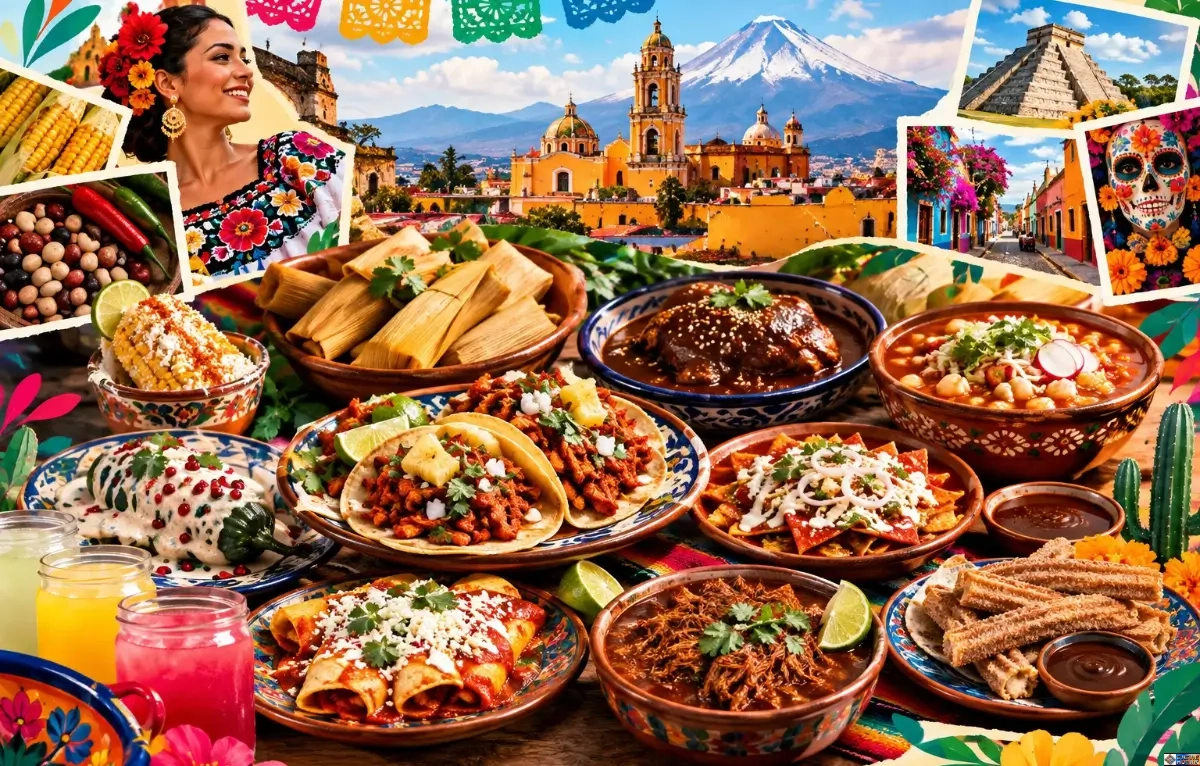
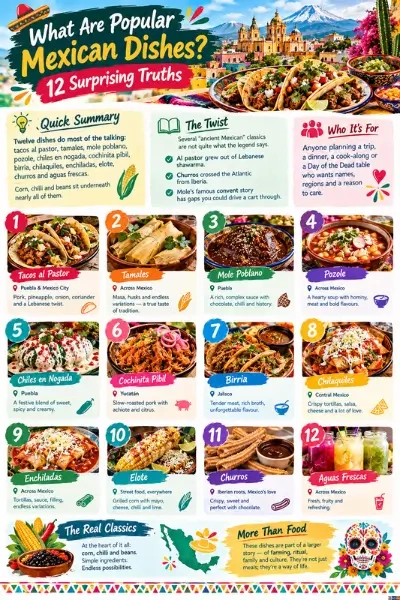
The short answer: What are popular Mexican dishes? Twelve do most of the talking: tacos al pastor, tamales, mole poblano, pozole, chiles en nogada, cochinita pibil, birria, chilaquiles, enchiladas, elote, churros, and aguas frescas. Corn, chilli, and beans sit underneath nearly all of them.
The twist: Several “ancient Mexican” classics are not quite what the legend says. Al pastor grew out of Lebanese shawarma. Churros crossed the Atlantic from Iberia. Mole’s famous convent story has gaps you could drive a cart through.
Who this is for: Anyone planning a trip, a dinner, a cook-along, or a Day of the Dead table who wants names, regions, and a reason to care.
Why Most Lists of Popular Mexican Dishes Let You Down
Search for Mexican dishes and you get a wall. Fifty names. Stock photos of sizzling plates. One line on each, usually the same line.
That’s the problem with most answers to what are popular Mexican dishes. A list tells you what exists. It doesn’t tell you what to order, why a stew turns up on New Year’s Eve, or why the dish everyone calls “authentically Mexican” began on a Lebanese spit.
There’s a quieter frustration underneath. Anyone who has stared at a menu full of half-familiar words knows the small flinch: you pick the safe thing, the taco you already know, and the rest of the menu stays shut. Yet UNESCO describes traditional Mexican cuisine as a whole cultural model, with farming, ritual and cooking bound into one chain [1]. That deserves better than the safe pick.
So here’s the fix. Twelve dishes, each with its real story, its home region, how it usually arrives at the table and what I’d do about it. I’ve leaned on UNESCO’s heritage record, an essay published by Mexico’s national university (UNAM), a Swiss food museum and working food writers in Mexico. Where the sources disagree, I’ve said so. They disagree often.
What Are Popular Mexican Dishes? Start With the Corn
Before the list, one fact that makes everything else click. In 2010, UNESCO inscribed traditional Mexican cuisine on its Representative List of the Intangible Cultural Heritage of Humanity. The description opens with the basics: corn, beans and chilli, grown through milpas (rotating fields of corn and other crops) and chinampas (man-made farming islets), then transformed by nixtamalization, the lime-water treatment that hulls maize and raises its nutritional value [1].
Read that twice. If someone asks what are popular Mexican dishes, the honest first answer is: variations on corn. Tortillas. Tamales. The hominy in pozole. The masa under a quesadilla.
I find that a relief. Instead of memorising fifty dishes, you learn one system and watch it rearrange itself by region. Yucatán leans on achiote and sour orange. Puebla and Oaxaca lean on mole. Jalisco leans on goat and dried chilli. If you enjoy reading a cuisine as a map, World Cultural Geography is a useful companion. And the farming side, where crops, rituals and cooks form one chain, is a neat case study for How Cultural Systems Relate to Sustainability.
Want a second checklist to set beside mine? This longer 33-dish guide to What Are Popular Mexican Dishes works well as a cross-reference.
1. Tacos al Pastor Started as Lebanese Shawarma
Picture the trompo: a vertical spit stacked with marinated pork, shaved into a small corn tortilla and finished with pineapple, onion and coriander. It is the taco many taquerías are judged by. By most accounts, it is also a Lebanese immigrant family’s idea [9].
Lebanese migrants reached Mexico in waves from the late 1800s into the early 1900s, and many settled in Puebla [25]. They brought spit-roasted lamb shawarma. In Puebla it became tacos árabes, still served in pan árabe, a pita-style bread [9]. Then the next generation swapped lamb for pork, rubbed it with a chilli-and-achiote marinade and moved it onto corn tortillas [10]. One account dates that swap to the 1960s; another places the dish’s creation in 1930s Puebla [9][10]. The pineapple? Chef Alex Stupak calls its origin a mystery, and I’m happy to leave it one [9].
I think that’s the most Mexican thing about it. A foreign technique was absorbed so completely that it now defines the national taco. It is the Global Cultural Mosaic idea in one handful: no recipe stays where it landed.
Region: Puebla and Mexico City. How it arrives: shaved from the trompo, pineapple on top, salsa on the side. Order it if: you want char and sweetness in one hand.
2. Tamales Carry the Calendar
A tamal is masa, the corn dough, wrapped in a husk or leaf and steamed. That’s the whole definition. Everything else is variation: red salsa and pork, green salsa and chicken, chilli strips and cheese, sweet pink ones studded with raisins. Tamales predate the Spanish arrival, and UNESCO’s record lists them, alongside tortillas, as part of Day of the Dead offerings [1].
The calendar part is my favourite. On 6 January families share the rosca de reyes, a ring of sweet bread with small figurines of the Christ child baked inside. Whoever’s slice holds a figurine hosts everyone for tamales on 2 February, Día de la Candelaria [11]. One Mexican historian, quoted in a hotel-group blog, calls the day a syncretism: pre-Hispanic farming ritual braided with Catholic and Jewish-origin feast traditions [11].
Timing matters here. Day of the Dead falls on 1 and 2 November, when tamales feature among the offerings [1]. Plan ahead and you can eat them in context. Ritual meals like this sit beside the traditions gathered in Culture Unveiled, and tamales are the easiest way into them.
Region: everywhere, with banana-leaf versions in Oaxaca and the Yucatán. How it arrives: steaming, unwrapped at the table, often with atole. Order it if: you’d rather eat a tradition than read about one.
3. Mole Poblano’s Origin Story Has Holes
Mole comes from a Nahuatl word, chilmolli, meaning chilli sauce or ragout [3]. Mole poblano, the best-known version, is built on chillies and cocoa, and it’s the dish people reach for at weddings and big family fiestas [3][12].
The legend: a Dominican nun, Sister Andrea de la Asunción, at the Santa Rosa convent in Puebla, hears that a weighty guest is about to arrive. She empties the larder, mixing native ingredients (chilli, tomato, cocoa) with newcomers (onion, garlic, almonds, cloves, cinnamon). Mole is born [3].
Lovely. Also shaky. The Swiss food museum Alimentarium says the true origin is uncertain [3]. A UNAM-published essay on the dish says any hunt for its beginnings ends in legend and invention [2]. And here’s my own cross-check: the tellings can’t agree on the guest. Some name Juan de Palafox, the 17th-century bishop of Puebla [3]. Others say a viceroy, with a date of 1685 [22], or a different bishop altogether [23]. Palafox had sailed home to Spain in 1649. Whatever happened at Santa Rosa, that version of it didn’t.
What the evidence does support is a meeting of two food worlds. Pre-Hispanic cooks already made chilli-and-seed sauces; colonial kitchens added Old World spices [3]. Other moles prove the range: mole verde from pumpkin seeds and green chilli, mole amarillo from yellow chillies, manchamantel with pineapple and plantain [3].
Region: Puebla and Oaxaca lead the argument. How it arrives: poured thick over turkey or chicken, with rice and tortillas. Order it if: you want a sauce with a long, complicated memory.
4. Pozole Isn’t Quite the Aztec Horror Story You’ve Read
Pozole is a stew of hominy, corn that has been nixtamalized so its kernels bloom, simmered with meat and served with a table of garnishes: radish, onion, lettuce or cabbage, oregano, lime, crisp tostadas [6][13]. Three colours dominate. Red, built on dried chillies, is associated with Jalisco and Michoacán. Green, with Guerrero. White is the plain, clear-broth form [6][13].
Then comes the story. Friar Bernardino de Sahagún, the 16th-century chronicler, describes a ritual meal in which a captive’s flesh was boiled with maize and shared out [13]. Many retellings simply stamp “pozole” on it.
Here’s the catch. A Mexico News Daily writer points out that Sahagún never names pozole, and that a specialist in pre-Hispanic food says the word doesn’t appear in any pre-Hispanic text [6]. The link is an inference, not a record. Scholars broadly accept that the Aztecs practised ritual cannibalism within sacrifice and warfare, though its dietary meaning is argued over [20]. The idea that Spaniards swapped in pork as a stand-in may itself be a colonial rationalisation rather than an Indigenous preference [21].
So I’d tell the story carefully. What’s safe to say: hominy stew is very old, its ritual associations are debated, and today it’s a celebration dish, served at Independence Day gatherings [13] and on New Year’s Eve [20].
Region: Jalisco, Michoacán, Guerrero and beyond. How it arrives: a deep bowl with a plate of garnishes you add yourself. Order it if: you want a dish that feels like a party.
5. Chiles en Nogada Have a Short Season
Chiles en nogada are seasonal, running from July through September [14]. Miss the window and you wait a year, so put it in your diary now. Seriously.
The dish: a mild poblano chilli stuffed with minced meat and fruit, smothered in walnut sauce (the nogada) and scattered with parsley and pomegranate seeds [5]. Green, white and red, like the flag. Colour carries meaning differently in every culture, a theme explored in The Meaning of Colors in Different Cultures.
The legend says Augustinian nuns at Puebla’s Santa Mónica convent created it in 1821 to honour Agustín de Iturbide, the first emperor of independent Mexico. An AP report repeats the nun-and-emperor tale [5]. A historian writing for Mexico News Daily calls it a myth, noting the recipe was already being cooked in the early 1800s and that nogada itself is a European sauce documented back to the 15th century [4].
My view? Both can be partly true. A convent kitchen may well have dressed an existing recipe for a political occasion. That’s what festive cooking does. Just don’t repeat the “invented that afternoon” version as fact.
Region: Puebla, then the whole country in season. How it arrives: a stuffed poblano under pale walnut sauce, pomegranate seeds on top. Order it if: it’s August and you can find it.
6. Cochinita Pibil Is a Maya Oven With a Spanish Pig
In the Yucatán, pork is marinated in achiote and sour orange, wrapped in banana leaves and slow-cooked in a pib, the Maya underground oven [7]. The result is tender, brick-orange, earthy and sharp at once.
The name is a small history lesson. Pib is Maya, for the earth oven. Cochinita is Spanish, for little pig. Before the Spanish arrived, the Maya cooked game in the same kind of pit; once pigs arrived in the 16th century, pork became the star [24]. Even the sour orange is thought to be a descendant of Seville oranges the Spanish introduced [24]. Achiote, meanwhile, held sacred meaning for the Maya, symbolising blood and vitality [7].
The dish is still tied to Hanal Pixán, the Maya Day of the Dead [18]. Outside the Yucatán, most kitchens use an oven rather than a pit, and honestly, that’s fine. Nobody should dig a hole in a rented garden.
Region: Yucatán. How it arrives: shredded into tacos or panuchos with pickled red onion and habanero salsa. Order it if: you like your pork acidic, smoky and soft.
7. Birria Went From Jalisco Goat to Viral Beef
Birria is a Jalisco stew, traditionally goat, built on dried chillies and slow cooking. One Mexican author defined it as a soupy barbacoa from Guadalajara [15]. Goats arrived with the Spanish, so birria is a colonial-era dish rather than an ancient one.
The modern twist belongs to Tijuana. According to the commonly cited account, a taquero named Guadalupe Zárate moved there from Puebla around 1950 and began making birria with beef and a rich consommé [15]. Later, birria moved into tortillas with cheese, quesabirria, served with a cup of that consommé for dipping. It was spotted on Tijuana taco trucks around 2009 and reached Los Angeles around 2016, where Instagram did the rest [16].
A caution: the sources here are thinner. I’ve leaned on a widely cited encyclopaedia entry because dedicated academic work is scarce, and the dates above are best treated as “commonly reported.” If you’re writing this up, check them.
Region: Jalisco, then Tijuana. How it arrives: a bowl of stew, or crisp cheesy tacos with consommé. Order it if: you want the dipping experience.
8. Chilaquiles Exist Because Nobody Wastes a Tortilla
Fried tortilla pieces simmered in red or green salsa, topped with cream, crumbly fresh cheese and raw onion, often crowned with an egg or shredded chicken. That’s chilaquiles, and it is the cheerful answer to stale tortillas.
I like how honest it is. No grand legend, no convent. Just a cook looking at yesterday’s corn and refusing to bin it. The tortilla pieces should hold some bite; if they dissolve into porridge, someone hurried the pan.
Region: nationwide, a breakfast staple. How it arrives: hot, on a plate, salsa pooling. Order it if: the night before was long.
9. Enchiladas Are Named for the Chilli, Not the Filling
The word comes from enchilar, to season or coat with chilli. So an enchilada is a tortilla dressed in chilli sauce, usually dipped, filled and rolled. Red, green and mole-sauced versions (enmoladas) all count.
People often assume the filling defines it. It doesn’t. The sauce does. Swap chicken for cheese or beans and you still have an enchilada; skip the sauce and you have a rolled taco.
Region: nationwide. How it arrives: rolled, sauced, scattered with cheese and onion. Order it if: you want a dinner that looks after you.
10. Elote Is the Street’s Most Honest Snack
Corn on the cob, grilled or boiled, rubbed with mayonnaise or crema, dusted with crumbly cheese and chilli powder, squeezed with lime. Its cup-form cousin, esquites, takes the kernels off the cob for easier eating.
Traditional Mexican street food is Modern Culture at its most direct: you can see who’s cooking, hear the grill, taste the result in under a minute. It also shows how Modern Society eats when it’s busy, standing up, napkin in fist.
Region: nationwide. How it arrives: on a stick or in a cup, messy by design. Order it if: you want the quickest route to the corn-and-chilli logic at the heart of this cuisine.
11. Churros Aren’t Mexican, but the Chocolate Is
Many people assume churros began in Mexico. Mexico News Daily states plainly that neither churros nor fried dough were invented there. Their origins are argued over (Spain, Portugal, even a Chinese-dough link), but the Spanish conquistadors brought them in the 16th century. The hot chocolate pairing came from Mexico [8][17].
That’s the part I love. A pastry crossed the ocean and came home with a Mexican partner. Mexico City’s El Moro, founded in 1935 by Spanish immigrant Francisco Iriate, still sells them to enormous queues [8]. In Mexico, fillings like cajeta, caramelised goat’s milk, are common [17].
Tres leches cake, a sponge soaked in three kinds of milk, is the other dessert you’ll see everywhere. Its birthplace is claimed by more than one Latin American country, so I’d tread lightly if anyone insists on a single origin.
Region: everywhere. How it arrives: hot, sugared, with chocolate or cajeta. Order it if: you believe dessert should be loud.
12. Aguas Frescas Do the Cooling Work
Alongside every taquería, a row of big glass jars. Aguas frescas: fruit, flowers or grains blended with water and sugar. Horchata (rice and cinnamon), jamaica (hibiscus), tamarindo. They cut through chilli and fat better than a fizzy drink does, and they cost little.
If you need one rule for ordering, here it is: match the drink to the heat. Jamaica for richly spiced stews. Horchata for fiery salsas. Don’t overthink it.
Region: nationwide. How it arrives: poured from a jar into a cup, ice rattling. Order it if: your mouth is on fire.
What Are Popular Mexican Dishes by Meal? A Cheat Sheet With Wildcards
So what are popular Mexican dishes at each meal? For every three classics, I’ve added one wildcard: the slightly odd pick that tells you more about the cuisine than the obvious one.
Street food (antojitos): tacos al pastor, elote, tostadas. Wildcard: chapulines, toasted grasshoppers sold in Oaxacan markets, seasoned with chilli and lime. Salty, crunchy, unexpectedly moreish.
Heritage mains: mole poblano, pozole, cochinita pibil. Wildcard: mucbilpollo, a corn-dough pie stuffed with pork and chicken and cooked underground for the Yucatán’s Hanal Pixán feast [18].
Breakfast: chilaquiles, huevos rancheros (fried eggs on tortillas under salsa), tamales with a cup of atole. Wildcard: the guajolota, a tamal tucked inside a bread roll, a Mexico City commuter classic.
Desserts and drinks: churros, tres leches, agua de jamaica. Wildcard: tejate, a foamy Oaxacan drink of maize and cacao.
Mexican Food List A–Z: The Top 20 Mexican Foods at a Glance
Use this as a menu decoder, or as search terms for Mexican dishes with pictures: searching a dish’s name plus “Mexico” beats a generic “Mexican food” search every time.
| Dish | Where it is from | Built on | How it arrives |
|---|---|---|---|
| Agua fresca | Nationwide | Fruit, flowers or grains, water, sugar | From a glass jar, over ice |
| Birria | Jalisco; Tijuana style | Goat or beef, dried chillies | Stew, or tacos with consommé |
| Carnitas | Michoacán | Pork slow-cooked in its own fat | Chopped into tacos, with salsa |
| Chapulines | Oaxaca | Toasted grasshoppers, chilli, lime | A crunchy snack by the handful |
| Chilaquiles | Nationwide | Fried tortilla pieces, red or green salsa | Hot, topped with cream and cheese |
| Chiles en nogada | Puebla | Poblano chilli, meat and fruit, walnut sauce | Cool-coloured, pomegranate on top |
| Churros | Iberian import / Mexican chocolate | Fried dough, sugar, chocolate or cajeta | Hot, for dipping |
| Cochinita pibil | Yucatán | Pork, achiote, sour orange, banana leaf | Shredded in tacos or panuchos |
| Elote / esquites | Nationwide | Corn, mayo or crema, cheese, chilli, lime | On a stick, or in a cup |
| Enchiladas | Nationwide | Tortillas dipped in chilli sauce, filled | Rolled, sauced, scattered with cheese |
| Guacamole | Nationwide | Avocado, lime, onion, chilli, coriander | With chips or alongside tacos |
| Huevos rancheros | Nationwide | Fried eggs, tortillas, salsa | Breakfast plate, beans on the side |
| Mole poblano | Puebla | Chillies, cocoa, seeds, spices | Poured over turkey or chicken |
| Pozole | Jalisco, Guerrero, Michoacán | Hominy, meat, red, green or white broth | Deep bowl with a garnish plate |
| Quesadillas | Nationwide | Tortilla, cheese or other fillings | Folded, griddled, with salsa |
| Tacos al pastor | Puebla, Mexico City | Spit-roast marinated pork, pineapple | Shaved from the trompo |
| Tamales | Nationwide | Masa, filling, husk or banana leaf | Steaming, unwrapped at the table |
| Tejate | Oaxaca | Maize and cacao | Foamy, served cold |
| Tlayuda | Oaxaca | Large crisp tortilla, beans, cheese, meat | Folded or open, like a Oaxacan pizza |
| Tres leches | Disputed (Latin America) | Sponge soaked in three milks | Chilled slice, cream on top |
Myth vs Record: What the Sources Actually Say
Which answers to what are popular Mexican dishes come with asterisks? I built this table while cross-reading the sources above, and it’s the part I’d most like readers to keep.
| Dish | The Popular Story | What the Sources Show |
|---|---|---|
| Tacos al pastor | A purely Mexican taco | Adapted from Lebanese shawarma in Puebla; dates range from the 1930s to the 1960s depending on the account [9][10] |
| Mole poblano | Invented in one panicked afternoon by a nun, c. 1680s | Origin uncertain; pre-Hispanic sauces existed; tellings name different guests and a bishop who had left decades earlier [2][3][22] |
| Pozole | An Aztec cannibal stew in disguise | Sahagún describes a ritual boiled meal but never names pozole; the link is an inference [6][13] |
| Chiles en nogada | Created for Iturbide in 1821 | Recipe circulating in the early 1800s; nogada is a European sauce documented from the 15th century [4] |
| Churros | A Mexican invention | Iberian import brought in the 16th century; the chocolate pairing is Mexican [8] |
| Birria | An ancient Mexican dish | A colonial-era Jalisco goat stew; Tijuana beef-and-consommé c. 1950; quesabirria goes viral in the 2010s [15][16] |
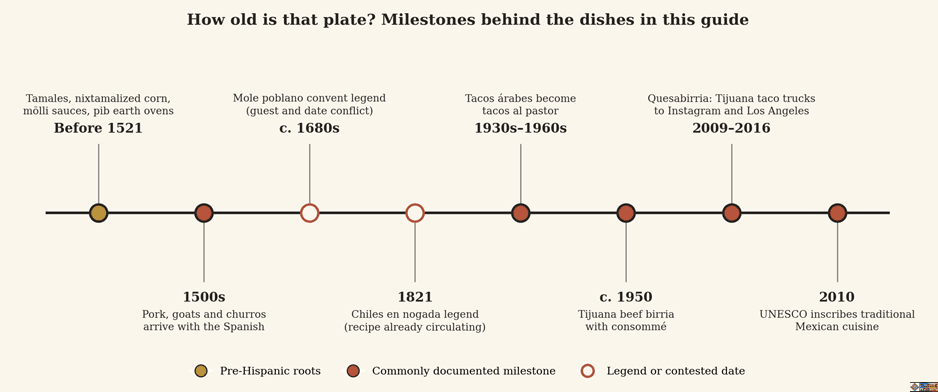
Figure 1. How old is that plate? Milestones for the dishes in this guide. Hollow markers are legends or contested dates. Source: author’s synthesis of sources [1][2][3][4][8][9][15][16].
Eating Popular Mexican Dishes in the UK
What are popular Mexican dishes worth ordering in a UK restaurant? I won’t hand you a restaurant list I can’t vouch for. What I can offer is a way of reading any UK menu.
First, ask about the tortillas. Corn tortillas made from nixtamalized masa tell you a kitchen respects the system described at the start of this guide [1]. Second, look for the trompo. A real vertical spit is a good sign for al pastor. Third, read regional labels as clues: Poblano, Oaxaqueño and Yucatecan menus tend to follow their home traditions, and mole, cochinita pibil and tamales are the dishes to test them on. Fourth, treat seasonal dishes like chiles en nogada as occasions, not permanent menu fixtures.
Eat with respect, too. The line between appreciation and appropriation is covered in Cultural Appreciation, and it applies to your plate as much as your wardrobe. Food scenes also tend to gather in particular neighbourhoods, the pattern behind the Cultural Cluster idea, so a good Mexican dish is often a short walk from another one. If you’re planning a food-led trip abroad, Latest Trends in Cultural Tours is a useful starting point. And for more food-and-heritage threads, the wider Culture mosaic archive is worth a wander.
Cooking at home? Masa harina and dried chillies are sold by specialist grocers and online sellers, but check stock before you promise anyone a tamale party.
Order the thing you can’t pronounce. The worst outcome is a good story.
Frequently Asked Questions
What are popular Mexican dishes?
What are popular Mexican dishes? Tacos al pastor, tamales, mole poblano, pozole, chiles en nogada, cochinita pibil, birria, chilaquiles, enchiladas, elote, churros and aguas frescas lead most lists. Nearly all rest on corn, chilli and beans, the foundation UNESCO recognised in 2010 when it inscribed traditional Mexican cuisine on its heritage list [1].
What are the 10 most popular Mexican dishes?
There is no official ranking, so any top ten is a judgement call. Mine: tacos al pastor, tamales, mole poblano, pozole, chiles en nogada, cochinita pibil, birria, chilaquiles, enchiladas and churros. I chose them for popularity and for the stories behind them, and I’d swap in elote or tostadas depending on whether you’re eating on the street or at home.
What are 5 popular Mexican dishes for dinner?
Pozole for a crowd. Enchiladas for a weeknight. Cochinita pibil tacos for something slow-cooked. Mole poblano over chicken or turkey for an occasion. Birria with consommé for dipping. Add a jug of agua de jamaica and a bowl of rice, and dinner is sorted.
What is traditional Mexican street food?
Traditional Mexican street food, often called antojitos (“little cravings”), includes tacos al pastor, elote and esquites, tostadas, quesadillas and tamales. It’s quick, cooked in front of you, and built on corn. Many street dishes, like al pastor, carry surprising migration histories [9].
What are the top 20 or top 50 Mexican foods?
The A–Z table in this guide covers 20 of the most-searched dishes with their regions and signature ingredients. A top 50 would add antojitos, soups, regional moles, pit-cooked meats and sweets, and no one agrees on the exact fifty. A longer cross-reference is the 33-dish guide linked near the top of this article.
Sources
[1] UNESCO Intangible Cultural Heritage. “Traditional Mexican cuisine – ancestral, ongoing community culture, the Michoacán paradigm.” Representative List, inscribed 2010. https://ich.unesco.org/en/RL/traditional-mexican-cuisine-ancestral-community-culture-the-michocan-paradigm-00400
[2] Taibo I, Paco Ignacio. “The Mystery of Mole from Puebla: A Baroque Convent Delicacy.” Voices of Mexico, UNAM, 1996. https://ru.micisan.unam.mx/bitstream/handle/123456789/17576/VOM_1996_0035_0041.pdf
[3] Alimentarium (food museum, Vevey, Switzerland). “Mole.” https://www.alimentarium.org/en/knowledge/mole
[4] Mexico News Daily. “Taste of Mexico: The curious history and myths of chile en nogada.” https://mexiconewsdaily.com/lifestyle/food/chile-en-nogada-mexico-independence/
[5] Associated Press, via Global Sisters Report. “Mexico’s nuns’ culinary innovations live on in storied cuisine.” https://www.globalsistersreport.org/ministry/mexico-nuns-culinary-innovations-live-storied-cuisine
[6] Mexico News Daily. “Why pozole is more than just a Mexican stew.” https://mexiconewsdaily.com/lifestyle/food/guerrero-pozole-mexican-stew/
[7] Mexico News Daily. “Taste of Mexico: Cochinita Pibil.” https://mexiconewsdaily.com/lifestyle/food/taste-of-mexico-cochinita-pibil/
[8] Mexico News Daily. “Churros: a delicious treat with an ancient history.” https://mexiconewsdaily.com/lifestyle/food/churros-a-delicious-treat-with-an-ancient-history/
[9] Tasting Table. “Tacos Al Pastor: Your Favorite Mexican Food Is Actually Lebanese.” https://www.tastingtable.com/693806/tacos-pastor-history/
[10] Time Out Chicago. “Taco history.” https://www.timeout.com/chicago/restaurants/taco-history
[11] Oasis Hotels blog (quoting UNAM Acatlán historian Arturo Cardoso). “Learn More About the Candelaria Day Tradition.” https://oasishoteles.com/blog/en/tradition-of-the-candelaria-day/
[12] Culinary Backstreets. “Chiles en nogada.” https://culinarybackstreets.com/cities-category/mexico-city/2013/chiles-en-nogada/
[13] El Financiero. “¿El pozole tiene un origen caníbal? Esto es lo que sabemos.” https://www.elfinanciero.com.mx/culturas/el-pozole-tiene-un-origen-canibal-esto-es-lo-que-sabemos/
[14] Grupo Camino Real. “Chiles en nogada: The true story behind Mexico’s most patriotic dish.” https://www.grupocaminoreal.com/en/real-inn/blog/chiles-en-nogada-the-true-story-behind-mexico-s-most-patriotic-dish
[15] Wikipedia. “Birria.” https://en.wikipedia.org/wiki/Birria (secondary source; verify against primary work before relying on dates)
[16] Wikipedia. “Quesabirria.” https://en.wikipedia.org/wiki/Quesabirria (secondary source; verify before relying on dates)
[17] Texas Monthly. “Churros Leave Other Desserts in Their Dust.” https://www.texasmonthly.com/food/churros/
[18] Pilgrimaps. “Cochinita Pibil: The Ancient Culinary Treasure of the Maya.” https://www.pilgrimaps.com/cochinita-pibil-the-ancient-culinary-treasure-of-the-maya/
[19] Sahagún, Bernardino de. General History of the Things of New Spain (Florentine Codex), 16th century. Primary source, read here only through the secondary quotations cited above [13].
[20] Wikipedia. “Pozole.” https://en.wikipedia.org/wiki/Pozole (secondary source; verify before relying on it)
[21] Eats History. “Authentic Pozole Recipe: From Aztec Ritual Stew to Mexico’s Christmas Table.” https://eatshistory.com/?p=5190
[22] The Tablet. “Holy Mole: Sauce a Divine Mix of Mexican History, Legend, and Flavor.” https://thetablet.org/mexican-mole-sauce-history/
[23] Familia Kitchen. “The History of Mole, Mexico’s National Tesoro.” https://familiakitchen.com/?p=11893
[24] Tasting Table. “Cochinita Pibil: The Yucatán’s Famed Barbecue Pork Dish.” https://www.tastingtable.com/1243481/cochinita-pibil-yucatan/
[25] Gulf News. “Tacos Al Pastor: The past that connects Salma Hayek and the shawarma.” https://gulfnews.com/amp/story/food%2Ftacos-al-pastor-the-past-that-connects-salma-hayek-and-the-shawarma-1.1611390051096