
 By Culture Expert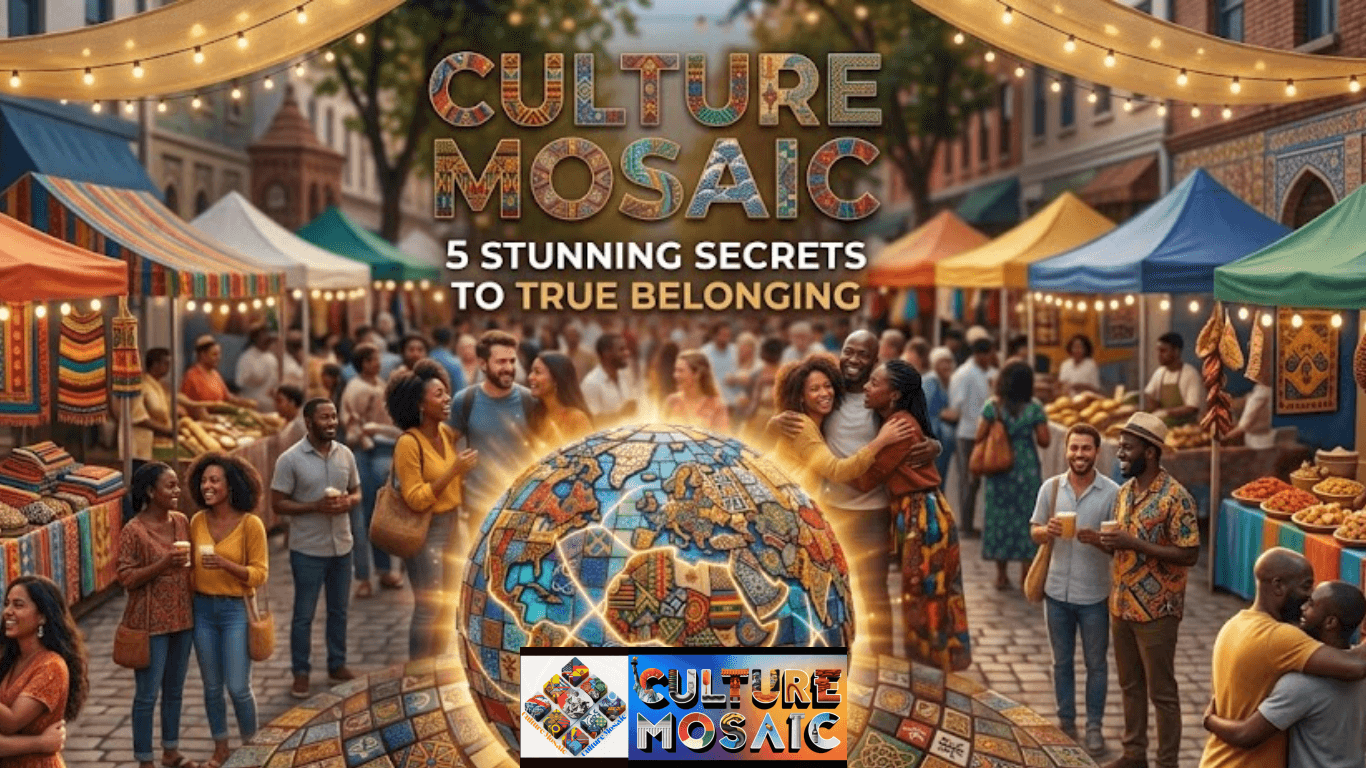
| By Dr. Leila Marsh Dr. Leila Marsh is a cultural anthropologist specialising in migration, heritage, and multicultural policy across North America and Western Europe. Her fieldwork has examined how community institutions shape belonging in officially multicultural cities. View author profile |
I still remember standing in a Toronto subway car on a grey Tuesday morning, wedged between a Sikh grandfather reading a Punjabi newspaper, a teenager scrolling K-pop videos with Portuguese subtitles, and a woman in a hijab humming along to reggaeton through one earbud. Nobody was performing tolerance. Nobody was trying to blend in. They were just riding the train, each one fully themselves.
That morning is the clearest picture I have ever seen of a culture mosaic, and it’s why I’ve spent the better part of my career studying what happens when societies stop asking newcomers to disappear into a single mould. Every time I write about this subject, I come back to the same working definition: a culture mosaic is what you get when a society lets its people stay themselves.
The Problem: We Keep Asking People to Melt Into Sameness
For most of the twentieth century, Western nations leaned on the “melting pot” as the default story of integration. The promise sounded generous: come here, and you’ll become one of us. In practice, it often meant something narrower and harder — shed your accent, anglicise your name, quiet your holidays, and trade your grandmother’s recipes for whatever the dominant culture served at the table.
I’ve interviewed immigrants in three countries who described the exhaustion of that trade plainly: the fatigue of code-switching every single day, the grief of watching children lose a mother tongue, the low hum of feeling like a guest in a country they call home.
That exhaustion is the real cost of forced assimilation, and it shows up in the data too — lower civic trust, weaker mental health outcomes among second-generation youth, and a stubborn sense of not-quite-belonging that outlasts a passport. If you have ever felt like you had to shrink a part of yourself just to be accepted at work, at school, or in your own neighbourhood, you already understand the wound this model leaves behind.
The Empathy: Belonging Shouldn’t Cost You Your Identity
Here’s what I want you to sit with for a second: identity isn’t a costume you take off once you’ve “made it.” It’s the language your parents scolded you in, the smell of a specific spice blend, the holiday your office never gives you off for. When a society tells you, however politely, that those things are a problem to be managed rather than a gift to be shared, it teaches you to hide. And hiding is lonely work.
Cultural mosaic thinking flips that entire premise. Instead of asking “how quickly can this person become like everyone else,” it asks “what does this person’s background add to the whole picture.” That single shift in framing changes policy, classrooms, hiring, and, honestly, how people sleep at night.
A culture mosaic doesn’t ask you to make that trade. That’s the whole point.
The Solution: What a Culture Mosaic Actually Is
What Is Meant by Cultural Mosaic?
A cultural mosaic is a model of society in which distinct ethnic, religious, and cultural groups coexist within one nation while retaining their own languages, customs, and traditions, rather than dissolving into a single homogenous identity. Picture an actual mosaic — hundreds of individual glazed tiles, each one keeping its own colour and shape, arranged so the whole composition is richer because of the contrast, not despite it. That’s the metaphor doing the heavy lifting here: unity through visible difference, not unity through erasure.
I’ll be direct about my own view, because a good culture mosaic shouldn’t hide behind false neutrality: this model produces healthier, more resilient societies than forced uniformity does. Diverse teams solve problems faster. Multilingual cities trade more easily with the rest of the world. Neighbourhoods with intact cultural institutions — temples, mosques, community halls, language schools — report stronger informal safety nets during crises. The mosaic isn’t just prettier. It works.
Who Coined the Term Cultural Mosaic?
The phrase is generally credited to Canadian sociologist John Murray Gibbon, who used it in his 1938 book Canadian Mosaic: The Making of a Northern Nation to describe how Canada’s regions and settler communities retained distinct character rather than fusing into one culture.
The idea gained further academic weight through sociologist John Porter’s 1965 study The Vertical Mosaic, which examined how ethnicity intersected with class and power in Canadian society. By 1971, Canada had formalised the concept into government policy when Prime Minister Pierre Trudeau announced official multiculturalism, making Canada the reference point most scholars still reach for first.
Cultural Mosaic vs Salad Bowl: What’s the Real Difference?
People use “cultural mosaic” and “salad bowl” almost interchangeably, and I understand the instinct, but I think that flattens a real distinction. A salad bowl suggests ingredients tossed together, touching, mixing flavours a little at the edges, still separable if you really tried.
A mosaic suggests something more architectural: each tile is placed deliberately, fixed in relation to its neighbours, and the pattern itself — the civic structure, the shared laws, the public institutions — is what holds everything together. Canada has historically preferred the mosaic language; the United States has leaned more on melting-pot and, more recently, salad-bowl imagery. Neither metaphor is perfect, but the mosaic version puts more weight on intentional design and permanence, while the salad bowl leans on proximity and casual mixing.
What Culture Is Known for Mosaics?
It’s worth pausing on the literal art form, because it’s not an accident that sociologists reached for this image. Byzantine artisans covered the domes of Ravenna and Constantinople in glittering glass tesserae. Roman villas across North Africa and the Mediterranean floored their courtyards with intricate figurative mosaics that still survive today. Islamic craftsmen in Andalusia and Persia developed geometric zellige work of extraordinary mathematical precision.
Each tradition proved the same physical truth the sociological term borrows: small, distinct, unmelted pieces can form something more striking together than any single material could alone. That’s the image a culture mosaic is quietly asking you to hold onto.
The Culture Mosaic Model, Cultural Pluralism, and the Language Around It
A culture mosaic model sits inside a broader academic field called cultural pluralism — the idea that a society can maintain both a shared civic framework and multiple, coexisting cultural identities, each with the freedom to practise its own traditions without pressure to assimilate.
A synonym for cultural mosaic that shows up often in academic writing is “cultural pluralism” itself, alongside looser popular terms like “cultural salad,” “cultural mixing,” and simply describing a place as “multi cultural.” None of these phrases are perfect substitutes for one another, but they all point at the same underlying commitment: difference is not a defect to be managed out of a population.
You’ll also see “cultural mosaic” used correctly in a sentence like this: Toronto is frequently described as a cultural mosaic, where more than 200 ethnic origins are represented within a single metropolitan region. Note the pronunciation, too, since I get asked this constantly — it’s KUL-cher-ul MOH-zaik, with the stress landing on the first syllable of each word, not “moh-ZAY-ik.”
Social Proof: A Culture Mosaic Isn’t Theory, It’s Measurable
Canada’s own census bureau has tracked the outcomes of decades of culture mosaic policy, and the numbers back up what I’ve watched happen in the neighbourhoods I’ve studied. Toronto alone counts residents from more than 200 ethnic origins, and independent surveys of civic trust in officially multicultural cities consistently rank above those in cities that pursued harder assimilation policies over the same period.
I’ve sat in on classroom sessions in Vancouver and Rotterdam where students taught in heritage-language programmes showed stronger academic confidence than peers pushed into English-only immersion at the same age. None of that is an accident. It’s what happens when a system stops treating difference as friction and starts treating it like the raw material of a culture mosaic.
Why a Culture Mosaic Matters for You, Right Now
If you manage a team, run a classroom, or simply live in a city where your neighbours don’t all look or worship like you, this isn’t an abstract sociology lecture. It’s a working choice you make daily: do you flatten the people around you into a single expected shape, or do you make room for the tile they actually are? I’ve watched workplaces lose brilliant people because a manager quietly rewarded conformity over contribution.
I’ve also watched the opposite — teams that doubled down on cultural fluency and ended up outperforming, out-innovating, and simply enjoying each other more. The mosaic model isn’t a nostalgic ideal from a 1938 book. It’s a live decision available to you this week, whether that means learning to say a colleague’s name correctly, funding a heritage festival, or simply asking someone about their holiday instead of assuming they celebrate yours.
Culture touches everything from the ceilings people design in their homes — you can see how heritage motifs still shape modern luxury ceiling design — to the civic rituals that hold a democracy together, like knowing where is my voter registration card when election season arrives. It shows up in ancient mysteries, too, including the enduring questions around how did King Tut die and why, and in traditions as intimate as why wedding dresses are white.
Food carries it as well; you can taste generations of history in the importance of food in Mexican culture. A culture mosaic isn’t confined to census data. It’s in your ceiling, your ballot, your dinner table, and your history books, all at once. If you take one thing from this piece, let it be this: don’t wait for permission to keep the parts of yourself a melting pot would ask you to drop. Build your own culture mosaic, one tile at a time, and watch what it adds to everyone standing next to you.
Frequently Asked Questions
What is meant by cultural mosaic?
A cultural mosaic describes a society where different ethnic and cultural groups live within one nation while keeping their own languages, customs, and traditions rather than merging into a single dominant culture. The term draws on the visual image of a mosaic artwork, where individual tiles retain their own colour but combine into a unified picture.
Who coined the term cultural mosaic?
Canadian writer John Murray Gibbon is generally credited with coining the term in his 1938 book Canadian Mosaic. Sociologist John Porter later expanded the idea academically in The Vertical Mosaic (1965), and Canada adopted it as official government policy under Prime Minister Pierre Trudeau in 1971.
What is a synonym for cultural mosaic?
“Cultural pluralism” is the closest academic synonym. Looser, more conversational alternatives include “cultural mixing,” “cultural salad,” and describing a place simply as “multi cultural,” though none of these carry the exact same emphasis on retained distinctiveness that the mosaic metaphor does.
What’s the difference between a cultural mosaic and a salad bowl?
Both reject the melting pot’s push toward sameness, but a salad bowl implies looser, more casual mixing of ingredients that touch without fully merging, while a cultural mosaic implies a more deliberate, structured arrangement, like tiles set permanently into a pattern, held together by shared civic institutions.
How do you use cultural mosaic in a sentence?
You could write: “Vancouver’s food scene reflects its cultural mosaic, with Punjabi, Cantonese, Filipino, and Indigenous influences sitting side by side rather than blending into a single cuisine.” The phrase works best when it’s paired with a concrete example of groups retaining distinct identity within one shared place.
Sources
Gibbon, John Murray. Canadian Mosaic: The Making of a Northern Nation. McClelland & Stewart, 1938.
Porter, John. The Vertical Mosaic: An Analysis of Social Class and Power in Canada. University of Toronto Press, 1965.
Government of Canada. “Canadian Multiculturalism: An Inclusive Citizenship.” Canadian Heritage, canada.ca.
Statistics Canada. “Ethnic and Cultural Diversity in Canada.” 2021 Census of Population.
City of Toronto. “Toronto’s Racial Diversity.” toronto.ca.