
 By Culture Expert
From enigmatic smiles to swirling night skies — these legendary masterpieces shaped human culture. By Dr. Elara Voss
The Top 10 Most Famous Paintings of All Time
At a Glance: The Top 3 Masterpieces
Short on time? The undisputed top three most famous paintings globally are Leonardo da Vinci’s Mona Lisa, Leonardo’s The Last Supper, and Vincent van Gogh’s The Starry Night. Read on for the full list.
Why These Paintings? A Note on the Top 10 Most Famous Paintings of All Time
What makes a painting cross the line from beautiful object into immortal icon? Millions of paintings are created every century, but only a handful capture the collective human imagination so completely that they become household names across languages, continents, and generations. The top 10 most famous paintings of all time aren’t just the most technically accomplished works ever made. They are the ones that survived — through wars, theft, centuries of interpretation, and the flattening grind of mass reproduction — still capable of stopping you in the room.
This list is built on three criteria: global recognition across cultures, documented cultural and historical impact, and longevity of critical reputation. I’ve spent time in front of most of these works. I’ll tell you what the scholarship says, and I’ll tell you what it actually feels like.
For broader context on the artists behind these works, see Culture Mosaic‘s wider coverage of who is the most famous artist — a question that overlaps significantly with this list.
1. Mona Lisa — Leonardo da Vinci
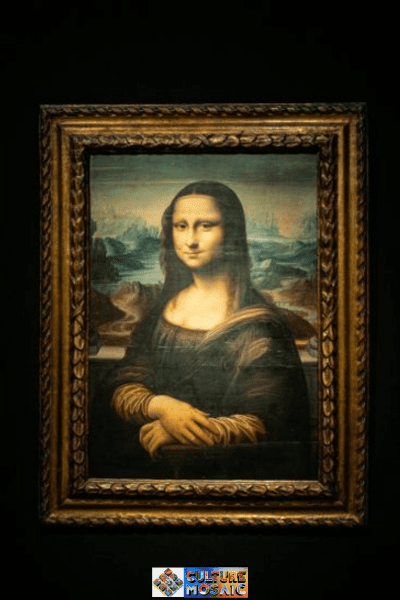
| Artist: | Leonardo da Vinci |
| Date: | c. 1503–1519 |
| Location: | Louvre Museum, Paris |
| Medium: | Oil on poplar panel |
I’ve stood in that Louvre gallery three times now. Each time, I’m struck not by the painting itself but by the peculiar theatre around it — the crowd six deep, phones raised like an offering. The Mona Lisa is smaller than you expect. And yet it pulls something out of you.
Leonardo worked on this portrait, believed to depict Lisa Gherardini, wife of Florentine merchant Francesco del Giocondo, for well over a decade. The sfumato technique — that deliberate, smoky blurring of outlines that creates atmosphere and depth — was essentially his invention, and this painting is its finest expression.
Her smile has been the subject of centuries of debate. Some neurologists now argue that the ambiguity is hard-wired into human perception: different parts of the eye read the expression differently depending on where you focus. That’s not an accident. Leonardo understood optics more deeply than most people of his era understood anything.
The theft in 1911 by Vincenzo Peruggia, an Italian handyman who simply walked out with the panel hidden under his coat, transformed a famous painting into a global obsession. Two years of newspaper coverage, worldwide searches, a ransom attempt. When it was recovered, it had become the most famous painting on earth. Fame, it turns out, is sometimes a matter of scandal.
| Art Fact: The Mona Lisa has no clearly visible eyebrows — scholars believe they were fashionable to shave in Renaissance Florence, though some think they were painted and later removed during restorations. |
2. The Starry Night — Vincent van Gogh
| Artist: | Vincent van Gogh |
| Date: | 1889 |
| Location: | Museum of Modern Art (MoMA), New York City |
| Medium: | Oil on canvas |
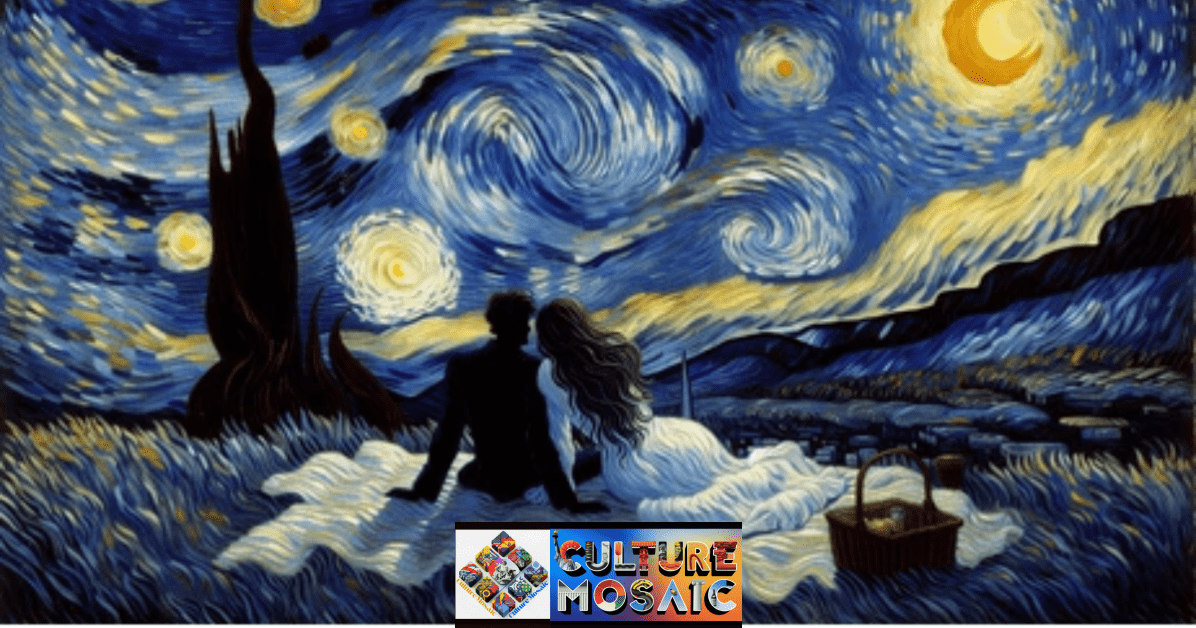
Van Gogh painted The Starry Night from the window of the Saint-Paul-de-Mausole asylum in Saint-Rémy-de-Provence, where he had voluntarily committed himself after the infamous ear incident. That context matters. This isn’t a serene landscape — it’s an interior state projected onto the sky.
The swirling, almost violent brushwork in those blues and yellows reads now as expressive genius. In 1889, it was considered madness. Van Gogh himself was ambivalent about the piece, describing it in a letter to his brother Theo as a ‘failure.’ History has disagreed with him thoroughly.
What I find genuinely striking is the village at the bottom — calm, still, lights on in the houses — set against that churning cosmic drama above. The contrast is the point. Human warmth, small and rooted, beneath an indifferent and magnificent universe.
The painting was part of MoMA’s collection from 1941 onward and has since become so embedded in popular culture that it requires conscious effort to see it fresh. But slow down. Look at that cypress tree in the foreground. It reaches up like a dark flame. There’s nothing gentle about it.
| Art Fact: Van Gogh completed around 150 paintings during his 12-month stay in the asylum, a rate of creative output that remains staggering given his psychological state during that period. |
3. The Last Supper — Leonardo da Vinci
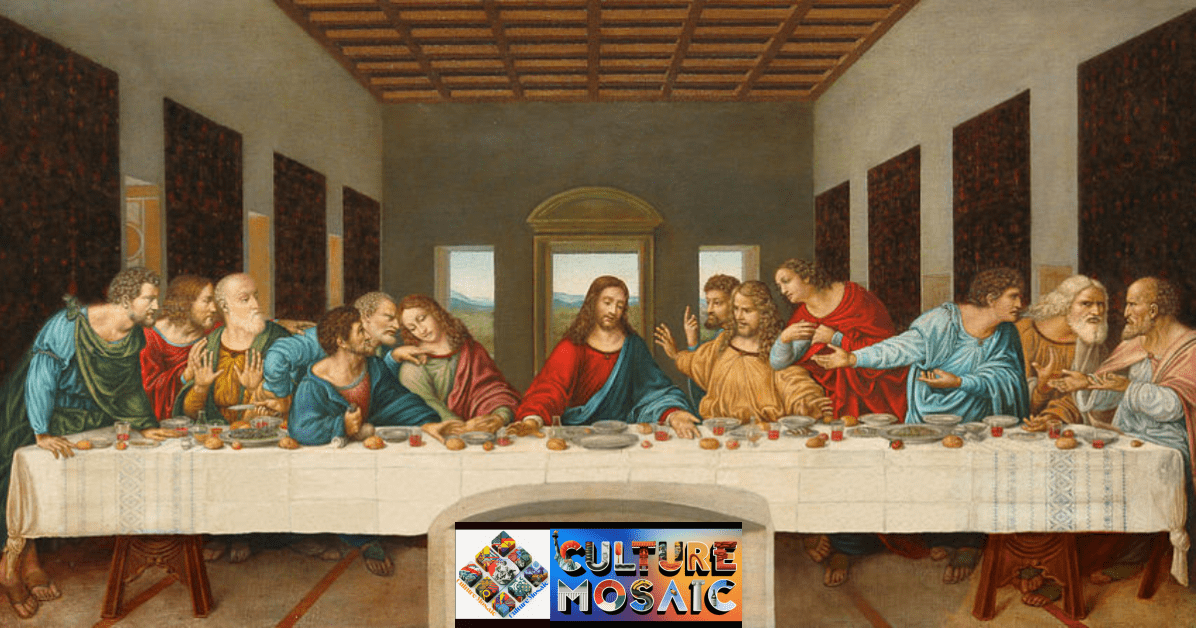
| Artist: | Leonardo da Vinci |
| Date: | c. 1495–1498 |
| Location: | Santa Maria delle Grazie, Milan |
| Medium: | Tempera on gesso, pitch and mastic |
Unlike almost every other work on this list, The Last Supper cannot be moved to a museum for safekeeping. It’s a mural — painted directly onto the refectory wall of a convent in Milan. It is also, technically, deteriorating. And has been for centuries.
Leonardo experimented here, bypassing the traditional fresco technique in favour of tempera on a sealed wall. The result was visually richer than standard fresco. It was also catastrophically unstable. The paint began flaking within decades of completion. What we see today is partly Leonardo and partly five hundred years of restoration.
The composition captures the precise moment after Christ announces that one of those present will betray him. The apostles’ reactions — shock, denial, protest — are rendered with such psychological specificity that you could assign emotional states to each face. That psychological realism was revolutionary.
Napoleon’s troops used this wall for target practice. A door was cut through the lower section. Allied bombs destroyed much of the surrounding building in 1943 but left the painting wall standing, sheltered under sandbags. It has survived by unlikely accumulation of accidents and interventions.
| Art Fact: The painting is roughly 460 cm tall and 880 cm wide — the scale was deliberately conceived so that diners in the refectory would feel as though they were sharing the table with Christ and the apostles. |
4. The Scream — Edvard Munch
| Artist: | Edvard Munch |
| Date: | 1893 |
| Location: | National Museum, Oslo (primary version) |
| Medium: | Oil, tempera, and pastel on cardboard |
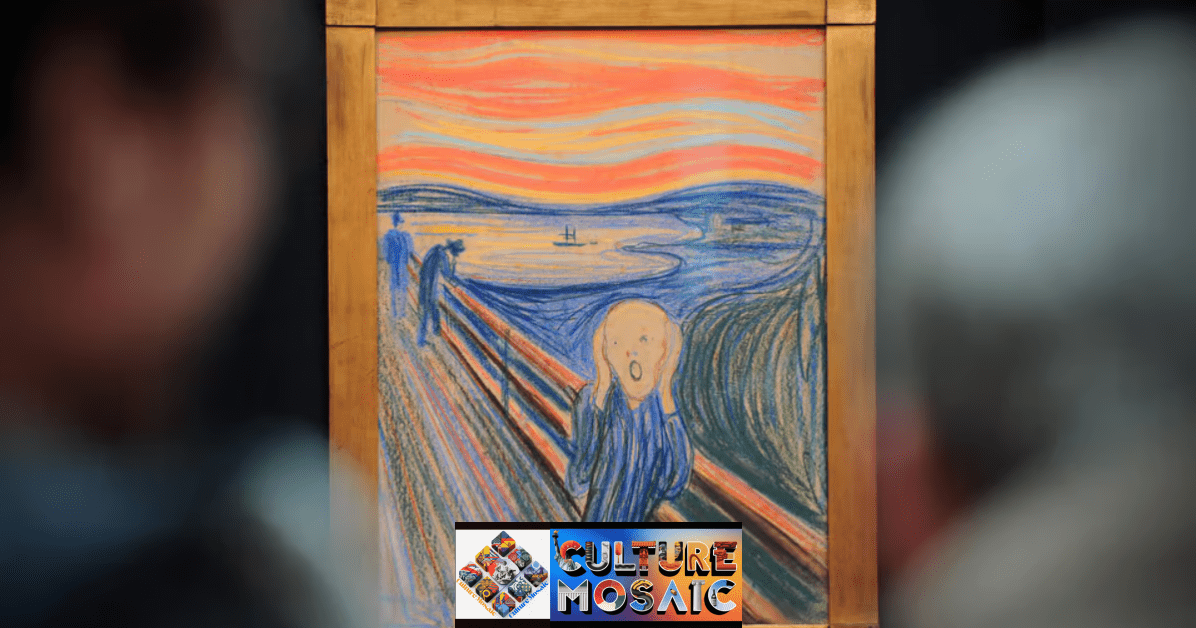
Munch wrote about the moment that generated this image in his diary: he was walking with friends, the sun setting, the sky turning blood red. He felt an ‘infinite scream passing through nature.’ The figure in the painting isn’t the source of the scream — it’s the receiver. That subtle distinction changes everything about how you experience it.
There are actually four versions of The Scream — two in paint, two in pastel. One of the pastels was sold at Sotheby’s in 2012 for $119.9 million, then a record. The swirling sky, the elongated figure with its skull-like head, the two friends walking calmly behind — it maps directly onto the sensation of panic in a way that still feels viscerally modern.
I think this is the most emotionally accurate painting on this list. It doesn’t depict emotion — it replicates it. The distorted perspective, the hot and cold colours fighting each other, the figure’s hands pressed to its face: these are not representations of anxiety. They are anxiety made visible.
The painting has been stolen twice — in 1994 and 2004 — both times from Norwegian museums, and both times recovered. Thieves clearly understood its value; the Norwegian state understood its cultural weight. After the second theft it was moved to a more secure location.
| Art Fact: Munch inscribed the phrase ‘Can only have been painted by a madman!’ on the frame of the 1895 pastel version — though debate continues over whether this was an act of self-awareness, provocation, or something in between. |
5. Girl with a Pearl Earring — Johannes Vermeer
| Artist: | Johannes Vermeer |
| Date: | c. 1665 |
| Location: | Mauritshuis, The Hague, Netherlands |
| Medium: | Oil on canvas |
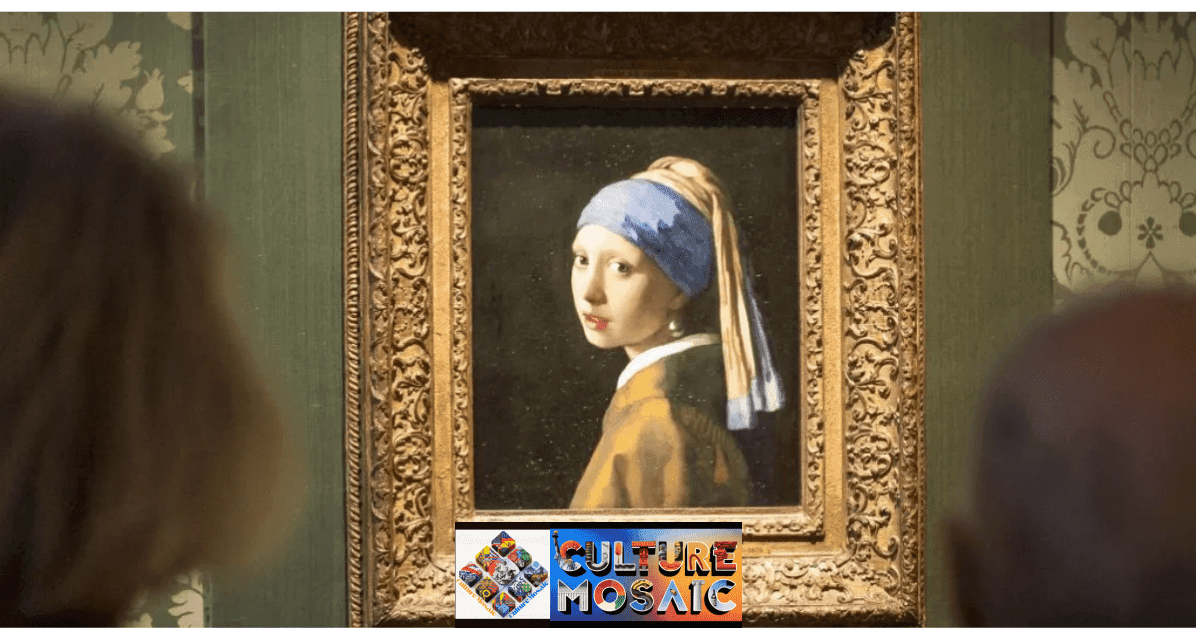
Sometimes called the ‘Mona Lisa of the North,’ which is both accurate and slightly reductive. Vermeer’s girl is a different kind of mystery. Leonardo’s subject is fixed, eternal, slightly removed. Vermeer’s turns to look at you — directly, over the shoulder — and the moment feels stolen.
We don’t know who she is. No historical record identifies the sitter. This ambiguity became the premise for Tracy Chevalier’s 1999 novel and the subsequent film, both of which deepened the painting’s cultural reach. The pearl earring itself may not be real — some art historians believe it was glass, a cheaper material that Vermeer rendered with such precision it became more convincing than the real thing.
What Vermeer achieved with light here is worth sitting with. The girl’s face emerges from a dark background, illuminated from the left, the pearl catching its own point of light below. The technique belongs to the tradition of chiaroscuro, but Vermeer’s handling has a quietness to it that Caravaggio’s drama never had.
The Mauritshuis in The Hague has built much of its international identity around this painting. I visited once and spent longer in front of it than I expected to. There’s something about that over-the-shoulder gaze that makes you feel — briefly, irrationally — that you’ve been noticed.
| Art Fact: The painting was in terrible condition when Mauritshuis acquired it in 1902 for just two guilders and thirty cents at an estate sale — one of the most significant undervalued purchases in art history. |
6. The Birth of Venus — Sandro Botticelli
| Artist: | Sandro Botticelli |
| Date: | c. 1484–1486 |
| Location: | Uffizi Gallery, Florence |
| Medium: | Tempera on canvas |
Botticelli’s Venus is one of the first large-scale mythological paintings of the Renaissance — not a religious image, not a historical scene, but a goddess. That shift, in the cultural context of 15th-century Florence, was significant. This was the Medici court signalling that classical antiquity was as legitimate a source of beauty and meaning as scripture.
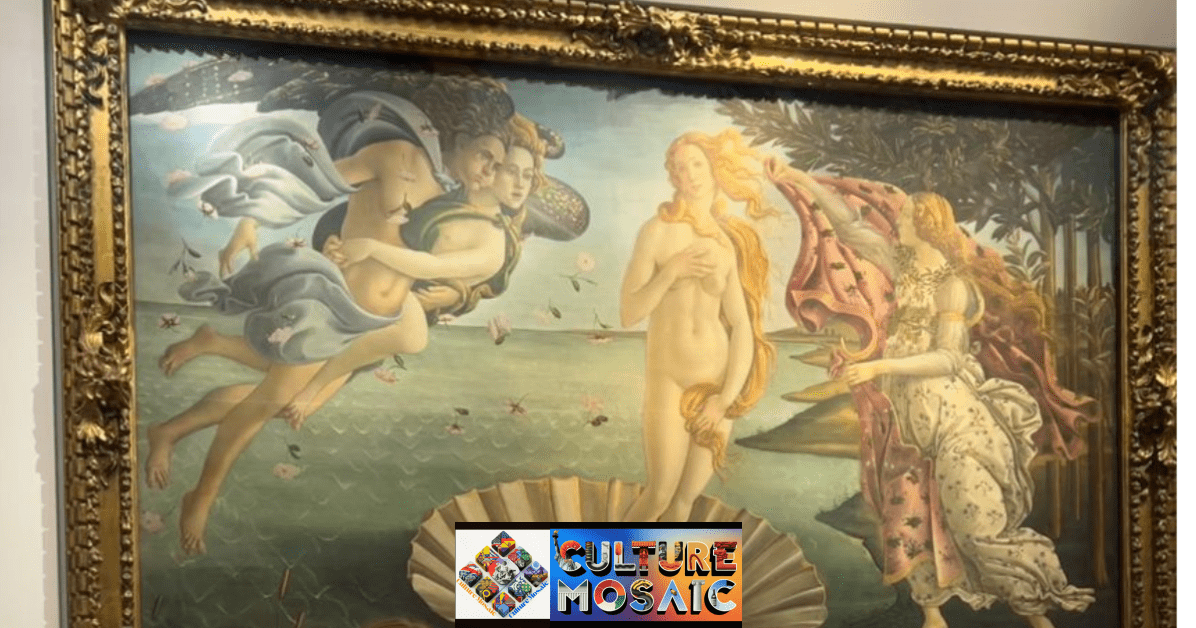
The composition is formally classical but emotionally warm. Venus stands in her scallop shell, wind-blown, a figure of impossible poise. The Hora to her right rushes forward with a flowered cloak. Zephyr and Chloris blow her to shore from the left. Everything is in gentle motion except Venus herself — she is still at the centre of it.
Botticelli fell into relative obscurity after his death and was essentially rediscovered in the 19th century by the Pre-Raphaelites, who found in his delicate, elongated figures something that spoke to their own aesthetic concerns. Ruskin and Pater wrote about him. The Uffizi crowds that gathered thereafter never really thinned.
What I notice about this painting now, having seen it in person, is the flatness of the landscape behind her. The sea barely has depth. The trees on the right are almost decorative. It’s as though Botticelli knew that any realistic backdrop would compete with Venus — and he wasn’t willing to let anything compete.
| Art Fact: The model for Venus is believed by some scholars to have been Simonetta Vespucci, the woman who was reportedly the unrequited love of Giuliano de’ Medici — and possibly of Botticelli himself. |
7. Guernica — Pablo Picasso
| Artist: | Pablo Picasso |
| Date: | 1937 |
| Location: | Museo Reina Sofía, Madrid |
| Medium: | Oil on canvas |
Guernica is the only painting on this list that is openly political — an act of witness, a protest painted in monochrome on a canvas roughly 11 feet tall and 25 feet wide. Picasso made it in response to the German and Italian bombing of the Basque town of Guernica during the Spanish Civil War in April 1937.
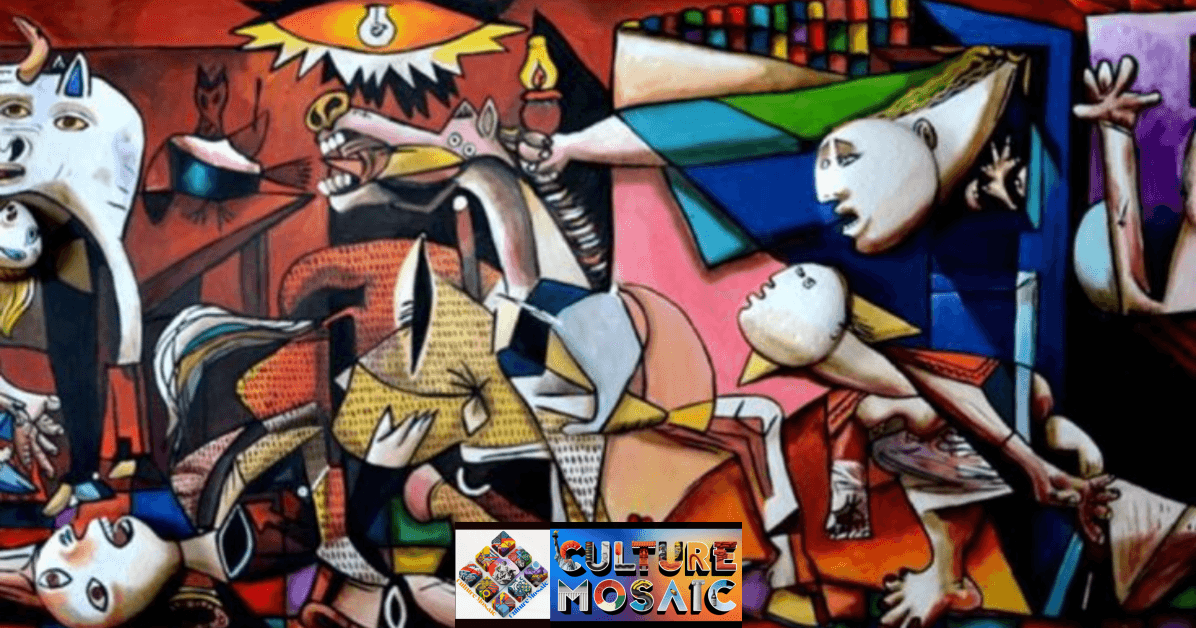
The imagery is fractured, screaming, impossible to resolve into comfort. A horse. A bull. A lamp. A mother holding a dead child. A soldier’s broken body on the floor. The fragmented Cubist style, which Picasso had developed largely as a formal experiment, becomes here a political tool — the literal shattering of the world rendered as visual fact.
I’ve seen this painting in person and the scale is the first thing that lands. You’re inside it before you’ve made a decision about it. Then the detail accumulates: the open mouths, the dislocated eyes, the electric light bulb in the shape of an eye at the top. Picasso knew exactly what he was doing. The bulb is not a warm light — it’s an interrogation light.
Picasso refused to allow the painting to return to Spain until democracy was restored. It was exhibited at MoMA in New York from 1939. Franco died in 1975. The painting arrived in Madrid in 1981. The conditions of its return mattered to Picasso as much as the painting itself.
| Art Fact: When a Nazi officer reportedly asked Picasso, looking at a photograph of Guernica, ‘Did you do this?’ — Picasso is said to have replied: ‘No, you did.’ |
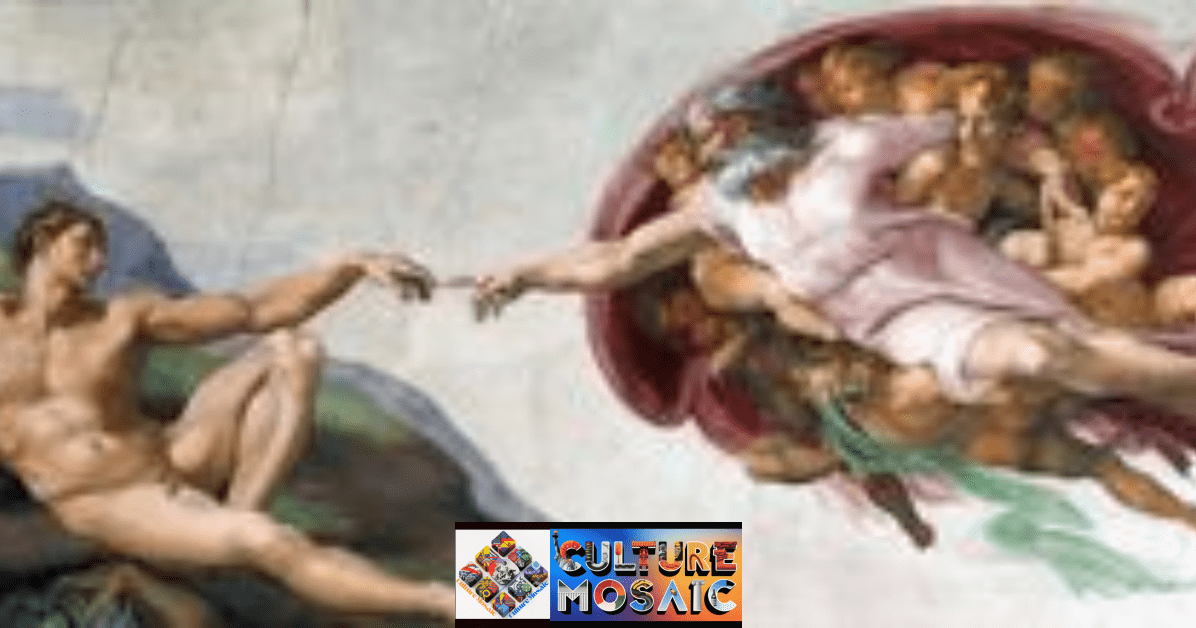
8. The Creation of Adam — Michelangelo
| Artist: | Michelangelo |
| Date: | c. 1508–1512 |
| Location: | Sistine Chapel, Vatican City |
| Medium: | Fresco |
Technically this is part of a larger work — one panel among many on the Sistine Chapel ceiling — but it has broken free of that context to become independently one of the most recognised images in Western art. The almost-touching fingers of God and Adam. That gap.
Michelangelo painted the entire Sistine Chapel ceiling lying on his back on a scaffold, largely without assistance, over four years. His correspondence from the period describes physical torment — neck pain, eye damage from dripping paint, the chronic misery of the position. The Creation of Adam, arguably the ceiling’s emotional apex, was completed under those conditions.
What makes this image so durable is the gap. God reaches down, arm extended, finger outstretched. Adam reaches up, arm resting on his knee, almost but not quite making contact. Everything hangs in that millimetre of space: divine will, human potential, the threshold between life and its opposite.
The figure behind God is sometimes interpreted as a cross-section of the human brain, which Michelangelo — who dissected cadavers in secret to understand human anatomy — may have encoded deliberately. Art historians argue about this. I find it plausible. Michelangelo was not a man who included things by accident.
| Art Fact: Michelangelo initially refused the commission to paint the Sistine Chapel ceiling, believing himself to be a sculptor rather than a painter. Pope Julius II was not a man who accepted refusals easily. |
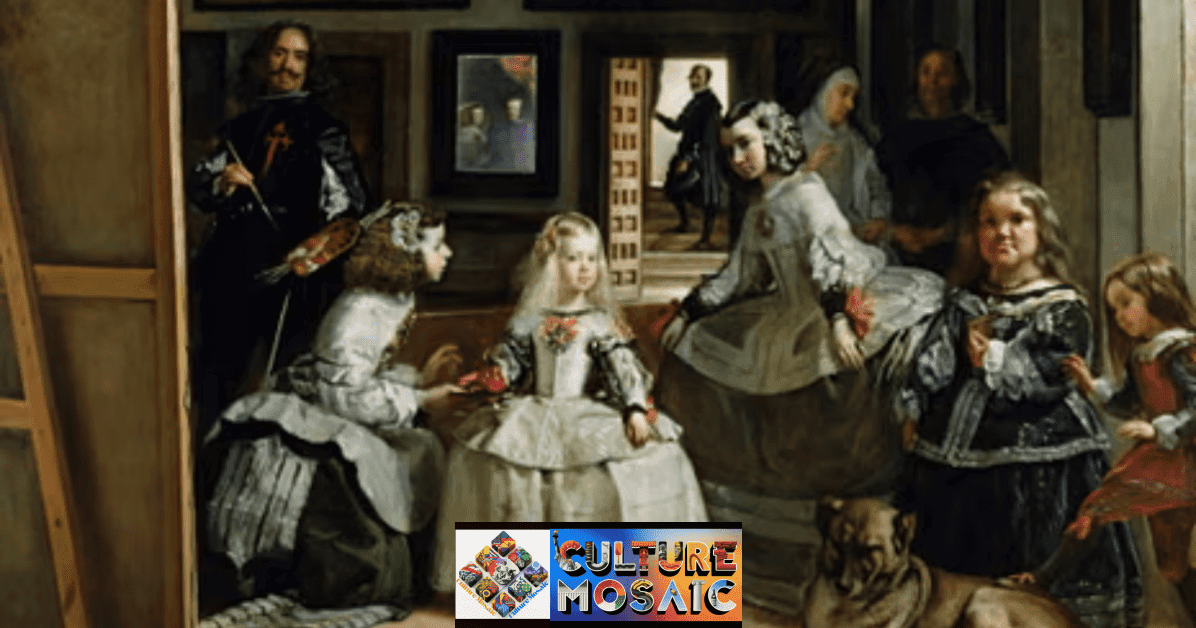
9. Las Meninas — Diego Velázquez
| Artist: | Diego Velázquez |
| Date: | 1656 |
| Location: | Museo del Prado, Madrid |
| Medium: | Oil on canvas |
Las Meninas is, in my estimation, the most intellectually interesting painting on this list. It’s a painting about looking. The young Infanta Margarita stands at the centre surrounded by her ladies-in-waiting. The painter — Velázquez himself — stands to the left, brush in hand, apparently painting the viewer. In the background mirror, the reflection of King Philip IV and Queen Mariana of Spain.
Who is Velázquez painting? The royal couple visible in the mirror? The viewer, who has stepped into their place? The Infanta? The painting asks these questions and refuses to resolve them. Foucault famously began ‘The Order of Things’ with an analysis of this work, describing it as a pure representation of representation — a painting about what painting does.
It is also, less philosophically, a domestic scene of extraordinary warmth. The dog at the front. The ladies in conversation. The light coming in from the right-hand window. Velázquez captures the texture of a specific afternoon in a specific room with a precision that photographs hadn’t yet made ordinary.
The scale of the original — roughly 10 by 9 feet — is significant. Standing before it in the Prado feels less like viewing a painting and more like stepping into a room where someone has just looked up from what they were doing.
| Art Fact: Velázquez has painted himself with the cross of the Order of Santiago on his chest — an honour he did not receive until three years after the painting was completed. Philip IV reportedly added it himself. |
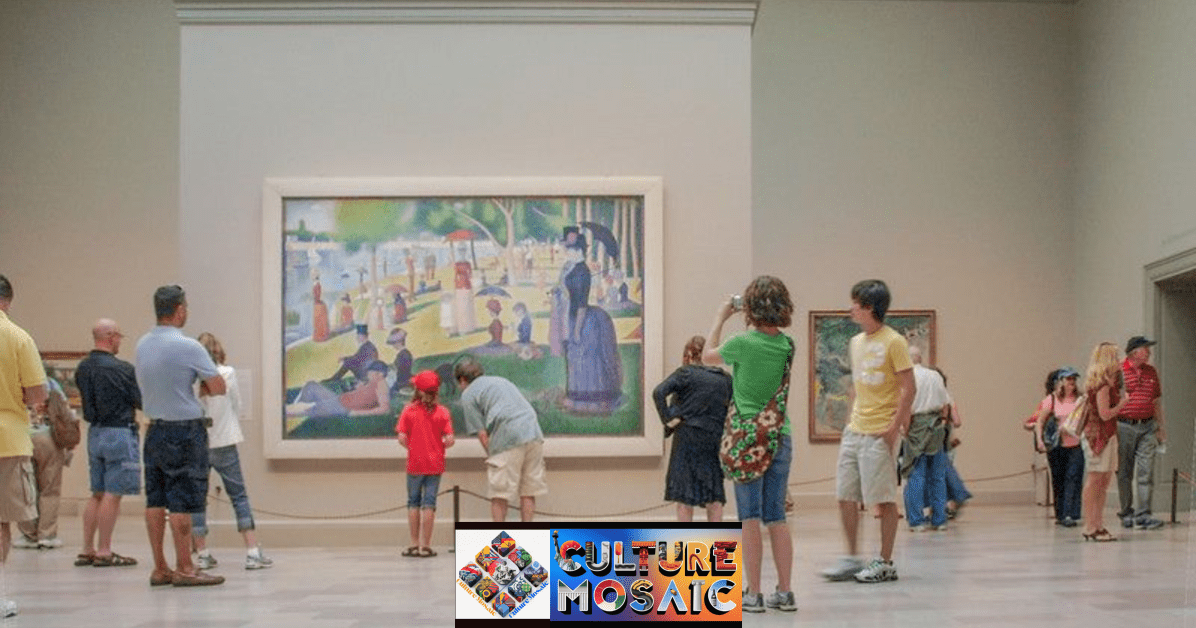
10. A Sunday on La Grande Jatte — Georges Seurat
| Artist: | Georges Seurat |
| Date: | 1886 |
| Location: | Art Institute of Chicago |
| Medium: | Oil on canvas |
Seurat spent two years on this painting. Two years of meticulous, systematic application of small dots of pure colour — pointillism, the technique he largely invented — to a canvas just over ten feet wide. The result is a scene of middle-class Parisians on a riverside island, rendered with a stillness that feels almost uncanny.
Nobody moves in this painting. Nobody speaks. The figures are static, geometrically composed, isolated from each other despite the apparent sociality of the scene. A woman holds a monkey on a leash. A man in a top hat stands rigid beside a woman with a parasol. They are adjacent but not together. Seurat understood something about urban leisure that still rings true.
The pointillist technique was theoretical in its origins — Seurat studied Chevreul’s colour theory and Ogden Rood’s work on optical mixing. He believed that placing complementary colours next to each other in small dots would create a more luminous effect in the viewer’s eye than physical pigment mixing. In practice, the effect is cooler and more distant than he perhaps intended.
What the painting gives you, in the end, is a kind of sociological portrait — a Sunday afternoon, Paris, 1886, a city learning what leisure was. Seurat was 25 when he began it and 26 when he finished. He died at 31. The scope of what he achieved in those brief years is its own kind of astonishment.
| Art Fact: Seurat returned to the canvas after exhibition and added a border of painted dots, followed by a painted white border — a frame within the frame — to control how the edges of the composition read optically. |
What These Ten Works Share: A Cross-Century Observation
Looking across the top 10 most famous paintings of all time, a few patterns emerge. First: psychological depth. None of these works are merely decorative. Each encodes something about the human interior — desire, terror, faith, grief, awe — in a way that proves remarkably stable across cultural contexts and centuries.
Second: each of these paintings has a story attached to it. The theft, the political exile, the deathbed regret, the ignored genius. Fame is not purely a function of quality; it is a function of narrative. These works have generated the kind of stories that get told and retold.
Third: with one exception (A Sunday on La Grande Jatte), all ten works were produced before 1900. This is partly a function of how long it takes for fame to consolidate. A work produced in 1886 has had 140 years to accumulate cultural weight. A work produced in 1986 has not. The canonical list will, inevitably, shift.
For those interested in the women who created work of equivalent ambition during the same centuries, our guide to historical artists female covers the largely overlooked contributions that deserve more than footnote status.
Leonardo da Vinci’s Enduring Dominance
It is worth pausing on the fact that Leonardo da Vinci places two works in this list — the only artist to do so. The Mona Lisa and The Last Supper represent different registers of his genius: the private and the monumental, the portable and the fixed, the secular and the devotional.
For a fuller survey of what Leonardo produced across his career, including many works that remain contentious in terms of attribution, our coverage of Leonardo da Vinci paintings images provides an illustrated reference. Leonardo’s dominance of this list is not a product of art-historical bias — it is a measure of how thoroughly he defined what Western painting could aspire to.
Summary: The Top 10 Most Famous Paintings of All Time at a Glance
| Painting | Artist | Date | Location |
|---|---|---|---|
| Mona Lisa | Leonardo da Vinci | c. 1503–1519 | Louvre Museum, Paris |
| The Starry Night | Vincent van Gogh | 1889 | MoMA, New York City |
| The Last Supper | Leonardo da Vinci | c. 1495–1498 | Santa Maria delle Grazie, Milan |
| The Scream | Edvard Munch | 1893 | National Museum, Oslo |
| Girl with a Pearl Earring | Johannes Vermeer | c. 1665 | Mauritshuis, The Hague |
| The Birth of Venus | Sandro Botticelli | c. 1484–1486 | Uffizi Gallery, Florence |
| Guernica | Pablo Picasso | 1937 | Museo Reina Sofía, Madrid |
| The Creation of Adam | Michelangelo | c. 1508–1512 | Sistine Chapel, Vatican City |
| Las Meninas | Diego Velázquez | 1656 | Museo del Prado, Madrid |
| A Sunday on La Grande Jatte | Georges Seurat | 1886 | Art Institute of Chicago |
Frequently Asked Questions About the Top 10 Most Famous Paintings of All Time
What makes a painting qualify among the top 10 most famous paintings of all time?
Fame in painting isn’t purely about artistic quality — it’s the intersection of artistic merit, cultural longevity, reproduction volume, museum attendance data, and moments of historical drama like theft, controversy, or political significance. The top 10 most famous paintings of all time tend to score across all of these dimensions simultaneously.
How to Research Art Fame Yourself:
- Study global museum attendance data — the Louvre, Prado, and Uffizi publish annual visitor figures that reveal which works drive footfall.
- Track reproduction and licensing history: images that appear in school textbooks, currency, and advertising have achieved a different tier of cultural saturation.
- Read primary sources — artist letters, contemporary reviews — to understand how a work was received when it was new, not just how it reads now.
- Cross-reference critical and popular fame: some works (Guernica) are critically paramount; others (The Scream) have become mass-culture symbols. Both qualify.
- Consider the ‘theft effect’: works stolen and recovered (Mona Lisa, The Scream) tend to acquire fame that survives the original incident by generations.
Which of the top 10 most famous paintings of all time is the most valuable?
Most of the top 10 most famous paintings of all time are held by public institutions and are considered effectively priceless and non-transferable. The Mona Lisa carries the highest recorded insurance valuation in history — estimated at over $1 billion in modern adjusted terms. Of works that have sold at auction, Salvator Mundi by Leonardo fetched $450.3 million in 2017, though it sits just outside the canonical top 10.
Understanding Art Valuation — Where to Look:
- Distinguish between insured value and auction value — public museum works are rarely auctioned and their insurance valuations use different methodologies.
- Consult Christie’s and Sotheby’s historical records for the most reliable auction data on works that have sold.
- Understand that rarity drives value: a Vermeer is worth more partly because he produced fewer than 40 works in his lifetime.
- Consider cultural and national significance: some governments would treat the sale of certain works as a constitutional matter, making valuation largely theoretical.
- Read the Association of Art Museum Directors guidelines on deaccessioning — they explain why most top-tier works will never reach the open market.
Can I see all the top 10 most famous paintings of all time in person?
Yes — all ten works remain on public display and accessible to visitors, though some require planning. The Mona Lisa and The Starry Night attract the longest queues. The Last Supper in Milan requires advance booking weeks or months ahead. Las Meninas and Guernica are both in Madrid, making a combined visit efficient. The Creation of Adam requires a Vatican Museums ticket.
Pro Tips for Visiting These Masterpieces In Person:
- Book timed-entry tickets well in advance — the Louvre, Vatican Museums, and Santa Maria delle Grazie (Last Supper) are chronically oversubscribed.
- Visit first thing in the morning or in the final hour before closing — crowds thin at both ends of the day and the experience changes significantly.
- Research each museum’s photography policy before your visit — flash photography is banned around many of these works.
- Use audio guides or reputable museum apps: context heard in front of the work lands differently than reading the same information at home.
- Plan Madrid as a two-museum day: the Prado (Las Meninas) and Reina Sofía (Guernica) are a 15-minute walk apart and both warrant several hours.
How has the internet changed how we engage with the top 10 most famous paintings of all time?
The internet has democratised access and simultaneously created what some art historians call ‘screen fatigue’ — the sense that a painting already seen in thousands of digital reproductions has been somehow used up before you encounter it in person. For the top 10 most famous paintings of all time, this is particularly acute. The Starry Night appears on enough mugs and phone cases that genuine visual surprise is now only possible in front of the original.
Getting Real Value from Digital Art Resources:
- Seek out high-resolution scans from institutional sources like Google Arts and Culture — these exceed what most photographs in books can deliver and reveal brushwork invisible to casual viewing.
- Read scholars who write specifically about reproductive culture — Walter Benjamin’s ‘The Work of Art in the Age of Mechanical Reproduction’ remains the foundational text on this question.
- Use digital access as a research tool rather than a substitute experience — zoom into details, read curatorial notes, then visit in person with that knowledge.
- Follow museum social media accounts, which increasingly share conservation photography and X-ray imaging that reveals underdrawings invisible to the naked eye.
- Be aware of colour accuracy in digital reproductions — monitor calibration, compression, and photographic conditions all affect what you see on screen versus what hangs on the wall.
Are there famous paintings by women artists that might belong on a list of the top 10 most famous paintings of all time?
This is a genuinely pressing question. The current canonical top 10 most famous paintings of all time are all by men — a reflection of the structural exclusion of women from formal artistic training, patronage systems, and critical recognition for most of Western art history. Artists like Artemisia Gentileschi, Berthe Morisot, and Frida Kahlo produced work of comparable power and are receiving increasing recognition. For context on historical female artists, see our guide to historical artists female on Culture Mosaic.
Where to Begin Exploring Women Artists Seriously:
- Read Germaine Greer’s ‘The Obstacle Race’ (1979) for a foundational account of the systemic barriers women artists faced across centuries.
- Explore dedicated museum collections: the National Museum of Women in the Arts in Washington D.C. holds one of the most significant collections of work by women.
- Follow contemporary scholarship on attribution — some works historically credited to male artists are being reassessed as potentially the work of female collaborators or students.
- Engage with the work of Frida Kahlo, whose self-portraits have achieved a level of global recognition that places her alongside the artists on this list in terms of cultural reach.
- Support institutions that actively collect and exhibit work by women: purchasing power and exhibition choices at major museums shape the next generation of canonical lists.
© 2026 Culture Mosaic. All rights reserved. Curated by our global arts division.
 Dr. Julian Thorne