
 By Culture Expert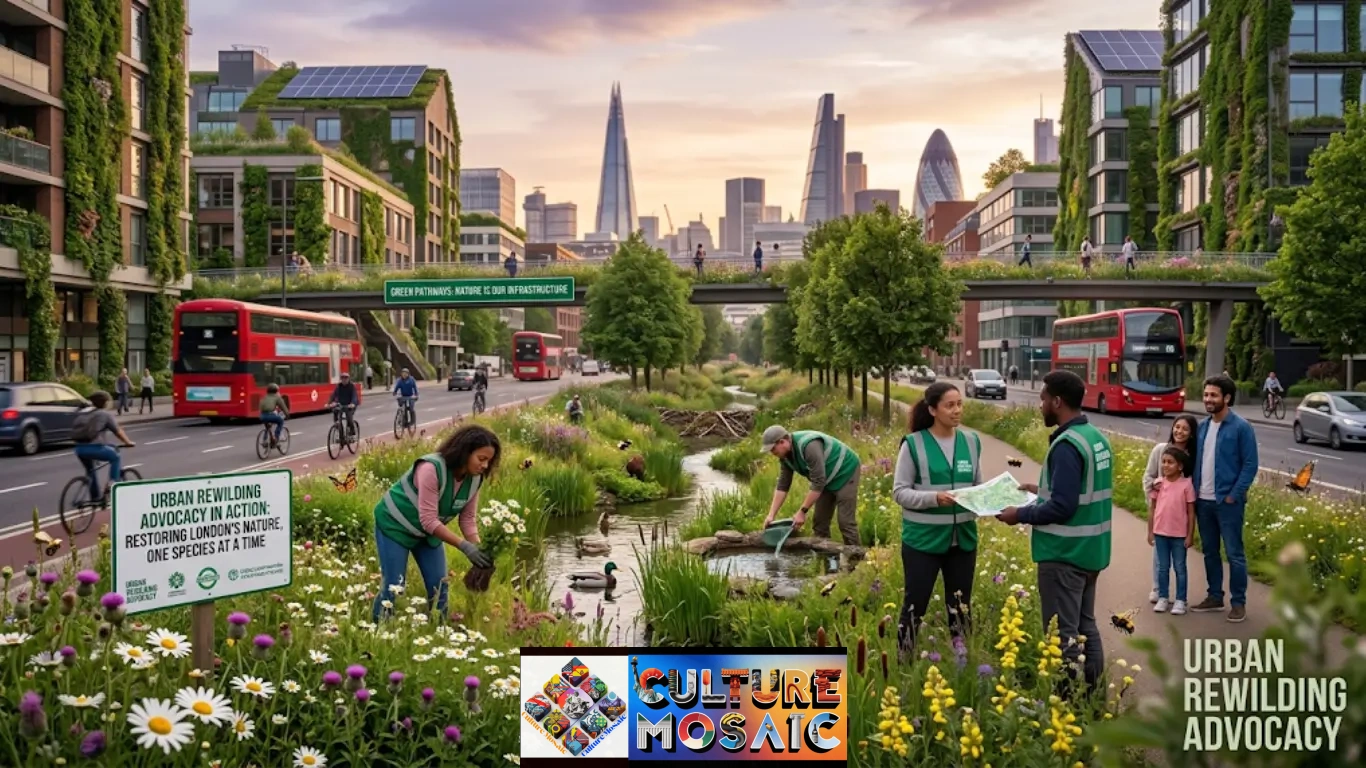
I still remember the first time I saw a wildflower verge in the middle of a British roundabout. Knee-high grass, ox-eye daisies, a bee absolutely losing its mind over a thistle head. Someone had complained about it to the council within a week. “Looks neglected,” the letter said. That tension — between what looks cared for and what actually cares for anything — is the whole story of Urban Rewilding Advocacy in one small roundabout.
Quick Summary
- What it is: Urban Rewilding Advocacy is the organised push to restore natural processes — wildflower verges, ponds, hedgerows, even beavers — inside towns and cities, and to defend those spaces once councils or developers push back.
- Why it matters: UK green space delivers measurable mental health, flood control, and biodiversity benefits, but access is wildly unequal across income levels.
- The catch: Done badly, rewilding can raise property values and push out the very residents it was meant to help — a pattern researchers call green gentrification.
- The fix: Community-led planning, transparent public consultation, and policy that treats wild space as infrastructure, not decoration.
- Right now in the UK: Beavers are back in west London after 400 years absent, Sadiq Khan’s Rewild London Fund has poured money into wetlands and meadows, and roadside “no-mow” schemes are spreading fast — alongside a genuine backlash from residents who find them messy.
- The role of advocacy: Urban Rewilding Advocacy is the connective tissue linking ecology, funding, and local trust — without it, most projects on this page would still be unapproved planning applications.
The Problem: Cities Are Nature-Starved, and Most People Don’t Notice Until It’s Gone
Here’s the uncomfortable bit. London’s mayor has called the UK one of the most nature-depleted countries on Earth. Not a struggling rainforest nation. Britain. The place with the hedgerows and the National Trust and the garden shows. Sadiq Khan is pursuing an ambitious £600,000 campaign to restore degraded sites for plants and wildlife across 20 percent of London, aiming to give the city’s residents what he calls a thriving web of nature on their doorstep.
I think most people walk past a mown verge or a paved-over garden and don’t register the loss. It’s not dramatic. There’s no bulldozer moment. It’s just quiet, slow subtraction — fewer bees this year than last, fewer birdsong mornings, a summer that felt hotter than it should. By the time anyone notices, the damage has been accumulating for a decade. This is precisely the blind spot Urban Rewilding Advocacy is built to fix — someone has to notice before the council does.
Despite biodiversity decline being most severe in and around cities, faunal urban rewilding has largely been overlooked — held back by cramped space, hostile non-native species, and a planning culture that still treats “wild” as a synonym for “unmanaged.” That’s the gap Urban Rewilding Advocacy exists to close, and it’s why the case for Urban Rewilding Advocacy keeps getting stronger every year the gap stays open.
I Get It — This Feels Like a Big Ask When Rent’s Already High
If you’re reading this while worrying about your energy bill, a campaign built around Urban Rewilding Advocacy might feel like a strange priority. I understand that reaction. It’s a fair one.
But here’s what changed my mind on this. Green space isn’t a luxury add-on to a functioning city — it’s infrastructure that happens to be alive. A restored wetland does flood control work that would otherwise cost millions in concrete and pumps. A street of mature trees does the cooling job of an entire block’s worth of air conditioning, quietly, for free, every summer. Rewilding earns its keep. It just doesn’t send an invoice the way a construction firm does. That’s the argument at the heart of Urban Rewilding Advocacy: nature isn’t decoration, it’s a line item that pays for itself.
What Is Urban Rewilding? A Straight Answer
Urban rewilding means letting natural processes — not ornamental planting schemes — take the lead in shaping city green space. Instead of clipped hedges and mown lawns, you get scrub, standing deadwood, unmanaged pond edges, and sometimes reintroduced animals. It sits inside the broader rewilding movement that gained real momentum in the 1990s, a movement that aims to integrate ecosystems into cities, blending nature and urban settings, using anything from vegetation to animals.
Crucially, it isn’t one-size-fits-all. Urban rewilding already happens in the US, Bangladesh, South Africa, China, Singapore, the UK, Australia, India, and beyond, with different countries taking more or less drastic approaches to what “rewilded” actually looks like on the ground. What ties every one of those national approaches together is Urban Rewilding Advocacy at the local level — nothing above happened because a government simply decided it should.
What Is the Difference Between Urban Greening and Urban Rewilding?
This question comes up constantly, and it deserves a plain answer. Urban greening is about adding plants — street trees, planter boxes, ornamental parks — chosen and maintained by people for a tidy, predictable look. Urban rewilding goes further: it hands some control back to natural processes themselves, tolerating scrub, self-seeded plants, and messiness that a greening scheme would trim away. A municipal flower bed is greening. A riverbank left to meander and flood on its own terms is rewilding.
Researchers put it this way in a 2026 review of the field: rewilding depends on three interacting domains working together — ecology (species interactions, biodiversity, ecosystem services), society (community engagement, perceptions, and stewardship), and governance (policy, management, and adaptive planning). Greening usually only touches the first of those three. Rewilding demands all three, which is exactly why it needs Urban Rewilding Advocacy behind it — governance doesn’t shift on its own.
Urban Rewilding Advocacy Examples From Britain, Right Now
I like starting with proof rather than theory, so here’s what Urban Rewilding Advocacy has actually produced on the ground.
Beavers in west London. Citizen Zoo, working alongside Ealing Wildlife Group, Ealing Council, and Friends of Horsenden Hill, reintroduced beavers to west London after a 400-year absence, transforming a chosen site in Ealing into a wetland habitat. A family of beavers now swims in wetlands in Ealing, roughly 20 kilometres from central London — the first time beavers have been in a UK city since the late 16th century.
The Rewild London Fund. London’s mayoral office backed a wave of habitat work across the capital, including expanding native wildflower meadows by tackling historic scrub encroachment and reseeding with species like yellow-rattle.
Wild West End. In the heart of the city, more than half a dozen major central London property developers are working together to weave natural pathways through the district using green roofs, walls, planters, and street trees, and the rare black redstart has already been spotted returning.
No-Mow May and beyond. Plantlife’s No-Mow May campaign asks councils and gardeners to let green spaces run wild with wildflowers, grasses, and self-seeded plants for a month, providing food and shelter for pollinators, before extending into “Let It Bloom June.”
Brighton’s rewilded golf course and a Glasgow river. A former golf course on England’s south coast in Brighton is being returned to the wildflower meadows that once grew there, while on the outskirts of Glasgow an industrial stretch of river is being reconnected to its natural floodplain in East Renfrewshire.
Roadside verges, at scale. The maths on this one surprised me. If every roadside verge in the UK were converted into meadow, that alone would rewild roughly 1.2 percent of the entire country’s landmass — without touching a single garden, park, or farm.
None of this happened by accident. Every one of these projects had somebody — often a resident, sometimes a council officer, occasionally a charity — arguing for it in a planning meeting nobody else wanted to attend. That’s Urban Rewilding Advocacy in its rawest form. It’s rarely glamorous, and every example above started with exactly this kind of unglamorous groundwork.
Urban Rewilding Benefits: What You Actually Get
I’ll be blunt about my own bias here: I think the benefits case behind Urban Rewilding Advocacy is strong enough that resistance to rewilding usually comes down to aesthetics, not evidence.
- Cooler streets. Greenery and green roofs cut the urban heat island effect through shade and evapotranspiration, lowering the risk of heat deaths during increasingly brutal summers.
- Fewer floods. Reforesting just 5 percent of upland areas has been estimated to cut flood peaks by as much as 29 percent, and allowing rivers to meander with beaver-built “soft dams” improves water retention across an entire watershed.
- Real mental health gains. Bringing wildlife back into daily life improves mental health, builds environmental stewardship, and reminds people that nature isn’t something distant “out there,” according to ecologist Dr Patrick Finnerty, who led the largest global review of urban rewilding published in *BioScience*.
- Lower maintenance bills. Letting ecosystems self-regulate — natural pest predators instead of pesticides, deep roots instead of irrigation — reduces the time and money typically spent managing green spaces the conventional way.
- Genuine biodiversity recovery. Rewilding restores ecological functions and enhances ecosystem resilience through the active reintroduction of species, not just tolerance of whatever survives.
Dr Finnerty’s own words stuck with me: reconnecting people with nature works as “an antidote to what researchers call nature deficit disorder,” he said, describing the goal as shaping healthier, more resilient cities for the generations coming after us.
Urban Rewilding and Public Health Considerations
This is where Urban Rewilding Advocacy stops being abstract and starts being personal. A large body of research shows more green space in a city delivers measurable physical and mental health benefits to residents, and the quality of that space matters — wooded areas, for instance, are linked to lower hypertension than a plain grass lawn.
There’s a real trade-off worth naming honestly, though. Wilder spaces can raise concerns about ticks, allergens, or a perceived loss of visibility and safety at night. Good advocacy doesn’t dodge these worries — it designs around them, with sightlines kept clear near paths, managed access points, and public information about what’s actually growing nearby. Ignoring these concerns is how well-meaning rewilding schemes lose local support fast — good Urban Rewilding Advocacy treats residents’ worries as design input, not noise to talk over.
How Does Rewilding Impact City Infrastructure and Safety?
Short answer: usually it helps, when it’s planned properly. Urban green spaces slow surface runoff through natural interception and infiltration, cutting inner-city flood risk, while also acting as ecological buffers that disperse and delay the impact of peak rainfall. That’s not a side benefit — it’s flood infrastructure that happens to also be beautiful.
The safety question people actually mean, though, is usually about wildlife and overgrowth near roads, paths, and buildings. That’s a fair concern, and it’s exactly where governance, equity, safety, and aesthetics become critical, especially since perceptions of “wild” often conflict with public expectations of tidiness and order. The answer isn’t to abandon rewilding near infrastructure — it’s targeted, not universal, wildness: dense scrub set back from footpaths, clear sightlines at junctions, and structural planting (root systems chosen for stability) near foundations and drains. This is a core design problem that any serious Urban Rewilding Advocacy effort has to solve before, not after, the first complaint arrives.
Does Urban Rewilding Mean Introducing Apex Predators to Cities?
No — and this is probably the single biggest myth I run into when talking to neighbours sceptical of Urban Rewilding Advocacy. Urban rewilding won’t see the reintroduction of apex predators; instead, smaller animals like water voles might be brought back to help restore ecosystems, alongside more birds, bees, and butterflies. Nobody is releasing wolves into Hyde Park. Beavers — the flagship species of UK urban rewilding — are herbivorous ecosystem engineers, not predators; they build dams, not den sites for hunting.
The genuinely large-scale, predator-driven rewilding you may have read about — Yellowstone’s wolves triggering a trophic cascade that reshaped the whole park’s food chain — belongs to wilderness rewilding, a different project entirely, at a different scale, in a different kind of landscape.
Can You Rewild a City If Space Is Heavily Restricted?
Yes, and this is genuinely the most encouraging part of Urban Rewilding Advocacy as a whole movement. Experts call this microrewilding — small-scale, individual-level action such as green roofs, walls, planters, and thinking about every surface as a potential host for nature. It works because it doesn’t ask for acreage. It asks for attention.
A balcony box of native wildflowers. A green roof on a bike shed. A single unmown corner of a shared courtyard. None of it looks like Yellowstone, and none of it needs to. Every window box, laneway garden, and rooftop forest contributes to a city that breathes, cools, and nurtures life, and by 2050 nearly 70 percent of the world’s population will be living in exactly these kinds of tightly packed, space-restricted cities — which makes micro-scale wins the only realistic path for most residents.
The Rewilding Controversy Nobody Likes Talking About
I’d be lying to you if I framed this as a story with no tension. There genuinely is a rewilding controversy, and pretending otherwise would insult your intelligence — no honest account of Urban Rewilding Advocacy skips this part.
The aesthetics backlash is real. Some UK commentators have publicly described council-backed rewilding, such as reduced herbicide use on urban verges, as evidence of laziness and neglect dressed up as environmentalism. That backlash isn’t fringe — it plays out in national newspapers and council chambers, and it can kill a project if Urban Rewilding Advocacy doesn’t engage with it directly rather than dismissing it.
Green gentrification is the bigger risk. This is the one that keeps me up at night, honestly. A Zoological Society of London report found rewilding could push lower-income residents out of their own communities, since improving a neighbourhood’s ecological space raises its desirability, and with it, rents and property values. Green gentrification happens when environmental improvements — a new park, a cleaner river, a restored wetland — drive up property values and living costs until lower-income residents are displaced or priced out entirely.
The cruel irony is that the neighbourhoods with the least green space, and therefore the most to gain from rewilding, are often the ones most vulnerable to being priced out of the benefit once it arrives. That’s not a reason to stop. It’s a reason to plan differently from day one.
How Does Urban Rewilding Overlap With Social Justice?
Almost entirely, once you look closely. Urban greening is now recognised as an essential part of sustainable, climate-responsive cities, yet a growing body of research argues new green infrastructure can itself contribute to gentrification, creating fresh social and racial inequalities in who actually gets to enjoy it. Rewilding inherits that same risk, just with higher ecological stakes attached.
Researchers reviewing the field in 2026 called for exactly this kind of scrutiny going forward, urging future work to examine how rewilding interacts with land tenure, housing equity, and green gentrification, alongside long-term ecological monitoring and honest assessment of human wellbeing trade-offs. In plain English: who gets the beavers, and who gets the bill. Urban Rewilding Advocacy that ignores that question isn’t neutral — it’s just quietly picking a side.
This is exactly why Urban Rewilding Advocacy can’t stay purely ecological. It has to sit alongside — not instead of — the broader civic conversation about who gets heard in local decision-making. Culture Mosaic has covered why public consultation is important and what public commentary actually means in practice, and both apply directly here: a rewilding scheme designed without the neighbourhood it affects is a scheme built to be resented, however good the ecology.
A Practical Playbook for Urban Rewilding Advocacy
Enough diagnosis. Here’s what actually moves Urban Rewilding Advocacy from idea to reality, based on what’s worked in UK case studies so far.
- Start small and visible. A single wildflower verge or a no-mow trial patch builds local trust faster than a grand five-year masterplan nobody can picture — and early wins are what keep Urban Rewilding Advocacy funded past year one.
- Bring the council to you, not the other way round. UK interventions labelled “rewilding” have ranged from large landscape-scale habitat restoration to something as modest as changing how often a roadside verge gets mown — meet your local authority with the scale of ask that matches your actual site.
- Use the public consultation process properly, not as a box-ticking afterthought — genuinely, not performatively. This is where Urban Rewilding Advocacy either earns trust or loses it for good.
- Name the equity risk before anyone else does. Bring green gentrification up yourself in the first meeting. It builds credibility and heads off the strongest opposing argument before it’s used against you.
- Recruit unlikely allies. Property developers backing Wild West End, a golf club handing over fairways in Brighton — Urban Rewilding Advocacy succeeds fastest when it stops looking like a fringe cause and starts looking like sound asset management.
- Track and publish results. Long-term studies tracking which rewilding efforts actually work, alongside new tools to help cities choose the right species and balance ecological goals with public support, remain a genuine research gap — local data from your own project fills part of that gap and strengthens your next ask.
- Connect it to civic literacy, not just ecology. Culture Mosaic’s reporting on declining civic knowledge in the US and the role of a local community college in rebuilding it both point to the same underlying truth: people who understand how local decisions get made are the ones who successfully change them. Rewilding advocacy is civic education wearing muddy boots.
Grant programmes are catching up to this shift, too — schemes like the Love Your Block Grant 2026 exist precisely because small, resident-led green projects are now recognised as legitimate infrastructure spending, not vanity greening.
What the People Doing This Work Actually Say
I think social proof matters more here than in most causes, because Urban Rewilding Advocacy lives or dies on whether neighbours trust it. A few voices worth hearing directly:
Ross O’Ceallaigh, founder of the Urban Wilding Hub — a nonprofit built specifically to mainstream urban wilding across Europe — describes urban communities as facing climate change, biodiversity loss, poor health, and disconnection from nature all at once, arguing that embracing wild nature in cities is a proactive, hopeful response to the climate and biodiversity crises that can genuinely improve quality of life. Within six months of launching, his Wilding Partners programme had grown to 50 members across 10 European countries, spanning environmental nonprofits, local authorities, landscape architects, researchers, and community leaders — proof that once the network exists, people show up fast.
Siân Moxon, founder of Rewild My Street, put the space-restricted case simply: microrewilding is about adding greenery and thinking about every surface as a potential host. It’s the line I come back to whenever someone tells me their flat has no garden.
And from the research side, Dr Finnerty’s team closed their major 2025 review with a call to action rather than a caveat: “If we want greener, wilder and more resilient cities, we can’t stop at plants. It’s time to bring the animals back too.”
Where Urban Rewilding Advocacy Leaves You
If you’ve read this far, you already care more than most of your neighbours do — that’s not flattery, it’s just statistically true. The gap between a nature-depleted street and a genuinely wilder one usually isn’t money. It’s somebody willing to stand up at a council meeting, or start a WhatsApp group, or plant the first unauthorised wildflower patch and see who complains.
I’ll leave you with the roundabout I started with. Nobody removed those wildflowers, in the end. Someone from the local wildlife trust wrote back to the council explaining what the daisies were actually for. The bees are still there.
Frequently Asked Questions
What is the difference between urban greening and urban rewilding?
Urban greening adds and maintains chosen plants — street trees, tidy parks, planter boxes — for a controlled, predictable appearance. Urban rewilding goes a step further, handing control back to natural processes themselves: scrub, self-seeded growth, meandering water, and sometimes reintroduced species, tolerating the mess that comes with genuine ecological function. Greening is decoration; rewilding, and the Urban Rewilding Advocacy that sustains it, is process.
Does urban rewilding mean introducing apex predators to cities?
No. UK-focused Urban Rewilding Advocacy centres on herbivores and smaller species — beavers, water voles, birds, pollinators — not predators. Beavers, the flagship UK reintroduction, are ecosystem engineers that build dams and wetlands; they pose no predatory risk. Large predator reintroductions like Yellowstone’s wolves belong to a separate category of wilderness rewilding, carried out at a totally different scale and location.
How does rewilding impact city infrastructure and safety?
Generally positively, when Urban Rewilding Advocacy insists on planning rather than leaving it to chance. Rewilded green space slows stormwater runoff, reduces flood peaks, and buffers extreme rainfall — functioning as living infrastructure alongside pipes and drains rather than against them. Safety concerns about overgrowth near paths and roads are legitimate and addressed through targeted design: clear sightlines, managed access points, and structural planting kept back from footpaths and building foundations.
Can you rewild a city if space is heavily restricted?
Yes — this is where “microrewilding,” a favourite tactic of grassroots Urban Rewilding Advocacy, comes in. Green roofs, balcony planters, unmown courtyard corners, and green walls all count, and collectively they matter more than people assume. With close to 70 percent of the world’s population expected to live in cities by 2050, small-scale, space-restricted interventions are the realistic majority path forward, not a lesser substitute for large rewilding projects.
How does urban rewilding overlap with social justice?
Heavily — responsible Urban Rewilding Advocacy treats this overlap as central, not incidental. Green space access in most cities already breaks down along income lines, and poorly planned rewilding can make that worse through green gentrification — rising rents and property values that price out the very residents the project was meant to benefit. Responsible Urban Rewilding Advocacy names this risk upfront, prioritises deprived neighbourhoods for early investment, and builds genuine community consultation into the process rather than treating equity as an afterthought.
Sources
- Rodriguez, M. E. & Lorimer, J. et al. “Urban rewilding as a nature-based solution: a critical perspective.” Taylor & Francis, 2026. https://www.tandfonline.com/doi/full/10.1080/29932297.2026.2629049
- Finnerty, P. B. et al. “Urban rewilding to combat global biodiversity decline.” BioScience, Vol. 75, Issue 7, 2025. https://academic.oup.com/bioscience/article/75/7/545/8140146
- University of Sydney. “Urban rewilding combats global biodiversity decline.” 2025. https://www.sydney.edu.au/news-opinion/news/2025/05/27/urban-rewilding-combats-global-biodiversity-decline.html
- The Conversation. “Urban rewilding has brought back beavers, hornbills and platypuses to city parks – and that’s just the start.” 2026. https://theconversation.com/urban-rewilding-has-brought-back-beavers-hornbills-and-platypuses-to-city-parks-and-thats-just-the-start-256102
- Winkless, L. “Urban Rewilding Makes Cities More Biodiverse And Better For Our Health.” Forbes, 2025. https://www.forbes.com/sites/lauriewinkless/2025/06/05/urban-rewilding-makes-cities-more-biodiverse-and-better-for-our-health/
- Zoological Society of London. “Rewilding Our Cities” report, Terry, A., 2022. https://cms.zsl.org/sites/default/files/2023-02/ZSL%20Rewilding%20our%20cities%20report.pdf
- EcoWatch. “‘Green Gentrification’ Can Force Out Long-Term, Lower-Income Residents.” 2022. https://www.ecowatch.com/green-gentrification-housing.html
- National Geographic. “Rewilding the UK one abandoned lot at a time.” 2022. https://www.nationalgeographic.com/environment/article/rewilding-the-uk-one-abandoned-lot-at-a-time
- The Revelator. “Urban ‘Microrewilding’ Projects Provide a Lifeline for Nature.” 2023. https://therevelator.org/urban-microrewilding/
- London Wildlife Trust. “The Rewild London Fund.” https://www.wildlondon.org.uk/projects/rewild-london
- Greenpeace UK. “Rewilding: the movement for nature that’s flourishing in the UK.” 2024. https://www.greenpeace.org.uk/news/rewilding-uk-nature-restoration/
- Mossy Earth. “Rewilding Cities: Why it’s needed and how you can help.” https://www.mossy.earth/rewilding-knowledge/rewilding-cities
- The Kingfisher. “Rewilding our cities could reduce the impact of extreme weather.” 2022. https://www.the-kingfisher.org/sustainable_leaders/europe/rewilding_cities.html
- Rodríguez-Rodríguez, D. et al. “Green gentrification in European and North American cities.” Nature Communications, 2022. https://www.ncbi.nlm.nih.gov/pmc/articles/PMC9250502/
- (Re)wilding London: Fabric, politics, and aesthetics. Transactions of the Institute of British Geographers, 2025. https://rgs-ibg.onlinelibrary.wiley.com/doi/10.1111/tran.12748
- “Exploring the implementation of rewilding in a British local authority.” ScienceDirect, 2024. https://www.sciencedirect.com/science/article/pii/S016920462400104X
- Liu, N. & Zhang, F. “Urban green spaces and flood disaster management: toward sustainable urban design.” Frontiers in Public Health, 2025. https://www.ncbi.nlm.nih.gov/pmc/articles/PMC12021837/
- Urban Wilding Hub. https://urbanwildinghub.com/
 Marcus J. Holloway