
 By Culture Expert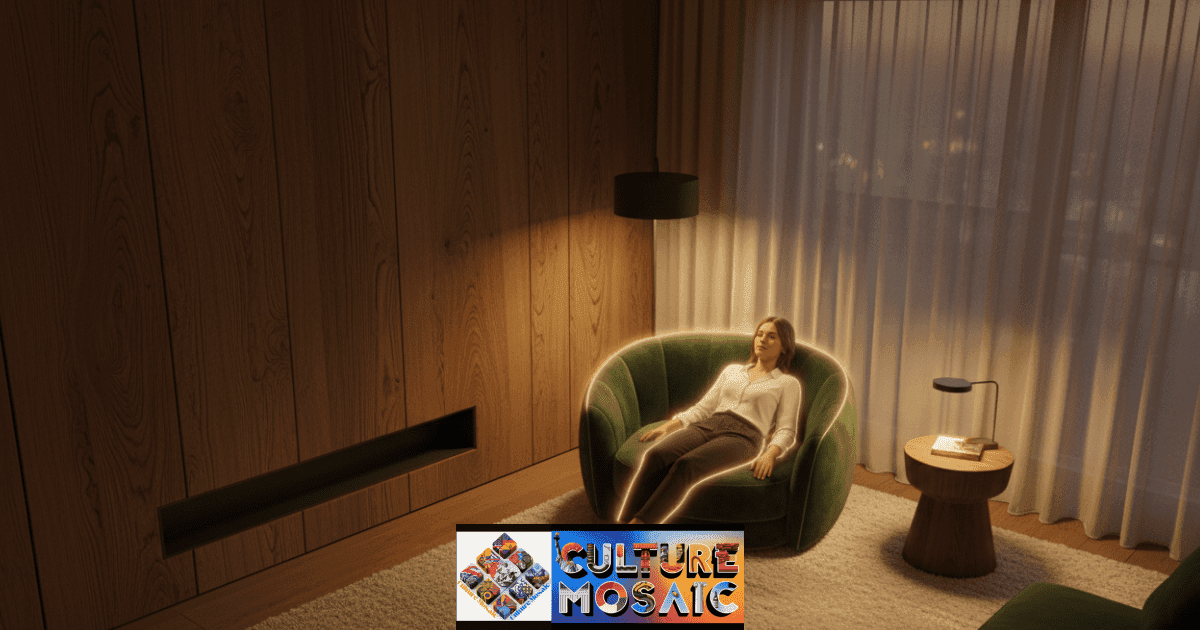
Start Here: A 30-Second Body Scan Before You Read On
Stop for a moment. Notice your shoulders. Are they up near your ears? Drop your jaw slightly and check whether it was clenched. Take a single breath and observe whether your chest or your belly moved. Now look around the room.
That small experiment is the entire argument for somatic home design compressed into half a minute. Your body is already reading this room. It was doing so before you sat down, before you opened this article, before you had a single conscious thought about the space. Every ceiling height, every surface texture, every flicker of light is being processed by your nervous system in real time.
What follows are the five principles I return to most often in practice, whether I am advising on a full residential renovation or helping someone make targeted changes to a rented flat. These are not aesthetic preferences. They are functional interventions, grounded in environmental neuroscience, that shift how a body feels in a room.
The Core Thesis
Somatic home design is not about how your room looks. It is about how your nervous system reads it.
What Somatic Home Design Actually Means
The word somatic is derived from the Greek word soma, meaning “body”. In clinical practice, somatic approaches range from physiotherapy to trauma-informed movement, all sharing the premise that the body holds information the mind has not yet fully processed. Somatic home design applies that same logic to residential space.
Where conventional interior design asks how a room looks, somatic home design asks how a room feels in the body. A glossy, high-contrast showroom can photograph beautifully and produce low-grade anxiety in the person who lives inside it for eight hours. A slightly worn linen sofa in a room with layered amber light and natural materials might look unremarkable in a listing photo but feel genuinely restorative day after day.
The difference is measurable. It is body-centred. And it draws on neuroscience rather than taste.
The Science Behind the Skin-Room Connection
Why Your Body Is Always Reading the Room
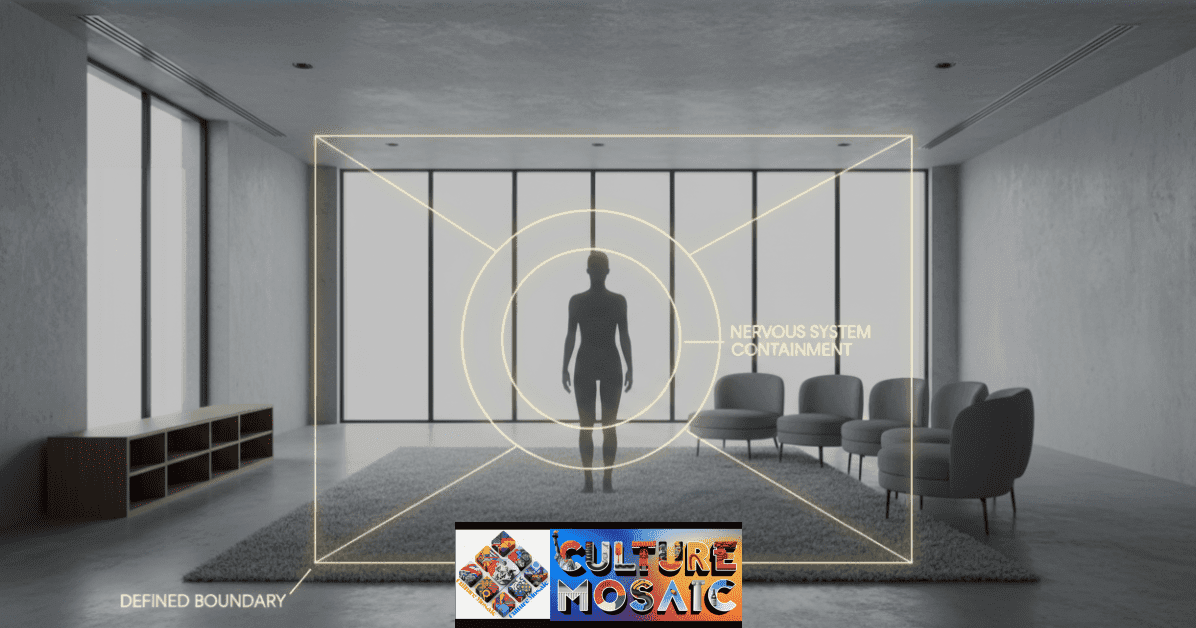
Your proprioceptive system, the network of sensors in your joints, muscles, and skin that maps your body’s position in space, also reads the boundaries of a room. This is a finding that does not get enough attention in design discussions. Rooms with defined perimeters give the body a quiet sense of completion. The sprawling open-plan kitchen-diner-lounge arrangements that dominated design for the past fifteen years often produce a low-grade proprioceptive anxiety because the body cannot locate its edges.
This is not an argument for small rooms. It is an argument for perceptual zones: furniture arrangements, rugs, partial screens, and acoustic objects that give the body a readable spatial map even within an open floor plan.
Neuro-Aesthetics: A Quick-Reference Guide for Somatic Home Design
Neuro-Aesthetics: A Quick-Reference Guide
| Design Element | Somatic Impact | Emotional Response |
|---|---|---|
| High ceilings (3m+) | Stimulates expansive, abstract thinking | Freedom / Mild vulnerability |
| Curved furniture edges | Activates the parasympathetic nervous system | Safety / Ease |
| Tactile wood surfaces | Lowers heart-rate variability | Groundedness / Warmth |
| Layered acoustic softness | Reduces auditory cortex activation | Calm / Containment |
| Amber lighting (2700K) | Suppresses evening cortisol production | Rest / Deceleration |
| Natural fibres (linen, wool) | Stimulates skin mechanoreceptors gently | Comfort / Embodiment |
| Organic forms (plants, stone) | Reduces sympathetic nervous system arousal | Ease / Safety |
The 5 Expert Principles of Somatic Home Design
These five principles are the framework I use when assessing any residential space. Each one addresses a different sensory channel. Together, they cover the full range of what the nervous system needs from a home environment.
Principle 1: Thermal and Acoustic Intentionality
Most design conversations about acoustics stop at the word quiet. That is not a good enough target. Complete silence, particularly in a room filled with the low irregular hum of electronics, often heightens auditory attention rather than relaxing it. The body interprets total quiet as a signal to listen harder, a posture of vigilance rather than rest.
The better goal is an intentional soundscape. Vinyl playing at low volume. A tabletop water feature. Wind through a cracked window. These give the auditory cortex enough input to satisfy it without demanding focused attention. The nervous system, in acoustic terms, needs something to rest on.
Thermal design works the same way. The aim is not a single fixed temperature but a gradient within the space: a slightly cooler reading corner, warmth near a lamp, a textured throw that raises perceived warmth without raising the thermostat. Thermal gradients give the body agency over its own comfort, and that agency is itself a somatic regulator.
Principle 2: Haptic Material Selection

Touch is the oldest of the senses and the most neglected in residential design. Somatic home design places haptic experience at the centre of every material decision, not as a secondary consideration after visual appeal.
Natural fibres such as linen, undyed wool, and raw cotton engage skin mechanoreceptors in a way that synthetic fabrics simply do not. Unfinished wood with visible grain provides a proprioceptive anchor that polished glass and lacquered surfaces cannot replicate. Natural stone, whether a worktop, a floor tile, or a single large object on a shelf, offers a temperature differential that reads as real and grounding to the body.
A quick test: from where you are sitting right now, can you reach three different textures? If the answer is no, your room is under-stimulating your haptic system, and no amount of visual styling compensates for that gap. The relationship between material culture and embodied memory runs deep, and you can explore that connection further through Somatic Food Memory, which maps how tactile and sensory experience in domestic spaces shapes emotional regulation over time.
Principle 3: Circadian Lighting Architecture
If I could make only one change to a client’s home, it would almost always be this one.
Cool, blue-spectrum light at around 5000K mimics midday sky. It suppresses melatonin, sustains cortisol, and holds the brain in a productivity and vigilance state. That is exactly right for a desk at ten in the morning. It is actively harmful at nine in the evening.
Shifting to warm amber light at around 2700K in the hours after sunset sends an unambiguous hormonal signal: the working day is ending and recovery can begin. This is photobiology, not metaphor. The investment in dimmable warm bulbs and a timed lamp or two is, in measurable somatic terms, the single highest-return change most people can make to their home.
The lighting temperature in your home after sunset is one of the most powerful levers you have over your own nervous system. Use it deliberately.
Principle 4: Spatial Decoupling and Digital Containment
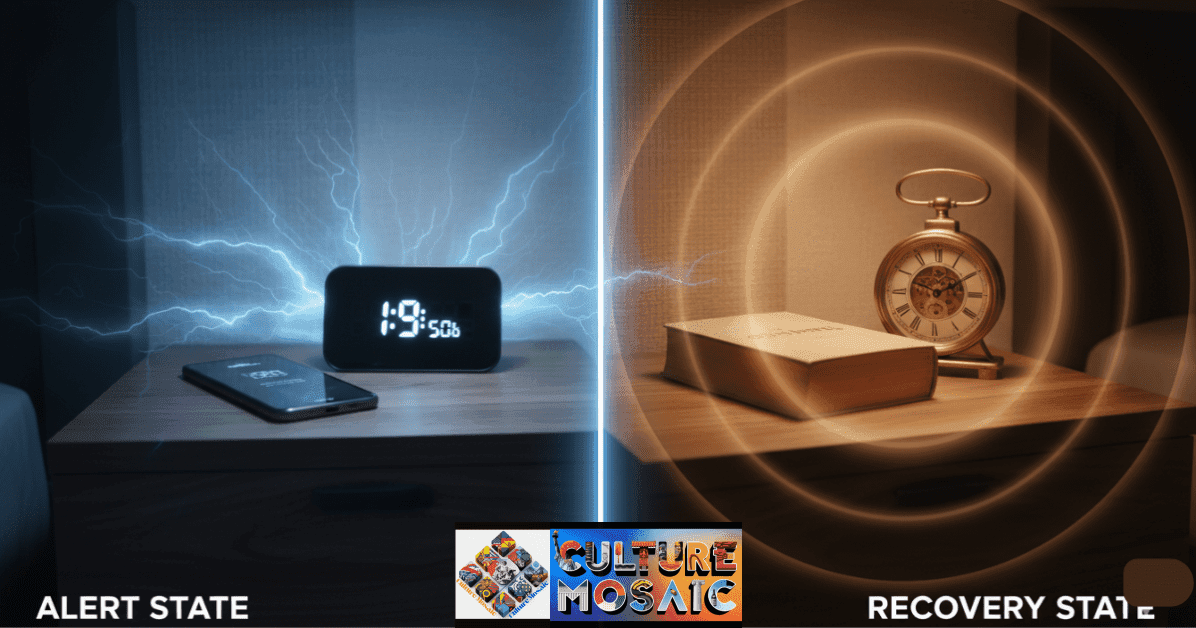
The bedroom is the most somatic-critical room in any home, and in most homes I visit it is also the most compromised. A phone charging on the bedside table is not simply a phone. It is a physical anchor for the alertness state. Its presence keeps the nervous system in a low-level monitoring posture: the amygdala is holding one eye open because an alertness device is within reach.
The intervention is specific. Replace the phone with a mechanical clock. Replace the digital reading device with a linen-bound book. Remove the charging cable from the room entirely. Place one natural-fibre textile within easy reach.
Each of these changes operates directly on the amygdala, the brain’s threat-detection centre. A mechanical clock, a physical book, and a natural surface do not trigger monitoring behaviour. A phone does. The somatic difference between these two bedside configurations is not small.
This principle, which I think of as spatial decoupling, is developed in much greater depth through the Analogue Maximalism Lifestyle framework, which offers a complete philosophy for building analogue infrastructure into contemporary domestic life.
Principle 5: Temporal Grounding Through Heritage Objects
This is the principle that surprises clients most, and the one that almost always produces the most immediate felt response when implemented.
Contemporary digital life produces a specific somatic deficit: the absence of temporal anchoring. When everything on a screen refreshes in milliseconds and every product in a room was manufactured to identical tolerances, the body has no material evidence of time passing. There is nothing to tell the nervous system that duration is real, that the present moment is part of a longer continuity.
Heritage objects, antiques, worn rugs, hand-thrown ceramics, patinated brass, address this deficit directly. The visible evidence of age and use, a worn table edge, an uneven glaze, a linen that has softened with washing, tells the body at a pre-cognitive level that time is safe. That reading is stabilising in a way that new, identical surfaces cannot be.
The practice of Mnemonic Landscape Analysis examines how built environments carry mnemonic weight and affect inhabitants’ sense of identity and continuity. The design implication is practical: mixing heritage objects into contemporary spaces is not sentiment. It is somatic strategy.
The Somatic Audit: Seven Questions for Any Room
Run through this audit in any room you spend significant time in. Be honest. The point is not to score well; it is to identify the channel that most needs attention.
- SIGHT: Is there a focal point in this room that is not a screen?
- TOUCH: Can you reach three different textures from where you are sitting?
- SOUND: Is the dominant ambient sound intentional, or is it the hum of electronics?
- SCALE: Does the furniture cradle you, or does it simply hold you?
- LIGHT: Is the light temperature right for the time of day and the activity happening here?
- SCENT: Is there a low-level natural scent present: wood, beeswax, dried botanicals?
- BOUNDARY: Does your body have a clear sense of where this room begins and ends?
If three or more of these questions fail, the room is working against your nervous system. None of these repairs require a renovation. A rug, a dimmable lamp, a ceramic object, and a wool throw can shift the somatic profile of a room more meaningfully than a complete aesthetic overhaul.
Case Study: Rebuilding a Digital-Leakage Bedroom
The Problem
A client came to me with a bedroom that looked, by any conventional measure, entirely fine. Neutral colours, quality bedding, blackout curtains. They were sleeping four to five hours most nights and waking feeling unrested. The room had four alertness triggers: a charging phone on the bedside table, a laptop on a chair near the bed, cool overhead lighting unchanged from its daytime setting, and a smart speaker they used as an alarm.
Every single object in that bedroom was telling the nervous system to stay alert.
The Intervention
We made five changes. The phone left the room. The laptop went to a dedicated workspace outside the bedroom. The overhead light was replaced with a dimmable warm-spectrum bedside lamp on a timer. The smart speaker was replaced with a wind-up clock. A linen throw was placed within reach.
Within ten days the client was sleeping six to seven hours. Within three weeks, seven to eight. Nothing structural changed. No renovation. No new bedding. The somatic architecture of the room changed, and the body responded accordingly.
This principle connects directly to the broader study of how physical proximity and shared domestic space affect nervous system regulation. The Proximity Mechanics of Shared Rituals framework is useful here, particularly for households where two people’s sleep environments need to be calibrated simultaneously.
How Objects Carry Emotional Weight: Somatic Art Documentation
Every object in a home carries a somatic charge. This is a product of associative memory, not sentiment. A photograph, a piece of craft, or a painting acquired during a meaningful period activates the body’s interoceptive network, its inner-sensing system, with a faint echo of the original experience. This is why inherited objects feel heavy and why the things we choose to surround ourselves with matter beyond their visual contribution.
Somatic home design curates objects with this charge deliberately. A wall of prints bought because they coordinate with paint colours produces a neutral somatic response. Objects with personal narrative weight produce something else: a low-level sense of continuity and belonging that accumulates over time. The field of Somatic Art Documentation maps the connection between material culture and the body’s emotional memory system in significant depth.
Designing for Co-Regulation: Shared Spaces and Proximity
Somatic home design attends not only to the individual body but to the relational body: how we regulate each other’s nervous systems through proximity, shared activity, and co-presence. The distance between chairs in a sitting room, the height of a kitchen island, the placement of a reading bench near a window: these are not just functional decisions. They are proximity decisions.
Research on co-regulation, the process by which humans stabilise each other’s stress responses through physical closeness, suggests that furniture arrangements facilitating easy, unforced proximity actively support nervous system health. Sitting beside someone rather than across from them, sharing a task surface, being in the same thermal zone: these arrangements matter. The Proximity Mechanics of Shared Rituals framework provides a rigorous foundation for understanding how physical proximity shapes collective experience in domestic spaces.
Regional Culture, Heritage, and Somatic Identity
The somatic reading of a home is never entirely personal. It is also cultural. The materials, proportions, and domestic rituals that feel grounding to a body raised in a particular landscape and tradition are not universal. They are specific, and that specificity matters in design.
The culture mosaic gallery collects material culture examples that bridge heritage sensibility with contemporary domestic life, and it is one of the most useful reference points I direct clients to when they are trying to understand what “home” feels like at a somatic level for them specifically. For a broader grounding in how British cultural tradition shapes domestic aesthetics and felt experience, The UK Culture and Traditions provides valuable historical and cultural context. And for those exploring how personal history and accumulated experience inform better domestic choices, the practice of Wisdom Flexing offers a compelling framework for applying what you already know.
Where to Begin: The Practical Implementation Sequence
The Five Highest-Return Starting Points
If you are new to somatic home design and uncertain where to direct your first attention, work through this sequence. Each step builds on the last.
- Lighting: Replace all evening-use bulbs with warm-spectrum 2700K options. Add at least one dimmable lamp. This is the fastest, cheapest, most impactful change in somatic home design.
- Haptics: Add one natural textile, a linen throw or a wool cushion, to your most-used room. Remove one synthetic surface. Notice the difference within a week.
- Acoustics: Place a thick natural-fibre rug in any uncarpeted rest space. A single rug shifts both the acoustic and haptic profile of a room simultaneously.
- Spatial boundaries: Use a large rug, a low bookcase, or a floor plant to create a perceptual zone in any open-plan space that currently feels unsettled or difficult to rest in.
- Digital decoupling: Remove one alertness device from your rest space. The bedroom phone is the obvious starting point. Replace it with an analogue equivalent and give it a month.
Planning a Somatic Renovation
If you are planning a more significant redesign, introduce somatic principles at the brief stage, before layouts are fixed, before materials are selected, before lighting plans are drawn. The question to lead with is not “What do I want this room to look like?” but “What does this room need to do to the body of the person using it?”
That reframe produces entirely different answers. It shapes ceiling height decisions. It changes material specifications. It determines thermal zoning and acoustic treatment. It makes lighting design genuinely functional rather than decorative. You can find further resources and applied case studies at Somatic Home Design.
Frequently Asked Questions About Somatic Home Design
What is somatic home design in plain terms?
Somatic home design is the practice of designing living spaces around how they affect the body and nervous system rather than around visual aesthetics alone. It draws on environmental neuroscience, sensory psychology, and embodied cognition to create rooms that actively support rest, focus, or social connection rather than simply photograph well.
Do I need a specialist to apply somatic home design principles?
No. The core principles, particularly lighting temperature, haptic material selection, acoustic softening, and digital decoupling in rest spaces, are all accessible without professional input. A good starting point is to walk through your home room by room and ask: does this space serve the nervous system function I actually need here? The answer almost always points directly at the first change worth making.
How does somatic home design differ from biophilic design?
Biophilic design focuses on the body’s connection to natural systems: plants, natural light, organic forms, and water. Somatic home design is broader. It incorporates biophilic principles but also attends to acoustic environment, thermal gradients, haptic material selection, circadian lighting, object curation, spatial boundary-making, and the proximity mechanics of social co-regulation.
Is somatic home design relevant in a rented property?
Entirely. Most of the highest-return somatic interventions involve no structural changes and leave no permanent trace. Lighting, textiles, rugs, acoustic softening, analogue bedroom setups, and spatial zone-making with furniture can somatically redesign a rented flat almost completely. A landlord need never know.
What is the most common somatic design mistake in modern homes?
Treating the bedroom as an extension of the home office. Charging devices on the bedside table. Cool overhead lighting left unchanged through the evening. Synthetic surfaces that provide no haptic grounding. The bedroom is the most somatic-critical room in a home, and it is the one most reliably undermined by digital infrastructure and undifferentiated design. Fix this first.
Ready to take your environment further? Read our guide on Analogue Maximalism Lifestyle for a complete framework on building a home that resists digital saturation at the architectural level.
About the Author
Marcus J. Hartwell is a Domestic Privacy and Somatic Consultant with over fifteen years of practice at the intersection of environmental psychology, residential architecture, and body-centred design. His work translates neuroscientific research into practical design decisions for everyday living spaces. Marcus advises private clients, architects, and interior practices on somatic briefs for residential projects across the United Kingdom and Europe. He contributes regularly to culture mosaic and maintains a specialist practice at Somatic Home Design.