
 By Culture Expert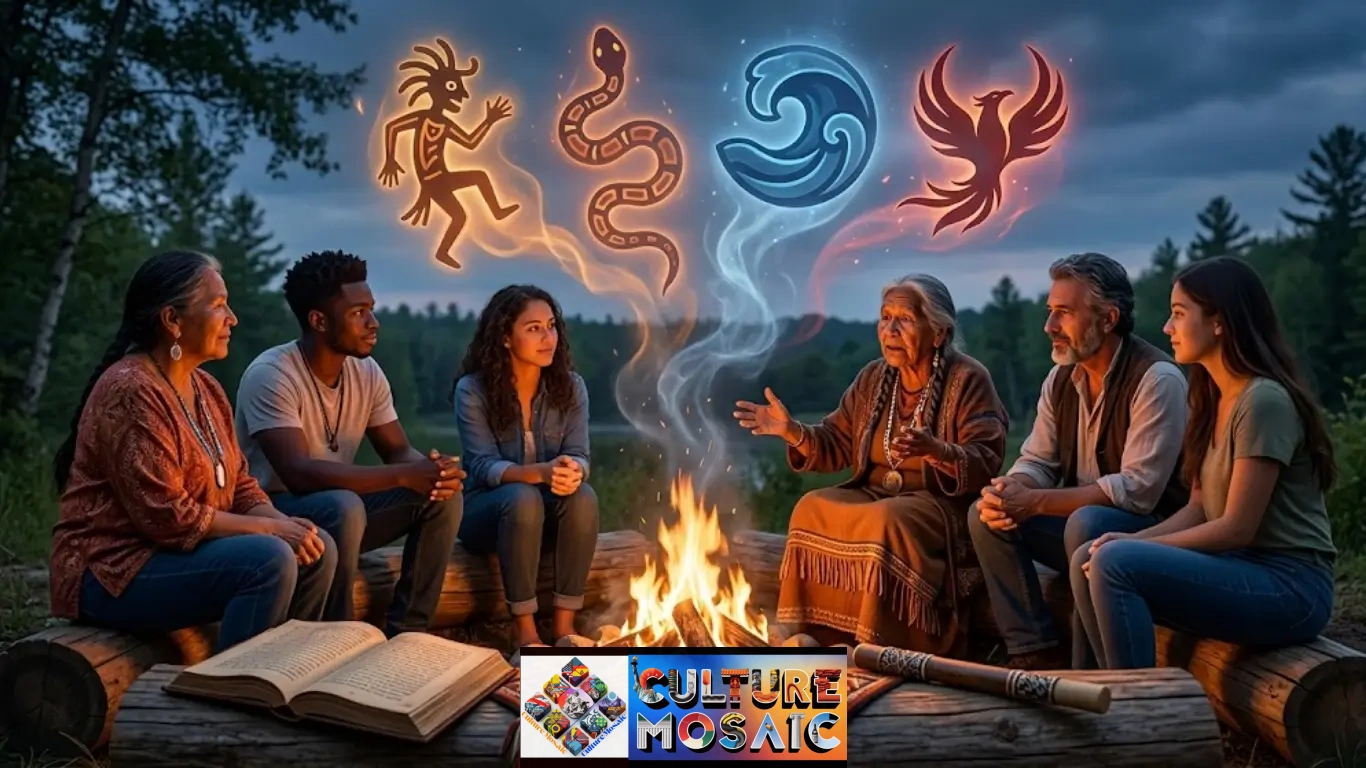
| Quick Summary: Cultural motifs as storytelling are the repeated symbols, images, and situations—a flood, a trickster, a long journey home—that writers and elders alike reach for because they carry meaning a culture already trusts. A motif is concrete and repeatable; a theme is the abstract idea it serves. Cultures separated by oceans share strikingly similar motifs because human beings face the same handful of problems: birth, loss, danger, belonging, death. I’ve spent years tracing Cultural Motifs as Storytelling traditions, from Ojibwe winter lodges to Mediterranean epic, and the short version is this: motifs are the engine, not the decoration. Skip them and a story goes flat. Get them right and a story survives a thousand years. |
I want to start with something that bothered me for a long time: I’d sit in on a folklore seminar, or read a submission from a young novelist, and I’d notice the same complaint surface again and again — “My story feels hollow.” Good grammar. Solid plot. Nothing wrong on the surface. And yet readers put it down halfway through and never picked it back up. That’s the problem, and it’s rarely bad writing. It’s missing architecture.
Here’s the pain, and I mean this literally, not as a marketing line: a story without motifs is a house without load-bearing walls. It might look finished from the street, but it won’t hold weight. Readers can’t always name what’s missing, but they feel it in their gut within the first three pages, and they leave.
I’ve watched this happen to smart, capable writers who understood plot but never learned that plot is not the same thing as narrative power. And I’ve watched the opposite happen too — an unpolished storyteller from an oral tradition holding a room silent for forty minutes with nothing but a repeated phrase, a repeated gesture, a repeated image of fire or water. That’s not luck. That’s motif doing its job.
So here’s the solution, and it’s simpler than most writing advice: learn to see the motif underneath your story, name it, and use it on purpose. That’s what this piece is going to hand you. Not theory for its own sake. A working toolkit, built from real traditions across the globe, that you can put to use immediately, whether you’re a novelist, a teacher, a marketer, or just someone who wants to understand why certain stories never let you go.
What Is a Cultural Motif, Really? (And Why Cultural Motifs as Storytelling Devices Matter)
A motif is the smallest unit of a story that can travel on its own and still mean something. Folklorist Stith Thompson, who spent decades cataloguing tens of thousands of these units into his six-volume Motif-Index of Folk-Literature, defined a motif as the smallest element in a tale with the power to persist in tradition. Not a scene. Not a chapter. A single repeatable unit — a poisoned apple, a hidden name, a river that must be crossed.
That word “persist” matters more than people realize. Motifs survive translation, survive centuries, survive the collapse of the civilizations that first told them. Themes are fragile by comparison; they need context to land. Motifs don’t. Show a stranger a picture of a serpent coiled around a tree, and something in them stirs before you’ve explained a single thing.
What Is the Difference Between a Motif and a Theme?
I get asked this constantly, usually by students who’ve been marked down for confusing the two, so let me be blunt about it.
A theme is the idea. Love is dangerous. Power corrupts. Home is worth fighting for. You can’t point to a theme on the page — you have to reason your way to it.
A motif is the thing. The scar on the forehead. The color red. The storm that arrives right when the family starts to fracture. You can point to a motif every time it shows up.
Here’s the relationship, stated plainly: motifs are how themes get built without the writer ever having to say the theme out loud. A recurring flood doesn’t announce “this story is about renewal.” It just keeps showing up, and by the third time, the reader has assembled that meaning on their own, which lands far harder than being told.
The Art of Oral Storytelling: Where Motifs Are Born
Before a single word was written down anywhere on earth, motifs were already doing their work.
The art of oral storytelling depends on repetition in a way written literature doesn’t have to. A storyteller reciting from memory, night after night, season after season, cannot afford to invent fresh imagery every time. They lean on fixed elements — formulaic phrases, recurring characters, familiar objects — because those elements are what the memory grips onto, both the teller’s and the listener’s. Homeric epic is full of this: “wine-dark sea,” “rosy-fingered dawn.” Scholars call these formulas. I call them motifs doing double duty as memory aids and meaning-carriers at the same time.
This is not a lesser form of storytelling than the written page. It’s arguably the harder craft. A written story can be revised in silence over months. An oral story has to work the first time, out loud, in front of a live audience that can walk away.
Ancient Storytelling Traditions Across the Globe
Ancient storytelling traditions from wildly different corners of the world keep landing on the same handful of narrative moves, and once you start noticing it, you can’t stop.
Ojibwe Storytelling Traditions and the Trickster Nanaboozho
The Ojibwe, who call themselves Anishinaabe, meaning “the original people,” built an entire seasonal calendar around storytelling. Winter, biboon, is aadizookaanan season — the time for sacred stories about creation and the shape of the world, when snow on the ground was understood as a signal that certain spirits were listening and certain tales could safely be told.
At the center of many of these stories sits Nanaboozho, a trickster-transformer figure who is clumsy, clever, generous, and reckless all at once. He is not a moral cardboard cutout. He fails constantly, and the failing is the lesson. Ojibwe storytelling traditions use Nanaboozho the way Greek storytelling uses Hermes or West African storytelling uses Anansi the spider: a boundary-crosser who breaks rules so the audience can safely examine what happens when rules get broken.
I find this motif, the trickster, to be one of the most emotionally honest devices any culture has ever built. It gives a community permission to laugh at its own mistakes without pretending those mistakes don’t happen.
Beyond North America
Look at Greek myth and you find the flood of Deucalion. Look at Mesopotamia and you find the flood in the Epic of Gilgamesh, recorded on cuneiform tablets that predate Genesis by centuries. Look at Hindu tradition and you find Manu and the great fish. Look at Mayan, Incan, and Aboriginal Australian traditions, and the water keeps rising there too — different gods, different rivers, the same motif.
Who Is a Storyteller?
Ask most people who a storyteller is and they’ll picture a novelist at a desk, or maybe a grandparent by a fireplace. Both are right, and both are incomplete.
A storyteller is anyone entrusted, by skill or by role, with carrying meaning from one person to the next in narrative form. That includes the Ojibwe elder holding a talking stick in a story circle. It includes the West African griot, whose job for generations was literally to be a living archive of a family’s or a kingdom’s history, sung and recited from memory. It includes the Homeric bard, the medieval troubadour, the stand-up comedian building a bit, and yes, the novelist at the desk.
What unites them isn’t the medium. It’s the responsibility. A real storyteller doesn’t just entertain — they preserve. Every culture I’ve studied treats its best storytellers with something close to reverence, because losing a good storyteller means losing a chunk of collective memory that nothing else can replace.
The Nature of Storytelling: Why We Keep Returning to the Same Symbols
Here’s a question worth sitting with: why does the nature of storytelling seem to converge on the same handful of images no matter where on the planet you look?
There are three honest answers, and I don’t think any one of them cancels out the others.
Shared human experience. Every culture, everywhere, has dealt with hunger, danger, death, birth, and the fear of the dark. A motif like “descent into the underworld” isn’t copied between cultures; it’s independently invented, over and over, because every culture has buried its dead and wondered what happens next.
Diffusion. Trade routes, migration, conquest, and marriage carried stories the same way they carried spices and diseases. The overlap between Near Eastern and Greek mythology is not a coincidence; it’s the Silk Road and the Mediterranean doing what they always do.
Psychological architecture. Carl Jung and later Joseph Campbell argued that certain images — the shadow, the wise elder, the threshold — sit in something close to a shared human unconscious. Campbell studied roughly three thousand myths from cultures with no contact whatsoever and kept finding the same underlying pattern, which he named the monomyth.
I hold this theory a little more loosely than Campbell did. It flattens real cultural difference if you lean on it too hard. But dismiss it entirely and you’re left with no explanation for why a hero’s departure, trial, and return keeps showing up in places that never spoke to each other.
Why Do Different Cultures Share the Exact Same Motifs?
Short answer: because the human condition doesn’t vary as much as human geography does. Long answer: it’s some blend of all three forces above, in different ratios depending on the motif in question. The flood motif leans heavily on shared experience, since floods actually happened, everywhere, throughout human history.
The trickster motif leans more on psychological architecture, since every society needs a safe outlet for questioning authority. Motifs rarely have one clean origin story. That’s part of what makes them so durable.
How Visual Symbols Create a “Cultural Engine” for Stories
Motifs don’t stay confined to spoken or written narrative. They migrate into cloth, pottery, architecture, and ritual objects, and once they’re embedded in the visual world, they start doing something a spoken story can’t: they work silently, all the time, in the background of daily life.
Think of it as an engine, not a decoration. A recurring visual symbol — a particular knot pattern, a specific color combination, a repeated animal figure — gets stamped onto textiles, carved into doorframes, painted onto pottery. Every time a community member sees it, the story attached to it gets a tiny reinforcement, without anyone having to sit down and retell the whole thing. That’s the mechanism. That’s how a culture keeps a story alive for a thousand years without a single written page: the symbol does the remembering so the population doesn’t have to consciously do it every day.
I want to make this concrete instead of theoretical, because the abstract version of this idea is easy to nod along to and forget by lunch. Take the Adinkra symbols of the Akan people of Ghana. One of the most recognized, Sankofa, shows a bird with its feet planted forward and its head turned backward, reaching for an egg balanced on its own back. The name comes from the Twi phrase “san ko fa,” go back and get it, and the accompanying proverb holds that it is never wrong to return for what you left behind.
That single image, stamped into cloth, carved into stools, worked into architecture and jewelry, carries an entire narrative philosophy: progress requires retrieval, not abandonment. Nobody has to retell the whole story of why that matters. The bird does it, every time someone sees it, for generations, without a single word being spoken.
Museums and heritage institutions build entire collections around exactly this principle, cataloguing how a single motif — a spiral, a serpent, a particular weave, a backward-facing bird — recurs across centuries of a culture’s material output. If you ever get the chance to walk a textile gallery slowly, watch for repetition. It’s rarely accidental. It’s a culture running its own operating system in plain sight.
Modern Oral Storytelling: The Motif Renaissance
Modern oral storytelling didn’t die when writing was invented, and it certainly didn’t die when the internet showed up. If anything, it’s having a moment.
Podcasts are oral storytelling with a microphone. Audiobooks are oral storytelling with a subscription fee. TikTok and Instagram Reels are, structurally, closer to a village storyteller working a tight three-minute slot than most people want to admit — hook fast, repeat a phrase for rhythm, land the image, get out. The same motifs — the trickster who outsmarts a bigger opponent, the underdog’s trial, the return home changed — show up constantly in short-form video, just dressed in new clothes.
I find this genuinely heartening rather than depressing. It tells me the appetite for motif-driven storytelling was never a relic of the past. It’s a permanent feature of how human beings process the world, and every new medium just becomes a new vessel for the same old engine.
The 3-Step Motif Audit: A Working Toolkit for Fixing a Flat Story
Before we get to the seven secrets themselves, here’s the exercise I actually hand to writers, because studying cultural motifs as storytelling devices only pays off once you know how to install one on purpose. I call it the motif audit, and it takes three steps.
- Identify your abstract theme. Name the idea in one phrase, guilt and redemption, the cost of ambition, the fear of being forgotten. This is the building, not yet visible.
- Select a concrete motif to carry it. Pick one image your reader can see, touch, or hear, water and washing hands, an unyielding winter, a mirror that keeps cracking. This is the brick.
- Track its evolution across three points. Introduce the motif neutrally in Act I. Return to it at the climax, twisted or corrupted. Resolve it in the falling action, transformed. That single object, tracked honestly across three appearances, does more narrative work than a page of exposition ever will.
That’s the whole exercise. It costs you twenty minutes and it will show you, immediately, whether your story has an engine or just a plot.
Cultural Motifs as Storytelling: 7 Secrets Behind the World’s Most Durable Symbols
Here are seven motifs, each paired with the strategic job it actually does. Knowing the example is trivia. Knowing the job is the secret behind cultural motifs as storytelling that actually holds a reader.
Secret #1: Use the Great Reset to Force Transformation
The flood motif, Gilgamesh, Noah, Deucalion, Manu, the Aboriginal Australian flood stories, isn’t really about water. It’s a narrative tool for forcing a character onto a clean slate the moment incremental change has stopped being possible. When your character can’t grow through small decisions anymore, the story reaches for something bigger than they are to make the decision for them.
Secret #2: Deploy a Trickster to License Doubt
Nanaboozho, Anansi, Hermes, Loki, Br’er Rabbit. A trickster gives an audience permission to question authority without actually threatening the social order, because the trickster, not the audience, takes the fall when a rule gets broken. If your story needs to critique a system without alienating the reader who still believes in that system, this is the motif that does it safely.
Secret #3: Structure Struggle Around Departure and Return
Odysseus, Moana, the Ramayana’s Rama. The hero’s journey works because a character can’t prove they’ve changed while standing still. Removing your protagonist from the world that shaped them, and then measuring who comes back, is a more honest test of growth than any amount of internal monologue.
Secret #4: Pair Loss With Visible Renewal
Osiris torn apart and reassembled. Persephone’s seasonal descent. The phoenix. Death-and-rebirth motifs work because they refuse to let hope arrive cheaply, the loss has to be real and specific before the renewal means anything. Skip the loss and the renewal reads as sentimental. Include it and the renewal reads as earned.
Secret #5: Guard the Threshold to Earn the Payoff
Cerberus at the gates of the underworld. The sphinx and her riddle. The dragon on the treasure hoard. Friction placed directly before a reward is what makes the reward register as valuable. A threshold guardian isn’t an obstacle for its own sake, it’s a mechanism for making the audience feel the cost of what’s on the other side.
Secret #6: Insert a Guide Who Knows More Than They Say
Merlin, Obi-Wan, the grandmother in countless fairy tales. A wise elder who hands over everything at once collapses your story’s tension. A wise elder who hands over exactly what’s needed, exactly when it’s needed, and holds the rest back, keeps the reader leaning forward instead of coasting.
Secret #7: Make Home the Real Destination
Odysseus rowing back to Ithaca. The prodigal son. Dorothy clicking her heels. The literal place matters far less than what the character has become by the time they reach it. If your ending returns a character to where they started without having changed them, the motif hasn’t done its job, and the reader will feel that gap even if they can’t name it.
Notice something about all seven. None of these motifs belong to one culture. Every single one has independent versions on at least three continents. That’s not coincidence stacking on coincidence seven times over. That’s the human species solving the same emotional problems with the same narrative tools, again and again, without a memo going around.
Why This Matters More Than You Might Think
If you’re a writer, a teacher, a brand storyteller, or just someone raising kids on bedtime stories, understanding cultural motifs as storytelling isn’t academic trivia. It’s leverage. Every editor who’s ever told a writer “something’s missing” was circling this exact gap, and every story that’s ever kept a reader up past midnight was quietly built on it, whether the author knew the terminology or not.
At Culture mosaic, we spend our days tracing exactly these patterns across cultures — wedding traditions, food history, architecture, and yes, storytelling itself — because the patterns are how a culture explains itself to the next generation. Cultural motifs as storytelling tools are, frankly, the difference between a story people finish and a story people abandon. Once you learn to see them, you can’t unsee them, and honestly, that’s the whole point.
Frequently Asked Questions
What is the difference between a motif and a theme?
Here’s a quick test I give students: if you can draw it, it’s a motif. If you can only argue for it, it’s a theme. A red door is a motif, you can sketch it. Guilt is a theme, you can’t. This is really the heart of cultural motifs as storytelling: a motif is what a director puts on screen or a novelist puts on the page; the theme is the reason it makes an audience feel something they can’t quite explain.
Why do different cultures share the exact same motifs?
It’s rarely one clean cause, and I’d be lying if I told you folklorists have settled the question. A flood story can travel along a trade route and get borrowed. A trickster figure can also get reinvented independently in a village that never touched that route, because every isolated community still has to explain why the clever and the powerful sometimes lose. Separating “copied” from “reinvented” case by case is still active, ongoing research, not a solved puzzle.
How do visual symbols create a “cultural engine” for stories?
A spoken story fades the moment the room goes quiet. A symbol doesn’t get that luxury. It’s stitched into the blanket you sleep under, carved into the doorway you pass through every morning, worn on the cloth at a funeral. That’s the real difference: a story you were told once versus a story your physical environment keeps retelling you, on a loop, without ever asking your permission.
What are some famous examples of narrative motifs?
Beyond the seven secrets above, watch for a few motif categories that show up almost everywhere: water, which can mean flood, baptism, or a river that must be crossed to change status; fire, which destroys and purifies in the same breath; the mask, identity hidden and then revealed; and the number three, three trials, three wishes, three siblings. Categories like these often outlast any single character or culture that first used them.
Who is a storyteller, exactly?
The old definition still holds: someone a community trusts to get the details right when they pass a memory forward, whether that’s an Ojibwe elder, a griot, or a novelist. What’s changed is that a recommendation algorithm now quietly decides which storytellers get an audience at all. That’s an uncomfortable new layer, but it doesn’t replace the older responsibility underneath it, it just adds a gatekeeper who wasn’t there when the definition first formed.
Sources
Thompson, Stith. Motif-Index of Folk-Literature: A Classification of Narrative Elements in Folktales, Ballads, Myths, Fables, Mediaeval Romances, Exempla, Fabliaux, Jest-Books, and Local Legends. Revised and enlarged edition. Indiana University Press, 1955–1958.
National Geographic Education. “Storytelling and Cultural Traditions.” education.nationalgeographic.org.
Campbell, Joseph. The Hero with a Thousand Faces. Bollingen Series XVII, 1949.
Treuer, Anton. Living Our Language: Ojibwe Tales and Oral Histories. Minnesota Historical Society Press, 2001.
University Musical Society (UMS), University of Michigan. “Celebrating Ojibwe Heritage through Words.”
Wikipedia contributors. “Motif-Index of Folk-Literature.” Wikipedia, The Free Encyclopedia.
Wikipedia contributors. “Hero’s Journey.” Wikipedia, The Free Encyclopedia.
Wikipedia contributors. “Sankofa.” Wikipedia, The Free Encyclopedia.
Wikipedia contributors. “Adinkra symbols.” Wikipedia, The Free Encyclopedia.
 Dr. Marcus Hale