
 By Culture Expert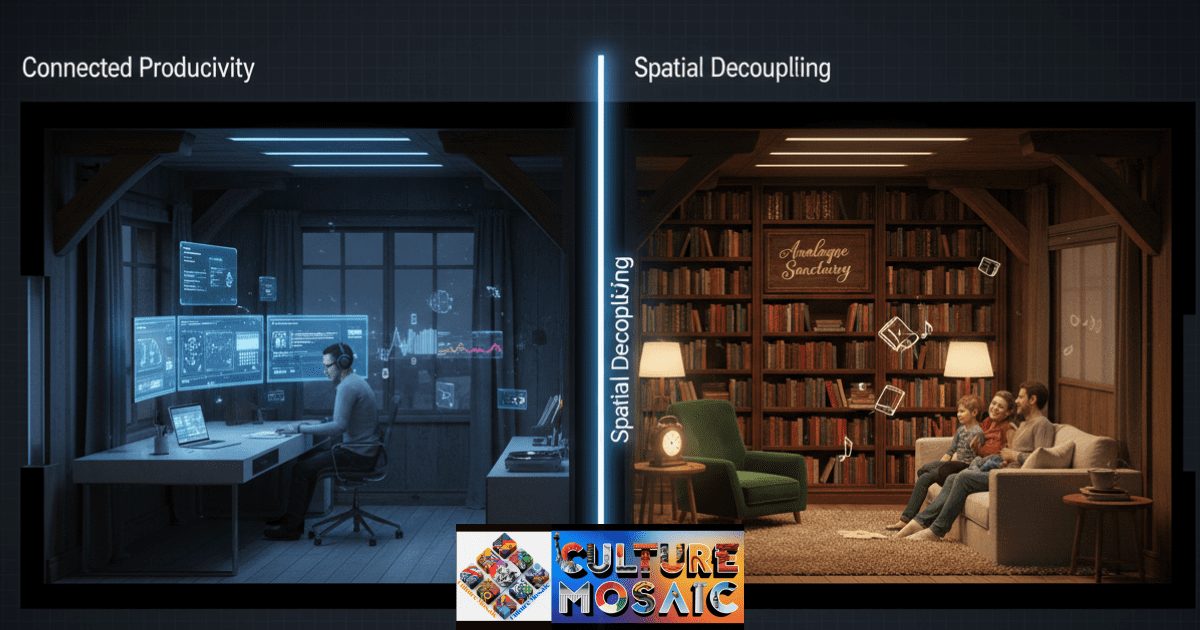
Spatial Decoupling for Home: The End of Digital Leakage
What Is Spatial Decoupling for Home?
Walk through most homes today and you will find the same scene: a laptop open on the kitchen counter, a phone charging on the bedside table, a tablet propped against the sofa cushions. Every room has quietly become a workspace, and nobody made a conscious decision to allow it.
Spatial decoupling for home is the deliberate practice of untangling digital activity from the rooms where you live, rest, and connect with the people you care about. Rather than banning technology outright, it assigns screens a specific, contained address inside your home and frees every other room to serve its original human purpose. For a rigorous grounding in the concept, the Spatial Decoupling for Home entry at the Sustainability Directory is worth reading first: it frames the principle as the geographical separation between where a system operates and where its consequences land — a logic that applies as precisely to domestic spaces as it does to industrial supply chains.
Think of it less as a productivity hack and more as a zoning ordinance for your nervous system. When digital stressors have a fixed location, your brain learns that the rest of the house is safe territory — and that single cognitive shift changes everything that follows.
Why Digital Leakage Is a Real Problem
Cognitive science has a term for what happens when work bleeds into rest spaces: context collapse. Your brain relies on physical cues to move between mental states. When the bedroom looks identical to a home office, the cue to “power down” never fires. Sleep researcher Matthew Walker has written extensively on how screen use in the bedroom suppresses melatonin production, but the problem runs considerably deeper than blue light.
It is the association itself that does the damage. A bed that has hosted two hours of anxious email-checking will trigger low-grade alertness the moment you lie down — even with the phone face-down on the other side of the room. Spatial decoupling for home breaks this association at the architectural level, which is why it outlasts every willpower-based approach.
The principles explored under Somatic Interior Design Principles make this physiologically concrete: the body registers spatial signals before the conscious mind does. A room colonised by notifications keeps the nervous system on constant standby — even when you are supposedly relaxing. Removing that stimulus is not a lifestyle preference; it is a physiological necessity with measurable consequences for cortisol levels, sleep architecture, and cognitive recovery.
The Core Principle: One Room, One Function
The foundation of spatial decoupling for home is a deceptively simple rule: one room, one primary function. Your bedroom is for sleep. Your dining room is for meals and conversation. Your living room is for rest, reading, and genuine connection. A dedicated workspace — whether a spare room, a study nook, or a well-defined partitioned corner — is where screens live.
This is not minimalism. You are not stripping richness from your home. You are routing digital activity to a single address, the way a city routes heavy traffic onto arterial roads rather than allowing lorries down every residential street.
Your Home as an Operating System
The most useful mental model for spatial decoupling for home is to treat your residence exactly like an operating system. Every OS has a kernel — a protected core that only authorised processes can access. Every room in a decoupled home has an equivalent: a defined function, a permission level, and a clear boundary that separates it from the noise outside.
2025 vs 2026: How Spatial Decoupling Transforms the Home
The shift from a hyper-connected home to a decoupled one is visible in every room. This table compares the default 2025 setup with the intentional 2026 approach that spatial decoupling for home produces — including the specific materials and technical solutions that make each transition permanent rather than aspirational.
| Feature | 2025 Standard Home | 2026 Decoupled Home |
|---|---|---|
| Smart Technology | Every room, always on. Smart speakers in kitchen, bedroom, and hallway. | Isolated in the Digital Zone. All other rooms remain acoustically and digitally private. |
| Bedroom | Phone doubles as alarm clock, sleep tracker, and late-night scroll device. | Mechanical clock or skeleton escapement. Phone charges in the study. Sleep is protected. |
| Dining Space | Phones visible and within reach throughout every meal. | Physical containment via a woven basket on the counter. Meals are fully present. |
| Living Room | TV as primary furniture. Seating arranged to face a single screen. | Seating faces each other. Screen schedule agreed. Library and tactile objects prominent. |
| Architecture | Open-plan “Flex” spaces where every surface becomes a potential workstation. | Hard functional boundaries. Rooms carry clear social contracts enforced by their design. |
| Network Privacy | All devices — personal and IoT — on one shared network. No segmentation. | VLAN-separated IoT network. Smart devices cannot access personal device traffic. |
The “Computer Room” as Containment Zone
The most effective implementation of spatial decoupling for home involves creating what practitioners call a Computer Room or Digital Zone — the one room where screens, notifications, and work tools are permitted to operate at full capacity.
It does not need to be large. A desk in a spare bedroom, a corner of a study, or a well-defined alcove will serve the purpose entirely. What matters is that when you leave that space, the agreement with yourself is clear: the digital world stays behind.
Setting Up Your Digital Zone: A Practical Checklist
- Designate one specific area for all screens and devices — then hold that boundary without exceptions.
- Install a physical charging station here to prevent phones migrating to the bedroom overnight.
- Use a warm-toned desk lamp to establish a distinct visual “work mode” signal in this space only.
- Keep a physical notebook and wall calendar in this room to remove the need to reach for a phone elsewhere.
- Mark the entry threshold visually — a mat, a curtain, or a change of flooring. Physical thresholds create surprisingly powerful psychological cues.
Implementing Spatial Decoupling for Home via the Analogue Sanctuary
Once your Digital Zone is established, the real work of spatial decoupling for home turns to filling the remaining rooms with something genuinely better than screens. An Analogue Sanctuary is any room that has been actively redesigned to reward non-digital engagement.
The key word is actively. A room that simply lacks a television is not a sanctuary; it is just an empty room. A sanctuary offers compelling alternatives: books you have been meaning to read, a record player, a chess set, a window seat with good natural light, materials for a craft. The room must make the analogue choice feel genuinely attractive rather than like a punishment or an absence.
This connects directly to the philosophy at the heart of Culture Mosaic, which frames the home as a site of accumulated meaning rather than passive consumption. When rooms are filled with objects that invite touch, thought, and conversation, they do not need screens to feel alive.
The Bedroom: Your First Analogue Sanctuary
The bedroom is the easiest room to transform and the one with the highest return on investment. Replace your phone alarm with a mechanical or battery-powered alarm clock. This single act removes the most common reason people carry phones to bed: the morning alarm.
With the phone out of the bedroom, most people report falling asleep faster, sleeping longer, and waking with noticeably less anxiety. The change costs roughly fifteen pounds and takes ten minutes to implement. That is the quiet power of spatial decoupling for home: the interventions are physical and permanent rather than behavioural and fragile.
The Living Room: Designing for Conversation and Rest
The living room is harder to reclaim because the television has been its centrepiece for decades. Full removal is rarely necessary. What matters is that the room offers credible alternatives when the screen is off: reposition seating to face each other rather than a single display, add a reading lamp beside every chair, and build a small household library with topics that genuinely interest everyone living there.
The ideas behind Modern Heritage Living Room design are especially relevant here. Layering timeless materials, tactile objects, and carefully chosen pieces alongside contemporary furniture creates a room that draws people in without a remote control. When the room itself is interesting, the television becomes one option among many rather than the unthinking default every evening.
The Kitchen and Dining Table: Protecting the Shared Ritual
Meals are one of the oldest and most effective social technologies human beings possess. Shared food creates trust, synchronises relationships, and signals belonging. When phones sit on the dinner table, every person present communicates — consciously or not — that the meal ranks below whatever might arrive in a notification.
The fix is a simple physical intervention: a small woven basket on the kitchen counter. Phones go in the basket when food comes out. The first week feels slightly awkward. By the third week, it feels entirely normal. And while you are thinking about the kitchen, Kitchen Scraps Management for Balcony-Free Apartments is worth reading as a companion piece. Small, intentional domestic systems compound: each one reduces friction and returns a little more of the room to its actual purpose.
Spatial Decoupling for Home and Digital Privacy
There is a privacy dimension to spatial decoupling for home that rarely receives the attention it deserves. Smart speakers, always-on cameras, and connected appliances are not simply attention sinks. They are listening and observing tools with microphones and lenses pointed at the most private moments of your day.
Containing these devices to a Digital Zone meaningfully reduces their surveillance footprint. A smart speaker in the study hears your work conversations. A smart speaker in the bedroom hears your most intimate ones. These are not equivalent risks, and most people have never paused to notice the difference in what they are passively consenting to.
Network Segmentation as a Technical Layer
For those who want to extend spatial decoupling for home into the network layer, router-level segmentation is the logical next step. Most modern home routers allow you to create a separate VLAN or guest network for IoT devices. Your smart TV, connected appliances, and voice assistant then operate on an entirely different segment from your laptop and personal devices. If a smart device is ever compromised, it cannot reach your personal data.
The diagram below shows exactly how this works — and why it matters even if networking is not your area. The principle is spatial decoupling applied to data traffic rather than furniture arrangement.
Spatial Decoupling for Home, Architecture, and Social Recovery
There is a school of thought — developed at length under the heading of Socially Restorative Architecture — that holds rooms responsible for the social health of the people who use them. A well-designed dining room does not merely contain a table; it creates the conditions for a particular quality of conversation. A well-designed bedroom does not merely contain a bed; it creates the conditions for genuine, uninterrupted rest.
Spatial decoupling for home sits squarely within this tradition. It is not digital abstinence. It is an act of architectural intention. When you remove the screen from a room, you are not taking something away. You are restoring something that was there before the screen arrived and has been quietly waiting ever since.
Spatial Decoupling for Home and Children
Parents searching for practical screen-time solutions will find that spatial decoupling for home is far more durable than app timers and parental controls, which are circumvented the moment a child learns to reset them. Physical room rules are harder to override and considerably easier to explain without creating conflict.
When screens have a dedicated room and a dedicated time, the conversation with children shifts from “you are not allowed” to “that is where screens live, and dinner is in the kitchen.” The rule is spatial rather than personal, which removes the adversarial quality from the negotiation entirely.
The Psychology Behind Spatial Decoupling for Home
Environmental psychology — the study of how physical spaces shape behaviour — offers strong support for these practices. Research on environmental cuing shows that a space primes specific behaviours before conscious thought even engages. Hospitals designed with visible staircases see higher rates of stair use. Offices with designated quiet zones produce more sustained, focused work.
Your home sends signals to your brain throughout every waking hour. Spatial decoupling for home is the art of ensuring those signals support the kind of life you actually intend to live, rather than defaulting to the one that hardware companies have quietly engineered for you.
Common Objections to Spatial Decoupling for Home
- “I need my phone nearby for emergencies.” A shared household landline or a dedicated emergency device kept on silent addresses this completely, without making your smartphone a permanent fixture in every room of the house.
- “My flat is too small for a dedicated Digital Zone.” A Digital Zone can be a single desk in a corner with a clear visual marker. Size is never the obstacle; intentionality is.
- “My partner will not agree.” Start with your own bedroom and your own devices. Demonstrate the benefits over a few weeks rather than arguing for them in the abstract.
- “I work from home and need screens everywhere.” Working from home is precisely when spatial decoupling matters most. Without clear physical boundaries, your home dissolves into your work permanently and the distinction between rest and labour disappears with it.
Getting Started with Spatial Decoupling for Home Today
You do not need to redesign your entire home to begin. The practical entry point is a single rule applied to a single room. Choose the bedroom. Buy a mechanical alarm clock this week. Charge your phone in the Digital Zone overnight, starting tonight.
That one change will produce a noticeable shift in sleep quality and morning mood within two weeks. From that foundation, expand steadily. Add the kitchen basket rule during mealtimes. Create a weekend screen curfew that returns phones to the Digital Zone after a certain hour. If you have router access, segment your network using the diagram above as a practical reference. Build outward from the habits that are already working and already feel sustainable.
Spatial decoupling for home is not a destination you reach. It is an ongoing, conscious negotiation between the life you want and the devices that are very well engineered to claim more of it than you ever intended to offer.
Measuring the Results of Spatial Decoupling for Home
After four to six weeks of consistent practice, most people report improvements in three areas: sleep quality, a genuine sense of presence during shared meals and conversations, and a reduction in low-grade ambient anxiety that they had previously attributed to work pressure rather than environmental design.
Keep a simple journal. Note how quickly you fall asleep. Note how often you reach for a device out of reflex rather than genuine purpose. Note the quality of conversation at dinner. These are your real metrics — and they matter considerably more than any app-generated screen time summary.
Ready to Reclaim Your Home?
Explore the full library of spatial design, analogue living, and cultural restoration essays at Culture Mosaic — written for people who want their homes to work harder for their wellbeing.
Explore Culture Mosaic → No sign-up required. Just ideas worth sitting with.Frequently Asked Questions
1. What does spatial decoupling for home actually mean in practice?
It means assigning screens and digital devices to one dedicated area of your home and keeping all other rooms free from them. The bedroom, kitchen, and living room each return to their original human functions rather than doubling as digital workspaces.
2. Is spatial decoupling for home the same as a digital detox?
No. A digital detox is temporary abstinence. Spatial decoupling is a permanent architectural rearrangement. You are not removing screens from your life; you are giving them a fixed, contained address so they stop colonising every room in the house.
3. How does spatial decoupling for home improve sleep?
By removing phones and screens from the bedroom, you eliminate both the blue light that suppresses melatonin and the psychological association between your bed and digital stimulation. Both factors independently disrupt sleep — removing them together produces a compounding benefit that app-based solutions cannot replicate.
4. Can spatial decoupling for home work in a small flat?
Yes. A Digital Zone does not require a separate room. A dedicated desk with a clear visual boundary — a curtain, a rug, or a chair used exclusively for screen work — is entirely sufficient. The principle is about intentionality and consistency, not square footage.
5. Does spatial decoupling for home have any digital privacy benefits?
Significant ones. Containing always-on devices like smart speakers, connected TVs, and IoT appliances to a Digital Zone reduces the rooms where those devices passively collect audio and behavioural data. Combined with VLAN-based network segmentation at the router level, it meaningfully reduces your home’s overall surveillance footprint.