
 By Culture Expert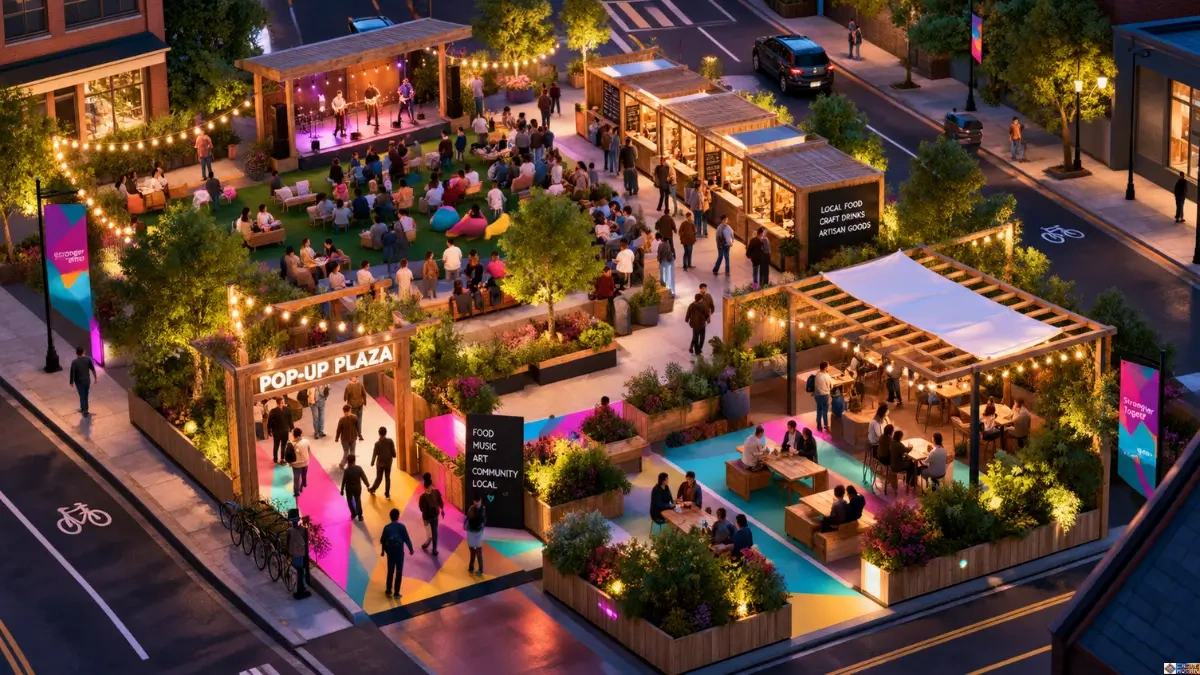
Quick Summary
Ephemeral social infrastructure refers to temporary, intentionally engineered physical and social spaces—such as festival grounds, pop-up plazas, and community encampments—designed to activate rapid trust, collective ritual, and civic connection before being dismantled. While the physical builds vanish within days, the social bonds, psychological restoration, and community contracts they generate often endure for years. By auditing these short-term spaces through spatial metrics and material provenance, urban planners and cultural organizers can extract permanent lessons for human-centered design.
The Problem of Modern Isolation in Permanent Cities
Modern urban centers are facing an unprecedented loneliness epidemic. Despite living in densely populated environments, millions of residents experience profound social fragmentation. Traditional urban planning frequently prioritizes efficiency, vehicular flow, and commercial transactions over genuine human encounter. Wide, sterile pavements, locked residential lobbies, and highly partitioned public zones serve an inadvertent social function: they enforce anonymity and keep strangers at a controlled, comfortable distance.
This spatial isolation exacts a heavy toll on psychological well-being and civic cohesion. Communities struggle to build trust when public spaces offer no permission or incentive for spontaneous, low-stakes interaction. When our physical environment isolates us, social resilience erodes.
Empathizing with the Loss of Gathering Places
It is easy to feel alienated in cities that offer few low-cost, low-pressure gathering points. People crave belonging and shared human experiences, yet the places capable of fostering rapid community are increasingly rare or heavily commercialized. We long for the warm, communal dynamics of ancestral gathering traditions, but standard municipal infrastructure moves far too slowly—and costs far too much—to adapt dynamically to real-world social needs.
The Solution: Impermanent Spaces, Permanent Bonds
This is where ephemeral social infrastructure intervenes. By transforming underutilized urban lots, vacant streets, and open countryside into short-term, purpose-built social environments, organizers can bypass the decades-long friction of permanent development. These temporary gathering places prove that a space does not need to stand for a century to forge connections that last a lifetime.
ISOLATED URBANITY
- Sterile Grids & Roads
- High Anonymity
- Social Fragmentation
EPHEMERAL ACTIVATION
- Pop-Up Built Environs
- Inward-Facing Layouts
- Rapid Trust Accelerators
PERMANENT SOCIAL RESILIENCE
- High Peer Trust
- Sustained Community Bonds
- Lasting Social Contracts
What Is Ephemeral Social Infrastructure? Meaning and Core Concepts
The term ephemeral social infrastructure sits at the intersection of urban sociology, tactical urbanism, and spatial design. While traditional social infrastructure—a term popularized by sociologist Eric Klinenberg—refers to permanent physical facilities like public libraries, parks, and schools, its ephemeral counterpart encompasses the temporary systems of space, ritual, and spatial logic that communities erect, inhabit, and subsequently strike.
Social Infrastructure vs. Ephemeral Social Infrastructure
Understanding the distinction between these two forms highlights the unique value of temporary design:
| Characteristic | Permanent Social Infrastructure | Ephemeral Social Infrastructure |
|---|---|---|
| Lifespan | Decades to centuries | Hours, days, or weeks |
| Capital & Cost | High public/private investment | Low cost, modular, high adaptability |
| Deployment Speed | Years of planning & construction | Rapid deployment (24–72 hours) |
| Primary Risk | High inertia; hard to modify | Low risk; easy to iterate or dismantle |
| Social Function | Long-term baseline civic service | Rapid trust acceleration & experimentation |
The Philosophy of Ephemeral Design and Impermanence
What is the benefit of designing for impermanence? Impermanence removes the fear of permanent failure. Because a pop-up project or temporary pavilion is built to disappear, designers, municipal leaders, and community members feel empowered to experiment with experimental geometries, radical inclusion policies, and spatial arrangements that traditional planning committees would routinely reject.
This aligns closely with ephemeral architecture, where temporary physical forms serve as real-world prototypes for future urban living.
Spatial Logic and Rapid Trust Acceleration
How does temporary space generate rapid trust? The secret lies in spatial geometry and environmental psychology. In a permanent city, daily routes are linear and compartmentalized. In contrast, well-designed temporary installations employ specific spatial layouts to catalyze human interaction.
Trust Accelerator Topology
- Central Anchor: Communal kitchen and campfire nodes are situated at the geographic center, mandating frequent, low-stakes visual and social contact.
- Inward Geometry: All residential or sub-cluster structures face inward toward the shared core rather than facing outward toward isolation.
- Shared Sightlines: Eliminating dead ends ensures that every node maintains line-of-sight visibility with communal gathering points, significantly boosting perceived safety and peer trust.
Research into Edward Hall’s theory of proxemics demonstrates that physical distance directly governs emotional intimacy and trust. When spaces force repeated, gentle intersections—such as sharing a central cooking hearth or navigating a shared circular pathway—participants record higher trust scores within 48 hours than residents of permanent suburban neighborhoods do over several months.
This somatic resonance underpins The Somatic Architecture of Collective Ritual, where physical spaces register directly on the body as safe, welcoming territory.
Real-World Examples: From Temporary Cities to Tactical Urbanism
To see ephemeral social infrastructure in action, one needs to look no further than large-scale cultural events, pop-up urban spaces, and regional cultural gatherings.
1. Temporary Cities and Festival Grounds
Real-world instances of temporary cities demonstrate how fast an ephemeral grid can blossom. Events like Black Rock City or major European cultural gatherings construct full municipal frameworks—complete with emergency services, transport grids, and central plazas—that host tens of thousands of citizens before returning the landscape to pristine wilderness. Exploring the Top 20 Biggest Festivals in the World illustrates how temporary cities operate as massive social laboratories.
2. Tactical Urbanism Examples and Pop-Up Community Spaces
Cities around the globe are applying tactical urbanism to test civic changes without massive capital expenditure. Converting parking spaces into temporary parklets, turning asphalt intersections into weekend pedestrian plazas, or running pop-up night bazaars allows neighborhoods to evaluate how spatial interventions impact social connection before laying permanent concrete.
3. Historical and Regional Cultural Gathering Spaces
Temporary gathering spaces are rooted deeply in historical traditions. From the Ancient roots of modern festivals to regional historic events like the Washington Whiskey Rebellion Festival, temporary gatherings have long served as vital pressure valves for political expression, community identity, and cultural continuity.
Festival Grounds
- • Circular Burn Camps
- • Micro-Cities
- • Temporary Stages
Tactical Urbanism
- • Pop-Up Street Parklets
- • Weekend Plazas
- • Mobile Play Streets
Cultural Heritage
- • Ethno-Cultural Fairs
- • Traditional Bazaars
- • Sacred Pilgrimage Camps
The Restorative Threshold: Design for Psychological Reset
Every successful piece of temporary social infrastructure relies on a clearly defined restorative threshold—a physical and psychological buffer zone separating the mundane, high-stress outside world from the temporary community within.
Outside World Exogenous
- • Commercial Signage
- • Sensory Overload
- • High Anonymity
Restorative Threshold Liminal
- • Material Transition (Tarmac to Woodchip)
- • Acoustic Isolation & Natural Elements
- • Ritual Welcome / Entry Fire
Festival Interior Communal
- • Shared Territory
- • Inward Sightlines
- • Rapid Trust Build
As environmental psychology reveals, passing through a structured sensory transition reduces cortisol levels and primes individuals for cooperative social behavior. Key design elements of a successful threshold include:
- Acoustic and Visual Isolation: Earthwork berms, acoustic baffles, or tree lines that mute surrounding city or vehicular noise.
- Material Transitions: Shifting tactile surfaces underfoot from hard tarmac to soft woodchip, bare soil, or natural stone.
- Sensory Anchors: Utilizing fire nodes or natural water features at the entry point to offer an immediate sensory reset.
This restorative approach is widely observed across cultural light festivals, where light and shadow are orchestrated to reshape public perception and lower psychological barriers. Similar principles apply to sacred gatherings documented in Religious Festivals in the World and external studies on Religious Festivals in the World, where entry rites mark the boundary between secular stress and sacred communion.
Material Provenance: Documenting Impermanent Spaces Before They Vanish
A recurring challenge facing temporary architecture is the documentation gap: if a structure is dismantled after 72 hours, how can urban planners study its social impact?
Digital Twins and Spatial Auditing
By leveraging modern LiDAR depth scanning and high-resolution photogrammetry, spatial analysts create accurate digital twins of temporary settlements prior to strike. As featured in studies on Ephemeral Social Infrastructure, capturing point-cloud data allows researchers to map pedestrian flow, measure interaction densities, and audit the structural efficiency of temporary builds long after the physical ground has cleared.
Measuring Success: The 5-Metric Audit Framework
To evaluate whether a temporary space met its community goals, spatial analysts utilize five quantifiable metrics:
Ephemeral Social Infrastructure — Performance Audit Metrics
| # | Metric | Definition & Evaluation Method | Target Benchmark |
|---|---|---|---|
| 01 | Interaction Density | Average peer-to-peer interactions per hour via anonymized proximity tracking or spatial heatmaps. | ≥ 4.5 / hour |
| 02 | Threshold Legibility | Survey and dwell-time measurement of how clearly the entry sequence signals a transition in social rules. | ≥ 70% within 15m |
| 03 | Material Resonance | Composite score of participant-reported sensory quality (lighting, acoustics, texture) relative to dwell time. | ≥ 7.2 / 10 |
| 04 | Provenance Integrity | Technical accuracy of the LiDAR or photogrammetric digital twin captured before strike. | Sub-5cm accuracy |
| 05 | Social Longevity | Stratified 6- and 12-month follow-up surveys measuring sustained social ties formed during the event. | ≥ 35% retention at 12m |
How Temporary Spaces Impact Permanent Urban Development
Integrating ephemeral principles into permanent municipal planning offers cities a cost-effective toolkit for revitalizing neglected areas.
Municipal Implementation Cycle
Benefits and Challenges of Ephemeral Urbanism
Benefits
- Rapid Prototyping: Municipalities can test public plazas or traffic diversions at a fraction of standard construction costs.
- Community Co-Creation: Citizens participate directly in shaping temporary spaces, building strong civic ownership.
- Low Risk of Failure: If an installation underperforms, it can be adjusted or removed without financial waste.
Challenges
- Access Equity: Temporary events can inadvertently cater primarily to privileged demographics if admission costs or travel barriers are high.
- Institutional Hesitancy: Traditional planning boards often struggle to sanction non-permanent installations due to rigid zoning codes.
By overcoming these barriers, cities can transform seasonal celebrations into engines for permanent civic renewal. From music gatherings like the Best UK Folk Festivals and Latino Cultural Festival to broader showcases outlined in the Global Cultural Festivals Guide, temporary spaces show how culture animates physical geography.
Furthermore, understanding What Is the Economic Impact of Music Festivals highlights how temporary infrastructure drives local commerce while fostering deep cultural pride.
Sustainable and Regenerative Practices for Temporary Installations
As temporary gatherings expand worldwide, managing environmental impact is critical. The concept of Regenerative Festival Culture advocates for circular builds, zero-waste principles, and land restoration protocols.
Circular Materials
- • Modular Scaffolding
- • Reusable Timber
Waste Elimination
- • Compost Systems
- • Zero Single-Use Plastics
Land Restoration
- • Soil Decompaction
- • Native Re-seeding
Addressing The post concert hangover requires shifting from disposable event decor to long-term modular architecture. Major international events, including upcoming platforms like Festivalle 2026, are adopting leave-no-trace building techniques that leave host environments healthier than they were found.
This ethos honors both Ethno Cultural Festivals Heritage and broader Traditional World Festivals Cultural Heritage, celebrating human culture while caring for the natural world. Modern immersive events also integrate Ancestral Somatic Rituals 2026, reconnecting urban populations with embodied heritage through temporary spatial design.
Frequently Asked Questions
What is the difference between social infrastructure and ephemeral social infrastructure? ▼
Permanent social infrastructure refers to long-lasting physical facilities like public libraries, community centers, and parks. Ephemeral social infrastructure consists of temporary, intentionally designed systems of space and community—such as festival grounds, pop-up plazas, or temporary market encampments—that function for a short period before being dismantled, yet leave lasting social impacts.
Can digital spaces be considered ephemeral social infrastructure? ▼
While digital platforms provide temporary gathering places (like live audio rooms or temporary chat channels), true social infrastructure generally requires physical spatial dynamics—touch, shared atmosphere, and physical proxemics—to trigger the full somatic trust responses that characterize physical temporary gatherings.
What are the main benefits of designing for impermanence? ▼
Designing for impermanence lowers financial and regulatory risk. It allows organizers and urban designers to experiment with bold spatial layouts, foster rapid community trust, and prototype civic innovations without the high costs and permanent commitments required by traditional urban planning.
What is a real-world example of an ephemeral city? ▼
Black Rock City, built annually for Burning Man in Nevada, is one of the most prominent real-world examples of an ephemeral city. It houses over 70,000 residents with full civic, medical, and spatial infrastructure for one week before completely dismantling and leaving no physical trace on the landscape.
Do temporary installations leave a lasting social impact? ▼
Yes. Longitudinal research indicates that social trust, collaborative networks, and friendships forged inside high-performing temporary social infrastructure persist far beyond the dismantling of physical builds, with over 35% of social bonds remaining active 12 months post-event.
References & Credible Sources
- Ellard, Colin. Places of the Heart: The Psychogeography of Everyday Life. Bellevue Literary Press. (Research on environmental psychology and restorative spatial design).
- Hall, Edward T. The Hidden Dimension. Anchor Books. (Foundational theory of proxemics and spatial distance in human trust formation).
- Klinenberg, Eric. Palaces for the People: How Social Infrastructure Can Help Fight Inequality, Polarization, and the Decline of Civic Life. Crown Publishing.
- Pawlyn, Michael. Biomimicry in Architecture. RIBA Publishing. (Principles of circular and regenerative spatial design).
- Sennett, Richard. Building and Dwelling: Ethics for the City. Farrar, Straus and Giroux. (Analysis of productive disorder and open urban grids).
- Culture Mosaic. Insights on cultural journalism, community engagement, and festival architecture at Culture mosaic.