
 By Culture Expert
I have spent years sitting across tables from makers, running my fingers over textiles, holding ceramics up to light, and asking one question that most buyers never think to ask: Can you prove it?
Not “is it beautiful?” Not “is it handmade?” Both answering and falsifying those questions is simple. The harder question — the one that separates a genuine heirloom from a well-marketed object — is whether the story behind it can be verified, recorded, and passed on intact.
That is what Material Provenance Documentation is. And in my view, it is the most underused standard in the world of considered living. Without it, every claim attached to an object remains exactly that — a claim.
What Material Provenance Documentation Actually Means
Most people hear “provenance” and think of auction houses, old paintings, and aristocratic estates. That instinct is not wrong, but it is narrow. Provenance is simply the recorded history of an object — where its materials came from, who worked them, how, and through whose hands the finished piece travelled to reach you.
Material Provenance Documentation is the act of making that history verifiable rather than merely claimed. When those two things come together, you get something that functions less like a receipt and more like a case file — a geological and biographical record that holds an object accountable to its own story.
In a market saturated with heritage language and sustainability claims, Material Provenance Documentation is the difference between a brand telling you something and a record proving it. That distinction is not subtle. It is the entire foundation on which trust between maker and collector is built.
The Problem With Objects That Have No Identity
Here is something I find genuinely troubling. Walk through any well-designed home — the kind with thoughtfully chosen ceramics, natural linen, hand-thrown pottery — and ask about any single object. Where was the clay dug? Who threw the pot? What temperature was the kiln? What water source was used in the glaze?
In almost every case, the answer is some version of: “I’m not sure, but the brand seemed really authentic.”
That is not provenance. That is atmosphere. And atmosphere is exactly what sophisticated greenwashing is designed to create. The absence of Material Provenance Documentation is not a neutral condition. It is an open door for misrepresentation.
An object without documentation is inventory with a good story attached to it. An object with proper Material Provenance Documentation is something you can interrogate, verify, and eventually pass on to someone else with full confidence. That distinction matters more than most people realise — not just ethically, but financially.
Pillar I — The Anatomy of a Provenance Dossier
When I work with makers and collectors to build Material Provenance Documentation from scratch, I use the word “dossier” deliberately. A dossier implies a level of rigour that words like “certificate” or “story” do not. It implies layers, cross-references, and a chain of evidence that can withstand scrutiny.
Here is what a serious provenance dossier actually contains.
Geological Origin — Where the Material Began
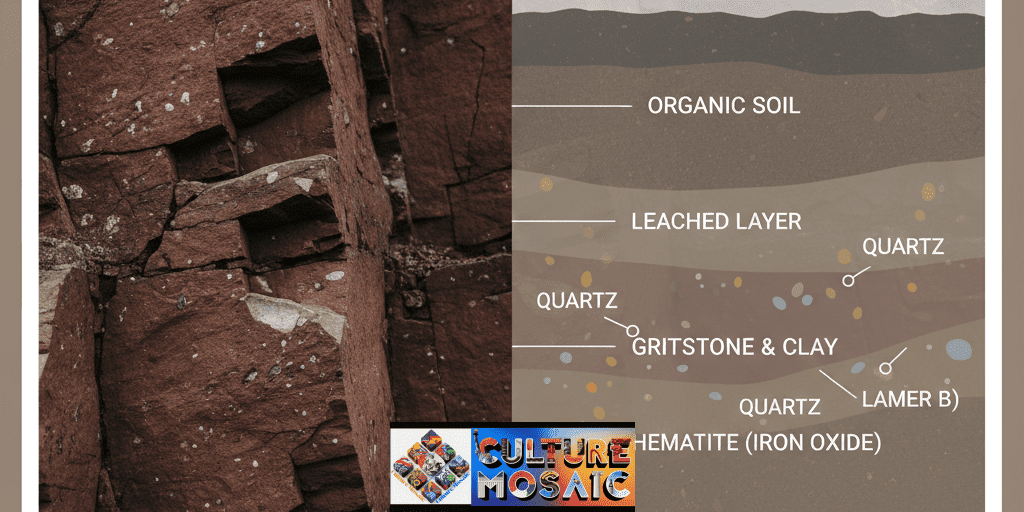
The earth is the first witness. A complete Material Provenance Documentation record captures the specific source of the raw material: the GPS coordinates of the clay pit, the name and location of the grazing field, the altitude and aspect of the flax meadow. It documents soil composition where relevant, seasonal harvest data, and environmental conditions that directly affect the material’s character.
This is not romantic detail added to make a product feel special. It is traceable, mappable, cross-referenceable data. A clay from Staffordshire gritstone has a mineral profile that is geologically distinct from any other region. Documenting that origin makes the claim verifiable rather than decorative, and it forms the bedrock of any serious provenance record.
Processing Methodology — The Technical Record
How a material is transformed is as important as where it came from. Kiln firing temperatures, water pH levels used in dye baths, loom tension settings, mordanting processes, curing times — these technical specifications are the fingerprints of a specific craft tradition. In Material Provenance Documentation, this layer is what separates a genuine process record from a general description of method.
When this information is recorded with precision, it creates a reproducible standard against which any deviation becomes visible. It also makes authentication possible. If someone claims a textile was woven using a particular tension and density, the cloth itself can be measured. The documentation either holds or it does not.
Maker Lineage and Artisan Dossiers: Material Provenance Documentation
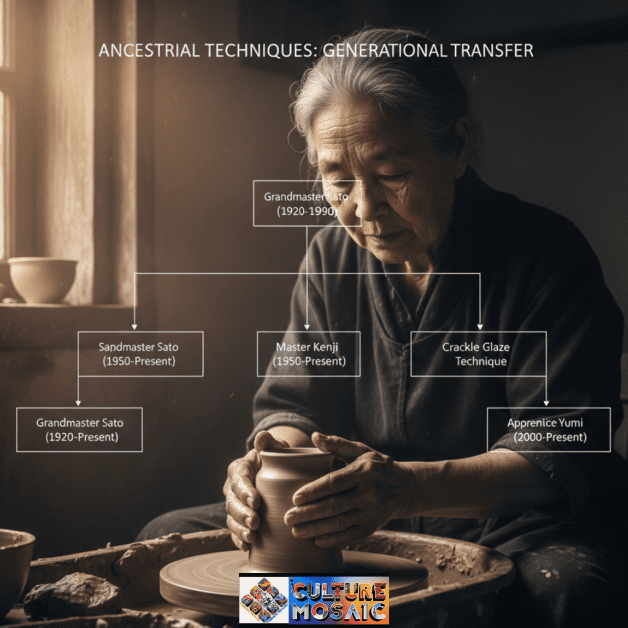
This is the layer that moves me most, personally. Behind every object is a human history. A complete artisan dossier — an essential component of thorough Material Provenance Documentation — records the names of the makers, their training lineage, the regional tradition they work within, and often the generational history of the workshop or family practice.
I have sat with potters in their seventies who could trace their glaze recipes back four generations. None of that knowledge existed on paper. Part of what Material Provenance Documentation does is create a formal record of living craft knowledge before it disappears. That is heritage verification in the truest sense.
Pillar II — The Forensic Layer: When Documentation Meets Science
The most compelling Material Provenance Documentation is the kind that does not rely entirely on trust. Science can now confirm or contradict what paper records claim, and understanding these tools is essential for anyone serious about craft traceability.
Isotopic Verification and What SIRA Actually Tells Us
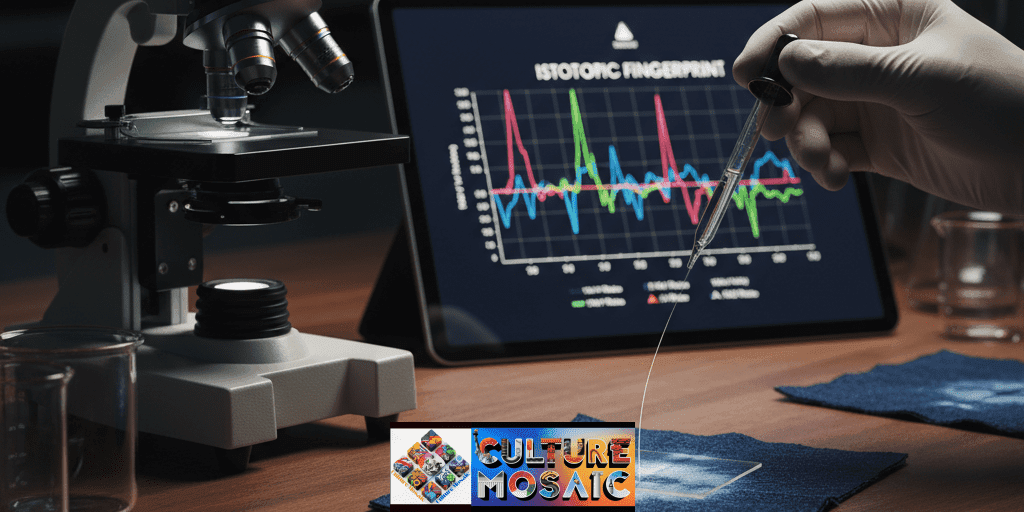
Stable Isotope Ratio Analysis — SIRA — measures the chemical signatures embedded in a material by the specific soil and water of its place of origin. Every region on earth has a distinct isotopic fingerprint, and materials grown or extracted in that region absorb it.
The laboratory method behind this is Isotope Ratio Mass Spectrometry (IRMS), which separates and measures isotopic variants with a precision that written records alone cannot replicate. Wool from a specific Scottish glen will carry a different isotopic profile than wool from a New Zealand farm, even if both are described as “premium natural fibre.” SIRA converts a geographical claim into hard, testable data, and when combined with thorough Material Provenance Documentation, it creates a record that is extraordinarily difficult to fabricate.
Chemical Signatures and Mineral Dye Profiles
Natural dyes are not neutral. They absorb the mineral content of the water used in the dye bath, and that mineral content reflects the specific geology of the water source. A weld-yellow dye prepared using water from a particular river becomes a traceable chemical event. Spectrometric analysis — which identifies the precise chemical makeup of dye compounds — can confirm whether the colour chemistry in the textile matches the documented source.
This is why Material Provenance Documentation that includes dye and water source records is so much more powerful than documentation that stops at the maker’s name and location. The chemistry of the object and the chemistry of the documented process have to agree. When they do, the record is forensically solid.
Digital Passports and the Blockchain Question
I am cautious about technological solutions that get positioned as automatic fixes for complex problems, but digital ledger technology has genuine utility in Material Provenance Documentation when used correctly.
A QR-coded Digital Passport attached to an object can carry an immutable, timestamped chain of custody. Every verification test result, every transfer of ownership, every new layer of documentation added over time becomes part of a record that cannot be quietly altered. The ledger secures the chain. It does not, by itself, guarantee that what was entered at the source was true. That is why the physical and forensic documentation layers must always come first.
Pillar III — Why Material Provenance Documentation Changes the Value of an Object
Resale Value and the Collector’s Premium
Documented objects command higher prices. This is not a matter of sentiment. It is market reality. A ceramic with a complete Material Provenance Documentation file — geological origin, maker lineage, firing records, chain of custody — is a fundamentally different proposition at auction or resale than an undocumented piece of equivalent visual quality.
Collectors and institutions pay for certainty. Material literacy — the ability to read, interpret, and build on provenance records — is becoming a core competency for anyone acquiring objects with long-term value in mind. The documentation itself becomes part of the asset.
The Anti-Greenwashing Shield
I have seen the word “artisan” applied to objects made in facilities with no identifiable makers. I have seen “natural” claimed for materials processed with synthetic fixatives. I have seen “heritage” used as pure atmosphere, attached to objects with no traceable connection to any tradition.
Rigorous Material Provenance Documentation is the most effective counter to this because it replaces language with evidence. A brand can claim sustainability without consequence. A dossier recording specific water usage, energy source, processing steps, and chain of custody cannot be contradicted by a well-designed webpage. The gap between what is claimed and what is verifiable becomes immediately visible, and that visibility is precisely what dishonest marketing cannot survive.
Tactile Sovereignty — The Right to Know What You Live With
This is perhaps the principle I feel most strongly about. Tactile Sovereignty is the right of every person who lives with objects — who eats from a bowl, sleeps under a blanket, sits on a chair — to know exactly what those objects are made from, where the materials originated, and whose hands shaped them.
It is not a luxury position. It is a foundational one. And Material Provenance Documentation is the mechanism through which Tactile Sovereignty becomes real rather than rhetorical. When you hold a documented object, you are not just holding a thing. You are holding a verified account of the earth, the water, and the human labour that made it possible.
The Provenance Checklist — A Working Framework for Collectors
This is the framework I use when working with collectors to build or audit their Material Provenance Documentation practice from the ground up.
| Record Type | What to Capture | Why It Matters |
|---|---|---|
| Raw Material Source | Farm/Pit/Forest & GPS location | Ties the object to a specific, testable geography. |
| Technical Specs | Firing temp, weave density, pH levels | Creates a reproducible standard for authentication. |
| Artisan Record | Maker name, lineage, tradition | Confirms the cultural and biographical claim. |
| Forensic Data | SIRA results, mineral profiles | Independent verification of the paper record. |
Material Provenance Documentation in Practice — Two Case Studies
The Salt-Glaze Crock
A properly documented salt-glazed crock is a remarkable forensic object. The salt-vapour reaction that creates its characteristic surface occurs at around 1300°C, when sodium from the introduced salt bonds with silica in the clay body to form a glassy, pitted glaze.
The Material Provenance Documentation for this kind of vessel captures the specific clay source, the kiln construction, the salt origin, the firing duration, and the atmospheric conditions inside the kiln at peak temperature. That record proves both the authenticity of the method and the chemical integrity of the finished vessel. The documentation is not separate from the object. It is the record of the physical event that made it what it is.
The Highland Wool Textile
Highland wool carries a haptic quality — a particular weight, resilience, and hand-feel — that is directly produced by the peat-rich water used in washing the raw fleece. The mineral content of that water affects the lanolin structure of the fibre in ways that influence how the finished textile ages and feels over decades of use.
When the water source is included in the Material Provenance Documentation and the washing process is precisely recorded, the textile’s sensory signature becomes verifiable. A buyer is not accepting a maker’s description. They are reading a geological and process record. That is the difference between craft traceability and craft marketing, and it is a distinction that serious collectors understand immediately.
Compliance Frameworks and Professional Standards Worth Knowing
For those building Material Provenance Documentation practices at scale or working with institutions, several frameworks provide useful structure.
The OECD Due Diligence Guidance for Responsible Supply Chains addresses provenance documentation across complex supply networks, particularly for minerals and natural materials. The Responsible Wool Standard and the Global Organic Textile Standard offer third-party verification models that incorporate traceability requirements. ISO 22095 covers the general principles of chain of custody across material categories and is particularly useful as a structural reference when designing a bespoke documentation system.
The consistent principle across all of these is that Material Provenance Documentation must begin at the point of extraction and continue without interruption through every stage of processing, transfer, and sale. A chain of custody with gaps is not a chain of custody. It is a collection of fragments that a determined buyer or auditor will see through immediately.
How to Start Building Material Provenance Documentation From Scratch
The question I am asked most often is: where do I begin, especially with objects I already own?
Retrospective Material Provenance Documentation starts with what exists. Receipts, maker correspondence, exhibition labels, purchase records — gather everything and create a baseline. Then reach back to the source where possible. Many makers will respond to a thoughtful request for technical information about their process. Some will have records they have never been asked to share, and the conversation itself becomes part of the provenance story.
From there, the practice becomes prospective. Every new acquisition enters your collection with a Material Provenance Documentation requirement attached from the start. Over time, you build an archive that reflects not just what you own, but what you actually know about what you own.
That shift — from ownership to custodianship — is the whole point.
Becoming a Curator of the Everyday
The object on your shelf is not just a thing. It is the endpoint of a series of decisions made by the earth, by climate, by human hands, and by trade routes that stretch back further than any single receipt can record. Material Provenance Documentation makes that journey legible.
To document an object is to refuse the amnesia that mass production depends on. It is to insist that the earth it came from and the hands that held it deserve to be named. It is, in the plainest terms, an act of respect — for makers, for materials, and for the people who will inherit what you leave behind.
Every object you live with could have a dossier. The question is whether you will build one.
Frequently Asked Questions About Material Provenance Documentation
1. What distinguishes Material Provenance Documentation from a standard certificate of authenticity?
A certificate confirms that an object meets a particular standard at a single point in time. Material Provenance Documentation creates a continuous, layered record from raw material origin through every stage of production, ownership, and transfer. One is a snapshot. The other is a biography that travels with the object indefinitely.
2. Can a private collector build Material Provenance Documentation for objects they already own?
Yes, and it is worth starting even if the existing record is incomplete. Retrospective Material Provenance Documentation begins with whatever evidence is available — receipts, photographs, maker correspondence, material testing — and builds forward from there. Partial documentation is still far more valuable than none, and it creates a foundation that future owners can continue to build on.
3. How does forensic provenance differ from written documentation?
Written documentation records what makers and owners claim. Forensic provenance uses scientific analysis — IRMS for isotopic origin, spectrometry for dye and chemical composition — to verify those claims independently. The strongest Material Provenance Documentation combines both layers, so that each confirms what the other records.
4. Is blockchain documentation trustworthy as a provenance standard?
The ledger technology itself is reliable because once a record is written it cannot be quietly altered. The limitation is that the ledger only secures what is entered into it. If the original data is inaccurate, the blockchain preserves that inaccuracy faithfully. This is why the physical and forensic layers of Material Provenance Documentation must always be established first, before any digital record is created.
5. Which industries are leading the adoption of Material Provenance Documentation?
Fine art and antiques have the longest established traditions. High-end textiles, natural gemstones, heritage ceramics, and natural building materials are now developing more rigorous Material Provenance Documentation standards. The practice is also expanding into premium food production and sustainable furniture, driven largely by consumer demand for verifiable supply chains rather than marketing claims.
This article was written by a specialist in material culture, craft documentation, and heritage verification with over a decade of experience working alongside makers, collectors, and cultural institutions. Their practice focuses on building rigorous provenance frameworks for objects where the story behind the material is as significant as the object itself. You can explore more of their work and documentation methodology at Heritage Stories.
 Dr. Marcus Hale