
 By Culture Expert
I have held a lot of cloth in my hands over the years. Mill ends from Lancashire. Raw fleece from a hill farm in Snowdonia. A fragment of naturally dyed wool from a cooperative in Oaxaca that a friend brought back and pressed into my palm without a word, just to watch my face change.
That last one stopped me. Not because it was lovely, even though it was. Because it felt alive in a way I had no language for at the time.
I have spent a long time since then trying to find that language. What I landed on was this: ethical textile provenance. And it has quietly become the most important idea in sustainable fashion that almost nobody is talking about properly.
What Is Ethical Textile Provenance?
Ethical textile provenance is the forensic tracing of a fiber from its geological point of origin through every stage of its transformation into cloth. It is not the same as supply chain transparency, though people use the terms interchangeably and they should not.
Transparency tells you which factory made your shirt. Provenance tells you which valley the sheep grazed in, what minerals were in the water used to wash the fleece, whose hands spun the yarn, and what ancestral technique shaped the weave. It accounts for the soil chemistry, the water mineralogy, and the cultural knowledge embedded in the making.
A transparent garment has a paper trail. A garment with genuine provenance has a biological and cultural fingerprint. That distinction is the entire argument of this article.
Why Transparency Is No Longer Enough
The Problem With Factory-Level Tracing
The fashion industry spent the better part of a decade congratulating itself on factory audits and supplier maps. Those things matter. Labor conditions matter enormously. But tracing a garment to its factory is a bit like tracing a wine to its bottling plant. It tells you almost nothing about the quality, authenticity, or integrity of what is inside.
A cotton shirt can be certified organic at the ginning stage and still contain fiber grown with pesticides at the farm level, because most certification systems do not reach that far back. Ethical textile provenance does. It starts at the soil, and it does not stop until it reaches your hands.
Pillar I: The Mineralogy of Color
Why Natural Dye Color Cannot Be Faked
One of the clearest expressions of genuine provenance is color. Not the color itself, exactly, but the way it behaves. A naturally dyed cloth fixed with water drawn from a specific mineral-rich source develops a depth and variation that synthetic dye chemistry cannot replicate, not because chemists are not clever enough, but because the interaction is genuinely geological.
The pH of a local river, the iron or copper content of surrounding rock formations, the presence of naturally occurring alum in the soil: these variables create a chemical conversation between the dye plant, the mordant, and the protein fiber that produces color as a place-specific outcome. You are not simply dyeing cloth. You are depositing geography into it.
Industrial Indigo vs. River-Wash Indigo
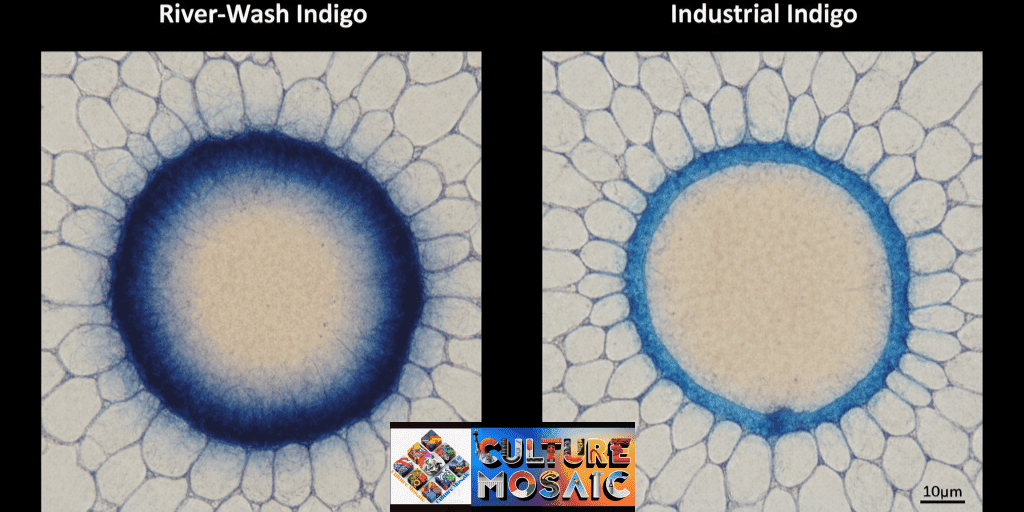
This distinction is most visible with indigo. Industrial indigo is synthesized from petrochemicals and produces a clean, flat, uniform blue. It is predictable by design. River-wash indigo, reduced and fixed using water from a specific source, produces a tone that shifts with light, deepens with age, and varies subtly across a single length of cloth.
That variation is not a flaw. It is the record of a real place.
The chemical bond between natural mordants and organic protein fibers like wool or silk is structurally different from synthetic dye adhesion. It penetrates rather than coats, which is why naturally dyed heritage cloth fades gracefully while synthetic-dyed fabric tends to go patchy and strange.
Pillar II: The Physics of the Twist
What Hand-Spun Fiber Actually Does

Machine-spun thread is engineered for consistency. Every meter is identical to the last. From a manufacturing standpoint, that is the goal. From a fiber performance standpoint, it is a significant limitation.
Hand-spun thread contains microscopic variations in twist angle and tension. These are not mistakes. They create tiny air pockets distributed throughout the yarn structure that regulate temperature, allow the cloth to breathe, and give the finished textile a responsiveness to the body that machine-spun fabrics lack. Some researchers describe this as live energy in the thread, which sounds poetic until you understand the physics behind it.
Reading the Haptic Signature of a Weave
Every regional weaving tradition produces what I think of as a haptic signature: the particular tactile quality of a cloth that reflects the spinner’s technique, the loom’s mechanics, the fiber’s behavior, and the specific tension the maker works at. It is a form of sensory encoding, place and practice made physical.
Learning to read haptic signatures takes time, but it is learnable. The way a Kashmiri pashmina yields to pressure is different from the way an Andean alpaca weave does, and both are different from a Harris Tweed. Those differences are not random. They are the accumulated physical decisions of generations of makers responding to specific fibers, specific climates, and specific cultural standards of what cloth should feel like.
Developing this tactile literacy is, I would argue, one of the most practical things a person interested in ethical textile provenance can do.
Provenance vs. Transparency: A Comparison
| Factor | Standard Transparency | Ethical Textile Provenance |
|---|---|---|
| Tracking | Factory Name | Soil and Farm of Origin |
| Integrity | Paper Certificates | Isotope Testing & Fiber DNA |
| Value Measured | Labor Compliance | Cultural & Biological Heritage |
| Sensory Output | Uniformity | Haptic Variation & Character |
| Greenwashing Risk | High | Significantly Lower |
Transparency is a floor. Provenance is the full structure. The table above is also, if you look at it carefully, a map of where the sustainable fashion conversation needs to go next.
Pillar III: The Isotope Revolution
How Science Is Making Provenance Claims Verifiable
This is where ethical textile provenance moves from a philosophical position to a forensic one, and where the conversation gets genuinely interesting.
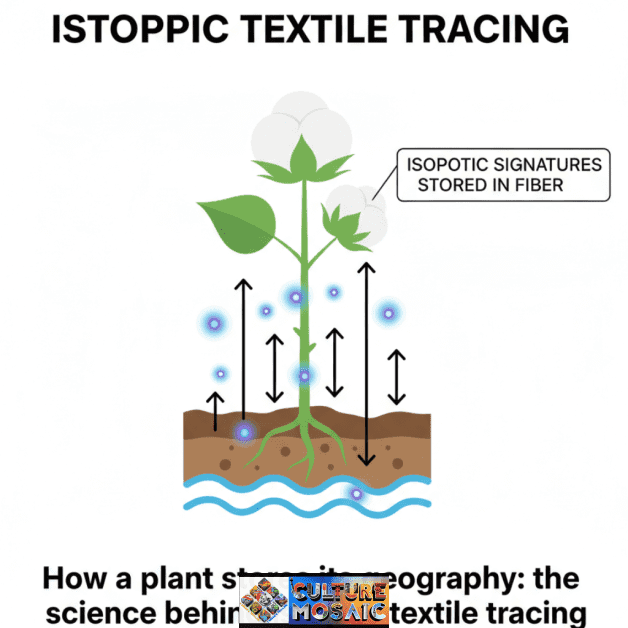
Stable isotope ratio analysis, known as SIRA, is now being applied to natural fibers to verify geographical origin with scientific precision. The principle is straightforward: as a plant grows, it absorbs water and nutrients from its local environment, and those inputs leave a measurable isotopic signature in the fiber itself. Cotton grown in the Nile Delta carries a detectably different isotopic fingerprint from cotton grown in the American South or Central Asia. The fiber carries its birthplace in its chemistry.
This matters enormously for ethical textile provenance because it makes origin claims verifiable at a level no certification system alone can reach. Certificates can be forged. Audit trails can be manipulated. An isotopic fingerprint cannot.
Isotope Tracing as a Greenwashing Guardrail
The practical application is already happening. Research institutions and a small number of forward-thinking brands are beginning to use SIRA alongside fiber DNA profiling to create what amounts to an unforgeable biological identity for a thread. When a brand claims its cotton is organically grown in a specific region, that claim can now be tested against the fiber’s actual chemistry.
For anyone serious about ethical textile provenance, this technology represents a shift from trust-based claims to evidence-based ones. That shift cannot come quickly enough.
Certification Standards Worth Understanding
The current certification landscape is imperfect but not useless. The Global Organic Textile Standard (GOTS) is the most rigorous, covering fiber production through to finished labeling and including both environmental and social criteria. The Responsible Wool Standard traces wool from certified farms. The Textile Exchange’s suite of standards covers responsible alpaca, cashmere, and down.
These frameworks create accountability structures that provenance science can reinforce and, where necessary, correct. The most credible approach combines third-party certification with laboratory verification, so the paper trail and the biological evidence point to the same place.
Blockchain-based traceability platforms like TextileGenesis are beginning to add another layer, creating immutable digital records of fiber journeys. None of these tools are sufficient in isolation. Together, they start to constitute something genuinely robust.
Ancestral Weaving Geographies: Three Places Worth Knowing
The Scottish Highlands and Peat-Rich Water
Harris Tweed’s particular resilience and its earthy, complex tone are not the result of a recipe. They are the result of peat-rich Highland water, naturally acidic and high in tannins, interacting with local Cheviot and Blackface wool during processing. That water chemistry affects how the fibers bond and how the finished cloth behaves over decades of wear. It is measurable. It is why an authentic Harris Tweed is not interchangeable with a tweed made anywhere else, regardless of how similar the fiber count appears on paper.
The Andes and High-Altitude Fiber Adaptation
Alpaca raised at high altitude develops a denser, finer fiber structure as a physiological adaptation to intense UV radiation and extreme temperature variation. That adaptation produces a fiber that is genuinely protective and extraordinarily durable in ways that lowland alpaca simply is not. Ethical textile provenance for Andean fiber means tracing the specific altitude band and the specific community, not just the country of origin, because those variables produce measurably different fiber characteristics.
The English Midlands and Gritstone Heritage Hemp
Early industrial hemp cultivated in the gritstone-heavy soils of the English Midlands developed a coarseness and tensile strength that made it the material of choice for rope and sailcloth during the height of British maritime expansion. Heritage hemp revival projects in that region are rediscovering that the same geology produces the same fiber behavior, centuries later. The soil remembers, even when we forget.
This is precisely the dynamic explored in the broader argument about how mineral-rich environments dictate the quality of heritage crafts: the quality is in the geography, and the geography is in the fiber.
How to Verify Provenance When You Shop
Ask more than the standard questions. Not just “Is this certified organic?” but “Which farm did this fiber come from?” and “Has isotope verification been conducted?” Brands doing this work seriously will have answers. Brands that cannot answer are operating at the transparency level, not the provenance level, and the difference matters more than most people realize.
Hold the cloth. A garment with genuine provenance usually feels different from one without it. Hand-spun, naturally dyed, regionally specific textiles carry their geography in their texture. That is not mysticism. It is physics and chemistry expressing themselves through material. Developing the sensitivity to notice it is worth the effort, and it is a skill that, once learned, is very difficult to unlearn.
Toward Tactile Sovereignty
There is a phrase I keep coming back to: analogue maximalism. Choosing clothes based on ethical textile provenance is an act of deliberate resistance to the frictionless anonymity of fast fashion. It is the decision to know the soil your shirt grew in, the river that colored it, and the hands that shaped its weave.
By verifying the isotopic origin of a thread, you are doing something more than shopping carefully. You are claiming sovereignty over your possessions and insisting that the objects in your life carry the truth of their making. That is not a luxury position. It is an ethical one. It is how we rebuild the relationship between making and meaning, between the things we wear and the places and people that produced them.
Know the thread. Know the soil. Know yourself.
The Forensic Audit: A Framework for Verifiable Provenance
From Performance to Sovereignty
The phrase I keep returning to is verifiable sovereignty — the idea that a brand, a farmer, a weaver, a consumer all have legitimate claim to the true story of a textile. That story belongs to them. When it’s falsified, that sovereignty is violated.
For too long, Ethical Textile Provenance has lived in the marketing department. It’s been a story told about supply chains rather than a standard applied to them. The forensic audit framework changes the power dynamic. It puts the burden of proof where it belongs: on the producer of the claim, not on the consumer trying to decode it.
I won’t pretend this is easy or cheap to implement. Isotopic testing adds cost. Independent auditing adds cost. Honest blockchain integration — with verified physical inputs — adds cost. But the alternative is an industry that continues to sell fiction at a premium, and I think we’ve reached the point where consumers, regulators, and frankly the workers at the base of these supply chains are no longer willing to absorb that cost on everyone else’s behalf.
The forensic audit isn’t a burden on ethical producers. It’s their competitive advantage. If your provenance is real, prove it — and let the proof speak louder than any campaign ever could.
FAQs: Ethical Textile Provenance
What separates ethical textile provenance from fair trade certification?
Fair trade focuses on labor conditions and pricing structures. Ethical textile provenance goes further back, tracing the biological, geological, and cultural origin of the fiber before it ever reaches a factory or a certification body.
Can isotope testing be applied to synthetic fabrics?
Not in the same way. SIRA works with natural fibers that absorb environmental isotopes during growth. Synthetic fibers have a petrochemical origin that requires different forensic methods, though fiber tagging technologies are beginning to close that gap.
What exactly is fiber terroir?
It is the idea, borrowed from wine, that a natural fiber carries the measurable characteristics of its specific growing environment: soil mineral content, water chemistry, altitude, and climate. These factors produce fiber with distinct, place-specific properties that can be detected in the finished cloth.
How does a haptic signature help me identify authentic cloth?
A haptic signature is the distinctive feel of a cloth produced by a specific regional tradition. With practice, you can learn to recognize authentic provenance through touch: the particular weight, grain, and give that reflects genuine hand processes and regional fiber behavior.
Are there accessible tools for tracing textile provenance?
Platforms like TextileGenesis and Sourcemap allow brands to map supply chains digitally. These are most meaningful when paired with laboratory isotope verification. For consumers, asking direct questions of makers and reading brand transparency reports remain the most practical starting points.
Laura Chenoweth is a writer and researcher with deep roots in ethical materials, heritage craft, and the stories that objects carry. She writes about the intersection of science, making, and meaning, and believes that knowing where things come from changes how we hold them. Read more about Laura at laurachenoweth.com/about-laura.