
 By Culture Expert
Quick Summary
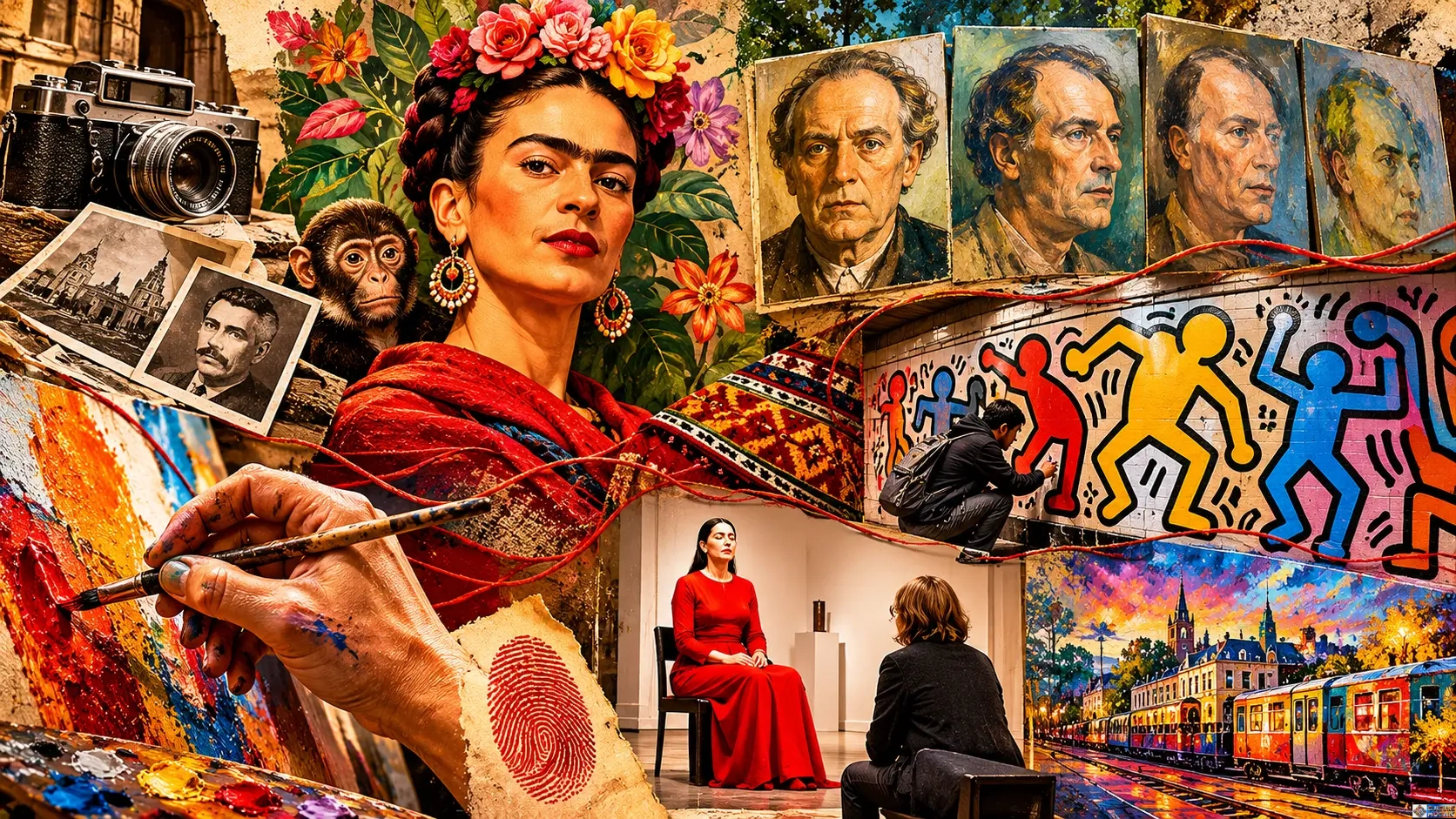
The Human Signature is the mark a real person leaves in their work through body, memory, culture, risk and presence. This guide defines the idea, tells seven true stories (Frida Kahlo, her father Guillermo Kahlo, William Utermohlen, Keith Haring, Marina Abramović, Thom Roberts and Oscar Wilde’s provocation about art), compares human-made and machine-made work, and answers the questions readers ask most.
The Problem: Why Everything Is Starting to Look the Same
You have probably felt it. You scroll, and the images blur together: smooth, symmetrical, polished and oddly weightless. Posters, product shots, illustrations and album covers can now be generated in seconds, and a lot of it is competent and forgettable.
When anything can be made instantly, people stop asking “Is it beautiful?” and start asking “Who made this, and what did it cost them?” The answer to that second question is the Human Signature, and it is the reason a hand-made object can still stop you in your tracks.
What Is the Human Signature? A Five-Part Definition
The Human Signature is the sum of the traces a person leaves in their work that cannot be separated from their life. It has five parts:
- Body. The hand, the injury, the breath, the tremor.
- Memory. What the maker carries, and sometimes what they are losing.
- Culture. The inherited colours, symbols, crafts and stories.
- Risk. What was at stake for the maker.
- Witness. The sense that a person was present and meant it.
No single part guarantees anything, and plenty of artists use digital tools with real intent. A machine can imitate a style. What it cannot do is have a body that was hurt, a memory that was fading or a community that shaped it. Think of the difference between a handwritten letter and a font made to look handwritten.
The Seven Stories Behind the Human Signature
Story 1: Frida Kahlo and the Body as Canvas
On 17 September 1925, when Frida Kahlo was 18, the bus she was riding in Mexico City collided with a streetcar. Her injuries, including damage to her spine and pelvis, kept her in bed for long stretches, and it was during that recovery that she began to paint. A special easel was made so she could work lying down.
Her self-portraits (about 55 of her paintings are commonly counted as such) turn pain, identity and Mexican cultural symbols into a visual diary. Her life with the muralist Diego Rivera, her husband from 1929 until their divorce in 1939 and again after they remarried in 1940, runs through that story, but her work is far bigger than that relationship.
Signature marks: body, culture, risk. For more on how colour carries feeling in work like hers, see The Psychology of Color in Design.
Story 2: Guillermo Kahlo and the Signature You Inherit
Frida’s father, Guillermo Kahlo, was born Carl Wilhelm Kahlo in Germany, emigrated to Mexico in the 1890s and became a professional photographer, best known for documenting Mexican architecture. Frida painted him, and her work shows how closely she studied his craft and his presence.
A Human Signature is rarely made from scratch. It is inherited: a father’s trade, a family’s story, a country’s history. Kahlo’s art carries German and Mexican threads at once, and that layering is part of why it is unmistakable.
Signature marks: memory, culture.
Story 3: William Utermohlen, the Artist Who Drew Himself With Dementia
William Utermohlen (1933–2007) was an American painter who lived in London. He was diagnosed with Alzheimer’s disease in 1995, at the age of 61, and began a series of self-portraits that he continued until about 2000. Across those years the portraits become flatter, more abstract and emptier of detail, showing a change in how he perceived space and his own face.
Wellcome Collection, which shows the work, quotes a researcher who worked with Utermohlen and his wife as saying the self-portraits convey the lived experience of Alzheimer’s more than any brain scan or graph could. It is tempting to read the series only as decline, but Wellcome staff point out that he kept making meaningful work. The portraits are a person insisting on being present, which is exactly what a signature is.
Signature marks: memory, body, witness. Readers interested in how making art supports wellbeing can continue with Art Therapy Power of Artistic Expressions.
Story 4: Keith Haring and the Art of Controversy
Keith Haring’s controversy came from several directions at once:
- Street work. In the early 1980s he drew in chalk on blank advertising panels in New York subway stations. Some saw public art; the authorities saw an illegal act, and he was arrested for it.
- Commerce. In 1986 he opened a Pop Shop selling products with his imagery. Critics accused him of selling out, while Haring argued that art should be accessible.
- Politics. He used his imagery for causes including anti-drug messaging and AIDS awareness. He died of an AIDS-related illness in 1990, aged 31, and the Keith Haring Foundation continues that work.
Admire him or question his choices, the line is unmistakable: bold outlines, dancing figures, urgency. That is a signature built from conviction.
Signature marks: risk, culture, witness.
Story 5: What Is Marina Abramović Famous For?
Marina Abramović is a Serbian-born performance artist famous for works that use her own body, endurance and presence, across a career of roughly five decades.
Two moments stand out. In Rhythm 0 (1974), she placed objects on a table and let the audience use them on her, testing how people behave when given power. In The Artist Is Present (MoMA, 2010), she sat silently across from visitors, one at a time, for the length of the exhibition, and many people wept. The work was a human being paying attention to another. You cannot download that.
Signature marks: body, risk, witness. To go deeper into how the body documents itself, read Somatic Art Documentation.
Story 6: Thom Roberts and the Joy of Seeing Differently
Thom Roberts is a Sydney artist who lives with an intellectual disability, and he is, first and foremost, a professional artist. He works from Studio A, a supported studio for artists with intellectual disability. He sees people, trains and buildings as colourful multiples and describes himself as a train.
His work was chosen for The National: New Australian Art 2019, and in 2025 he opened his first solo exhibition, The Immersive World of Thom Roberts, at the National Portrait Gallery in Canberra, with more than 100 works. A scholarly article in Art/Research International describes his habit of “reading” friends’ crowns, running his hands over the backs of their heads, as an artistic gesture in its own right.
His story reminds us that a Human Signature includes ways of perceiving that standard systems often overlook. For more on touch as a way of making, see Haptic Sculpting Rituals.
Signature marks: body, culture, witness.
Story 7: Oscar Wilde’s Most Famous Quote About Art
The line most often quoted is from the preface to The Picture of Dorian Gray (1891): “All art is quite useless.”
Wilde was not saying art does not matter. He was defending art as something that exists for its own sake, not for obedience, profit or utility. In an age of tools built to make creativity efficient, the line takes on new meaning: the human reason to make art may be that it cannot be reduced to function.
Signature marks: risk, witness.
Human Signature vs. Machine-Generated Work: A Comparison
Use this comparison as a qualitative guide rather than a rigid rulebook.
| Quality | Human Signature | Typical generated output |
|---|---|---|
| Origin | A lived life, body and culture | Patterns learned from existing data |
| Cost to the maker | Time, risk, sometimes pain | Seconds of computing |
| Imperfection | Visible and meaningful (a shaky line, a seam) | Often smooth, or randomly flawed |
| Provenance | Traceable to a person and place | Often unclear |
| Meaning | Rooted in intent and context | Depends on the prompt and the viewer |
| Emotional pull | Comes from knowing a person was there | Comes from the image alone |
How to Spot and Support a Human Signature
- Look for traces of process. Visible seams, layered paint, repeated attempts. See Fragmented Collage with Visible Seams and Tactile Abstract Art Techniques.
- Ask about the story. Who made it, where and why?
- Notice the material. Clay, pigment, thread and wood carry their own presence. Read The Haptic Resonance of Raw Materials.
- Value the ritual. Making by hand is often a practice. Explore Tactile Minimalism Art Techniques.
- Buy from people. Support working artists directly, including work like Neuro-Aesthetic Wall Art.
Why the Human Signature Matters for Creators and Galleries Today
For makers, galleries and collectors, the phrase works as a promise: a real person stands behind this work and can say how it was made. That promise has value only when it is true, so transparency about process, materials and authorship is the best way to protect it. Artists at supported studios and small workshops often have the least institutional backing, which makes the choices of audiences and buyers right now especially important.
In one line: the Human Signature is proof that someone was there, and in a world of automation that is worth looking for.
The Human Signature: Frequently Asked Questions
1. What does “the Human Signature” mean in art?
It means the personal traces (body, memory, culture, risk and presence) that make a work identifiably the product of a particular human life. It is a descriptive idea, not a formal art-historical term, so use it as a lens rather than a rulebook.
2. Why did William Utermohlen draw himself after his Alzheimer’s diagnosis?
He was diagnosed in 1995 and began a series of self-portraits that he continued until about 2000. Reporting and Wellcome Collection commentary describe the series as an effort to understand and document what was happening to him. It has also been valuable to clinicians and researchers because it shows changes in perception and spatial sense.
3. What is Marina Abramović famous for?
She is famous for performance art that uses her own body, endurance and presence. Key works include Rhythm 0 (1974) and The Artist Is Present at MoMA in 2010.
4. Why was Keith Haring controversial?
Reasons include his unauthorised subway drawings, for which he was arrested, the commercialisation of his work through his Pop Shop, and his public political messages. Many now regard his work as a cornerstone of 1980s public and activist art.
5. Can art made with AI have a Human Signature?
Possibly, if a person’s choices, risk and intent are central. The idea is less about the tool and more about whether a real person’s life, judgment and responsibility are present in the work. Being open about the process helps audiences decide.
Your Next Step
Pick one artist from this article, spend ten minutes with their work on a museum’s own website, and then buy from, share or commission a living maker this month. That one choice is how a Human Signature survives.
Keep Exploring on Culture Mosaic
Sources
- Wellcome Collection. William Utermohlen self-portraits (story and exhibition guide, The Coming of Age). Read the Wellcome Collection story
- NBC News. “Artist paints his struggle with Alzheimer’s.” Read the NBC News article
- Watfern, C. (2021). “Thom Roberts Reads Crowns: Musing on Art and Neurodiversity through the Lens of One Artist’s Practice.” Art/Research International 6(2). Read the journal article (DOI)
- Studio A. Thom Roberts artist profile. Studio A artist page
- SBS News. “Australian artists with disability getting more support to unearth their talents.” Read the SBS News report
- Tate. Frida Kahlo, artist biography. Tate artist page
- Museo Frida Kahlo (Casa Azul). Museo Frida Kahlo website
- The Museum of Modern Art. Marina Abramović: The Artist Is Present (2010). MoMA exhibition page
- Keith Haring Foundation. Biography and chronology. Keith Haring Foundation website
- Wilde, O. (1891). Preface, The Picture of Dorian Gray. Project Gutenberg. Read the text on Project Gutenberg