
 By Culture Expert
Quick Summary
Choose traditional if you live in a period home, love heirloom storytelling and want tactile warmth. Choose modern if your space is open-plan, you crave visual calm and you’d rather buy fewer, reusable pieces. Most people end up mixing the two. This guide weighs traditional vs modern Christmas decor on colour, materials, lighting, cost and longevity, then shows you how to blend them without a clash. The short version: let one style lead, borrow two or three pieces from the other, and keep every bulb warm.
It’s late November. There’s a box of Christmas baubles in the loft that no longer matches anything you own, three browser tabs open on matte ceramic trees, and a creeping suspicion that whichever way you jump, the living room will look wrong by the first week of December.
That feeling isn’t really about baubles. It’s about identity. Do you want the house to look like the Christmas you remember, or the one you’d design if nobody was watching? Buy on a whim and you end up with a tree that fights your sofa and a set of ornaments that goes back in the box by Boxing Day.
Here’s the good news. The fork is far less binary than the shop windows make it look. The real question in traditional vs modern Christmas decor isn’t which side wins. It’s which one leads and which one supports. Below I compare both honestly, side by side, then show you how to combine them. If you want the cultural backstory first, our guide to historic Christmas traditions UK households still keep sets the scene, and everything else here sits on top of it.
1. Traditional Christmas Decor Is Younger Than You Think
Start with a surprise. The look most of us call traditional, a fir tree glittering with glass, is under two centuries old in its modern form.
Royal Collection Trust credits Queen Victoria and Prince Albert with popularising the Christmas tree in Britain after an 1848 Illustrated London News engraving showed the family gathered round one at Windsor Castle. Albert gets slightly too much credit, mind. Countryfile notes that Queen Charlotte brought a tree to Britain back in 1800.
The glass came from Germany. The Corning Museum of Glass dates the first hand-blown glass fruit and nuts to 1847, made by Hans Greiner in the Thuringian glassmaking town of Lauscha, and Homes & Antiques reports that by the 1870s Lauscha was exporting ornaments to Britain. Before that, trees wore apples, nuts and sugared biscuits.
Victorian decor wasn’t grand by default, either. English Heritage points out that much of it was made from household odds and ends. The “authentic” Victorian tree was homemade, a little lopsided and partly edible.
Why does this weigh so much on your decision? Because it frees you. Traditional was always a blend: royal fashion, German craft and household thrift. Modern decor is simply the latest layer. For the fuller timeline, read When did modern Christmas traditions begin, and for the handmade strand, our piece on Christmas folk art traditions.
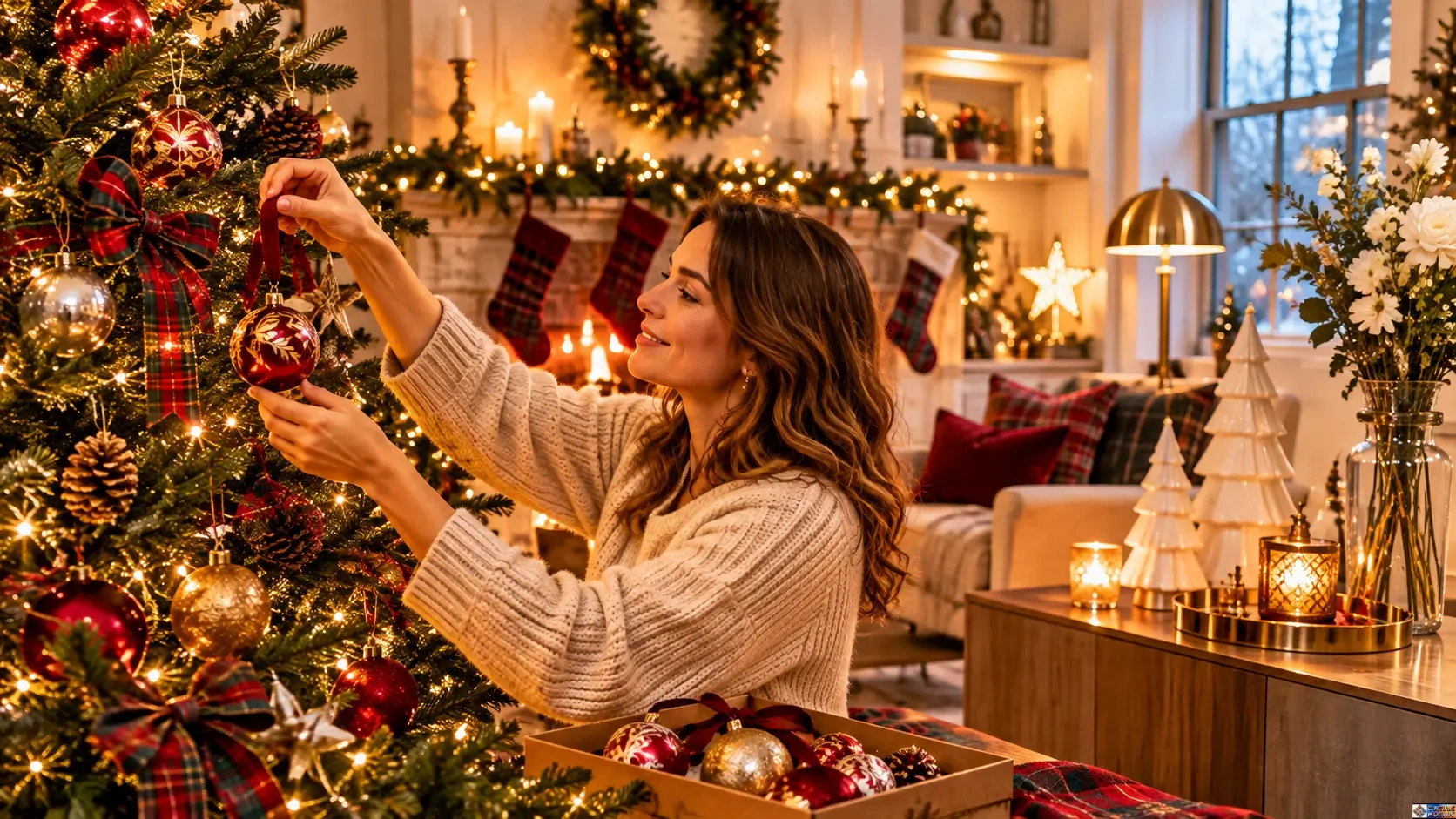
What counts as traditional? Think classic red and green Christmas decor with gold. Hand-blown glass, velvet, tartan ribbon, brass and wood, plus heirloom Christmas ornaments and vintage Christmas decorations passed down the family. A mantelpiece swagged with garland, a nativity, a row of stockings. The light is low and amber. The mood is nostalgic, layered and a bit crowded, and that’s the point: every object has a story attached.
What counts as modern? Restraint. A tight palette of white, stone, black or a single metallic. Matte ceramic, paper, linen, brushed metal, simple geometry. Fewer, larger pieces with air around them. The mood is calm and curated, closer to a gallery than a grotto. Type minimalist vs traditional Christmas decor or classic vs contemporary Christmas decorations into a search bar and you’re asking the same thing in different words.
2. Traditional vs. Modern Christmas Color Palettes & Materials
Here’s the cheat sheet. Screenshot it, argue with it, tape it inside the loft door.
A few notes the table can’t carry. Red and green earned their place honestly. Homes & Gardens notes that greenery came indoors in winter partly because people believed it kept bad spirits out. Gold simply catches candlelight.
Materials weigh more than colour, I think. Velvet drinks light; matte ceramic hands it back. A glass bauble clinks against its neighbour when the door shuts. A paper star stays silent. You feel those differences from the sofa before you can name them.
Heritage tartan and velvet ribbons are the quickest way to give a neutral scheme some history, a trick I’ll come back to in section 6. And if your taste leans Scandinavian, the shared ground between the two camps is bigger than it looks (more on that in section 5).
3. Lighting Changes the Mood, the Bill and the Fire Risk
Lighting is where traditional vs modern Christmas decor quietly shake hands. Warm-white LED suits both. Cold white suits neither, and I’ll say it plainly: a blue-white string is the fastest way to make a modern scheme feel like a car showroom and a traditional one feel like a hospital corridor.
Choose LEDs for sense as well as taste. Which? found that LED lights use almost 90% less energy than traditional incandescent bulbs, and London Fire Brigade recommends them for the tree because they stay cooler. A few checks cost nothing:
- Switch the lights off at bedtime and when you go out, or put them on a timer.
- Check old strings for loose wires, blown bulbs and damaged cords.
- Buy new fairy lights with a CE or UKCA safety mark.
- Swap real candles for LED ones near greenery, paper and fabric.
- Water a real tree. London Fire Brigade says one stays relatively safe for only about two weeks.
Candlelight is traditional decor’s signature. Flameless versions keep most of the glow, and they work just as well in a modern scheme, where one cluster of warm points does the job a hundred baubles would do elsewhere.
4. Which Home Suits Which Style? Traditional vs Modern Christmas Decor, Side by Side
UK homes pull in both directions. A Victorian terrace with a cast-iron fireplace practically begs for a garlanded mantelpiece. A new-build apartment with one long wall and a TV unit doesn’t. Table 2 scores the two styles on the practical things comparison shoppers actually weigh.
These rankings are my editorial judgement, drawn from the materials involved and from published trend and safety guidance. They are not survey results, and the cost line describes tiers, not price quotes.
The 60-second room test. Answer yes or no.
- Is your home period, with a fireplace, mantelpiece or picture rail?
- Do you own ornaments with a story you’d hate to lose?
- Does a crowded, layered room make you feel cosy rather than anxious?
- Is your space open-plan or short on surfaces?
- Would you rather finish decorating in under an hour?
Yes to questions 1 to 3 and no to 4 and 5? You’re traditional-led. Flip it and you’re modern-led. A mix is the likeliest result, which is why section 6 exists.
Small flat? I’d start modern-led, with a slim tree, one garland and a single shelf of heirlooms. Minimalist Christmas decorations suit a tight footprint, and a modern traditional Christmas aesthetic keeps it from feeling sterile. Fewer things, placed deliberately, make a small room feel generous. Dressing a village hall or workplace instead of a home? The same one-lead, one-accent logic applies, and you can borrow cues from Classic Christmas Themed Events. For longer lists of neighbourhood ideas, see Christmas event ideas community.
5. How to Make Modern Christmas Decor Feel Cosy
Modern decor has a reputation problem: cold, tidy, joyless. Fair enough. But the fix isn’t more stuff. It’s more sensation.
- Layer textures. A wool throw, a linen runner, a knitted stocking against smooth ceramic.
- Warm the light. Warm-white bulbs, lamps at three heights, flameless candles.
- Bring in something alive. Fir, eucalyptus, dried orange slices, pine cones. The smell does half the work.
- Keep one handmade thing. A paper heart, a salt-dough star, a bauble somebody’s grandmother wrapped in tissue.
Nordic design is the bridge, and I think it’s the most underrated route into a blend. Glencairn Museum describes Swedish straw ornaments and the woven paper heart basket, a 19th-century Danish tradition, as staples of the Scandinavian tree: sparse, natural, handmade. Furniture News expects Scandinavian minimalism and Japanese simplicity to shape UK Christmas schemes this year. That’s Scandinavian Christmas decor and wider Nordic holiday decor in one line: minimal in palette, traditional in spirit.
Want to borrow further afield? Our guides to Global Christmas Customs, Unusual Christmas traditions around the world and multicultural Christmas traditions are full of ornaments, colours and rituals that suit a modern room without a single bauble in sight.
6. How to Blend Traditional and Modern Christmas Decor
This is where most people weighing traditional vs modern Christmas decor end up, and honestly where I’d steer you. The hybrid, sometimes called modern heritage Christmas decor or, in the trade, transitional Christmas decorating ideas, works because it fixes both failures at once. Mixing vintage and modern Christmas ornaments is the heart of it. Pure traditional can feel crowded. Pure modern can feel borrowed. The rules are simple. Break them only on purpose.
Decide which style owns roughly 70 per cent of the room. The other gets 30. It’s my rule of thumb, not a law, but a 50/50 split with nobody in charge usually reads as indecision.
Pick a single shade that appears in both camps: burgundy and brass, or white with one deep green. Argos names burgundy as the shade to lead with in 2026, so you’ll find it in every price band.
Cluster two or three heirloom pieces, say a glass bauble, a carved wooden figure and a tin star, on a mantelpiece or shelf with space round them. Scattered heirlooms look like clutter. Grouped ones look curated.
Brass with brass, silver with silver, and one warm-white temperature across every string. Mismatched metals and mismatched whites are the two clashes the eye catches first.
Put matte beside gloss. A matte ceramic tree wearing three glossy hand-blown baubles looks deliberate. The contrast does the blending for you.
Heritage tartan and velvet ribbons on a neutral tree is the cheapest heritage-modern move there is. Homes & Gardens reports that bows are returning to trees, tabletops and mantels this year, so you’re on trend as well.
The wildcard: skip the tree. Prop a bare branch in a matte-black pot, string one line of warm-white lights, and hang only your six oldest baubles. It’s the most modern way I know to show off traditional pieces, and if you have a garden it needn’t cost anything. A second oddity worth trying: hang one heirloom bauble from every window latch in the house.
Three quick examples. A period terrace: traditional-led, with garland on the fireplace and one oversized modern paper star in the window. A 1930s semi: roughly 60/40, with a neutral tree and an heirloom cluster on the mantelpiece. A new-build apartment: modern-led, with a slim tree, tartan ribbon and heirloom baubles heaped in a glass bowl.
Figure 1: Suggested starting split between traditional and modern by home type
Editorial guidance based on architectural proportions and visual balance (not survey data).
If you’d rather pull a palette from paint than plastic, our look at Famous Christmas Artwork is a good place to raid. And the table follows the same rule as the tree: a classic feast looks sharper against a pared-back linen runner, as our traditional Christmas feast guide shows.
7. What the Biggest Christmas Decorating Trends for 2026 Say About Traditional vs Modern Christmas Decor
Follow the 2026 trend reports and a pattern jumps out: the style most people are buying is neither pure. Homes & Gardens reports that heritage decorating is still riding high after last year’s Ralph Lauren-style Christmas, alongside a Victorian revival and, at the opposite pole, playful “kitschmas” excess. Argos points to burgundy and jewel tones such as emerald and ruby. Ideal Home, citing Pinterest UK, reports that searches for vintage Christmas wallpaper are up 900 per cent and for easy DIY Christmas decorations up 680 per cent.
Read together, that’s nostalgic Christmas styling in a fresh coat of paint. Martina Casonato’s phrase in Homes & Gardens, things that feel “collected rather than coordinated”, is the whole 2026 brief in four words.
My view: this favours traditional-led and blended homes. Pure minimalism isn’t dead, but the energy this year sits in warm, layered, slightly mismatched rooms. If you’re modern at heart you aren’t behind. You just need two or three heritage touches. For a retailer’s take on the same fork in the road, this UK seasonal trade comparison is a useful view of what’s actually on the shelves, as opposed to a design study.
So settle your lead style this weekend. Advent begins on Sunday 29 November, the loft box is still within reach, and heirlooms and ribbon can be sorted in an evening. Buy a real tree later, because it only stays relatively safe for about a fortnight. That’s the kind of practical heritage story we like to tell at Culture Mosaic.
Somewhere in your loft is a bauble older than your current sofa. Whatever you decide in the traditional vs modern Christmas decor debate, hang that one first.
Frequently Asked Questions
1. Is traditional or modern Christmas decor better for small spaces?
Modern-led schemes usually suit small rooms best, because fewer, larger pieces leave air around them and stop a tight space feeling busy. A slim tree, a single garland and one shelf of ornaments is plenty. Traditional decor can still work if you treat it as one focused cluster, such as a mantelpiece garland with three heirloom baubles, rather than spreading small pieces across every surface. If floor space is tight, try a bare branch in a pot or a wall-hung tree, and keep fairy lights warm white so the room feels bigger, not busier.
2. How do you make modern Christmas decor feel cozy?
Add sensation rather than clutter. Layer textures such as wool throws, linen runners and knitted stockings against smooth ceramic. Use warm-white bulbs and lamps at different heights instead of one bright overhead light. Bring in natural greenery like fir or eucalyptus, because the smell does as much as the look. Finally, keep one handmade or inherited object somewhere visible, since a single object with a story warms a minimal room faster than a dozen shop-bought extras. Flameless candles give the glow without the fire risk.
3. What is the difference between traditional and contemporary Christmas style?
In the traditional vs modern Christmas decor question, traditional style leans on classic red, green and gold, dense layers of ornaments and objects with stories, from hand-blown glass baubles to tartan and velvet ribbon. Contemporary style is edited: neutral or monochrome palettes, matte and metallic finishes, geometric shapes and fewer, larger pieces. There’s a subtle point too. Contemporary means “of the moment”, so it shifts from year to year, while modern or minimalist decor often describes a steadier aesthetic. Traditional looks tend to stay put, which is why heirlooms rarely date.
4. Can you mix warm traditional colors with minimalist Christmas decor?
Yes, and it is one of the easiest blends to get right. Keep the structure minimalist, with a neutral tree, clean lines and plenty of space, then add one warm traditional shade in a small dose: burgundy velvet ribbon, deep green garland or a few gold baubles. Stick to a single metal tone and one warm-white light temperature so the warm colour looks planned. As a rule of thumb, let the minimalist look own about 70 per cent of the room and the traditional colour the rest.
5. What are the biggest Christmas decorating trends for 2026?
The 2026 reports point towards nostalgia and heritage styling, including a Victorian revival, alongside burgundy and other jewel tones. Bows are back on trees, tables and mantels, and playful maximalism, nicknamed kitschmas, sits at the opposite end of the scale. Ideal Home, citing Pinterest UK, reports big jumps in searches for vintage Christmas wallpaper and easy DIY decorations. Scandinavian minimalism remains an influence too, so the overall mood is warm, layered and personal rather than strictly one style.
Sources
- Royal Collection Trust. “A Royal Christmas” and “The Christmas Tree” (Queen Victoria, Prince Albert and the 1848 Illustrated London News engraving): rct.uk/collection/stories/a-royal-christmas
- Countryfile. “Horse skulls and onion-induced dreams: the quirky British Christmas traditions you should try this year” (Queen Charlotte’s tree, 1800): countryfile.com
- Corning Museum of Glass. “Traditional Mold-blown Ornaments” (Hans Greiner and Lauscha, 1847): oldblog.cmog.org
- Homes & Antiques. “Discover Lauscha, the birthplace of glass baubles” (exports to Britain by the 1870s): homesandantiques.com
- English Heritage. “Christmas crafts and traditions” (Victorian household-made decorations): english-heritage.org.uk
- Homes & Gardens. “Christmas traditions: 16 festive rituals” (greenery and protection): homesandgardens.com
- Which?. “Which setting on your Christmas lights is cheapest to run” (LED energy use): which.co.uk
- London Fire Brigade. “Christmas trees: avoid a festive fire hazard” (LED lights, CE/UKCA marks, two-week tree safety): london-fire.gov.uk
- London Fire Brigade. “Fire brigade appeals to all Londoners to do a pre-Christmas fire safety check” (LED tea lights): london-fire.gov.uk
- Glencairn Museum. “Workshop: Scandinavian Christmas Tree Ornaments” (Swedish straw ornaments, 19th-century Danish woven hearts): glencairnmuseum.org
- Furniture News. “Predicting the 2026 Christmas trends” (Scandinavian minimalism and Japanese simplicity): furniturenews.net
- Homes & Gardens. “6 Christmas Decorating Trends Set to Define the 2026 Holiday Season” and “6 Designer-Approved Holiday Decor Themes for Christmas 2026”: homesandgardens.com
- Argos. “Christmas homeware trends 2026” (burgundy and jewel tones): argos.co.uk
- Ideal Home. “Christmas decor trends 2026” (Pinterest UK search figures as reported): idealhome.co.uk
- UK Christmas World. “Traditional or modern: which way to go with your Christmas decor this year” (retailer and trade perspective, not an academic source): ukchristmasworld.com
 Marcus J. Holloway