
 By Dr. Marcus Hale
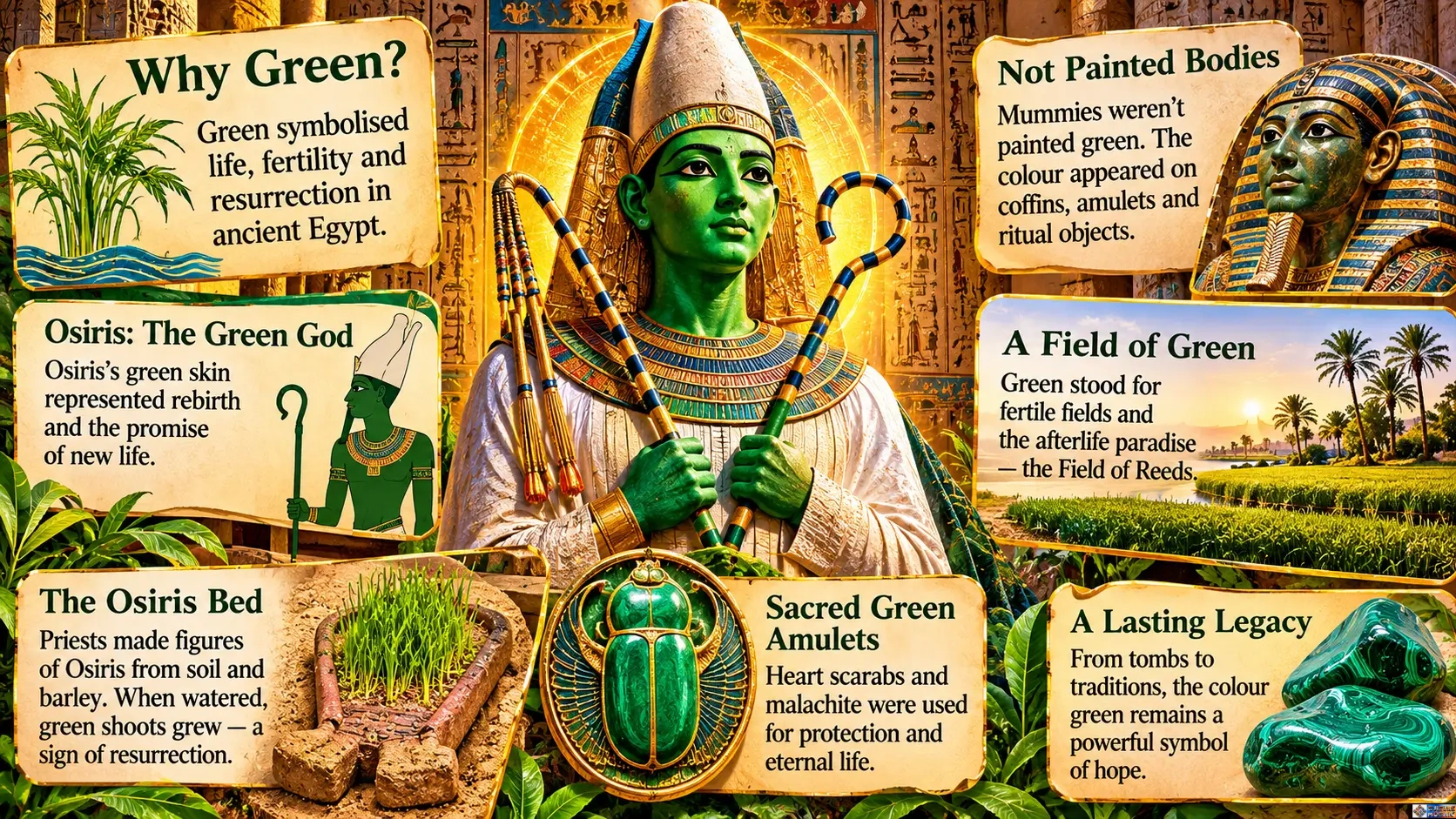
📌 Quick Summary: Green Mummies Egyptian Afterlife Facts
Egyptologists don’t recognise a separate “green mummy” technique—no priest dyed a human corpse green. The colour belongs to the symbolism around the dead, showing up across three core practices: Osiris’s skin, green-faced coffins, and sprouting barley figures.
- Osiris: Lord of the afterlife, frequently painted with vibrant green skin to signify rebirth.
- Coffins & Cartonnage: Burial masks and sarcophagi featured green faces to identify the deceased with Osiris.
- Grain “Corn” Mummies: Ritual figures packed with soil and barley were watered inside tombs until green shoots broke through the dark.
The ancient Egyptians called green wadj, meaning to flourish and referencing the papyrus plant. Green stood for the Nile’s yearly flood, fresh crops, and eternal resurrection. While priests wrapped bodies in linen and sealed them with resins, green minerals like jasper and malachite provided symbolic power. This pattern spans from the Old Kingdom (c. 2686–2181 BC) through the Ptolemaic and Roman periods. Nobody wanted a green corpse—they wanted a green future.
Why Do People Search “Green Mummies” At All?
You’ve seen the images: a pharaoh-like figure with a face the colour of pond weed, or a museum label that mentions green without explaining why. It’s natural to wonder if something strange went on in the embalming tent.
It’s also a bit unsettling, because we expect the dead to look grey or brown. Egyptian art put living colour on the dead, offering a visual promise that life continues. For a deeper grounding in how these people lived before they died, explore our guide on everyday life in ancient Egypt to set the scene.
Why Is Osiris Always Green?
Short answer: Osiris is green because he is the god of resurrection and growing crops. His skin colour says “life coming back,” not “decay.”
Osiris first appears in writing in the Pyramid Texts, the oldest religious texts known. Egyptian myth tells us he was murdered, dismembered, and revived, positioning him as ruler of the underworld and the divine embodiment of grain that dies in the soil and returns in spring. Painters depicted him wrapped like a mummy, holding the crook and flail, with green or black skin. Both colours point to the same spiritual promise: black represents the rich Nile silt, while green represents the life that grows from it.
The Symbolism: What Was Wadj?
Short answer: Wadj means green, fresh, and flourishing. It names the papyrus plant and the concept of health and new life.
The word is neat in a practical way. A stalk of papyrus, a healthy field, and a thriving person could all be wadj. The Egyptian word for green also covered various shades of blue, showing how ancient colour categories differed from ours. The Nile mattered because the yearly flood laid down fertile silt. As the waters receded, vibrant green appeared—concrete proof to an Egyptian farmer that death could be reversed. Egypt’s sea-facing northern edge was even called Wadj-wer, the “Great Green.”
7 Essential Green Mummies Egyptian Afterlife Facts
- Mummies weren’t painted green: The human body was dried with natron salt and wrapped in linen. Green belonged to coffins, amulets, and ritual objects. Learn more in our overview of ancient Egyptian mummification process history and mummies preservation techniques.
- Osiris is the key: Because the deceased hoped to merge with Osiris, a green skin tone on a coffin face signaled that divine identification.
- Heart scarabs favored green stone: A heart scarab amulet was placed over the chest, inscribed with Spell 30B from the Book of the Dead to protect the heart during judgment. Many were carved from green jasper.
- Malachite meant joy and life: This copper mineral was ground for eye paint as far back as the Predynastic Period before black kohl became popular.
- Green frit colored tomb walls: Artists manufactured synthetic greens and blues that retain their brilliance on tomb walls today.
- Grain figures actually sprouted: Ceremonial Osiris beds germinated inside tomb chambers.
- Green was an afterlife promise: Texts describe a paradise of fertile, blooming fields awaiting the justified soul.
Corn Mummies and Osiris Beds: The Part That Still Surprises Me
Short answer: Egyptians made human-shaped trays from earth and barley, watered them, and watched green shoots appear as a living sign of Osiris rising.
These are called Osiris beds or “corn mummies.” Mud and grain were pressed into an Osiris-shaped frame, kept damp, and left to germinate. The shoots pushing through the fabric were a living miniature of resurrection. Ptolemaic temple texts from Dendera describe these figures being made during the month of Khoiak. An Osiris bed was even discovered among the treasures in Tutankhamun’s tomb (read more on secrets of the mummy’s tomb).
What Was the “Field of Malachite”?
A word of caution: the phrase “Field of Malachite” circulates widely online as a supposed name for the afterlife. However, primary-text hieroglyphic citations for this exact label remain unconfirmed. What is firmly documented is the Field of Reeds—the fertile paradise where justified souls farmed and feasted for eternity.
Where Were Mummies Buried, and When Did Green Appear?
Burial customs evolved over millennia, moving from early mastabas to pyramids and rock-cut tombs. Check out where ancient Egyptian mummies were first buried and ancient Egyptian burial customs for the full timeline.
While green symbolism threads through nearly all periods, sprouting-grain rites are best documented late in Egyptian history. Most surviving mummies are far younger than the pyramids, as detailed in how old most Egyptian mummies are. Animals received sacred burials as well (ancient Egyptian animal mummies), while royal women had dedicated afterlife plans.
Quick Comparison: Green Symbolism in Egyptian Burial
How to Survive the Afterlife Like an Ancient Egyptian
Preparation was practical: a preserved body, protective spells, gifts from the living, and passing Osiris’s judgment test. Modern science continues to uncover these rituals non-invasively through modern technology (virtual unwrapping Egyptian mummies). If you are new to the basics, start with what is mummy in history?.
Frequently Asked Questions
1. Why did the ancient Egyptians paint mummies or sarcophagi green?
Green meant renewal, linking the dead to Osiris. A green face on a coffin declared that the person would rise again in the afterlife.
2. Why is the Egyptian god Osiris always depicted with green skin?
He rules the dead and personifies agricultural grain sprouting anew. Green skin represents rebirth, while black skin points to the fertile Nile silt.
3. Did the green minerals used on mummies have a special meaning?
Yes. Malachite and green jasper symbolized life, joy, and spiritual protection. Green heart scarabs were wrapped with mummies to ensure safe passage during judgment.
4. Is there a real mummy alive?
No. Human mummies are non-living preserved remains. The “living” aspect was purely symbolic, seen in grain-filled Osiris beds that sprouted real plants.
5. What are green mummies Egyptian afterlife facts for kids (KS2)?
Green represented new life, Osiris was the green god of rebirth, and priests grew real barley inside mummy-shaped frames to show that life overcomes death.
Sources
- Reading Museum, “Journey to the afterlife: mummification in ancient Egypt,” https://www.readingmuseum.org.uk/blog/journey-afterlife-mummification-ancient-egypt
- Mark, Joshua J., “The Pyramid Texts: Guide to the Afterlife,” World History Encyclopedia (2012), https://www.worldhistory.org/article/148/the-pyramid-texts-guide-to-the-afterlife/
- Taylor, John H., Death and the Afterlife in Ancient Egypt (British Museum Press / University of Chicago Press, 2001)
- Pinch, Geraldine, Egyptian Mythology (Oxford University Press, 2002)
- Wilkinson, Richard H., Reading Egyptian Art (Thames & Hudson, 1992)
- Faulkner, R.O., The Ancient Egyptian Pyramid Texts (Oxford, 1969)
- Lucas, A. and Harris, J.R., Ancient Egyptian Materials and Industries (4th ed., 1962)
- Chassinat, Émile, Le mystère d’Osiris au mois de Khoiak (1966–68)
- Raven, M.J., “Corn-mummies,” Oudheidkundige Mededelingen 63 (1982)