
 By Culture Expert
Quick Summary
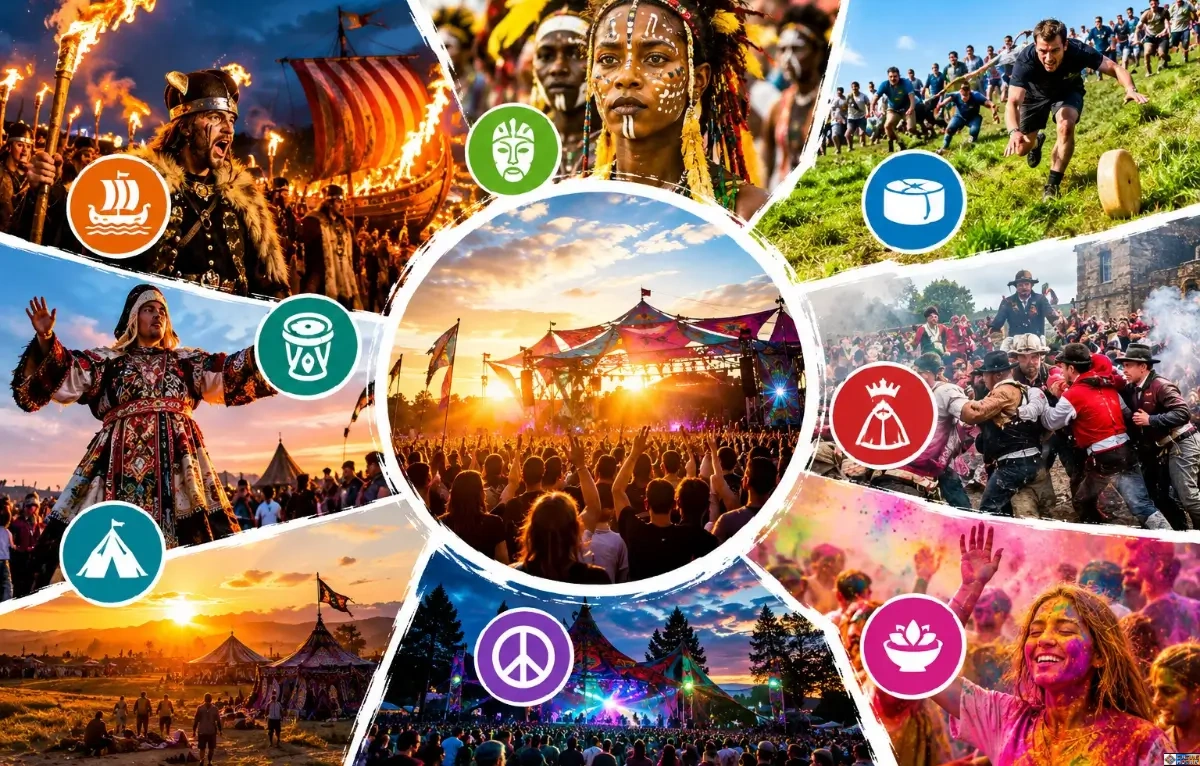
Underground cultural festivals are gatherings that grow out of a community, not a marketing budget. Some are centuries-old traditions the tourist trade hasn’t swallowed (Up Helly Aa, Gerewol, the Haxey Hood). Others are newer scenes built on word of mouth, lotteries and encrypted group chats (Fusion, the free-party and teknival circuit). To find them, follow people, not brands. To attend them well, behave like a guest, not a customer. Dates below shift, so confirm each one with the organisers.
The problem with “top 10 festivals” lists
Search “top 10 festivals in the world” and you’ll get the same names, the same wristbands and the same sponsor logos. Fine if you want a good weekend. Useless if you want to feel something you can’t buy again next year.
If you’ve ever left a big festival feeling oddly empty, that’s the pain I’m talking about. You were in a crowd of 80,000 and nobody knew your name. (I wrote about the aftermath in The post concert hangover, and the mess is not only emotional.)
The fix is the underground. Here’s how I’d define it.
What “underground” actually means
I think the word gets used two ways, and people confuse them.
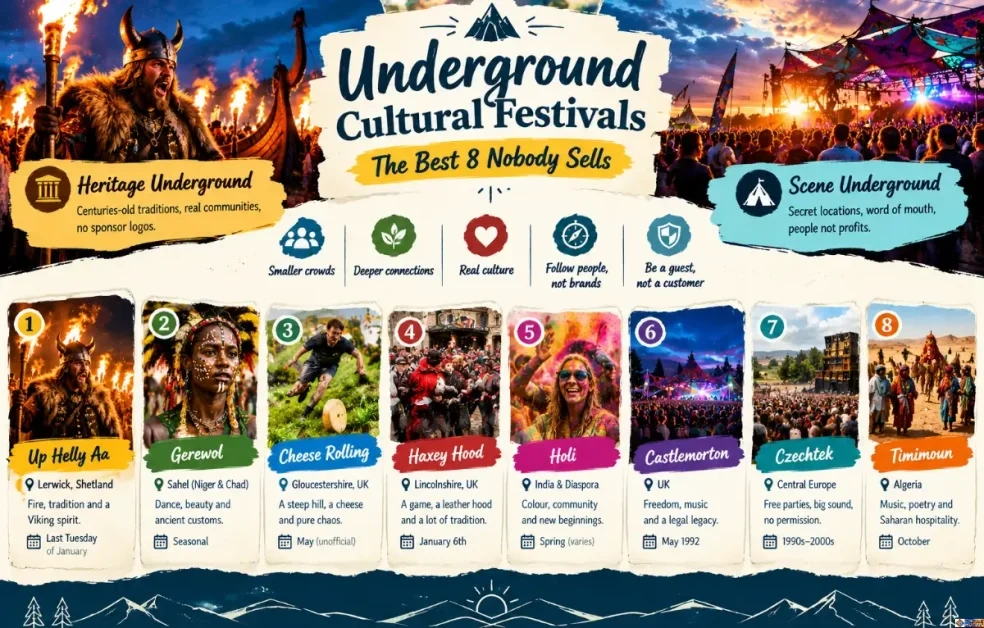
Scene-underground: events kept small on purpose. No big lineup announcements, no sponsor decks, sometimes no legal permission. Free parties, teknivals, invite-only art gatherings.
Heritage-underground: traditions that were never “events” in the first place. Nobody built a brand around them. Nobody sells VIP packages for a village fire ceremony. The community is the audience, and visitors are tolerated, sometimes welcomed.
Both are real. Both are fragile. And I’d argue the heritage kind is the rarer find, because it can’t be reproduced. A promoter can launch a secret party next month. Nobody can launch 400 years of custom.
For the wider landscape, see our Global Cultural Festivals Guide and the piece on the ancient roots of modern festivals.
Underground vs mainstream: the real differences
Eight real examples worth knowing
Heritage-underground
1. Up Helly Aa, Lerwick, Shetland. Fire-lit Viking marches through town, ending with a galley burned in a torchlit ceremony. It’s held on the last Tuesday of January and run by local squads, and most of the participants are Shetlanders. It’s one of the strongest answers I know to “what are the top festivals in the UK that aren’t for tourists?” I haven’t stood in that cold myself. I’m relying on published accounts, and they all agree on one thing: it belongs to the islanders first.
2. Gerewol, Sahel (Niger and Chad). The WoDaaBe, a Fula pastoral people, hold gatherings in which young men paint their faces, line up, roll their eyes and show their teeth in a long dance, while women judge. Britannica’s entry on the WoDaaBe is a sound starting point. Please read it before you consider going. Access is difficult and often unsafe, and government travel advice for the region matters here. I’d say this plainly: for most readers, Gerewol is something to learn about, not visit.
3. Cooper’s Hill Cheese Rolling, Gloucestershire. Runners chase a wheel of Double Gloucester down an absurdly steep slope. The official organised event has long been discontinued, but locals have kept turning up. Injuries are common. It’s one of the best-known “unusual festivals around the world” for a reason: it’s chaos with a pedigree.
4. Haxey Hood, Lincolnshire. Held each January 6th, a huge “smoking” scrum pushes a leather hood toward one of several pubs. Pub landlords, costumed characters, and a game with no clear end. Some of it can’t be explained without being there.
5. Holi, India and the diaspora. Yes, Holi is globally famous, and the Instagram version is commercialised. But the original spring festival, rooted in the Hindu month of Phalguna, still lives in neighbourhood courtyards. If you want the quiet version, go local. See our Traditional World Festivals Cultural Heritage guide.
Scene-underground
6. The UK free party scene and Castlemorton. In May 1992 a huge illegal gathering on Castlemorton Common drew tens of thousands and changed British law. The Criminal Justice and Public Order Act 1994 gave police powers over gatherings featuring amplified music “wholly or predominantly characterised by the emission of a succession of repetitive beats” (section 63). That one phrase still shapes how organisers work.
7. Czechtek and the teknival circuit. Central Europe’s free-party tradition produced huge unlicensed gatherings in the 1990s and 2000s. Raids and legal fights followed. I’d point to this as the clearest case of how fast an underground event stops being underground once it gets big.
8. Fusion Festival, Germany. Held at a former airfield in Lärz, Fusion sells access by lottery and keeps an anti-commercial identity. It’s been in public disputes with police over security plans. For discovery, it’s a model: you can’t buy your way in. You have to enter and wait.
The wildcard
Burning the Clocks, Brighton. A winter solstice lantern parade where people carry paper-and-willow lanterns to the beach and burn them. Community-made, free to join, and strange in the best way. Pair it with cultural light festivals if you like the fire-and-dark theme.
What about Las Vegas and Nevada?
Honest answer: I can’t point you to a verifiable underground cultural festival in Las Vegas, and I won’t invent one. What Nevada does have is Burning Man, held in the Black Rock Desert each late summer. It began in 1986 on a San Francisco beach and moved to Nevada in 1990. It’s now too large and expensive to call underground, but its regional offshoots and art-build communities still run on the old participatory ethos. For Nevada searches, start there, and look at local arts calendars and venue mailing lists rather than “secret party” listicles.
How to find and get invited
This part matters most, so I’ll be blunt about what works.
- Follow people, not brands. Promoters and collectives announce on personal accounts, newsletters and group chats first.
- Go to the small version first. Local nights, record shops, community halls. Organisers remember regulars.
- Enter the lottery. Events like Fusion distribute access randomly. Put your name in early and don’t treat a miss as final.
- Ask a local. Pub landlords, museum curators, parish councils. For heritage events this beats any website.
- Read the host community’s own channels. Shetland’s own guides, not travel blogs.
Social media is a double-edged tool here. It helps the underground spread, and it kills it. Once a location hits a viral post, you get crowds, police and pressure. Many organisers now share details only in closed groups, or only hours beforehand. Word of mouth is slower, but it screens for people who care.
What organisers actually struggle with
Legal. In the UK, section 63 of the 1994 Act and local licensing rules hang over unlicensed events. Landowner consent, noise and public safety law all apply. This is the main reason many scenes either go legal or stay very small.
Funding. No sponsors means no cash cushion. Donations, bar sales and volunteer labour carry everything. I’d argue this is why so many good events fold quietly after three or four years. For the money side of bigger events, see what is the economic impact of music festivals.
Safety. Fire, crowds, water, medical cover, drug harm. Underground doesn’t excuse skipping any of it. The best events I read about run their own medics, welfare teams and testing partners. If an event has none of that, I’d walk away.
Visit like a guest
For heritage events especially:
- Ask before you photograph people, and skip ritual moments if asked.
- Don’t treat locals as a backdrop. Buy from them, eat with them.
- Arrive early, leave nothing behind, and don’t be the loudest person there.
- Check official travel advice, particularly for the Sahel.
- If a community asks outsiders to stay away, believe them.
More on this in Ethno Cultural Festivals Heritage and Regenerative Festival Culture. If you’re planning a trip around one of these, our Event-Centered Escapes and Unique cultural festivals pages are useful starting points, and Best UK Folk Festivals covers the gentler end. For a UK-specific take from another site, underground cultural festivals is worth a look.
Frequently Asked Questions
1. What is the rarest festival in the world? +
2. What is the best kept secret festival? +
3. What is the biggest cultural festival in the world? +
4. What are the top 5 festivals in the UK? +
5. How can I attend underground cultural festivals respectfully? +
Next January, a few hundred torches will go up in Lerwick. The ones worth chasing never needed you there. Go anyway, quietly.
Sources to verify before publishing
- Britannica, “Wodaabe”: britannica.com/topic/Wodaabe
- Criminal Justice and Public Order Act 1994, s.63: legislation.gov.uk/ukpga/1994/33/section/63
- UNESCO Intangible Cultural Heritage, Kumbh Mela: ich.unesco.org/en/RL/kumbh-mela-01258
- Burning Man Project history: burningman.org
- Up Helly Aa official and Visit Shetland pages
- Fusion Festival official site: fusion-festival.de
- BBC News archive coverage of Cooper’s Hill and Castlemorton