
 By Marcus J. Holloway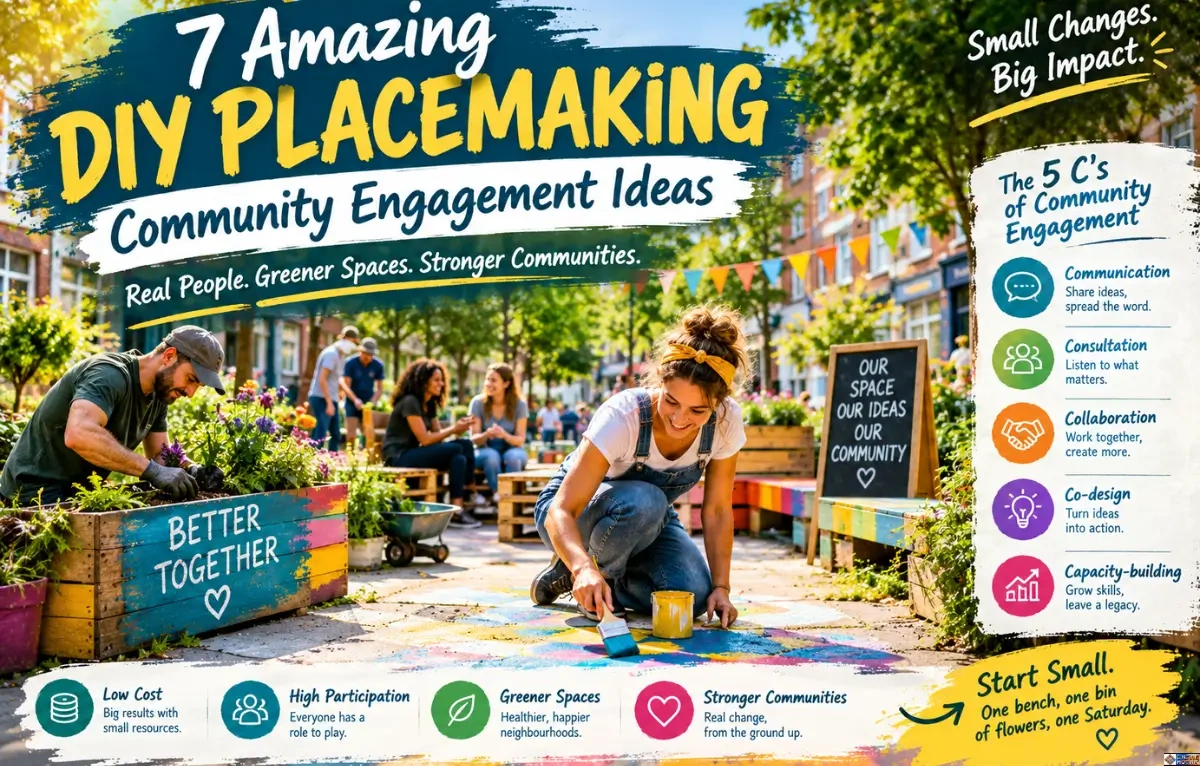
Quick Summary
- DIY placemaking community engagement means residents redesigning and reactivating a shared space themselves, using low-cost, high-participation tactics rather than waiting on council-led masterplans.
- It works because it lowers the barrier to entry: chalk, planters, pallets, and a Saturday afternoon can do what a two-year consultation often can’t.
- The evidence base sits with Project for Public Spaces’ Placemaking 101 framework and their 11 Principles of Placemaking.
- Community engagement generally breaks down into what practitioners call the 5 C’s — Communication, Consultation, Collaboration, Co-design, and Capacity-building.
- Grab the free template near the end of this piece and start with one bench, one bin of flowers, one Saturday.
I’ve stood in enough half-finished civic squares to know the smell of a stalled regeneration project. Cold concrete dust, cigarette butts around a hoarding that’s gone grey, a laminated sign promising “community consultation” that expired eighteen months ago. That’s the problem. Councils across the UK are stretched thin, budgets for public realm work keep shrinking, and residents are left staring at a gap site or a tired precinct that nobody has the money — or apparently the will — to fix.
The Problem: Waiting for Permission
Here’s what I hear on almost every high street I visit: people care, deeply, about the bit of pavement outside their door. They notice the broken bench before the ward councillor does. But most of them believe change has to come top-down — a planning application, a consultants’ report, a budget line that never materialises. That belief is the actual obstacle, more than any lack of funding. I’ve watched entire neighbourhood forums die of exhaustion waiting for a masterplan that was always three years away.
And I get the frustration. You’ve been to the drop-in session. You filled in the feedback form. You waited. Nothing moved. It’s demoralising in a very specific way — not the drama of a big fight lost, but the slow drip of being told your input matters while watching absolutely nothing change on the ground.
The Shift: Do It Yourself, Together
DIY placemaking community engagement flips that script. Instead of asking permission to fix a corner, a street, or a car park, residents design and build the fix themselves — cheaply, quickly, and visibly — then invite the council to catch up. It borrows heavily from Tactical Urbanism in Community Civic Engagement: paint, planters, pallet furniture, chalk-drawn game boards, a folding table and some bunting on a Saturday morning. None of it needs planning permission. All of it needs people.
The Project for Public Spaces network — the American nonprofit that more or less wrote the modern rulebook on DIY Placemaking Community Engagement — calls it “lighter, quicker, cheaper.” Their Placemaking 101 guide and 11 Principles of Placemaking exist precisely because so many public space projects fail for the same avoidable reasons: designed by outsiders, built for cars instead of people, and finished before anyone who actually uses the space got a say.
What “Placemaking” Actually Means
Placemaking, in the plain sense, is the practice of shaping a public space around how people genuinely use it — not how a masterplan imagined they would. DIY placemaking is that same practice run by volunteers, tenants’ associations, shopkeepers, and local charities rather than a design firm. It sits close to Culture Mosaic‘s wider work on civic life — the same instinct that drives Local Civic Engagement Strategies and everyday Civic Engagement shows up here, just aimed at physical space instead of policy.
The 11 Principles of Placemaking
PPS built its Placemaking 101 framework around eleven ideas, refined over four decades of watching public spaces succeed or fail. I’ve paraphrased them below rather than quoting directly, because the value is in applying them, not reciting them.
| Principle | What it means for a DIY project |
|---|---|
| The community is the expert | Ask residents before you design anything |
| You’re creating a place, not a design | Function and feeling matter more than aesthetics |
| You can’t do it alone | Bring in shopkeepers, schools, faith groups |
| They’ll always say “it can’t be done” | Start small enough that nobody can stop you |
| You can see a lot just by observing | Sit on the site for an hour before you plan |
| Develop a vision | A shared picture of what the space could be |
| Form supports function | Layout should follow how people already move |
| Triangulation | Put activities near each other so they reinforce one another |
| Start with the petunias | Small, cheap, reversible fixes build trust fast |
| Money is not the issue | Creativity and volunteer time substitute for budget |
| You are never finished | Treat the space as a project to tend, not a job to close |
Read that table twice. The one that trips people up is “start with the petunias” — plant boxes, in the original American phrasing. It means: don’t wait for the big grant. Do the small, obviously reversible thing this weekend, and let it earn the trust that unlocks the bigger changes later.
The 5 C’s of Community Engagement
People ask me constantly what the 5 C’s of community engagement actually are, so here’s my working version, built from a decade of running these projects on UK high streets:
- Communication — telling people what’s happening and why, in plain language, before you ask anything of them
- Consultation — asking for opinions on a proposal that’s still genuinely open to change
- Collaboration — working alongside residents as partners, not respondents to a survey
- Co-design — handing over some of the actual decision-making, not just the feedback
- Capacity-building — leaving the community with skills and structures that outlast your project
Some frameworks compress this into what’s called the three C’s of community engagement — Communication, Consultation, and Collaboration — treating co-design and capacity-building as advanced stages of collaboration rather than separate rungs. Either version works. What matters is that you move up the ladder rather than parking permanently on “communication,” which is the rung where most council consultations quietly stall.
If you want the fuller civic picture behind these categories, Co-design in urban planning and civic engagement goes deeper on the design side, and How Public Feedback Shapes Local Policy covers what happens after you’ve collected the opinions.
Why the PPS Network Matters to a DIY Project
If you’re serious about this, it’s worth understanding what a project for public spaces network associate actually does day to day: site visits, facilitated design workshops, “lighter quicker cheaper” pilot builds, and post-occupancy evaluation — checking, months later, whether people actually use what got built. You don’t need the title to borrow the method. Sit in the space. Count who uses it and when. Ask the person on the bench, not just the person who filled in the online form.
DIY Placemaking Community Engagement Ideas That Cost Next to Nothing
I’ve collected these from real projects — mine and other practitioners’ — rather than a brainstorm:
- Chalk and games day — paint or chalk a hopscotch grid, a giant chessboard, or a snakes-and-ladders trail on underused paving. Costs under £20 in chalk paint.
- Pallet furniture build — free wooden pallets, a Saturday, and a few pots of exterior varnish turn a dead corner into seating.
- Pop-up parklet — a single parking bay, some turf rolls, and folding chairs for a weekend, timed to a market or fete.
- Yarn-bombing and street art trails — low-cost, high-visibility, and brilliant for pulling in people who’d never attend a formal meeting.
- “Wish tree” or comment board — a plywood board with hooks or chalk space where passers-by leave one-line answers to a single question, like “what would make you stop here?”
- Repair café or tool-share stall — practical, sociable, and it puts DIY placemaking community engagement examples directly in front of people who weren’t looking for civic activity at all.
- Community mapping walk — an hour walking the site with residents, marking on a printed map what works, what’s broken, and what’s missing.
Every one of those is something a school PTA, a residents’ association, or three neighbours with a WhatsApp group can run without council sign-off. That’s the point — and it’s exactly the kind of small, legal, low-risk intervention covered under Tactical Urbanism in Community Civic Engagement and Micro-Civic Interventions.
Real Examples: What Success Looks Like
New York’s Times Square is the flagship American case. NYC DOT’s own before-and-after study, hosted on PPS’s site, records a 35% drop in pedestrian injuries once folding chairs and paint replaced traffic lanes on Broadway — long before the permanent redesign arrived. Closer to home, dozens of UK town centres have run parklet trials on old parking bays, and Meanwhile Space-style projects have turned empty shopfronts into pop-up galleries and youth hubs while long-term tenants were found. None of these started with a masterplan. They started with someone deciding not to wait.
Feedback from residents who’ve actually run a small DIY session tends to circle the same few lines: “I didn’t think anyone would show up.” “The kids found it before the adults did.” “The council came and asked us how we did it.” That last one — the council coming to you — is the real marker of success. It means you’ve built enough visible proof that the next round of funding conversations starts from evidence, not a proposal document.
A Free DIY Placemaking Community Engagement Template
Here’s the one-page structure I hand to first-time organisers. Print it, fill it in by hand, and you have a working plan.
| Step | What to fill in |
|---|---|
| 1. The spot | Exact location, current problem, one photo |
| 2. The people | Who’s already using it, who’s missing, who to invite |
| 3. The date | One Saturday, 2–4 hours, weather backup plan |
| 4. The budget | Target under £50; list what’s free vs. bought |
| 5. The activity | One clear thing to do (paint, build, plant, play) |
| 6. The ask | One line to collect on a comment board |
| 7. The follow-up | Who reports back to the council, and by when |
That’s genuinely the whole free DIY placemaking community engagement template. No consultant fee, no software. Copy it into a notebook and start.
Where This Meets the Wider Civic Picture
DIY placemaking rarely stays purely physical for long — once people are gathered around a shared bench they built themselves, conversation tends to drift toward everything else that’s broken locally. That’s a genuine opening. It’s worth pointing people toward 10 Civic Engagement Opportunities for what to do next, and toward practical grounding pieces like Civic Literacy and Understanding Civic Duty for residents who are engaging with local democracy for the first time. If the group starts asking why nobody voted on the last local budget decision, Why Is Voting Important in Local Elections? is a fair next read, alongside What is the Value of Civic Participation?
For groups that want to formalise beyond a one-off Saturday, Community Activism Strategies and Civic Voice map out what sustained pressure looks like, and Volunteer for Civic Education Programs is worth sharing with anyone who caught the bug for organising during the build day. Groups working across genuinely mixed communities often lean on the thinking in Diverse Civic Harmony, and if you want to know where the whole field is heading, Civic Engagement Trends is a useful scan.
None of this happens in a vacuum, either. Vernacular Governance Structures explains the informal rules that actually govern how neighbourhoods make decisions, separate from the official council process, and Ethical Grassroots Advocacy is worth reading before your project gets big enough to attract political attention. If your group wants to run its consultation online between build days, Hyperlocal Digital Deliberation covers the tools; if you want to understand how the council is legally meant to listen once you’ve got its attention, Why Public Consultation Is Important and What Is Public Commentary? both cover that ground.
And funding does exist, even if it doesn’t find you on its own. UK groups running small public realm projects should look at schemes modelled on the Love Your Block Grant 2026, which fund exactly this scale of work. These small wins matter because they’re evidence that Social Change in Modern Society often starts hyperlocal, not national — one bench, one street, one Saturday, addressing Real-World Problems that a council report was never going to reach in time.
The 8 Types of Community Engagement — Where DIY Placemaking Fits
Practitioners generally recognise eight recurring formats: inform, consult, involve, collaborate, empower, co-design, deliberate, and advocate. DIY placemaking sits mostly in “involve” and “co-design” — it hands residents actual tools and actual decisions, rather than a survey. That’s precisely why it works where a standard consultation stalls: people don’t need to imagine the outcome, they’re standing in it by 4pm on Saturday.
A Last Word Before You Start
I’ll be blunt: the biggest risk to a DIY placemaking project isn’t the council saying no. It’s nobody starting. Every successful project I’ve been part of began smaller and scrappier than the organisers wanted — a borrowed gazebo, a friend’s leftover paint, six people instead of the sixty they’d hoped for. Six people on a Saturday beats sixty people at a meeting that never happens. Pick your spot this week.
Frequently Asked Questions
What is DIY placemaking community engagement, in one sentence?
It’s residents redesigning and activating a shared public space themselves — through low-cost, temporary, highly visible projects — rather than waiting for a council-led scheme, and using the results as proof to push for permanent change.
What are the 5 C’s of community engagement?
Communication, Consultation, Collaboration, Co-design, and Capacity-building — a ladder running from simply informing people up to handing them real decision-making power and the skills to keep using it.
What are the three C’s of community engagement?
A shorter version of the same ladder — Communication, Consultation, and Collaboration — used by organisations that treat co-design and capacity-building as advanced stages within collaboration rather than separate steps.
What are some good ideas for community engagement activities?
Chalk games on underused paving, pallet furniture builds, pop-up parklets in a single parking bay, wish-tree comment boards, repair cafés, and community mapping walks are all proven low-cost starting points that need no planning permission.
What are the 8 types of community engagement?
Inform, consult, involve, collaborate, empower, co-design, deliberate, and advocate — a spectrum running from one-way communication through to residents holding genuine decision-making authority over the outcome.
Sources
1. Project for Public Spaces — “What Is Placemaking?”
2. Project for Public Spaces — “11 Principles for Creating Great Community Places”
5. Project for Public Spaces — “The Uses of Public Space”