
 By Culture Expert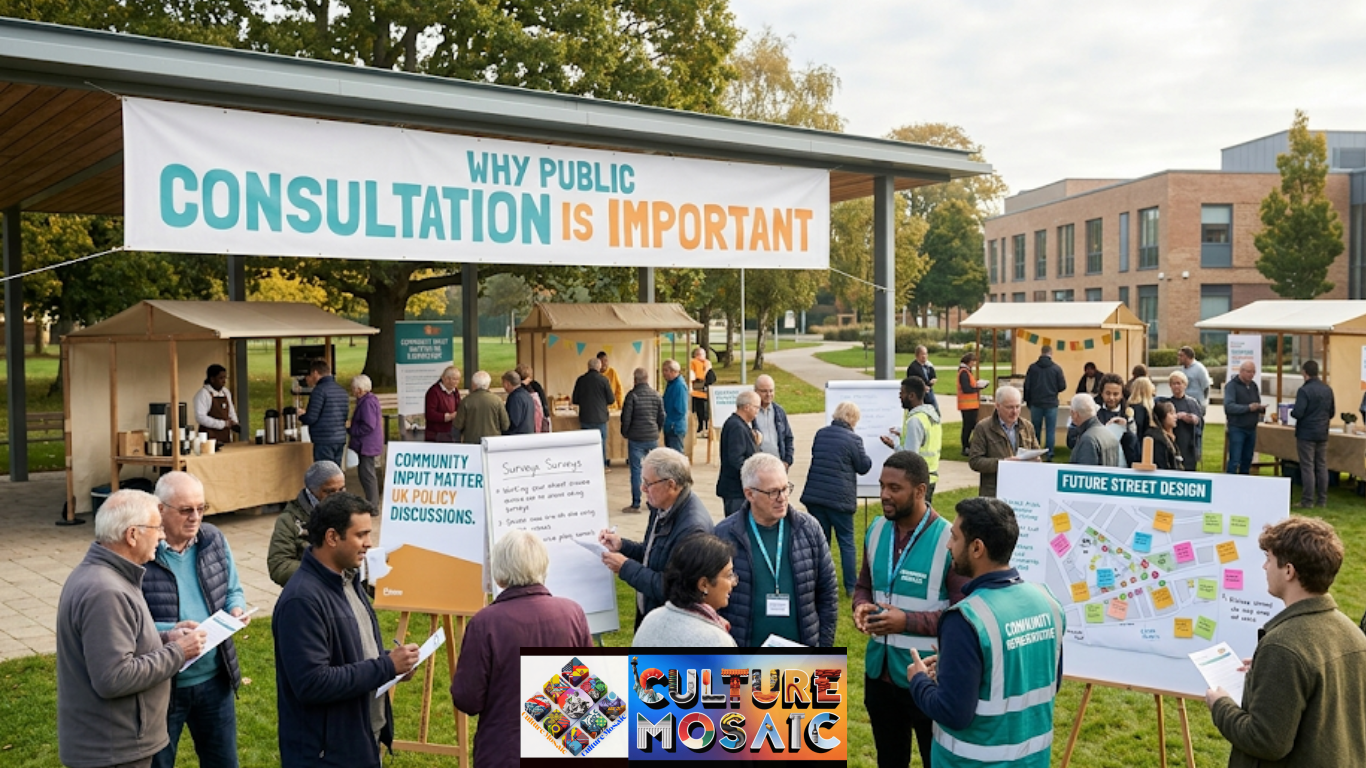
I’ve sat in enough town hall meetings to know the smell of a bad consultation. Stale coffee. A slideshow nobody asked for. A council officer reading from a script while forty residents fold their arms and wait for the part where their opinion actually matters. It rarely comes.
That’s the problem. Across the UK, decisions that reshape streets, schools, hospitals, and high streets still get made behind closed doors, then wheeled out to the public dressed up as a done deal. People feel it instantly. They can tell the difference between being asked and being told. And when they sense the latter, trust doesn’t just dip — it curdles.
I’ve spent years working alongside civic groups, parish councils, and community organisers, and I keep coming back to the same, stubborn truth: why public consultation is important isn’t an abstract policy question. It’s the difference between a community that feels ownership over its future and one that feels steamrolled by it.
What Is Public Consultation, Really?
Strip away the jargon and public consultation is simple. It’s the structured process by which a public body — a council, a government department, an NHS trust, or a transport authority — asks the people affected by a decision what they think before that decision is finalised. Not after. Before.
If you’ve ever filled in a survey about a new cycle lane, attended a drop-in session about a planning application, or written a response to a Department for Transport document, you’ve taken part in one. In the UK, consultations should be clear and concise, with responses published on gov.uk so it’s obvious when the government has actually responded to public feedback. That last bit matters more than people realise — a consultation without a visible response is just a survey nobody reads.
What Is the Role of Public Consultation in Local Democracy?
Here’s where I’ll take a stand, because I think this gets muddled far too often. The role of public consultation isn’t to make people feel good. It isn’t a box-ticking exercise squeezed in between the planning application and the press release. Its real job is threefold:
- To improve the decision itself: Residents notice things planners miss — the school run that clogs a junction, the drainage problem from ’07, or the elderly neighbour who can’t manage a steep new ramp.
- To test whether a proposal can survive contact with reality: A policy that looks tidy on a spreadsheet often falls apart the moment someone who actually lives with the consequences asks a hard question.
- To give the decision legal and moral legitimacy: Courts in England and Wales have repeatedly struck down decisions where consultation was rushed, hollow, or held after the choice was effectively already made.
That third point isn’t opinion — it’s case law. The Gunning principles, established through the 1985 case R v London Borough of Brent, ex p Gunning, require that consultation happen while a proposal can still be changed, that people are told the reasoning behind it, that they get adequate time to respond, and that the results are genuinely taken into account in the final decision. Skip any one of those steps and a consultation can be challenged, delayed, or thrown out entirely. I’ve watched it happen to a housing scheme that looked unstoppable right up until a judicial review sent it back to square one.
Why Public Consultation Is Important — The Honest Answer
So let’s answer it plainly, because I promised myself I wouldn’t bury the point under ten paragraphs of throat-clearing.
Why public consultation is important comes down to four things, and I’ve seen every one of them play out in real communities:
- It catches mistakes while they’re still cheap to fix: A road layout is easy to redraw on paper. It’s brutally expensive once the tarmac is down.
- It builds the kind of trust that survives disagreement: People don’t need to get their way every time. They need to believe they were heard. Those are different things, and good consultation delivers the second even when it can’t deliver the first.
- It spreads ownership of hard choices: When a community has genuinely shaped a decision, they defend it. When a decision lands on them from above, they resist it — sometimes for years.
- It protects the decision from legal challenge: Skipping proper engagement doesn’t just annoy people. It creates a live legal risk under the statutory duty to consult.
I’ll be blunt: councils that treat consultation as a formality tend to pay for it later in delays, litigation, and a public that stops believing anything they’re told. Councils that consult properly — early, honestly, and with a real willingness to change course — build something far more durable than a single project. They build a working relationship with the people they serve.
What Is the Importance of Consultation Beyond the Town Hall?
It isn’t only local government where this matters. The importance of consultation shows up in the NHS when a trust proposes closing a ward, in energy regulation when Ofgem consults on tariff changes, or in transport when a rail operator revises a timetable that guts an early commute. Anywhere a public body holds power over people’s daily lives, consultation is the mechanism that keeps that power accountable rather than absolute.
I’d also gently push back on the idea that consultation is just for government. Businesses, charities, and campaign groups increasingly run their own versions — informal, sure, but built on the same instinct. If you want a grounded look at how ordinary citizens organise outside formal institutions, exploring an Ethical Grassroots Advocacy Framework offers a complementary perspective on modern community engagement.
The Principles of Public Consultation
Ask ten consultation officers what “good” looks like and you’ll get ten slightly different answers, but the core foundation remains consistent. Drawing on the Gunning principles and the UK government’s own framework, the core principles of public consultation include:
- Timing: Consult while the proposal is still genuinely open to change, not after the decision has quietly been made.
- Clarity: Explain the reasoning, the criteria, and the trade-offs in language a non-specialist can follow.
- Adequate time: Consultations should generally not be launched during election periods and must run for a proportionate amount of time relative to the decision’s impact.
- Genuine consideration: The results have to actually shape the outcome, not just decorate a report nobody reads.
- Proportionality: A minor planning tweak doesn’t need the same machinery as a hospital closure; treating every consultation identically wastes everyone’s goodwill.
I’d add a sixth, unofficial principle from years of watching this up close: honesty about constraints. Tell people upfront what’s actually negotiable and what isn’t. Nothing burns trust faster than a consultation that pretends everything is on the table when the budget was fixed eighteen months ago.
The Public Consultation Process, Step by Step
If you’re new to this, the public consultation process usually runs through five distinct stages:
- Scoping: The public body defines the core question, the affected population, and the specific decision it is attempting to make.
- Publishing: A consultation document goes live — typically on
gov.ukor a council’s consultation portal — alongside supporting background evidence. - Gathering views: Feedback is collected through surveys, public meetings, written submissions, focus groups, or digital engagement platforms.
- Analysis: Responses are independently and thoroughly reviewed, including the inconvenient counter-arguments.
- Response and decision: The public body publishes what it heard, explains how it altered the plan (or why it couldn’t), and proceeds to a final decision.
That last stage gets skipped constantly, yet it’s the precise step residents remember most. For those looking to see how these steps connect to broader public initiatives, exploring Local Civic Engagement Strategies highlights how proactive community efforts run alongside formal consultation processes.
A Real Example of Public Consultation in the UK
Let me give you something concrete rather than theory. Large infrastructure projects like HS2 have run multiple rounds of formal public consultation over the years — on route options, station design, and environmental impact — precisely because the scale of disruption to homes and land demanded it.
Locally, you’ll see the same pattern on a smaller scale: a borough council proposing a Low Traffic Neighbourhood will typically run a consultation phase, publish a “you said, we did” report, and adjust road closures based on what residents and emergency services actually raised.
What separates a good example from a bad one isn’t the paperwork. It’s whether the final scheme visibly reflects what people said. I’ve reviewed consultation responses where residents flagged a genuine safety issue — a blind junction, a missing dropped kerb — and watched the design change because of it. That’s public consultation doing its job.
Public Consultation Guidelines Every Council Should Follow
For anyone running a consultation, the core guidelines worth following start with the Cabinet Office’s framework, which moved away from a rigid twelve-week default toward a more flexible, proportionate model. In practice, that means:
- Match the length of the consultation to the scale and sensitivity of the decision.
- Use plain English instead of bureaucratic jargon.
- Proactively reach the people actually affected, not just those who regularly attend public meetings.
- Publish a post-consultation response every single time — even when the outcome is “we’re going ahead as planned, and here’s why.”
If your organisation is drafting its own public framework, resources like a Civic Leader’s Playbook detail how to build engagement structures that earn long-term trust. For smaller, neighborhood-scale projects that don’t warrant a massive statutory effort, implementing Micro-Civic Interventions offers an effective alternative.
A Note on UK-Wide Consultations and Specific Sector Needs
Public consultation across the UK isn’t one uniform process — it varies by nation, sector, and statutory duty. Scotland, Wales, and Northern Ireland each maintain their own frameworks alongside Westminster. Furthermore, within specific sectors, consultation gets remarkably granular. In further education, for instance, the Department for Education frequently consults on updates to the Individual Learner Record — often referred to as the public consultation ILR process — which dictates how colleges report student data and funding. It’s a clear reminder that consultation extends far beyond roads and planning into technical systems that quietly structure public services.
You’ll also hear public consultation described using alternative terms. Common synonyms like “public engagement,” “community engagement,” or “stakeholder engagement” are used depending on the industry, though the fundamental legal duty to consult properly remains unchanged regardless of the terminology used.
Where to Find a List of Government Consultations
If you want to get involved directly, the UK government maintains a live list of government consultations on gov.uk, searchable by department and open/closed status. It’s worth taking five minutes to explore. Most people assume public decisions happen entirely without input, but most of the time, a formal consultation window existed — and almost nobody outside professional lobby groups submitted a response.
That’s the real, quiet tragedy: the system for being heard already exists. It is simply underused, not absent.
Why This Matters More Than It Looks
I think about civic apathy a lot in my work — that pervasive feeling that showing up changes nothing. Examining issues like Declining Civic Knowledge in US reveals common systemic patterns across Western democracies that closely match what we experience in UK town halls. Statutory consultation remains one of the few formal avenues where an ordinary person’s written feedback can directly alter a council’s plan, a hospital’s layout, or a town’s road network.
Waste that moment and you lose more than a single decision — you destroy the public’s willingness to engage in the future. For those interested in alternative advocacy methods, our guide on Narrative Advocacy illustrates how communities effectively use personal storytelling alongside formal submissions to sway public outcomes.
The Takeaway
If you take one thing from this piece, let it be this: understanding why public consultation is important isn’t just a tagline for a council report — it is the fundamental line between decisions that stick and decisions that face endless resistance.
Here is my honest pitch: read the consultation document. Fill in the survey. Attend the drop-in session, even the one with stale coffee. Public consultation only works when communities treat it as real, and it only remains real when public bodies continually prove it was worth the effort. Both sides have to hold up their end.
At Culture mosaic, we analyze the civic infrastructure shaping daily life because it deserves the exact same scrutiny as headline political news. For a complete overview for non-specialists, our comprehensive guide on Why public consultation is important serves as a foundational primer for navigating consultation policy.
 Marcus J. Holloway