
 By Culture Expert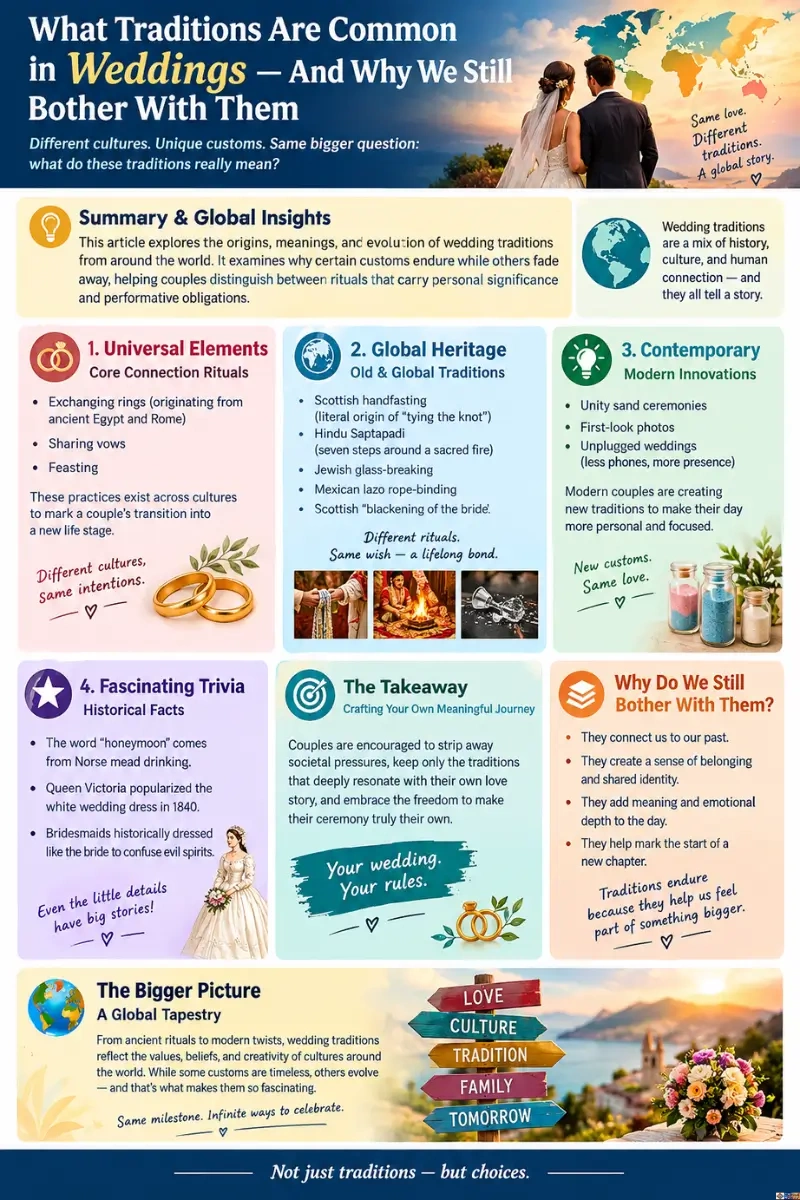
What Traditions Are Common in Weddings — And Why We Still Bother With Them
Wedding Traditions Around the World
This article explores the origins, meanings, and evolution of wedding traditions from around the world. Drawing on extensive cross-cultural fieldwork, it examines why certain customs endure while others fade away, helping couples distinguish between rituals that carry personal significance and performative obligations.
Core Connection Rituals
Core practices like exchanging rings (originating from ancient Egypt and Rome), sharing vows, and feasting exist across cultures to mark a couple’s transition into a new life stage.
Old & Global Traditions
The piece highlights diverse global customs, such as Scottish handfasting (the literal origin of “tying the knot”), Hindu Saptapadi (seven steps around a sacred fire), Jewish glass-breaking, Mexican lazo rope-binding, and even the eccentric Scottish “blackening of the bride.”
Modern Innovations
Newer practices like unity sand ceremonies, first-look photos, and unplugged weddings have emerged to help modern couples carve out private moments and navigate digital distractions.
Fascinating Trivia
Fun facts include the origins of the word “honeymoon” (Norse mead drinking), Queen Victoria popularizing the white wedding dress in 1840, and bridesmaids historically dressing like the bride to confuse evil spirits.
Crafting Your Own Meaningful Journey
Couples are encouraged to strip away societal pressures, keep only the traditions that deeply resonate with their own love story, and embrace the freedom to make their ceremony truly their own.
I have sat through a lot of weddings. Fifty, at minimum, across four continents, in my years as a cultural anthropologist. And I still remember the first time a bride I was studying in Rajasthan turned to me, halfway through her mehndi application, and asked, “Do people in your country do this too?” I didn’t have a good answer. That question has stuck with me for over a decade.
Here’s the problem I keep running into, both in my fieldwork and in conversations with friends planning their own weddings: nobody tells you why you’re doing any of it. You’re handed a garter, a veil, a tiny sixpence for your shoe, and a list of “shoulds,” and nobody explains where any of it came from. That gap between ritual and meaning is uncomfortable. It makes weddings feel like performances instead of promises. I’ve watched brides cry not from joy but from sheer exhaustion, buried under traditions they didn’t choose and don’t understand.
So here’s what I want to do in this piece. I want to answer the question people type into Google at eleven at night, three weeks before their wedding: what traditions are common in weddings, and why do we still bother with any of them? I’ll walk you through the old customs, the new ones, the strange ones, and a few of my own favourites. By the end, you should be able to look at your own ceremony and pick out exactly which pieces you want to keep, which ones you want to toss, and which ones you never knew existed. That, to me, is worth far more than another generic checklist.
I should say upfront, I’m not neutral on this topic, and I don’t think I should be. Some traditions deserve to be kept exactly as they are. Others deserve a quiet, respectful burial. Part of my job, as someone who studies this for a living, is telling you honestly which is which, instead of pretending every single custom is equally sacred just because it’s old. That’s not always the comfortable answer, but it’s the useful one.
What Traditions Are Common in Weddings?
If you ask ten different cultures what traditions are common in weddings, you’ll get ten different answers, and that’s the point. But a handful of practices show up again and again, in wildly different forms, because they’re solving the same human problem: how do you mark the exact moment two lives become one?
Exchanging rings is probably the most universal. The circle has no beginning and no end, which is a tidy metaphor, but the real history is grittier. Ancient Egyptians wove rings from reeds and hemp; Romans later switched to iron, then gold, once they figured out gold doesn’t rust or crack under the strain of daily wear. The left-hand, fourth-finger placement comes from an old (and medically wrong) Roman belief that a vein ran straight from that finger to the heart. Wrong biology, right sentiment.
Vows are another near-universal fixture, though their tone shifts wildly by culture. Some are legal formulas recited word for word. Others are handwritten, raw, occasionally a little embarrassing to read aloud in front of your grandmother. I happen to think the embarrassing ones age better.
Feasting shows up everywhere too. A Chinese banquet with its ten-course structure, a Nigerian owambe with enough jollof rice to feed a small city, a quiet Irish supper of colcannon and soda bread. Food, at a wedding, is never just food. It’s proof that a family can provide, that a community showed up, that nobody left hungry on the one day that’s supposed to matter most.
For a broader survey of these customs, Brides has put together a solid roundup of what traditions are common in weddings across dozens of countries, and it’s worth a browse if you want the full scope.
Old Wedding Traditions Across Cultures
Old wedding traditions tend to survive for one of two reasons: either they’re genuinely useful, or they’re stubborn. Sometimes both.
Take the Scottish handfasting ceremony. Couples’ wrists are literally bound together with cord or tartan cloth while vows are spoken, which is where the phrase “tying the knot” actually comes from. It’s not a metaphor. It’s a physical restraint, gently applied, meant to last exactly as long as the vows do and not a second longer.
In Hindu weddings, the Saptapadi, or “seven steps,” has the couple circle a sacred fire seven times, each round representing a specific vow: nourishment, strength, prosperity, wisdom, family, companionship, and lifelong loyalty. It’s slow, it’s smoky, and it’s genuinely moving to watch even if you don’t understand a word of Sanskrit.
Jewish weddings break a glass underfoot at the ceremony’s close, most commonly interpreted as a reminder that joy is fragile, that even at the happiest moment, the couple should remember the destruction of the Second Temple in Jerusalem. Guests shout “Mazel tov!” the instant the glass shatters, and there’s something almost violent about the relief in that shout.
Then there’s the sixpence-in-the-shoe tradition from Britain, part of the old rhyme: “Something old, something new, something borrowed, something blue, and a sixpence in her shoe.” Each item ties the bride to her past (old), her future (new), her community (borrowed), fidelity (blue), and, with the coin, financial prosperity. It’s a small ritual with an enormous amount packed into it.
Modern Wedding Traditions
Modern wedding traditions are, frankly, more interesting than people give them credit for. They’re not replacing the old customs so much as answering questions the old ones never had to.
Unity ceremonies have exploded over the last twenty years: sand blending, where two colours of sand are poured into one vessel and can never be separated again; unity candles; even, at one wedding I attended in Portland, a joint tree planting where the couple buried a small oak sapling in the venue’s garden. None of these have deep historical roots. They were invented, mostly in the twentieth century, because couples wanted a visual, physical moment that older ceremonies didn’t provide.
First-look photos are another newer habit, where the couple sees each other privately before the ceremony instead of at the altar. It sounds like it would ruin the drama. In practice, I’ve found it does the opposite. Couples get to have their reaction in private, without three hundred phones pointed at their faces, and the ceremony itself becomes calmer because the big emotional release already happened an hour earlier.
Then there’s the rise of second-day and destination weddings, unplugged ceremonies with no phones allowed, and couples writing their own officiant scripts instead of using a religious or civil template. I’ll be blunt: I think the unplugged trend is one of the best things to happen to weddings in my lifetime. Nothing kills a vow exchange faster than fifty raised phone screens between you and the person you’re marrying.
Wedding Traditions Around the World
It’s a fair question to ask: what are weddings like in your country, compared to somewhere else? The range is genuinely wild, and once you start comparing notes with people from other backgrounds, you realise how much of what you assumed was “normal” is really just local.
In Mexico, the lazo, a large decorative rope or rosary, is draped in a figure-eight around the couple’s shoulders after their vows, physically binding them as a couple in front of the room. In South Korea, the paebaek ceremony has the newlyweds bow formally to the groom’s parents, who throw chestnuts and dates at the couple to catch in a cloth, one representing sons, the other daughters, an old and slightly chaotic fertility ritual. In Germany, guests smash porcelain (never glass, which is considered bad luck) the night before the wedding in a tradition called Polterabend, and the couple sweeps up the mess together as practice for solving problems as a team.
Here’s my outside-the-box one, and it’s a personal favourite: the Scottish “blackening of the bride,” where friends douse the bride-to-be (or occasionally the groom) in a foul mixture of soot, treacle, and whatever else is at hand, then parade her through town tied to a chair. It sounds miserable. It’s meant to. The idea is that if you can survive that kind of public humiliation with your friends laughing beside you, marriage will feel easy by comparison. It’s the strangest tradition I’ve studied, and I still think about it more than any of the elegant ones.
Interesting Facts About Weddings
A few details I love pulling out at dinner parties. The word “honeymoon” likely comes from an old Norse custom of drinking honey mead for the first month of marriage, to sweeten the union. The white wedding dress wasn’t standard until Queen Victoria wore one in 1840; before that, brides simply wore their best dress, in whatever colour they owned.
Bridesmaids originally dressed identically to the bride to confuse evil spirits (or jealous suitors) about which woman was actually getting married. And the average modern wedding, across most Western countries, now involves somewhere between three and five separate events: engagement party, shower, rehearsal dinner, ceremony, and reception, a far cry from the single-day affairs of even fifty years ago.
A few more that rarely make the highlight reel. The best man’s role started out as an actual bodyguard in some Northern European traditions, there to physically fight off rival suitors or disapproving relatives, not just to hold the rings and give a slightly too-long toast.
Throwing rice, an old fertility blessing meant to wish the couple a plentiful household, has largely been swapped for confetti or bubbles at modern venues, since rice can be dangerous for birds and a nightmare for the cleaning crew. And the wedding cake tradition traces back to Ancient Rome, where a loaf of bread was actually broken over the bride’s head for good fortune, which is, I’ll admit, a considerably messier custom than the tiered fondant version we use today.
What Traditions Are Common in Weddings: My Favourite Wedding Tradition
People ask me constantly what my favourite wedding tradition is, expecting something grand. It’s not. It’s the Quaker practice of silent worship weddings, where the couple simply sits with their guests in total silence until they feel moved to stand and speak their vows, unprompted, whenever it feels right. No processional.
No officiant. No script. Just quiet, until it isn’t. I attended one in rural Pennsylvania years ago and the silence itself became the ceremony. Nobody rushed it. When the groom finally stood, his voice cracked on the second word, and half the room was in tears before he finished his first sentence. I’ve never forgotten it.
If you’re planning a wedding right now and feeling buried under everyone else’s expectations, take this as your permission slip: you don’t need every tradition on this list. Pick the two or three that actually mean something to your story, skip the rest without guilt, and lean on people who’ve studied this stuff so you don’t have to reinvent it alone. That’s exactly the kind of research and storytelling Culture Mosaic was built to do, and I’d genuinely love for you to keep exploring there.
Wondering why we still throw rice, break glasses, or wear white down the aisle? Take a fascinating global journey through wedding history—from ancient Egyptian reed rings to quirky Scottish traditions—to help you decode the rituals, ditch the stress, and keep only the traditions that truly matter to your love story!
FAQs About What Traditions Are Common in Weddings
What are some interesting facts about weddings?
The word “honeymoon” traces back to an old Norse custom of drinking honey mead for a full month after the wedding. Wedding rings have been exchanged since ancient Egypt, originally woven from reeds rather than metal. The white wedding dress only became standard after Queen Victoria wore one in 1840, and bridesmaids once dressed identically to the bride specifically to confuse evil spirits about who the real bride was. Even the phrase “tying the knot” comes from a literal act, the Scottish handfasting ceremony, where a couple’s wrists are bound with cord during their vows.
What traditions are common in weddings across most cultures?
Despite huge cultural variation, a handful of elements show up almost everywhere: an exchange of rings or symbolic objects, spoken vows or promises, a shared meal or feast, some form of blessing from family or community elders, and a public declaration that shifts the couple’s status in the eyes of their community. The specific form changes constantly, but the underlying function stays remarkably consistent across continents and centuries.
What are wedding traditions like in different countries?
They vary enormously. In India, the Saptapadi has the couple take seven steps around a sacred fire, each one tied to a specific promise. In Germany, Polterabend has guests smashing porcelain the night before the ceremony for good luck. In South Korea, the paebaek has parents throwing chestnuts and dates at the couple to predict how many children they’ll have. In Mexico, the lazo binds the couple in a decorative rope figure-eight after their vows. No two countries approach the moment identically, which is exactly what makes studying them so rewarding.
What’s the difference between old and modern wedding traditions?
Old wedding traditions tend to be tied to religious belief, family structure, or community survival, things like dowries, arranged blessings, or fertility rituals. Modern wedding traditions, like unity sand ceremonies, first-look photos, and unplugged ceremonies, were mostly invented in the last fifty to a hundred years to solve problems couples face now: too many phone cameras, too little private emotional space, or a desire for a visual moment with no religious weight attached. Neither category is more “real” than the other; they’re just answering different questions.
What’s your favorite wedding tradition, and why?
Mine is the Quaker silent worship wedding, where the couple sits with their guests in total silence and stands to speak their own vows only when they feel ready, with no officiant and no script. I love it because it strips away every performative layer of a wedding and leaves just two people choosing, in their own time, to say something true out loud. I’ve watched one, and the silence before the groom spoke was more powerful than any orchestrated processional I’ve studied before or since.