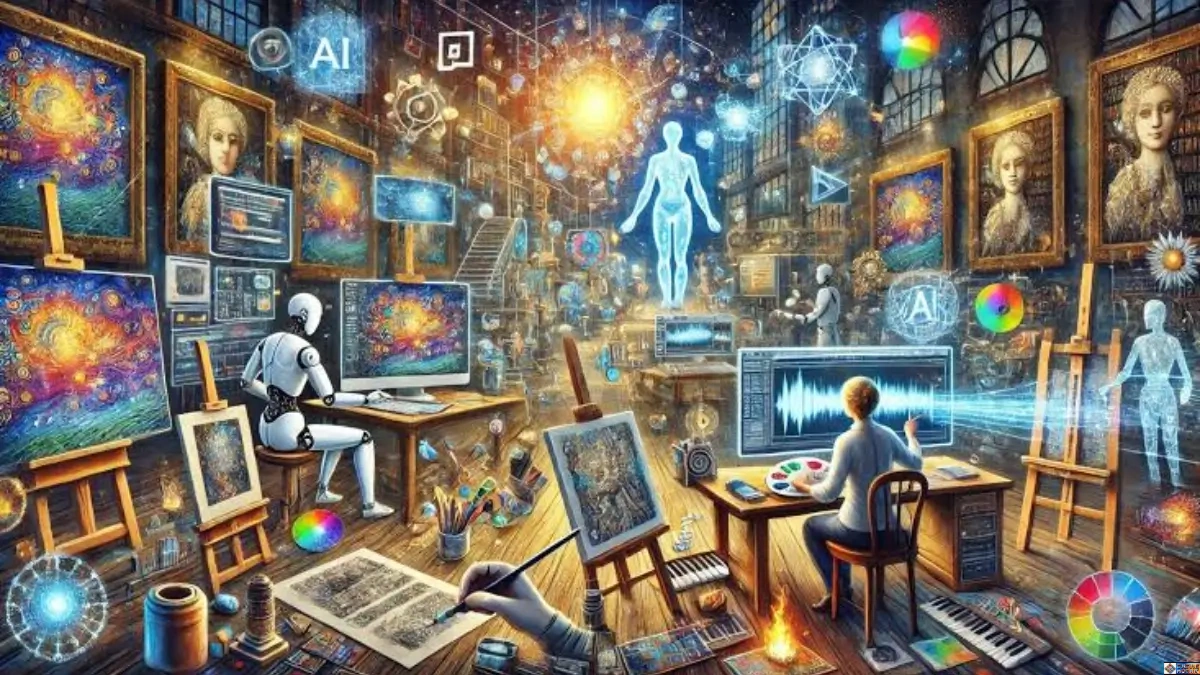
The intersection of AI and cultural production has ignited one of the most profound debates of our digital age. As generative artificial intelligence tools become increasingly sophisticated, they’re not just changing how we create art, music, and literature—they’re fundamentally challenging our understanding of what it means to be creative, authentic, and human.
From AI-generated paintings selling at major auction houses to synthetic voices indistinguishable from real musicians, we’re witnessing a transformation that touches every corner of cultural production. This shift raises urgent questions: Can machines truly be creative? What happens to human identity when AI can perfectly mimic our creative voices? And how do we navigate a world where the line between human and machine-made content grows increasingly blurred?
Understanding AI and Cultural Production in the Modern Era
AI and cultural production refers to the growing ecosystem where artificial intelligence systems participate in, augment, or fully generate creative works across all artistic mediums. This phenomenon extends far beyond simple automation—it represents a fundamental reimagining of the creative process itself.
Today’s generative AI systems can compose original music, write compelling narratives, create photorealistic images, and even develop entirely new artistic styles. These tools have democratized certain aspects of creativity while simultaneously threatening established creative industries. The technology processes vast datasets of existing cultural works to generate new content that often appears remarkably human.
The current landscape of AI and cultural production includes text-to-image generators like DALL-E and Midjourney, large language models capable of sophisticated writing, AI music composition tools, and video generation systems. Each advancement pushes the boundaries of what machines can create, forcing us to reconsider long-held assumptions about originality, authorship, and creative genius.
The Crisis of Authenticity: Can AI Art Be Truly Creative?

At the heart of the AI and cultural production debate lies a philosophical crisis: the question of authenticity. Traditional definitions of art have centered on human experience, emotion, and intention. When an AI system generates a beautiful landscape painting or a moving piece of music, does it possess these qualities, or is it merely executing sophisticated pattern recognition?
Critics argue that AI-generated content represents a form of high-tech collage—a remixing of existing human creativity without genuine understanding or emotional depth. They point out that AI systems lack consciousness, lived experience, and the intentionality that has historically defined artistic creation. From this perspective, AI and cultural production create aesthetically pleasing outputs but not authentic art.
Defenders counter that this view is overly restrictive and anthropocentric. They suggest that creativity exists on a spectrum and that AI represents a new form of creative expression. After all, human artists also learn by studying existing works, building on cultural traditions, and recombining influences in novel ways.
The legal and ethical dimensions of this authenticity crisis are equally complex. Current intellectual property law wasn’t designed for AI and cultural production scenarios. Major lawsuits are underway examining whether training AI on copyrighted works constitutes fair use or theft. Artists whose distinctive styles can be replicated by AI with a simple text prompt face an unprecedented threat to their creative livelihoods and cultural capital.
The US Copyright Office has taken the position that AI-generated works lacking substantial human authorship cannot be copyrighted, adding another layer of complexity to questions of ownership and authenticity in AI and cultural production.
From Art to Identity: AI’s Impact on Personal and Digital Personas

The implications of AI and cultural production extend beyond traditional art forms into the very fabric of personal identity. We’re entering an era where AI can generate perfect digital doppelgängers—synthetic versions of ourselves that speak, create, and interact in ways indistinguishable from our authentic selves.
AI voice cloning technology has advanced to the point where just seconds of audio can be used to generate speech in someone’s exact voice. Musicians have found their vocal signatures replicated without consent. Actors face the prospect of their digital likenesses being deployed long after they’ve chosen to stop working. This technological capability fundamentally challenges our understanding of identity ownership in the digital age.
The proliferation of AI and cultural production tools has also enabled the creation of entirely fictional personas that feel authentic. Virtual influencers with AI-generated faces and personalities attract millions of followers. Deepfakes blur the line between reality and fabrication, making it increasingly difficult to trust what we see and hear online.
For creative professionals, this identity crisis is particularly acute. A writer’s unique voice, developed over decades, can now be approximated by AI. A visual artist’s distinctive style becomes a simple parameter in an image generator. The very thing that made creators unique—their individual creative identity—becomes reproducible, challenging the economic and cultural value of personal artistic expression.
This democratization of style and voice has paradoxical effects. While it allows more people to participate in cultural production, it simultaneously diminishes the distinctiveness that made individual creators valuable and recognizable in the cultural marketplace.
Augmentation vs. Replacement: AI as a Creative Tool

Not all perspectives on AI and cultural production frame it as a threat. A growing movement of artists, writers, musicians, and other creators is embracing AI as a powerful augmentation tool rather than viewing it as a replacement for human creativity.
These practitioners use AI systems as collaborative partners in the creative process. A visual artist might use AI to rapidly generate dozens of compositional options, then apply their human judgment and refined skills to select and perfect the most promising directions. A writer might use AI to break through creative blocks, generate alternative phrasings, or explore narrative possibilities they hadn’t considered.
Musicians are incorporating AI in sophisticated ways that enhance rather than replace their artistry. Some use AI to generate novel harmonies or rhythmic patterns, then arrange these elements into cohesive compositions. Others employ AI to create backing tracks or to experiment with genre-blending approaches that would be prohibitively time-consuming manually.
This augmentation approach to AI and cultural production emphasizes the continued centrality of human judgment, taste, and intentionality. The AI provides possibilities; the human artist provides direction, meaning, and the critical editorial eye that transforms raw output into resonant cultural work.
Forward-thinking educational institutions are beginning to teach AI literacy alongside traditional creative skills, preparing the next generation of cultural producers to work fluently with these new tools. Rather than resisting technological change, this approach embraces it while maintaining human creativity at the center of cultural production.
The augmentation perspective also addresses economic concerns more constructively. Rather than viewing AI as simply eliminating creative jobs, it suggests that the future belongs to creators who can effectively harness AI capabilities while bringing irreplaceable human qualities—emotional intelligence, cultural understanding, ethical judgment—to the creative process.
The Economic Disruption: Impact on Creative Industries

The rise of AI and cultural production has triggered significant economic turbulence across creative industries. The financial implications extend from individual freelancers to major entertainment corporations, reshaping business models and professional pathways.
Stock photography and illustration markets have experienced dramatic disruption as AI image generators can produce custom visuals in seconds at minimal cost. Commercial artists who once earned a steady income from routine creative work find themselves competing against tools that can generate hundreds of variations instantaneously.
The writing industry faces similar pressures. Content mills and marketing departments increasingly turn to AI for routine copywriting, blog posts, and social media content. While the quality varies, the economic pressure on human writers is undeniable, particularly for entry-level and mid-tier commercial work.
Music production and composition are not immune. AI systems can now generate background music, jingles, and even genre-specific compositions that meet many commercial needs. Production music libraries that once sustained numerous musicians face competition from AI-generated alternatives.
However, the economic story of AI and cultural production isn’t uniformly negative. New opportunities are emerging for creators who can bridge the human-AI divide. Specialists in “prompt engineering”—the art of effectively directing AI systems—command premium rates. Creative directors who can oversee AI-augmented production pipelines bring valuable expertise. Artists who incorporate AI into genuinely novel creative practices attract attention and patronage.
The highest end of creative markets—work requiring genuine originality, deep cultural insight, emotional resonance, or prestigious human authorship—has proven more resistant to AI disruption. Collectors still pay premium prices for works by recognized human artists. Readers seek out novels by beloved authors. Audiences value performances by living musicians.
This bifurcation suggests that AI and cultural production may be creating a two-tier creative economy: a lower tier where routine creative work becomes increasingly automated and economically devalued, and an upper tier where distinctly human creativity becomes even more valuable and celebrated.
Legal and Ethical Frameworks: Navigating Uncharted Territory
The rapid advancement of AI and cultural production has outpaced legal and ethical frameworks, creating a landscape of uncertainty and active contestation. Societies are grappling with fundamental questions about rights, ownership, and responsibility in this new creative paradigm.
The thorniest legal issues center on training data. Most powerful AI systems were trained on enormous datasets scraped from the internet, including copyrighted works whose creators never consented to this use. Artists, photographers, writers, and musicians have filed class-action lawsuits arguing that this constitutes systematic copyright infringement.
AI companies counter that training constitutes transformative fair use—that AI doesn’t copy works but learns patterns and relationships from them, similar to how human artists study existing works. Courts are now working through these arguments, with outcomes that will profoundly shape the future of AI and cultural production.
Attribution presents another challenge. When AI generates content influenced by thousands or millions of source works, how should attribution function? Current systems typically provide no attribution at all, erasing the cultural lineage that has traditionally been recognized in creative fields.
Ethical concerns extend beyond legal questions. The environmental impact of training and running large AI systems is substantial, requiring massive computational resources and energy consumption. The cultural impact of potentially flooding creative markets with AI-generated content raises questions about diversity, quality, and the preservation of human creative traditions.
Some creators and organizations are developing ethical alternatives. Opt-in datasets where artists voluntarily contribute training data in exchange for recognition or compensation represent one approach. AI systems trained exclusively on public domain or licensed content offer another path. These efforts attempt to create forms of AI and cultural production that respect creator rights while still advancing the technology.
Transparency has emerged as a key ethical principle. Many argue that AI-generated content should be clearly labeled, allowing consumers to make informed choices about what they consume and support. However, detection remains technically challenging, and incentives for disclosure are often weak.
The Consumer’s New Role: Navigating an AI-Saturated Media Landscape
As AI and cultural production become ubiquitous, consumers face new responsibilities and challenges. The traditional role of simply consuming culture is evolving into something more active and critical—navigating an increasingly complex landscape where authenticity is no longer self-evident.
Developing AI literacy has become essential for informed cultural consumption. Understanding the basic capabilities and limitations of AI systems helps consumers evaluate what they encounter. Recognizing the hallmarks of AI-generated content—subtle inconsistencies in images, characteristic patterns in text, unnatural elements in synthetic media—becomes a valuable skill.
The proliferation of deepfakes and synthetic media has made critical evaluation crucial. What appears to be a video of a public figure making controversial statements might be fabricated. What seems like authentic photography might be entirely AI-generated. This reality requires heightened skepticism and fact-checking habits.
Consumers who care about supporting human creativity face new choices. Many are consciously seeking out and preferring to support verified human creators, viewing their consumption as a form of cultural advocacy. Platforms and marketplaces that clearly distinguish human from AI-created work enable this preference.
The concept of “authentic” cultural experiences is being redefined. For some consumers, knowing a work was created by a human being—with all the struggle, intention, and lived experience that implies—fundamentally enhances its meaning and value. For others, the subjective experience of the work matters more than its origin.
This generational divide in attitudes toward AI and cultural production is notable. Younger consumers who have grown up with algorithmic recommendations and synthetic media often feel less attachment to traditional notions of human authorship. Older generations more frequently express nostalgia for pre-AI cultural production and concern about what might be lost.
Consumer advocacy is taking new forms. Organizations are emerging that certify human-created content or advocate for creator rights in the AI age. Boycotts and campaigns target companies perceived as exploiting AI at the expense of human creators. The marketplace for culture is becoming a site of active ethical debate.
Looking Forward: The Future of AI and Cultural Production
The trajectory of AI and cultural production suggests we’re still in the early stages of a transformation that will continue unfolding for decades. Emerging trends and technologies provide glimpses of what might come next.
AI systems are becoming increasingly multimodal, able to work seamlessly across text, image, audio, and video. Future tools may enable entirely new forms of cultural expression that don’t fit neatly into traditional categories—interactive narratives that adapt to each reader, visual art that evolves, musical compositions that respond to environmental factors.
The concept of collaboration between human and AI creators will likely become more sophisticated. Rather than AI being a simple tool or replacement, we may see genuine creative partnerships where human and artificial intelligence contribute complementary strengths to cultural works.
Virtual and augmented reality platforms are creating new spaces for AI and cultural production. Entirely synthetic worlds populated with AI-generated characters, environments, and narratives may become major cultural venues. The distinction between experiencing human-created and AI-generated culture may blur further in immersive environments.
Personalization represents another frontier. AI systems might create cultural content tailored to individual preferences—a novel that adapts to your reading pace and interests, music that responds to your mood, and visual art that evolves based on your reactions. This radical personalization challenges the traditional model of culture as a shared experience.
Regulatory frameworks will eventually catch up with technological reality. We can anticipate new laws addressing AI training data, attribution requirements, labeling standards, and creator rights. International coordination will be necessary as AI and cultural production are inherently global.
Educational systems will need to evolve, teaching not only traditional creative skills but also AI literacy and human-AI collaboration. The next generation of cultural producers will likely view AI as simply another tool in their creative arsenal, integrated from the beginning of their training.
The philosophical questions raised by AI and cultural production—What is creativity? What makes something authentic? What does it mean to be human in our creative capacities?—will continue driving cultural and academic discourse. These aren’t questions with simple answers, but wrestling with them may itself become an important form of cultural production.
Conclusion: Embracing Complexity in the Age of AI and Cultural Production
The revolution in AI and cultural production doesn’t offer simple narratives of utopian promise or dystopian threat. Instead, it presents us with profound complexity—technological capabilities that are simultaneously liberating and constraining, democratizing and displacing, creative and derivative.
What remains clear is that AI is not going away, and its role in cultural production will only expand. The question is not whether AI will be part of our creative future, but how we choose to integrate it—what values we prioritize, what safeguards we establish, what distinctly human elements we choose to preserve and celebrate.
The most productive path forward likely involves holding multiple truths simultaneously: acknowledging the real threats AI poses to creative livelihoods while recognizing its potential as a creative tool; celebrating human creativity while remaining open to new forms of expression; protecting creator rights while enabling innovation.
For creators, the challenge is finding ways to harness AI’s capabilities while maintaining the human elements—emotional depth, cultural insight, ethical judgment, lived experience—that give creative work meaning and resonance. For consumers, it’s developing the critical literacy to navigate an increasingly complex cultural landscape while supporting the human creativity they value.
The conversation about AI and cultural production is ultimately a conversation about who we are and who we want to become. It asks us to articulate what we truly value about human creativity and why it matters. In that sense, the AI revolution may be provoking a cultural renaissance—not despite the challenges it presents, but because of them, forcing us to deeply reconsider questions we had taken for granted.
As we move forward, the goal should not be to resist change or uncritically embrace it, but to shape the evolution of AI and cultural production in ways that enhance human flourishing, preserve cultural diversity, and expand rather than constrain the possibilities for meaningful creative expression.
Frequently Asked Questions About AI and Cultural Production
Q: Can AI-generated art be copyrighted?
Currently, the US Copyright Office has ruled that AI-generated works lacking substantial human authorship cannot receive copyright protection. Works where a human uses AI as a tool within a creative process directed by human judgment may qualify for copyright, but purely AI-generated content does not. This area of law is rapidly evolving as courts address numerous pending cases about AI and cultural production.
Q: How can I tell if content was created by AI?
Detecting AI-generated content is becoming increasingly challenging as systems improve. Common indicators include unusual patterns in images (strange hands or text, inconsistent lighting, impossible reflections), unnaturally smooth or generic writing styles, and subtle logical inconsistencies. However, sophisticated AI output may be indistinguishable from human creation. Several tools are being developed to detect AI-generated content, though they’re not foolproof.
Q: Will AI replace human artists, writers, and musicians?
The impact of AI and cultural production on creative careers is complex. AI is already displacing certain types of routine creative work, particularly in commercial applications like stock photography and copywriting. However, work requiring genuine originality, emotional depth, cultural insight, or prestigious human authorship remains valuable. Many experts predict a bifurcated creative economy where routine work becomes automated while distinctly human creativity becomes even more valued.
Q: Is training AI on existing artwork ethical?
This remains one of the most contentious questions in AI and cultural production. Critics argue that training AI on copyrighted works without permission or compensation constitutes theft and undermines creators’ livelihoods. Proponents contend it represents transformative fair use similar to how humans learn from existing works. Multiple lawsuits are working through courts to establish legal precedents. Ethically, many argue for opt-in training datasets where creators consent and receive recognition or compensation.
Q: How should consumers support human creators in the age of AI?
Consumers concerned about supporting human creativity can take several actions: consciously seek out and patronize verified human creators; use platforms that clearly distinguish human from AI-created work; advocate for transparency in labeling AI-generated content; support organizations fighting for creator rights; and educate themselves about AI and cultural production issues. Many creators now explicitly market their work as human-made, allowing conscious consumer choice to shape market dynamics.