
 By Culture Expert
Quick Summary
- What is employee engagement?
- The CIPD defines it as a blend of commitment to the organisation, belief in its values, and a genuine willingness to help colleagues — not just job satisfaction.
- Why is employee engagement important?
- Gallup’s 2026 research puts global engagement at 20%, its lowest point since 2020, costing the world economy roughly $10 trillion a year in lost output.
- What is employee engagement infrastructure?
- The combined system of tools, rituals, feedback loops, and management habits that turn a one-off engagement score into a lasting behaviour change.
- Why do engagement platforms fail?
- Almost never the software. They fail when leaders treat a dashboard as the fix instead of changing what gets rewarded, followed up on, and acted upon.
- How do you measure ROI?
- Track turnover reduction, absenteeism cost, and productivity lift against total programme spend, then apply a conservative attribution rate (30–50%) so the number holds up under scrutiny.
I once sat in a boardroom while a CFO asked a simple question: “We spent £180,000 on this engagement platform last year. What did we get for it?” Nobody in the room could answer him. Not because the platform hadn’t worked — the pulse scores had actually ticked up — but because nobody had built the infrastructure to connect a survey score to a business outcome. That silence is more common than most HR departments would like to admit.
The Problem: Everyone Measures Engagement. Almost Nobody Builds For It
Here’s the uncomfortable part. Gallup’s State of the Global Workplace: 2026 Report found worldwide engagement has dropped to 20%, down from a peak of 23% in 2022 — the first time in the study’s history it has fallen two years running. That single number represents tens of millions of people who’ve quietly checked out. And the cost isn’t abstract. Gallup estimates low engagement costs the global economy $10 trillion annually, or roughly 9% of global GDP.
In the UK specifically, the picture is grim but improving at a crawl. Overall UK engagement rose 3% to 65% — its first increase since the pandemic — though the country still sits in the bottom 39% globally, with poor engagement costing the UK economy an estimated £257 billion a year. Only about one in ten UK workers is genuinely, fully engaged. The rest are either coasting or actively working against the goals their organisation has set.
Most companies respond to numbers like these the same way: buy a survey tool, run an annual census, publish a heatmap, hold a town hall, and move on. Then twelve months later, wonder why nothing changed.
That’s not an engagement strategy. That’s a photograph of a problem, framed and hung on the wall.
The Pain: I’ve Watched Good HR Teams Burn Out Chasing a Score
I’ve sat across from HR directors who genuinely care — who read every open-text comment in the engagement survey, who lose sleep over a dip in the eNPS. And I’ve watched that care curdle into cynicism after the third year in a row where the same issues showed up, got acknowledged in a slide deck, and then quietly disappeared.
One HR leader put it to me bluntly: three years of engagement data, and not a single visible change to point to. That’s not a failure of empathy. It’s a failure of infrastructure — the plumbing that’s supposed to carry a complaint from an employee’s mouth to a manager’s action plan simply doesn’t exist in most organisations. The pipes are there. Nothing flows through them.
If this sounds familiar, you’re not doing engagement wrong. You’re doing engagement without a system built to hold it up.
What Is Employee Engagement, Really?
Let’s get precise, because vague definitions are half the reason engagement work goes nowhere. The CIPD’s employee engagement factsheet examines the nature of engagement and its benefits, how to assess and measure it, and the ways to foster an engaged workforce — and notably admits there’s no single agreed definition. The 2009 MacLeod Review alone found over 50 different definitions in circulation.
The version I find most useful, and the one Employee Engagement Infrastructure as an idea is built around, comes straight from the CIPD’s own framing: a combination of commitment to the organisation, its values, and a willingness to help colleagues. Not happiness. Not a free-lunch Friday. Commitment plus discretionary effort plus goodwill toward the people sitting next to you.
Academically, Kahn’s early definition frames it as how people “express themselves physically, cognitively, and emotionally” while doing their jobs — an internal state that shows up externally as going the extra mile without being asked twice.
Why Is Employee Engagement Important? The Numbers Nobody Can Argue With
Skeptics still exist. I understand the instinct — “engagement” has been oversold as a wellness buzzword for a decade. But the data isn’t soft anymore.
- Engaged employees are roughly 2.5 times more likely to exceed performance expectations.
- Highly engaged teams post 14% higher productivity and up to 18% higher sales.
- Organisations with high engagement see turnover fall by 21% in high-turnover industries and by 43% in low-turnover ones.
- Aon Hewitt’s analysis of 94 global companies found each percentage point of engagement improvement correlated with 0.6% in sales growth.
- Gallup’s Q12 meta-analysis draws on more than 3.3 million employees across 183,806 teams — arguably the largest dataset ever assembled linking engagement directly to profit, safety, and retention.
Manager engagement deserves its own mention, because it’s where the 2026 numbers turned genuinely alarming. Manager engagement dropped from 31% in 2022 to just 22% in 2025, while individual contributor engagement stayed roughly flat over the same period — meaning the layer of people responsible for translating strategy into daily experience is the layer disengaging fastest. Best-practice organisations, by contrast, recorded manager engagement of 79%, nearly four times the global average. That gap is the entire ballgame. A disengaged manager cannot produce an engaged team, no matter how good your survey tool is.
What Are the Core Components of Engagement Infrastructure?
This is where most companies get the emphasis backwards. They buy the tool first and hope a strategy grows around it. Infrastructure works the other way — you build the system, and the tools slot into it. Here’s what the system actually needs.
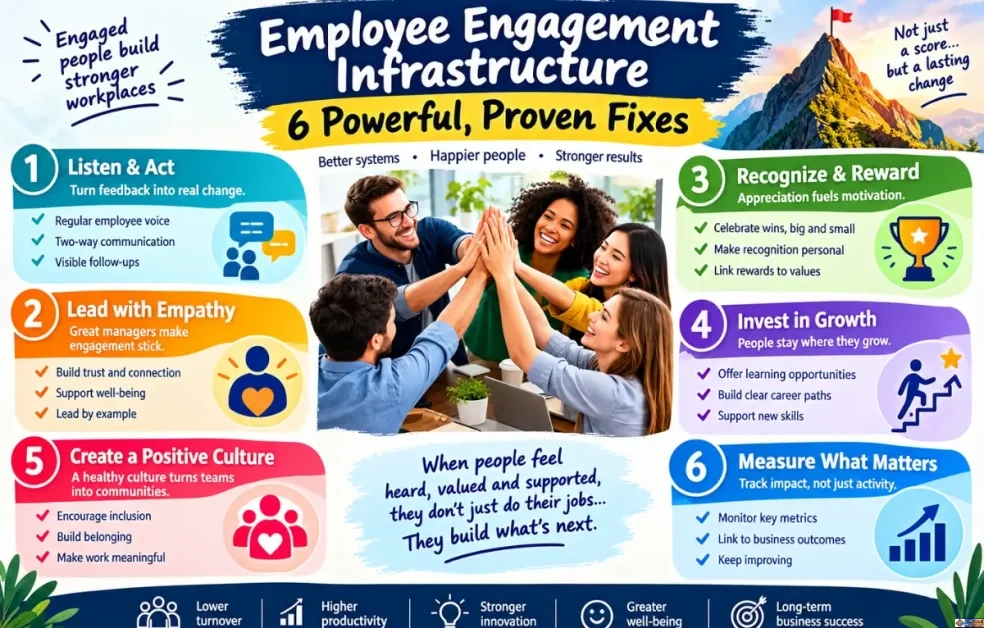
- 1. A listening layer that runs constantly, not annually. Pulse surveys, always-on feedback channels, stay interviews, exit interviews mined for patterns rather than filed away. One annual census tells you where things stood eleven months ago.
- 2. A closed-loop action mechanism. This is the piece almost everyone skips. Every piece of feedback needs a visible owner, a timeline, and a public update — even if the update is “we looked at this and here’s why we can’t act on it yet.” Silence is what kills trust, not bad news.
- 3. Manager enablement, not manager surveillance. Managers need training in how to run a real one-on-one, how to recognise contribution specifically rather than generically, and — critically — they need to be evaluated on whether their team’s engagement moves, not just whether it’s measured.
- 4. Recognition wired into daily workflow. Not an annual awards dinner. Recognition that happens in the tools people already use, from peers as much as from managers, tied specifically to company values rather than vague praise.
- 5. Career and development pathways that are visible and real. Nothing drains engagement faster than a talented employee realising there’s no route upward or sideways inside the organisation. When the internal ladder is short, external partnerships can extend it — accredited upskilling routes through a Local Community College, for instance, often stretch a development pathway further than an internal L&D budget can reach alone.
- 6. Governance and accountability at leadership level. Someone senior owns the engagement number the way a CFO owns cash flow. Without this, infrastructure becomes an HR side project instead of an operating discipline.
Miss any one of these six, and you don’t have infrastructure. You have a survey with good intentions attached.
Employee Engagement Infrastructure Examples
Theory is easy. Here’s what this looks like when organisations actually build it out.
- A tech scale-up replaced its annual survey with monthly two-minute pulses, routed every low score directly to the relevant manager’s dashboard within 24 hours, and required a documented response within five working days. Response times became a leadership KPI, not an HR metric.
- A UK retail chain built peer recognition directly into its shift-scheduling app, so a colleague could flag exceptional customer service the moment it happened, not three weeks later in an awards ceremony nobody remembered.
- A manufacturing firm ran quarterly “town hall to task board” sessions, where every theme raised in the town hall got logged publicly with an owner and a deadline visible to the entire site.
- A financial services company, and I mention this one because it’s a cautionary tale as much as an example, spent $250,000 on a slick engagement platform while ignoring repeated feedback about unsustainable workloads. Usage of the app’s wellness features stayed high. Burnout kept climbing anyway. You cannot tech your way out of a structural problem.
The wildcard one, if you want something genuinely different: a logistics company started publishing an internal “we heard you, we didn’t act, here’s why” quarterly note — deliberately surfacing the feedback they rejected, with reasoning. Counterintuitive, but it did more for trust than any amount of good news ever had, because it proved the listening was real rather than curated.
Employee Engagement Strategy Examples Worth Stealing
Strategy sits one layer above infrastructure — it’s the “what we’re actually trying to move” question. A few approaches I’ve seen genuinely shift the needle:
- Values-linked recognition programmes, where praise is tagged to a specific company value rather than issued as generic “great job” comments — this makes culture legible rather than aspirational.
- Manager scorecards that weight team engagement trend alongside output metrics, so a manager hitting targets by burning out their team doesn’t get rewarded for it.
- Stay interviews conducted before the exit interview becomes necessary — asking your best people what would make them leave, on a schedule, rather than finding out after they’ve resigned.
- Cross-functional “voice councils” made up of rotating employee representatives who meet leadership quarterly, giving feedback a structured, ongoing channel rather than a once-a-year survey box.
Why Do Engagement Platforms Fail?
Almost every failure story follows the same script, and it rarely starts with bad software. Teams collect feedback, publish dashboards, hold a town hall — then priorities shift, and employees learn that sharing input is either risky or pointless.
The root cause is usually organisational, not technical. Employee engagement platforms fail to change culture because companies ask technology to do leadership’s job — buying a platform, launching surveys, celebrating a small score bump, and then discovering managers haven’t changed a single habit and incentives remain untouched.
Complex platforms with extensive functionality often struggle with low adoption simply because they’re difficult for employees to actually use, and low adoption, poor mobile experience, and disconnected tools are consistently the main reasons engagement platforms fail to deliver value. Add them together and the pattern is clear: technology can scale a listening habit that already exists. It cannot manufacture accountability that was never there in the first place.
It’s worth saying plainly: an employee who fills out the same survey three years running without seeing a single visible change stops believing the exercise is real. That’s not a workplace-specific phenomenon — it’s the same trust collapse public bodies see when consultation feedback vanishes into a filing cabinet, and Culture Mosaic has covered that pattern from the civic side in more depth.
Further reading: Local Civic Engagement Strategies · How Public Feedback Shapes Local Policy · Why Public Consultation Is Important · What Is Public Commentary? · Declining Civic Knowledge in US
How Do You Measure the ROI of This Infrastructure?
This is the question that gets HR a seat at the budget table, so it’s worth doing properly rather than waving at a survey score.
Start with the basic formula:
ROI (%) = [(Financial Benefits − Total Costs) / Total Costs] × 100
Break the benefits side into three measurable buckets:
- 1. Turnover savings. Calculate your baseline turnover rate (departures ÷ average headcount × 100), track the change after your infrastructure goes live, and multiply the reduction in departures by your true cost-per-replacement — SHRM benchmarks this at 6–9 months of the departing employee’s salary, rising to as much as 200% for senior or specialist roles.
- 2. Productivity lift. Even a conservative 5% productivity increase against average revenue-per-employee produces a real, defensible number finance teams respect.
- 3. Absenteeism reduction. Engaged employees are roughly 41% less likely to be absent. Multiply the absenteeism rate change by average daily cost per employee (salary plus lost output) to get your figure.
Then apply the credibility discipline almost nobody follows: attribute conservatively. Even if your total calculated benefit looks enormous, claim 30–50% attribution to the engagement infrastructure specifically, acknowledging that other factors — pay rises, market conditions, leadership changes — always contribute too. A defensible 300% ROI convinces a CFO. An implausible 2,000% ROI gets your whole report thrown out.
One caution from practitioners worth repeating here: don’t measure too early. Recognition programmes can show movement within a quarter. Leadership development and management-habit change often take two to three review cycles before the number moves. Measuring at month three and declaring the whole infrastructure a failure is its own kind of methodological error.
Building It: The Solution That Actually Sticks
If you’ve read this far, you already know the survey isn’t the problem. The plumbing behind it is. Building real employee engagement infrastructure means starting smaller than most consultants will tell you to — one closed feedback loop, done visibly and consistently, beats five half-implemented tools every time.
Start here, in order: pick one listening channel and commit to closing every loop it opens within five working days. Put a senior leader’s name against the engagement number, publicly, the way you would against revenue. Train managers on the one-on-one before you buy them a dashboard to fill in. Then, and only then, layer in the software — because by that point, you’re automating a habit that already exists rather than hoping the tool creates one from nothing.
At Culture Mosaic, we’ve spent years writing about the systems that hold communities and institutions together — civic trust, cultural ritual, the quiet infrastructure that makes people feel heard. Workplace engagement runs on exactly the same wiring. Build the loop. Close it publicly. Repeat it until it’s boring. That’s the whole secret, and it’s less glamorous than any platform demo you’ll ever sit through.
Three Things to Actually Do Monday Morning
If none of the above sticks, remember these three. They’re the ones I’d defend in front of a CFO.
- Measure habits, not just scores. A survey score is a snapshot. The thing that actually predicts whether next year looks different is whether feedback loops closed — visibly, on a deadline — not whether the eNPS moved two points.
- Fix managers before you fix the platform. Manager engagement dropped from 31% to 22% globally in three years. A disengaged manager cannot produce an engaged team, and no software licence changes that. Put your first pound there.
- Start small, on purpose. One feedback channel. A five-working-day response SLA. Real accountability for whoever owns it. Prove that loop before you spend a penny on new software — you’ll buy a much better platform once you actually know what you need it to do.
Frequently Asked Questions
1. What is employee engagement, in plain terms?
It’s the degree to which someone feels genuinely committed to their organisation, believes in what it’s trying to do, and is willing to put in effort beyond the strict minimum their job description requires. CIPD frames it as commitment plus a willingness to help colleagues — it’s broader than job satisfaction, which just measures whether someone likes their day-to-day tasks. You can be satisfied and still disengaged; plenty of comfortable employees are quietly coasting.
2. What’s the difference between an engagement strategy and engagement infrastructure?
Strategy is the direction — what you’re trying to move and why. Infrastructure is the machinery that makes the strategy repeatable: the listening channels, the accountability structures, the manager training, the recognition workflows. You can have a brilliant strategy on a slide and still fail completely if there’s no infrastructure translating it into daily behaviour. Most failed engagement initiatives had a fine strategy and zero infrastructure underneath it.
3. Why is employee engagement important if my turnover numbers already look fine?
Turnover is a lagging indicator — by the time someone resigns, you’ve usually lost their discretionary effort months earlier. Engagement measures the quieter cost: reduced productivity, more errors, less collaboration, weaker customer interactions from people who are technically still on payroll but mentally checked out. Gallup’s global data shows engaged organisations post meaningfully higher productivity and profitability even when their turnover looks identical to a disengaged competitor’s. Low turnover with low engagement usually just means people are staying and quietly doing less.
4. How long does it take to see ROI from engagement infrastructure?
Recognition and quick-win communication fixes can show movement within a single quarter. Deeper changes — manager behaviour, leadership accountability, career pathway visibility — typically need two to three engagement measurement cycles, often six to eighteen months, before the numbers move in a way you can defend to a finance team. Judging the whole programme off a three-month snapshot is one of the most common mistakes HR teams make, and it usually kills funding for genuinely good initiatives before they’ve had time to work.
5. Do small businesses need engagement infrastructure, or is this only for large enterprises?
Small businesses often have an advantage here, not a disadvantage — the feedback loop between a comment and a visible action can be almost instant when there are twenty people instead of twenty thousand. You don’t need enterprise software. You need the same six components at a smaller scale: someone listening consistently, someone closing the loop publicly, and a leader who treats the engagement number as seriously as the sales number. A spreadsheet and genuine follow-through will outperform an expensive platform with no accountability behind it, at any headcount.
Sources
1. Chartered Institute of Personnel and Development (CIPD). Employee Engagement and Motivation Factsheet. cipd.org/en/knowledge/factsheets/engagement-factsheet/
2. Chartered Institute of Personnel and Development (CIPD). Employee Engagement Resources. cipd.org/en/topics/employee-engagement/
3. Gallup, Inc. (2026). State of the Global Workplace: 2026 Report. gallup.com/workplace/349484/state-of-the-global-workplace.aspx
4. Institute for Public Relations. Summary: Gallup State of the Global Workplace 2026. instituteforpr.org/gallup-global-workplace-2026/
5. UNLEASH. Gallup’s State of the Global Workplace 2026 Report: Three Essential Actions for HR Leaders. unleash.ai/strategy-and-leadership/analysis/gallups-state-of-the-global-workplace-2026-report-three-key-decisions-for-hr-leaders
6. Key UK Employee Statistics 2026, citing Gallup and Engage for Success data. mollearn.com/about/news/key-uk-employee-statistics/
7. AIHR. Measuring ROI of Employee Engagement: A Practical Guide. aihr.com/blog/employee-engagement-roi/
8. UC Today. Why Employee Engagement Platforms Fail in 2026. uctoday.com/employee-engagement-recognition/employee-engagement-platforms-fail/
9. AccessPerks. The Ultimate Guide to Employee Engagement (2026 Edition). blog.accessperks.com/employee-engagement-guide
10. Society for Human Resource Management (SHRM) turnover cost benchmarking, as cited via 15Five Employee Engagement ROI Calculator. 15five.com/blog/employee-engagement-roi-calculator
 Marcus J. Holloway