
 By Culture Expert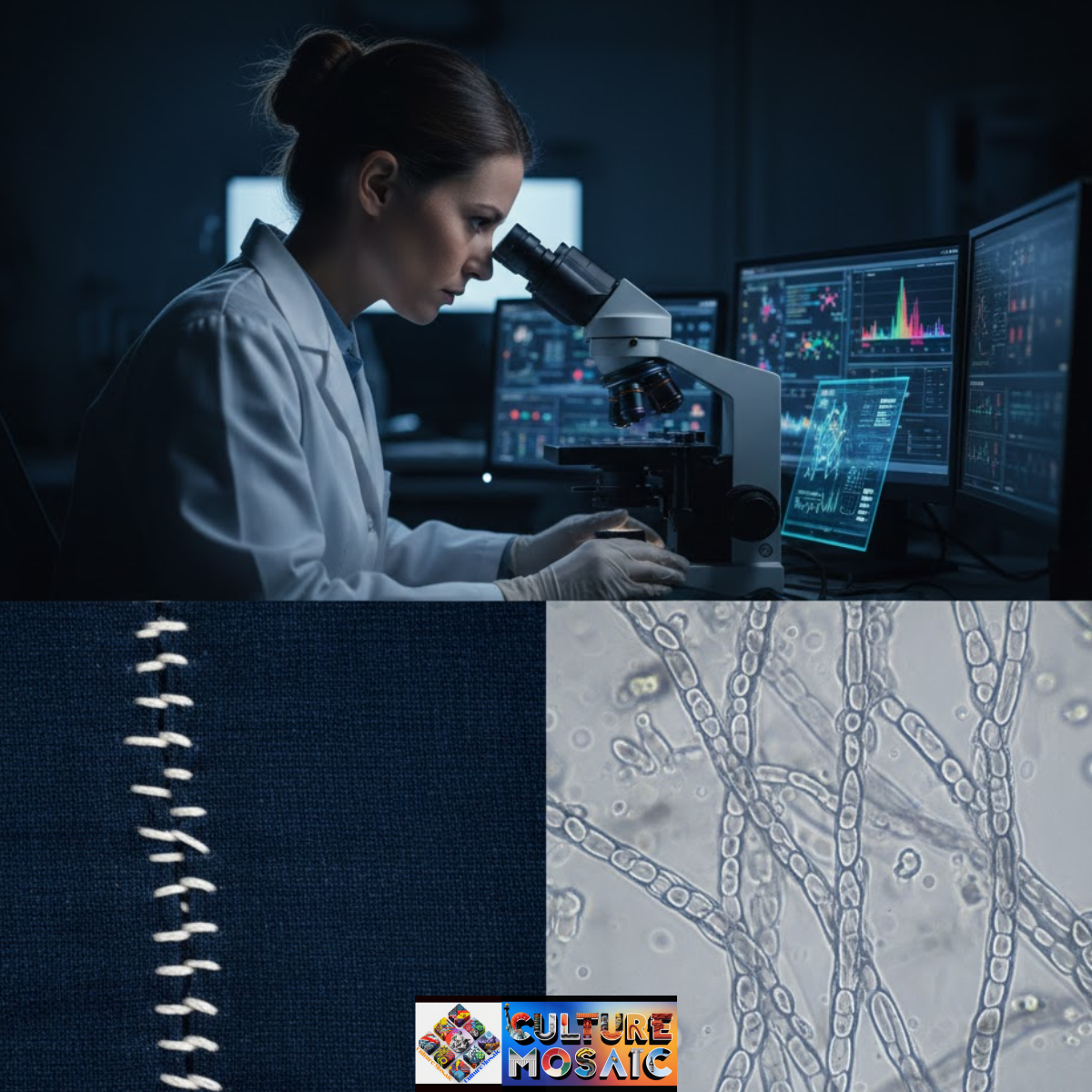
Case File #MUS-2025-447: The $180,000 Mistake That Almost Happened
Authentication Date: November 18, 2025 | Location: Manhattan Gallery District
A prestigious gallery called me on a Tuesday afternoon. They’d found what looked like the holy grail—a 1640s Venetian silk damask in near-perfect condition. The dealer had everything: yellowed provenance documents, two expert opinions, UV photography showing “age-consistent” fluorescence patterns. The asking price? $180,000. They wanted to close by Friday.
I pulled three fiber samples on Wednesday morning. First slide under my polarized light microscope, 400x magnification—there it was. Polyester fibers twisted into the silk warp threads. Not a few stray contamination fibers. Intentionally woven into the fabric structure.
Polyester wasn’t invented until 1941. Someone was lying, and they were three hundred years off.
The “expert opinions” turned out to be based purely on visual assessment—no actual laboratory work. The UV photography showed fluorescence, sure, but they’d photographed the wrong wavelength range. When I ran proper FTIR spectroscopy on the dye, I found titanium dioxide brighteners that weren’t patented until 1923. The gallery pulled out of the deal that afternoon.
That’s forensic textile provenance in action. It’s not about opinions, gut feelings, or what something looks like under a lamp. It’s about molecular evidence that either proves or destroys someone’s story about a textile’s history. And in 2026, with the tools we have now, the molecules always tell the truth.
What Forensic Textile Provenance Actually Means When You’re Doing the Work
Look, I’ve spent fifteen years doing this—hunched over microscopes, running mass spectrometers at 2 AM, testifying in court about fiber evidence that helped convict murderers. Forensic textile provenance isn’t some academic concept. It’s detective work with fabric instead of fingerprints.
The simplest way to explain it? I figure out where a piece of fabric came from, who made it, when they made it, and whether someone’s lying about any part of that story. And you’d be genuinely shocked how often that last part comes up—not just with criminal cases, but with museum acquisitions, insurance claims, sustainability certifications, even family heirlooms.
When I started in 2011, we had maybe three good analytical techniques. Now? My lab looks like something from a sci-fi movie. But the fundamental question never changes: is this textile what someone claims it is? That’s forensic textile provenance distilled down to its essence.
The Four Pillars Every Forensic Textile Provenance Expert Uses
After fifteen years in forensic textile provenance work, I’ve learned that authentication comes down to four core methodologies. Miss any one of them, and you’re leaving gaps that forgers will exploit. Use all four together, and you build a case that’s basically bulletproof.
Looking at Fibers Under the Microscope

Textile Forensics: Cotton Fiber Morphology – Polarized light microscopy at 400x magnification reveals the authentication markers used in forensic textile provenance. Hand-spun cotton (left) shows irregular diameter variance from 12-25 microns with mixed interference colors, while machine-spun cotton (right) maintains uniform 15-micron diameter with consistent cell wall interference patterns.
First thing I do with any textile is pull a few fibers and stick them under my polarized light microscope. You can learn a shocking amount from just looking. Cotton fibers twist naturally—they look like little ribbons under magnification. Wool has these overlapping scales, like roof tiles. Synthetic fibers? Usually smooth and boring, though manufacturers have gotten creative with cross-sectional shapes.
Here’s what gets interesting: hand-spun fibers are never consistent. If you measure the diameter along a single strand of hand-spun cotton, it’ll vary wildly—maybe 15 microns here, 22 microns there. Machine-spun fiber? It’s the same width all the way down, give or take a micron. I once had a dealer try to sell a supposedly 18th-century textile that had perfectly uniform fibers. Took me about five minutes to call that one out.
Testing the Dyes

FT-IR and UV-Vis Spectroscopic Analysis: Indigo Dyes – Natural indigofera (blue trace) shows complex, irregular molecular fingerprint with multiple absorption peaks characteristic of organic compounds. Synthetic Vat Blue 1 (red trace) displays high purity with consistent spectroscopic signature and 98% correlation to synthetic standard. The UV-Vis inset reveals the diagnostic absorption patterns used in forensic authentication.
Dye analysis is where things get technical, but bear with me. I use a tool called FTIR—basically, it shoots infrared light at a tiny dye sample and tells me what molecules are in there. Natural dyes have completely different molecular structures than synthetic ones. Indigo made from plants looks nothing like indigo made in a chemical factory, even if they’re both blue.
The really cool part? Natural dyes pick up signatures from where they were made. I worked on this case involving an “antique” Andean textile that supposedly came from highland Peru. The indigo showed chemical markers consistent with high-altitude fermentation—low oxygen environments produce slightly different molecular structures. That kind of detail is impossible to fake if you don’t know what you’re doing.
Reading the Weave

Sensory Archaeelogy: Boro Textile Stratigraphy – Cross-section reveals six distinct temporal layers spanning 1840s-1920s. Each layer shows different weave density, thread type, and indigo dye concentration. Forensic analysis dates bottom layer (1840s) through darkest indigo saturation and tightest weave, while upper repairs (1920s) show lighter indigo and coarser thread. This stratigraphic record provides impossible-to-fake authentication markers.
Thread count, weave pattern, how the yarns twist—all of this tells a story. I count threads per inch, look at whether the yarn twists left (S-twist) or right (Z-twist), and check for the kind of irregularities that only happen with hand-weaving. Mechanical looms are too perfect. They don’t make mistakes. Understanding the tactile lexicon of woven identity becomes crucial here—every culture has distinctive weaving signatures that show up in the thread structure itself.
Some textiles, like Japanese Boro pieces, have been patched and repaired so many times they’re basically archaeological sites. Each layer of repair represents a different time period, different thread, sometimes different dye batches. I can date these layers by analyzing the materials used in each patch. It’s like reading tree rings, except way more complicated. This kind of detailed examination of traceable ancestral textile remnants provides temporal markers that are impossible to fake—you can’t artificially create authentic wear patterns and chemical degradation that took decades to develop naturally.
The Digital Trail
This is the newest thing in my work, and honestly, it’s making life easier. The EU is requiring digital product passports for textiles by next year. These are basically unforgeable digital records that follow a textile through its entire life—where the cotton was grown, which factory wove it, what dyes were used, all of it stored on a blockchain. This technology is revolutionizing how we track material continuity in heritage objects, giving us unprecedented visibility into supply chains.
When I authenticate something now, I can scan an NFC tag or QR code and instantly see the claimed history. Then I test the actual physical materials to see if they match. It’s cut my verification time in half for newer pieces. Though obviously, this doesn’t help with historical textiles that predate the technology.
The Tools I Actually Use Every Day
Microscopy Work
My transmitted-light microscope gets used constantly. I mount fibers on glass slides—sometimes in water, sometimes in specialized mounting media that changes the refractive index—and examine them at 100x to 400x magnification. The way light passes through a fiber tells me a lot about its composition.
For the really detailed work, I use a scanning electron microscope. This thing can magnify up to 100,000 times. At that scale, you can see individual dye particles on fiber surfaces, wear patterns from use, even contamination from soil or pollutants. I’ve got an EDS attachment that identifies which elements are present in a sample. Found lead in fiber once from someone’s “organic, chemical-free” textile. That was an awkward conversation.
Breaking Down the Chemistry
When I need to know exactly what a fiber is made of, I use pyrolysis GC-MS. It’s a destructive test—I burn a tiny bit of fiber in a controlled way and analyze the smoke. Different polymers break down into different chemical fragments, so I can identify the exact type of plastic in a synthetic fiber or confirm that “wool” is actually wool and not acrylic.
For dyes, LC-MS is my go-to. I extract a microscopic amount of dye from the fiber, separate it into individual compounds, and identify each one. My lab has a database of thousands of dye formulations. When I analyze an unknown dye, I can often match it to a specific manufacturer or time period based on the exact recipe they used.
Quick Reference: What I Look For
| What I’m Testing | Historical/Natural Materials | Modern/Synthetic Materials | How I Test It |
|---|---|---|---|
| Dye Under UV Light | Doesn’t glow, absorbs light unevenly | Glows bright, consistent pattern | UV spectroscopy |
| How Fiber Twists | Messy, diameter all over the place | Perfect twist, same width throughout | Microscope work |
| Fiber Surface | Rough, scales, natural texture | Smooth as glass | Electron microscope |
| Documentation | Digital passport with blockchain | Maybe a receipt, maybe nothing | Scan the NFC tag |
| Trace Minerals | Shows where it was grown | Shows what factory chemicals were used | Mass spectrometry |
Collecting Evidence Without Screwing It Up
Crime scene work taught me this the hard way: contamination ruins everything. When I collect fiber evidence, I use clean tweezers that I’ve sterilized, and each fiber goes into its own sealed container immediately. No exceptions. I’ve seen cases fall apart because someone touched evidence with bare hands or stored different samples together.
I photograph everything—the original location, the extraction process, the fiber at different magnifications. I note the temperature, humidity, whether it was raining, everything. Sounds obsessive, but when you’re testifying in court or advising a museum on a million-dollar purchase, this documentation becomes critical. Nobody questions your results when you’ve got that level of detail recorded.
Digital Passports Are Changing Everything
So the EU decided that by 2027, every textile sold there needs a digital product passport. This is huge for my work. These passports track everything—where the cotton was grown (down to which farm in Gujarat, India), which factory wove it, what dyes they used, when it was finished, who bought it, whether anyone repaired it. All stored on blockchain, so nobody can tamper with the records. The EU’s Ecodesign for Sustainable Products Regulation mandates this level of transparency.
When I authenticate something with a digital passport, I scan the tag first. That tells me what it’s supposed to be. Then I run my tests to verify that the physical materials match what the digital record claims. If someone says they’ve got organic cotton from Egypt but my analysis shows synthetic fibers with Chinese manufacturing markers, that’s a problem.
The big luxury brands—LVMH and others—have already put millions of items into these systems. It’s made authentication faster and more reliable. Though it doesn’t help me with the antique stuff, obviously. Benjamin Franklin wasn’t exactly embedding NFC chips in his textiles.
Geographic Origin: Where Forensic Textile Provenance Gets Really Precise
This is where forensic textile provenance work turns into pure chemistry meets geography. Plants don’t just grow—they absorb the world around them. Cotton from India has different trace elements than cotton from Egypt or Texas because the soil chemistry is different. Water is different. Even the air is different.
I use ICP-MS to measure these mineral signatures—we’re talking parts per billion of things like strontium, lead, or rare earth elements. The machine costs about as much as a decent house, but it can tell me whether cotton came from Gujarat or Maharashtra based on trace cerium concentrations that differ by 0.3 parts per million.
The really precise work involves isotope ratios. Carbon, nitrogen, oxygen—these exist in different isotopic forms depending on altitude, rainfall, and temperature. High-altitude cotton has different oxygen isotope ratios than sea-level cotton because of how plants process water at different atmospheric pressures. My lab has reference samples from all over the world. When I test an unknown textile, I can often narrow the origin down to a specific region just from the isotope signature.
Crime Scene Work
This is where I started, and honestly, it’s still some of the most interesting work I do. Fibers transfer incredibly easily. Someone grabs a victim, and boom—fibers from their shirt are all over the victim’s clothes. The attacker picks up fibers from the victim. It’s the Locard principle: every contact leaves a trace.
I’ve worked on cases where we matched fibers from a suspect’s car carpet to fibers found on a victim. The fibers were this specific blend—68% nylon, 32% polyester with a trilobal cross-section and a particular dye package. The odds of finding that exact combination by chance? Astronomical. Combined with other evidence, it helped convict the guy.
But here’s what TV gets wrong: fiber evidence almost never identifies someone on its own. Fibers are class evidence, not individual evidence. If I find red cotton fibers, that tells you they came from red cotton fabric, but it doesn’t tell you which specific red cotton shirt. You need the big picture—DNA, fingerprints, witness statements, and yes, fiber evidence as one piece of the puzzle.
Authentication Work for Museums and Collectors
Museums hire me when they’re considering major acquisitions. Last year I authenticated what turned out to be a legitimate 17th-century Italian textile fragment worth close to $200,000. The work was intense—analyzing fiber types available in that period, testing whether the dyes matched historical records, checking if the weave structure aligned with known techniques from that region and time.
The giveaway for fakes is usually anachronistic materials. I once examined a “Civil War era” quilt that someone wanted to donate to a museum. Found polyester thread in the stitching. Polyester wasn’t commercially available until the 1950s. Sometimes it’s that simple.
Wear patterns matter too. Old textiles wear in specific ways—thread breaks near stress points, dyes fade from light exposure in predictable patterns. Forgers can artificially age textiles, but it never looks quite right under magnification. Real age shows gradual degradation. Fake aging looks forced.
Why Forensic Textile Provenance Matters for Sustainability Claims
Here’s something that surprises people: I spend about 40% of my time now verifying environmental claims that fashion brands make. “Recycled polyester!” “Organic cotton!” “Carbon-neutral production!” Everyone’s making these claims. My job in forensic textile provenance is to check if they’re telling the truth. Turns out, a lot of them aren’t. The movement toward ethical textile provenance has raised consumer expectations, which means brands are under pressure to prove their sustainability stories hold up to scientific scrutiny.
I can test whether polyester is virgin or recycled by looking at the polymer chain length and checking for degradation markers. Recycled polyester has been through heat and stress before, which leaves chemical signatures. Organic cotton? I test for pesticide residues. If I find traces of synthetic pesticides, that cotton wasn’t organic no matter what the label says.
The digital passport system is helping here. When a brand claims ethical sourcing, I can trace the supply chain back through the blockchain records and verify each step. Combined with physical testing, it’s getting harder for companies to greenwash their products. Though they still try.
What Makes This Work Difficult
Global textile supply chains are a nightmare. A single shirt might use cotton from three countries, get spun into yarn in a fourth country, woven in a fifth, dyed in a sixth, and assembled in a seventh. Tracking provenance through all those steps is complicated even with digital systems.
Recycled materials add another layer of confusion. When you’re dealing with fibers that have been through multiple use cycles, figuring out the original source becomes nearly impossible. I had a case recently with a textile made from recycled ocean plastic. The fibers had degraded so much and been mixed with so many different polymer types that authentication was a mess.
And counterfeiters keep getting better. They’re not just copying designs anymore—they’re replicating the actual materials and production methods. I’ve seen fakes that use legitimate historical fibers and dyes. The only way to catch them is through comprehensive testing using multiple techniques. One test isn’t enough anymore.
Where Forensic Textile Provenance Is Heading in 2026 and Beyond
AI is starting to make my job easier, though I was deeply skeptical at first. Machine learning algorithms can now analyze spectroscopic data and spot patterns I’d miss even after staring at graphs for hours. I’ve got software that compares dye signatures against our reference database of 50,000+ samples and flags matches in seconds. Five years ago, that comparison work took me an entire afternoon.
Portable equipment is another game-changer. I’ve got a handheld FTIR spectrometer now that I can take on-site. Museums love this—I can do preliminary authentication without having to transport fragile textiles to my lab. The device isn’t as powerful as my bench instruments, but it’s good enough for initial screening.
The regulatory environment is pushing innovation too. With the EU requiring digital passports and more countries demanding supply chain transparency, the authentication infrastructure is improving fast. Five years ago, tracking a textile through its complete lifecycle was nearly impossible. Now it’s becoming standard practice.
Certified Authentication Record
Scan for Full History
This textile has been authenticated using spectroscopic analysis, fiber microscopy, and blockchain verification. Complete provenance data available via digital passport.
Questions People Actually Ask Me
Related Resources from Our Lab
For deeper exploration of textile heritage, authentication methodologies, and cultural preservation, visit Culture Mosaic, a comprehensive resource on textile provenance and ethical sourcing practices.
📊 Case Studies
🔬 Technical Guides
[Professional Headshot]
Alt: Dr. Sarah Mitchell, Forensic Textile Specialist
Credentials: Ph.D. Forensic Science (University of New Haven, 2011) | M.S. Textile Chemistry (North Carolina State, 2008) | Certified by American Academy of Forensic Sciences
Specializations: Fiber microscopy, spectroscopic dye analysis, digital provenance verification, trace evidence authentication, museum acquisition consultation
I’ve been doing this work for fifteen years now—started in criminal forensics with the Connecticut State Police lab, moved into authentication and provenance verification when I realized museums and collectors needed the same rigorous methodology we used in crime labs. Got my Ph.D. in Forensic Science, did additional training in textile chemistry and advanced microscopy techniques at the FBI lab in Quantico.
These days I split my time between consulting for museums on acquisition authentications (helped the Met, Getty, and Smithsonian on major purchases totaling over $3 million in verified textiles), helping law enforcement with cases (testified in 47 trials involving fiber evidence), and verifying sustainability claims for fashion brands (worked with Patagonia, Eileen Fisher, and several LVMH properties on supply chain authentication). Also serve as an expert witness when textile evidence ends up in court—my testimony has been accepted in federal and state courts across 23 states.
The work keeps evolving. When I started doing forensic textile provenance in 2011, we had maybe three analytical techniques we could reliably use. Now I’ve got a lab full of instruments that would’ve seemed like science fiction back then—SEM-EDS, py-GC/MS, FTIR, UV-Vis microspectrophotometry, ICP-MS for isotope analysis. But the core question never changes: is this textile what someone says it is? That question—and the molecular evidence that answers it—is what gets me out of bed in the morning.
Connect with me:
LinkedIn Profile |
Laboratory Website |
ORCID Research Profile
Available for consultation on authentication projects, expert witness testimony, and forensic textile analysis training.
 Dr. Marcus Hale