
 By Culture Expert
My kitchen counter is covered in jars. Kimchi turning crimson in one corner, sourdough starter bubbling away near the stove, pickles going cloudy in their brine by the window. My partner jokes that we’re running a microbiology lab. But somewhere between batch 200 and today, I figured out what I’m actually doing here.
I’m learning how to wait. How to trust things I can’t see. How to stop trying to control every damn outcome.
Fermentation as philosophy hit me at 2 AM one night when I couldn’t sleep. I’d been obsessing over a work project, trying to force it into shape. Then I looked over at my kimchi crock sitting quietly on the counter, doing its thing without any help from me. The cabbage was transforming in the dark. I was just spinning my wheels. That’s when it clicked.
The Alchemy of Patience
I killed my first three sourdough starters. Murdered them through sheer eagerness. I kept opening the jar, stirring it, adding more flour because I thought I was helping. I wasn’t helping. I was suffocating the poor thing with attention.
My grandmother, who made kvass in her Soviet apartment for fifty years, would’ve laughed her ass off at me. She knew what I had to learn the hard way: you can’t rush microbes. They work on their own clock, not yours.
Just like lactobacillus needs three days minimum to turn cabbage into proper sauerkraut, some things in life need time to develop complexity. The fight with my brother took two years to really resolve, not the two weeks I kept trying to force it into. My novel needed eighteen months to find its voice, not the frantic three-month sprint I initially attempted.
Here’s what fermentation as philosophy taught me about patience: waiting isn’t passive. Those bacteria are working their asses off in that jar. Millions of them breaking down sugars, producing acids, creating entirely new compounds that didn’t exist before. It looks like nothing’s happening, but everything is happening.
Same with grief, same with skill-building, same with relationships that matter. The important work happens invisibly, under the surface, in the dark.
What’s Actually Going On in There
Before we get too abstract, let’s talk about what fermentation actually is. Controlled rot, basically. You’re creating conditions where good bacteria thrive and bad bacteria die. Salt helps with this. So does lack of oxygen. Temperature matters too.
Every culture figured this out independently. Koreans made kimchi. Germans made sauerkraut. Japanese made miso. Nobody was texting each other recipes. They just observed that cabbage in salt water did something interesting if you left it alone for a while.
That’s thousands of years of accumulated knowledge, refined through generations of people paying attention. When I make kimchi, I’m using techniques that some Korean grandmother perfected in 1750. She didn’t know about lactobacillus. She just knew it worked.
This is fermentation as philosophy in its most basic form: trust what you observe, even if you don’t understand the mechanism yet. The microbes don’t care if you understand them. They’ll do their job anyway.
Three Things Fermentation Taught Me About Living
Surrender Control
You can’t micromanage bacteria. Believe me, I tried. My early ferments were disasters because I kept messing with them. Opening the jar to check progress. Adjusting the salt mid-ferment. Moving them around looking for the “perfect” temperature.
Everything I touched turned to mush or grew weird mold.
Success came when I learned to set things up right and then back off. Choose good cabbage, use the right amount of salt, pack it properly, cover it, and walk away. The fermentation happens without you. Your job is to create conditions, not dictate outcomes.
This maps onto everything else I’ve tried to control too tightly. My daughter’s college applications. My friend’s recovery process. Creative projects that I strangled with over-editing. Some things need space to develop on their own timeline.
Value What You Can’t See
There are trillions of microorganisms in that jar of sauerkraut. You can’t see a single one without a microscope. But they’re doing all the actual work. Without them, you just have salted cabbage slowly rotting.
Most important things are invisible. The slow accumulation of knowledge that suddenly crystallizes into understanding. The quiet ways people show up for each other that nobody photographs. The underground network of support that holds communities together.
I keep those jars on my counter partly to watch them bubble, but mostly as a reminder. When I’m frustrated that my writing isn’t progressing visibly, I look at the kimchi. Under that liquid, transformation is happening. I need to trust it.
Fermentation as Philosophy: Growth Happens Under Pressure
The sourness in good sauerkraut comes from stress. You put cabbage in a hostile, salty, oxygen-free environment. Under that pressure, bacteria transform. They create lactic acid. That’s what gives you the tang.
Remove the stress—add oxygen, reduce salt—and you get rot instead of fermentation.
This was hard for me to accept. I spent my twenties trying to eliminate all discomfort from my life. Fermentation as philosophy taught me that certain transformations require controlled pressure. Not trauma. Not chaos. But tension that’s contained and purposeful.
The difficult conversation. The challenging project. The period where you’re not sure it’s working. These aren’t obstacles to growth. They’re the conditions under which growth happens.
Make This: Sauerkraut as Meditation
Forget fancy fermentation crocks and airlocks. Here’s what you actually need:
Ingredients: One cabbage (about 2 pounds). Salt, roughly 1 tablespoon per pound of cabbage. That’s it.
Step 1: Slice the cabbage thin. Notice how it’s built in layers. This thing grew slowly over months. No shortcuts. Just time and dirt and photosynthesis.
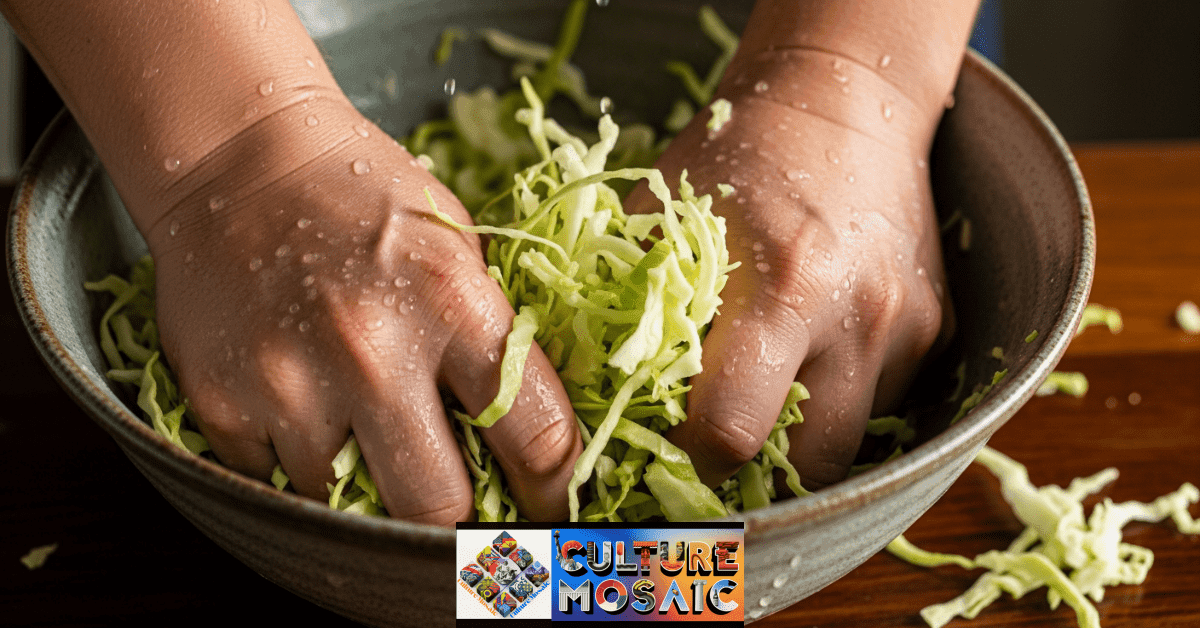
Step 2: Put the cabbage in a big bowl and add the salt. Now massage it. Really work it with your hands for 5-10 minutes. Your hands will get tired. The cabbage will start releasing liquid and getting soft.
This is the part where people usually quit. Their hands hurt and nothing seems to be happening. Keep going. This is active work followed by passive waiting. Both matter.
Step 3: Pack everything into a clean jar. Smash it down with your fist. You want the cabbage completely submerged under its own liquid. If there’s not enough liquid, mix 1 teaspoon salt into a cup of water and add that.
Step 4: Cover it loosely. I use a cloth secured with a rubber band. You need some airflow but you don’t want bugs getting in.
Step 5: Now wait. This is the hardest part. For 3-10 days, it just sits there. You’ll see bubbles after day 2 or 3. That’s good. That’s life. If it smells pleasantly sour and tangy, it’s working. If it smells like death and makes you gag, something went wrong.
Step 6: Taste it starting at day 3. When it’s sour enough for you, stick it in the fridge. Cold slows everything way down. It’ll keep for months.
Your senses evolved over millions of years to tell good fermentation from bad. If it tastes good, it is good. Trust yourself.
How Fermentation Rewired My Brain: Fermentation as Philosophy
I think in fermentation time now. When someone asks how long something takes, I automatically think “three days at room temp, two weeks if it’s cold, six months for the really good stuff.”
This is weird in a culture where thirty seconds feels too long to wait for a webpage to load. But it’s also centering. Things take the time they take. My sourdough starter needed a week to stabilize. No amount of wanting it to happen faster made any difference.
There’s research backing this up. Process-oriented activities—where you focus on the doing, not the outcome—reduce anxiety and increase feelings of meaning. Fermentation is pure process. You control your actions but not the exact result.
I’ve watched anxious people calm down over a few months of fermenting regularly. Not because sauerkraut cured their anxiety, though the gut-brain stuff might help. But because they practiced relating to uncertainty differently. They learned that you can’t control everything, and that’s okay. Better than okay—it’s how transformation works.
Every Jar Connects You to Centuries
The kimchi recipe I use came from my friend’s Korean mother-in-law. She learned it from her grandmother. That grandmother learned it from her grandmother. You can trace this knowledge back centuries, refined through countless batches, adjusted for different cabbages and different seasons.
I’m not Korean. I didn’t grow up making kimchi. But when I follow that recipe, I’m participating in something bigger than me. I’m trusting in the accumulated wisdom of people who figured out, through generations of observation, exactly how much gochugaru to use and exactly when to add the fish sauce.
Fermentation as philosophy means accepting that some knowledge can’t be invented alone or quickly. It has to be transmitted, practiced, adjusted, passed on. You stand on the shoulders of people who came before.
This feels radical in a culture that worships innovation and disruption. But some things shouldn’t be disrupted. They should be honored and continued.
Why Fermentation Workshops Sell Out
I started teaching fermentation five years ago in a community kitchen. Six people showed up to the first one. Now there’s a waiting list. Why?
People are starving for this. Not just for the food, though fermented vegetables are delicious. They’re starving for connection to natural processes, to traditions, to each other. For practices that run counter to the speed and anxiety of modern life.
Fermentation offers a regular, tangible reminder that we’re not separate from nature. That we participate in biological processes older than our species. That transformation doesn’t always require our constant input.
When I teach, people show up thinking they want to learn about probiotics or food trends. They stay because fermentation changes how they think. It provides a counter-rhythm: “Wait. Trust. Let time work.”
That’s not escapism. That’s survival.
Fermentation as Philosophy: Getting Your City Involved
Here’s where fermentation as philosophy extends beyond your kitchen. When local governments support fermentation education—community kitchens, farmers’ market programs, food preservation workshops—they’re building community resilience.
I’ve consulted on food programs for three municipalities. The successful ones all incorporate fermentation because it naturally addresses multiple needs. It reduces food waste by preserving seasonal abundance. It maintains cultural traditions. It creates opportunities for knowledge exchange across generations. It doesn’t require expensive equipment or electricity.
But beyond practicality, communal fermentation teaches collective patience. When a neighborhood ferments together, they practice trusting shared knowledge and celebrating invisible work. These are exactly the capacities communities need for addressing complex, long-term challenges.
Want to deepen your practice? Contact your local food policy council. Ask about fermentation education programs. Offer to teach a workshop. Start a ferment swap at your farmers’ market. When fermentation becomes communal, the philosophy multiplies.
The Science Catches Up
Modern research increasingly confirms what fermentation practitioners have always known intuitively. Fermented foods support gut health through probiotics. Gut health influences mental health through the gut-brain axis. The bacteria that teach you patience might also be supporting your mood.
But I’m less interested in reducing fermentation to probiotic delivery than in honoring the full practice. Yes, the bacteria are nutritious. But the philosophy isn’t separate from the practice—it’s embedded in it.
When you eat food you fermented yourself, you’re consuming your own patience, your own trust, your own participation in natural processes. That matters as much as the lactobacillus count.
Fermentation as Philosophy: Starting Your Practice
You don’t need special equipment or years of study. You need one jar, one simple project, one practice in patience.
Pick something that appeals to you. The sauerkraut I described. Quick pickles if you want faster results. Sourdough if you’re feeling ambitious. Water kefir if you like fizzy drinks.
Approach it as practice, not just food prep. Notice what comes up. Notice your impatience when nothing seems to be happening. Notice your anxiety about whether you’re doing it right. Notice the satisfaction when bubbles appear.
I set up my fermentation corner ten years ago with three jars and a notebook. Now it’s a whole shelf, but I still use those original jars. They’ve become a visible commitment to slowness, to trusting invisible processes, to accepting that some things can’t be rushed.
What Changes After Years of Practice
Fifteen years in, fermentation as philosophy has fundamentally changed how I move through the world. I’m more patient with processes I can’t control. I trust invisible work—my own and others’. I know that tension and discomfort often come before real growth.
These aren’t abstract insights. They’re embodied knowledge, learned through thousands of hours of massaging cabbage, feeding starters, waiting for bubbles, tasting transformation.
The philosophy didn’t come from books. It came from practice.
Those bubbles rising in your jar? They’re tiny revolutions against the cult of speed. Each one says: some things are worth waiting for. Invisible processes matter. Transformation happens not through force but through creating the right conditions and trusting time.
When you develop a new relationship with that kimchi on your counter, you develop a new relationship with time itself. That difficult relationship that seems stuck? It’s fermenting, developing depth you can’t taste yet. That skill you’re learning where nothing seems to be happening? Invisible transformation is underway.
Fermentation as philosophy isn’t about the food, though the food is wonderful. It’s about learning to live at a pace that allows for real transformation. In jars and in lives.
Frequently Asked Questions About Fermentation as Philosophy
What makes fermentation as philosophy different from just fermenting food?
Fermentation becomes philosophy when you start noticing what the practice teaches beyond the food. I fermented for years just making stuff I wanted to eat. The philosophy emerged when I started seeing parallels between what worked in my crocks and what worked in my life. The patience needed for sourdough mirrors the patience needed for meaningful relationships. The surrender required for kimchi applies to parenting and creative work. It’s the difference between following a recipe and understanding principles you can apply everywhere.
How does slowing down with fermentation speed up your life?
This confused me at first too. When you practice patience with fermentation, you learn to tell the difference between what needs urgent attention and what needs time to develop. You stop wasting energy forcing things that aren’t ready. I’ve become more productive because of my fermentation practice, not despite it. I know when to push and when to wait. Slow becomes strategic. Plus there’s simple efficiency—having a shelf of fermented food means healthy meals are always ready. Time invested in fermenting compounds over weeks.
Can beginners embrace fermentation as philosophy?
Absolutely. I started knowing nothing. My first sauerkraut was too salty. My second batch grew mold. The lessons come through practice, through failures as much as successes. Actually, beginners often get the philosophy faster than experienced cooks because they’re forced to surrender control from the start. You don’t need expertise. You need curiosity and willingness to observe. Start with one simple project. Pay attention to what it brings up. That’s where philosophy lives.
What’s the connection between fermentation and mental health?
Two connections, both real. Scientifically, fermented foods contain probiotics that support gut health, which affects mental health through the gut-brain axis. Research shows this is significant. But the practice itself matters just as much. Fermentation is a mindfulness practice that reduces anxiety, creates routine, provides accomplishment, connects you to traditions. When my anxiety spikes, making pickles grounds me. The rhythmic work, the patient waiting—it’s therapeutic regardless of probiotics. The philosophy and the biochemistry work together.
How do I get my community involved in fermentation as philosophy?
Start small and local. Talk to your farmers’ market manager about hosting a ferment swap where people trade jars. Ask your library about teaching a workshop—libraries love food programming. Contact your city’s food policy council about fermentation education. Start a monthly fermentation club to taste experiments and share knowledge. When I started teaching community workshops five years ago, six people came. Now there’s a waiting list. People want this—the practice and the philosophy. They want connection, patience, embodied knowledge, transformation. Create the space. People will come. That’s fermentation as philosophy too—create conditions, then trust.