
 By Culture Expert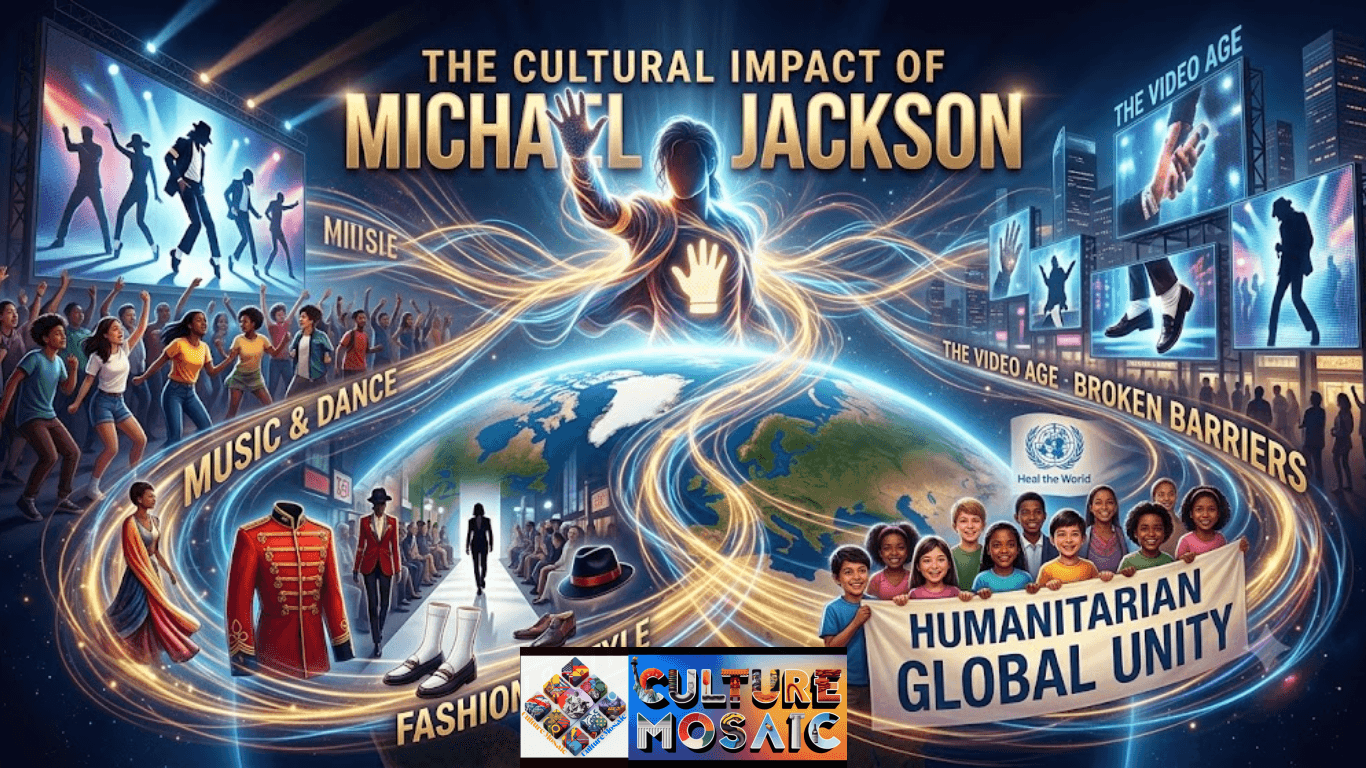
Table of Contents
ToggleThe Cultural Impact of Michael Jackson: How He Redefined Music and Society
Michael Jackson, widely recognized as the “King of Pop,” was far more than an extraordinary vocalist and stage performer—he was a seismic cultural phenomenon. Crossing geographic borders, generational divides, and social barriers, his artistry permanently redefined the landscape of global entertainment.
Through groundbreaking visual storytelling, boundary-pushing choreography, high-concept fashion, and global humanitarianism, Jackson fundamentally altered how music is created, consumed, and experienced. Here is how Michael Jackson transformed global culture and set the blueprint for the modern pop era.
1. Breaking Racial Barriers in the Entertainment Industry
In the early 1980s, mainstream media platforms like MTV primarily featured white rock artists, leaving Black musicians largely sidelined from prime-time rotation. Jackson’s record-breaking solo work completely dismantled this paradigm.
The high-rotation broadcast of videos for tracks like “Billie Jean” and “Beat It” forced media networks to pivot, proving that a Black artist could command massive, universal audiences. By breaking through these institutional doors, Jackson paved the way for generations of Black artists across R&B, hip-hop, and pop to achieve mainstream crossover success.
2. Transforming Music Videos into Cinematic Art
Before Jackson, music videos were largely promotional tools featuring band performances or low-budget concepts. The release of the 13-minute short film “Thriller” in 1982—directed by John Landis—changed the industry overnight.
[Traditional Promo Clip] ───► [Jackson's Narrative Vision] ───► [Cinematic Event]
Featuring an iconic storyline, theatrical makeup, complex choreography, and film-grade production values, Thriller transformed the music video into a legitimate, high-budget art form. It established the visual album standard that artists still strive to meet today.
3. Setting the Global Standard for Pop Dance
Jackson’s contributions to movement and dance are as foundational as his musical achievements. When he debuted the Moonwalk during the Motown 25: Yesterday, Today, Forever special in 1983, it captured the world’s imagination instantly.
“His ability to synthesize street styles, tap, and classical jazz into a cohesive, signature vocabulary revolutionized what audiences expected from a pop vocalist.”
By embedding complex, high-energy routines into live concerts and music videos, he made master-level dancing an essential requirement for pop stardom—inspiring a legacy clearly visible in the performances of Usher, Beyoncé, Chris Brown, and Bruno Mars.
4. Pioneering Socially Conscious Mainstream Pop
Jackson consistently utilized his global platform to spotlight pressing societal and humanitarian crises. Rather than sticking purely to traditional pop themes, he brought conscious messaging into mainstream heavy rotation:
“Man in the Mirror” – Focused on personal responsibility, self-reflection, and systemic reform.
“Earth Song” – Highlighted environmental degradation, war, and animal welfare.
“Heal the World” – Promoted global unity and support for underprivileged children.
Beyond lyrics, Jackson backed his advocacy with action, donating tens of millions of dollars to global charities and establishing the Heal the World Foundation.
5. Engineering the Concept of Global Pop Culture
Long before the internet and social media connected the world, Michael Jackson achieved a level of worldwide stardom that remains unprecedented. His international tours brought Western pop performances to regions that had rarely hosted major global acts.
Jackson proved that music could transcend language, cultural, and political boundaries. His universal appeal established the framework for a shared, global pop culture—demonstrating that a single artist could hold the attention of the entire planet simultaneously.
6. Iconography and Redefining Fashion
Jackson understood the power of visual identity. His wardrobe choices were bold, distinct, and instantly recognizable:
| Signature Wardrobe Item | Cultural Impact & Legacy |
|---|---|
| Red Leather Thriller Jacket | Defined 1980s street fashion and remains one of history’s most recognized garments. |
| Single Sequined Glove | Transformed a simple accessory into a global hallmark of mystery and showmanship. |
| Military Jackets & Loafers | Blended theatricality with streetwear, challenging traditional gender norms in pop styling. |
His daring aesthetic demonstrated that visual branding is just as vital to an artist’s identity as their sonic signature.
7. Blending Genres to Shape Modern R&B and Pop
Jackson was a master at fusing distinct musical genres into a seamless, accessible sound. By blending elements of R&B, pop, rock, funk, and gospel, he broke down rigid radio formatting barriers.
Collaborating with rock icons like Eddie Van Halen on “Beat It” proved that pop and hard rock could successfully co-exist, establishing a multi-genre production model that continues to dominate chart-topping records today.
8. Tackling Taboo Themes Through Art
Jackson was never afraid to confront controversial or uncomfortable topics directly through his art:
“Black or White” tackled racial harmony while visually challenging cultural stereotypes.
“They Don’t Care About Us” directly criticized police brutality, institutional corruption, and systemic inequality.
By using high-profile releases to spark public dialogue around controversial topics, Jackson validated the idea that pop music could serve as a vehicle for serious social critique.
9. Defining the Blueprint for the Modern Pop Megastar
Before Jackson, the total-package pop superstar—someone who dominated radio, television, live performance, fashion, and merchandising simultaneously—did not truly exist on a global scale.
He established the structural blueprint for media engagement, image control, and stadium-level touring. Modern pop powerhouses, from Taylor Swift to Lady Gaga, operate within the framework of global fan culture and brand ecosystems pioneered by Jackson.
10. Mobilizing Fan Networks for Social Good
Jackson’s message of global unity cultivated a uniquely dedicated, proactive worldwide fanbase. Rather than remaining passive listeners, his supporters frequently organized international charity drives, environmental initiatives, and community service projects in his honor.
This fan-driven activism set an early precedent for modern online fandoms, demonstrating how collective audience energy can be mobilized to achieve real-world humanitarian impact.
Conclusion: An Enduring Legacy
Michael Jackson’s influence on modern culture extends far beyond his record sales and chart positions. By breaking down racial barriers, elevating music videos into cinematic events, establishing dance as a pop necessity, and bringing humanitarian causes to center stage, he fundamentally reshaped the entertainment industry.
His artistic choices created the blueprint for contemporary pop culture, ensuring that his creative legacy continues to inspire generations of artists and fans around the globe.
Frequently Asked Questions
What was Michael Jackson’s biggest contribution to music history?
His single greatest contribution was elevating the music video into a cinematic art form with short films like Thriller, alongside breaking critical racial barriers on mainstream broadcast networks like MTV.
How did Michael Jackson impact dance in popular culture?
He popularized street and studio dance styles on a global stage, introducing iconic moves like the Moonwalk and complex ensemble choreography that made master-level dance a standard requirement for pop performers.
How did he address social issues through his music?
Jackson used anthemic songs like “Man in the Mirror,” “Earth Song,” and “They Don’t Care About Us” to shine a light on environmental issues, racial justice, poverty, and peace, pairing his music with substantial personal philanthropic contributions.
 Dr. Julian Thorne