
 By Culture Expert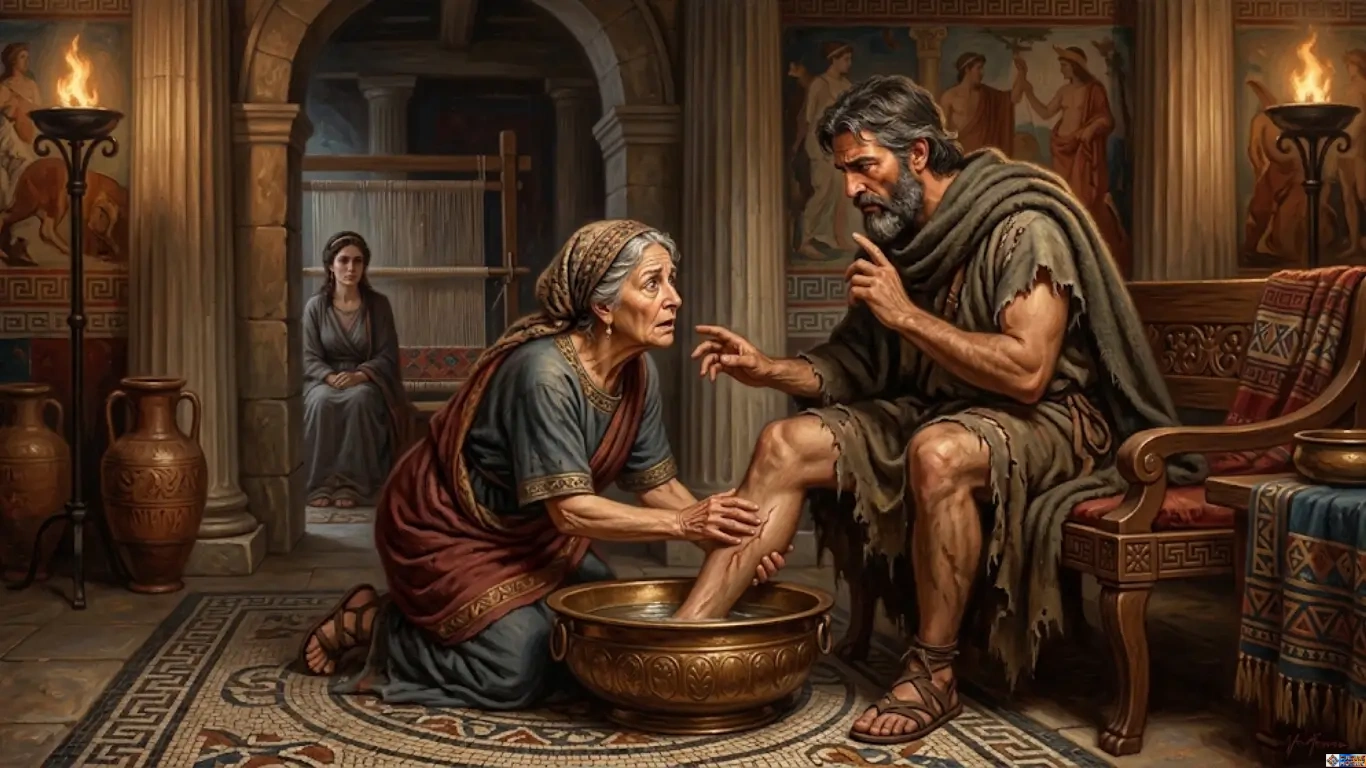
Quick Summary: Eurycleia in The Odyssey
Eurycleia is the faithful nursemaid of Odysseus and Telemachus in Homer’s The Odyssey, originally bought as a young woman by Laertes, king of Ithaca. She serves as the guardian of royal memory and domestic order within the palace. Her pivotal narrative moment occurs in Book 19, when she identifies a disguised Odysseus by a boar-hunting scar on his thigh while washing his feet. Bound by honor and absolute loyalty, she maintains his dangerous secret, helping him execute his vengeance against the suitors and reclaim his throne.
Eurycleia in The Odyssey: The Scar That Held a Kingdom’s Memory
When we think of Homer’s The Odyssey, memory gravitates toward grand spectacle: sea monsters, enchantresses, cyclopes, and epic battles. Yet the turning point of the entire epic unfolds not on the high seas, but in the dim light of an Ithacan bedchamber, where an elderly woman pours warm water into a basin.
Understanding Eurycleia in The Odyssey requires looking past the warriors to the domestic sphere, where the fate of Ithaca’s royal house truly rests. As the nursemaid who suckled both Odysseus and his son Telemachus, Eurycleia embodies the ancient Greek ideal of pistis (faithfulness). She is far more than a background servant—she is the living memory of the House of Arcesius and the essential engine behind Odysseus’s return.
Meaning, Etymology, and Pronunciation
Before examining her role, her name itself reveals her thematic weight in classical epic poetry:
- Etymological Meaning: The name Eurycleia derives from the ancient Greek words eury- (broad, wide) and kleos (glory, fame). Literally translated, her name means “Broad Glory” or “Widespread Fame.” It is a striking name for an enslaved woman, signaling that her kleos within the household rivals that of the epic’s aristocratic heroes.
- Pronunciation Guide: Spelled phonetically, it is pronounced yoo-ri-KLAY-uh (/juːrɪˈkleɪə/).
Household Position: Laertes’ Household and Maternal Bonds
Eurycleia was born to Ops, son of Pisenor. As a young woman, she was purchased by Odysseus’s father, Laertes, for the astronomical price of twenty oxen—a sum reserved for highest-status captives.
Out of respect for his wife Anticleia, Laertes never took Eurycleia to his bed, treating her instead with the dignity of a royal household manager. This unique respect established her as a surrogate mother to young Odysseus. She was the one who nursed him, bandaged his childhood scrapes, and cradled Telemachus in his infancy.
When Odysseus sailed for Troy, Eurycleia became the guardian of the household’s interior space, managing the female servants, protecting the royal treasury, and serving as a steady anchor for a grieving Queen Penelope.
The Moment of Recognition (Anagnorisis): The Scar and the Secret
The central turning point of Book 19 is one of the most famous scenes in Western literature: the anagnorisis (literary recognition) of Odysseus by Eurycleia.
Returning to his palace disguised as a ragged wanderer, Odysseus accepts Penelope’s offer of hospitality. The Queen commands the old nursemaid to wash the stranger’s feet. As Eurycleia runs her hands over his limbs, her fingers trace a distinct physical mark: a long scar above the knee.
How Does Eurycleia Identify Odysseus?
She recognizes him by the boar-hunting scar received on Mount Parnassus during his youth while visiting his grandfather Autolycus. The physical scar carries his true identity, instantly shattering his disguise.
What Did Odysseus Do to Eurycleia?
In a moment of intense narrative tension, when Eurycleia gasps and drops the bronze basin, crying out “You are Odysseus!”, Odysseus instantly grips her throat with his right hand while pulling her close with his left. He warns her sternly that if she reveals his presence before his trap is sprung, he will not spare her when he punishes the disloyal maidservants.
Far from reacting with anger, Eurycleia proves her unbreakable resolve, famously replying:
“My child, what a word has escaped the fence of your teeth! You know how firm my spirit is… I will hold fast like hard stone or iron.”
She not only keeps his secret but actively identifies which of the palace’s twelve maidservants have betrayed the house by allying with the suitors.
Domestic Comparison: Faithful vs. Disloyal Servants
Homer uses a stark contrast between servant characters to explore moral integrity, social order, and loyalty within classical Greek culture (oikos).
| Character | Social Status & Role | Key Relationship | Actions & Fate | Thematic Significance |
| Eurycleia | Chief Nursemaid / Treasury Keeper | Devoted surrogate mother to Odysseus & Telemachus | Preserves secrecy; identifies traitors; guards the palace storehouse. | Represents Pistis (Loyalty), maternal devotion, and old-world integrity. |
| Melantho | Palace Maidservant | Favored by Penelope, but mistress to the suitor Eurymachus | Mocks disguised Odysseus; reveals Penelope’s weaving ruse to suitors. Executed in Book 22. | Symbolizes betrayal, vanity, and corruption of internal domestic space. |
| Eumaeus | Swineherd | Loyal servant in the rural pastures | Shelters disguised Odysseus; fights alongside him against suitors. | Embodies external/rural loyalty and traditional hospitality (xenia). |
| Eurylochus | Second-in-Command on Ship | Kin and companion to Odysseus on voyage | Constantly questions Odysseus’s judgment; convinces crew to slaughter Helios’s cattle. Perishes at sea. | Represents mutinous dissent, human frailty, and fatal lack of self-restraint. |
Eurycleia in Cinema, Screen Adaptations, and Pop Culture
The character of Eurycleia has appeared across decades of film, television, and theatrical retellings of Homer’s epic:
- 1954 Film (Ulysses): Portrayed by veteran actress Elena Zareschi, capturing the dramatic weight of the foot-washing scene alongside Kirk Douglas.
- 1997 Miniseries (The Odyssey): Played by acclaimed actress Geraldine Chaplin. Her performance highlighted the emotional, maternal warmth connecting her to both Odysseus (Armand Assante) and Telemachus (Alan Stenson).
- Modern Cinema Expectations: As new cinematic adaptations of classical mythology emerge—including upcoming 2026 epic film projects re-examining Homer’s works—casting for Eurycleia remains a vital touchstone for historical authenticity.
- Character Disambiguation: Audiences frequently confuse Eurycleia with Eurylochus. While Eurycleia is the faithful domestic nurse who protects the home, Eurylochus is Odysseus’s second-in-command at sea whose poor choices ultimately lead to the destruction of his crew.
Frequently Asked Questions
Eurycleia was the chief nursemaid and domestic manager of Odysseus’s household in Ithaca. Purchased by King Laertes as a youth, she raised both Odysseus and his son Telemachus, playing a crucial maternal role in the royal family.
She identified him while washing his feet under Penelope’s orders. She recognized an old boar-hunting scar on his upper thigh, which he had received during a hunting trip on Mount Parnassus in his youth.
To prevent her from ruining his element of surprise, Odysseus seized her by the throat, commanding her under threat of death to remain silent until he had completed his revenge against the suitors.
The name Eurycleia comes from ancient Greek, meaning “Broad Glory” or “Widespread Fame.” It is pronounced phonetically as yoo-ri-KLAY-uh (/juːrɪˈkleɪə/).
Eurycleia is the steadfast nurse who protects Odysseus’s home, family secrets, and royal lineage in Ithaca. Eurylochus is Odysseus’s second-in-command on the voyage home whose bad decisions—such as convincing the men to eat the Cattle of the Sun—lead to the crew’s demise.
Primary References and Classical Citations
- Homer. The Odyssey. Translated by Robert Fagles. Penguin Books, 1996. (Specifically Book 19: “The Beggar and the Secret”, lines 340–507; Book 22: “The Slaying of the Suitors”, lines 410–501).
- Auerbach, Erich. “Odysseus’ Scar.” Mimesis: The Representation of Reality in Western Literature. Princeton University Press, 1953. (Classic literary essay examining narrative structure in the recognition scene).
- The British Museum Archive. Objects of Everyday Life in Ancient Greece: Domestic Servitude and Weaving Motifs. British Museum Collection.
- Center for Hellenic Studies. Kléos and Domestic Agency in Homeric Epic. Harvard University Press.
Explore more classical folklore, ancient literature, and historical storytelling on Culture mosaic.
 Dr. Marcus Hale