
 By Culture Expert
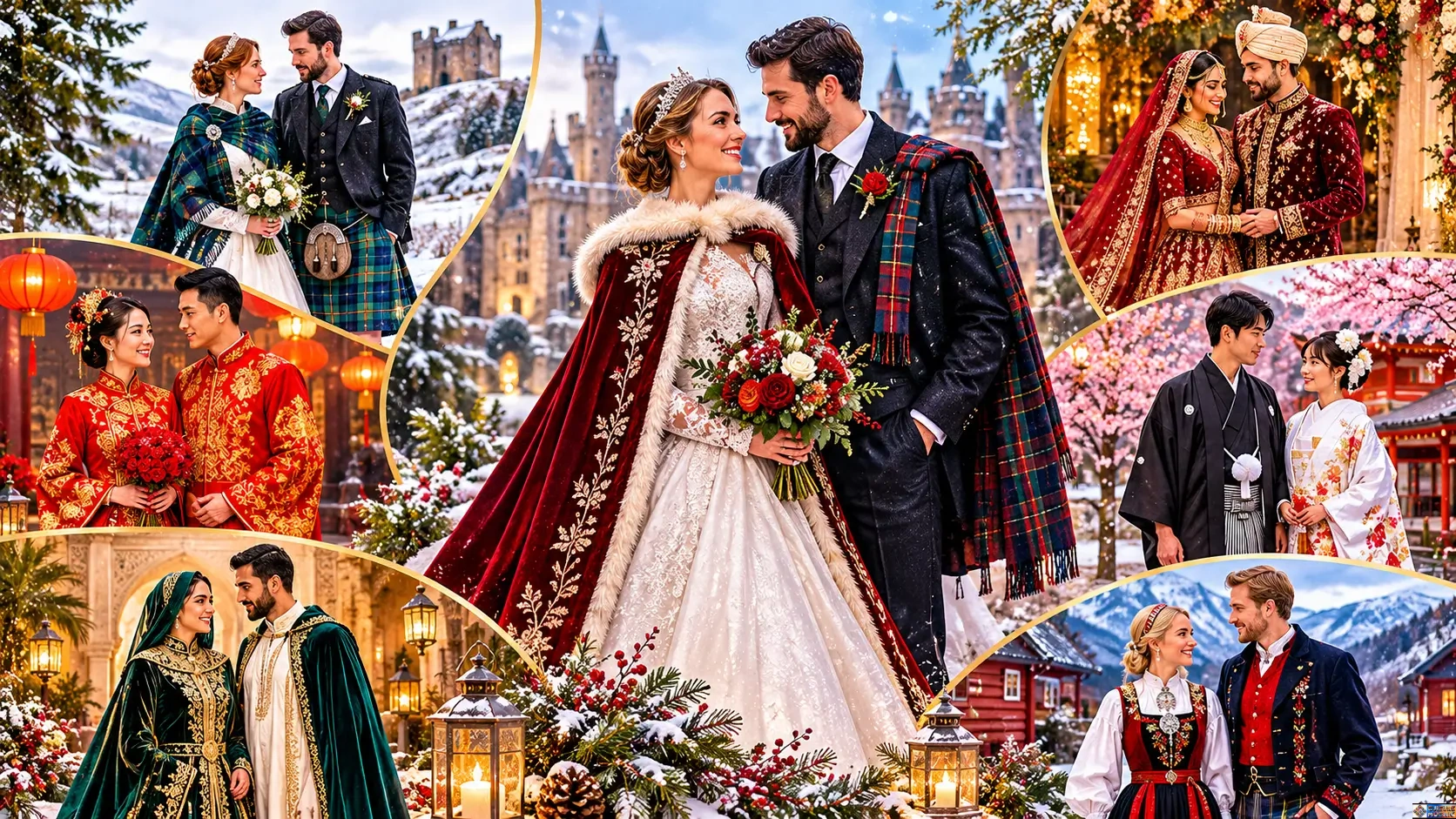
Traditional winter wedding outfits solve one old problem: how to look ceremonial when the air is freezing. Scottish tartan, Indian velvet lehengas, Chinese red brocade, Japanese lined kimono, Moroccan velvet caftans, and Norwegian wool bunads each answer the cold with heavier cloth, more layers, and deeper colour—never with a compromise on formality.
Editorial Note: Below, explore what brides and grooms wear across seven traditions, what keeps them warm, and how to borrow the look respectfully. Adapt the fabrics and palettes (a velvet cape, a tartan wrap, deep jewel tones) and leave sacred ceremonial garments to the communities they belong to.
The Problem Nobody Mentions in the Bridal Magazines
Here’s the picture the glossy shoots sell you. A bride in sleeveless satin, a December sky, a smile. Now the real version: a church that was last warm in 1974, goosebumps in every photograph, a coat thrown over the dress the second the vows end.
It’s a real pain, and a common one. And it’s why I think the most useful place to look for answers isn’t a trend report. It’s history. Communities that married in the cold for centuries already worked this out, and the answers are beautiful.
So this guide walks through traditional winter wedding outfits from seven cultures: the garments, the fabrics, the colours, the accessories, and the practical warmth tricks. If you’re planning a ceremony, you’ll leave with a mood board. If you’re only curious, you’ll leave knowing why velvet keeps turning up in December. For the wider symbolism behind what couples wear, our guide to traditional wedding dress symbolism is a good companion read.
Why Cold Weather Shaped Wedding Dress Traditions
Cloth follows climate. Where winters bite, wedding clothing leans on wool, velvet, heavy silk, brocade, quilting, and fur trim. Those fabrics trap air. They also look rich, which is exactly what a wedding wants.
Colour does double duty too. Reds, golds, emeralds, and deep burgundy read as warmth to the eye, and in many cultures they carry luck or prosperity on top.
Truth 1: Western Christmas Wedding Dress and Festive Bridal Attire
Start with a winter wedding most people know without realising it. Queen Victoria married Prince Albert on 10 February 1840, in white satin trimmed with Honiton lace, and the Royal Collection Trust documents the dress. That one winter ceremony helped fix white in the Western imagination, a story I unpick in why wedding dresses are white. Before that, plenty of brides simply wore their best dress, in whatever colour it happened to be.
The bride: A modern Christmas wedding dress usually means long sleeves, a heavier crepe, satin, or velvet, and a layer that can come off for photographs. Think velvet capes, faux-fur stoles, sleeved lace bodices, and detachable overskirts. If you like the festive angle, I’ve written more on the Christmas wedding dress. Prefer colour? A red or deep emerald gown is a legitimate, historic choice, and the cloth itself has a story, covered in the cultural significance of red velvet fabric.
The groom: A wool morning coat, a three-piece tweed suit, or a velvet dinner jacket in midnight blue or bottle green. A wool overcoat for the church steps. A silk waistcoat in burgundy ties the palette to the bride’s.
Warmth tip: Pick one structured fabric for the outer layer and keep the underlayers thin. Bulk shows; warmth shouldn’t.
Truth 2: Scottish Tartan, the Original Heritage Wrap
Scotland may have the neatest winter solution of all. Wool is the point. The groom’s kilt is a heavy woollen garment in a family or district tartan, worn with an Argyll or Prince Charlie jacket, waistcoat, sporran, kilt hose, and ghillie brogues, with a sgian-dubh tucked into the sock.
The bride rarely wears tartan head to toe. More often it’s a sash or shawl pinned at the shoulder with a brooch, over an ivory gown. It’s understated, and it’s warm. Hogmanay and December weddings suit it perfectly, and I think it’s the single easiest tradition to borrow if you have any Scottish link.
Warmth tip: A tartan wrap, a wool cape in a matching shade, and tights under the dress. Nobody sees the tights. Everybody feels them.
Truth 3: Indian Winter Wedding Outfits, Velvet and Zardozi
In much of northern India, the colder months are peak wedding season, and the clothing responds with weight and shine.
The bride: A lehenga in red, maroon, or deep pink is the classic. In winter it’s often cut from velvet or heavy silk, with zardozi, a rich metal-thread embroidery, around the hem and bodice. Banarasi brocade is another staple. Add a dupatta (long scarf) in a second layer of silk, and a shawl, often pashmina, around the shoulders.
The groom: A sherwani in velvet, brocade, or wool-blend silk, worn over fitted trousers or churidar. A bandhgala or Nehru jacket layers over it. Add a stole, a safa (turban), and mojari shoes.
Accessories: Gold jewellery, bangles, a maang tikka at the parting. Cold hands are real, so many brides slip into long gloves between ceremonies.
Warmth tip: Line the lehenga skirt with a soft cotton or thermal layer. The velvet does the work visually, but the lining keeps you warm in a marquee.
Truth 4: Chinese Red Brocade and Quilted Silk
Red is joy and luck in Chinese wedding tradition, so the colour barely changes with the season. What changes is the cut and the cloth.
The bride: A qun kwa (the two-piece Cantonese wedding set) or a xiuhe, embroidered with gold dragons and phoenixes, the emblem of a balanced couple. In winter, silk is quilted or lined, and a fur-trimmed cape or padded jacket goes over the top.
The groom: A red or dark changshan, the long robe, often with a short mandarin jacket in brocade over it.
Warmth tip: Brocade is heavier than plain silk, so a brocade overjacket adds warmth without a puffy coat. Keep the embroidery on the outside and the quilting inside.
Truth 5: Japanese Shiromuku and the Lined Kimono
The shiromuku is the white kimono worn in Shinto ceremonies. Over it sits the uchikake, a heavy, trailing over-robe that can be white, red, or gold, embroidered with cranes and pine. A white hood or a tsunokakushi covers the hair.
The groom wears a black montsuki haori and hakama with family crests.
Kimono in colder months are lined, and that matters. Layers of underrobes, tabi socks, and a haori coat do the rest. A brocade shawl is common for photographs outdoors.
Warmth tip: Ask the dressing specialist about hidden warmers. Kimono dressing is precise, and a thin pocket warmer at the lower back goes unseen.
Truth 6: Middle Eastern Velvet, Gold Thread and the Bisht
The Middle East isn’t one wardrobe, so I’m going to be careful here. Two threads run through the region’s winter ceremonies, though: velvet and gold embroidery.
In Morocco, the bride may wear a takchita, a two-layer caftan in velvet or brocade with heavy gold trim. In Palestine, the thobe, with its cross-stitch tatreez, appears in wool or velvet for cooler months. In the Gulf, grooms wear a bisht, a long cloak with gold-edged trim, over a white thobe. It’s a cloak. It’s also a statement.
Warmth tip: The outer layer carries the display. Lined velvet, a wool bisht, or an embroidered wrap give you warmth with ceremony intact.
Truth 7: Scandinavian Bunad and Wool
Norway’s bunad is wool, and it’s regional, so a bride from one valley wears something different from a bride three valleys away. Silver brooches called søljer are pinned at the collar, and the bridal crown, the brudekrone, completes the look. The groom’s bunad is wool too, with a waistcoat and jacket.
In Sápmi, the Sámi gákti is a blue wool tunic with bands of red and yellow. It’s striking, and it’s built for cold.
Warmth tip: Wool tights, a fur-lined cloak, and a heavy shawl. Winter here isn’t something to hide from. It’s the whole point.
Quick Comparison: Winter Wedding Outfits by Tradition
| Tradition | Bride’s Key Garment | Groom’s Key Garment | Main Winter Fabrics | Typical Colours |
|---|---|---|---|---|
| Western / UK | Long-sleeved gown, cape | Wool or velvet suit | Velvet, crepe, satin, wool | Ivory, burgundy, emerald |
| Scottish | Gown with tartan sash | Kilt and Argyll jacket | Wool, tartan | Family tartan, ivory |
| Indian | Velvet lehenga | Velvet sherwani | Velvet, brocade, pashmina | Red, maroon, gold |
| Chinese | Qun kwa or xiuhe | Changshan | Quilted silk, brocade | Red, gold |
| Japanese | Shiromuku, uchikake | Montsuki haori hakama | Lined silk | White, red, gold |
| Middle Eastern | Takchita, thobe | Bisht over thobe | Velvet, wool, brocade | Gold, deep jewel tones |
| Scandinavian | Bunad with crown | Bunad | Wool | Black, red, blue, silver |
My own reading of this table: the warmest garments are the ones where the outer layer is also the showpiece. Hidden warmth is fine. Visible warmth is better.
What Do Brides Wear If It’s Cold?
Long sleeves, first. Then a layer that can be taken off for photographs: a velvet cape, a bolero, a faux-fur stole, a wool wrap in a matching tone. Underneath, thermal tights or fine wool leggings and closed shoes. For the dress itself, velvet, crepe, and heavier satin hold heat far better than chiffon or tulle. Taffeta gives structure and a little insulation, though it won’t save you alone.
Silhouette matters too. A close-fitting mermaid cut (see what is a mermaid wedding dress) shows off a cape beautifully but insulates very little, while the draped sleeves and heavier folds of a modern Greek style wedding dress layer more easily. That’s my read, anyway. A rented velvet gown is also a clever winter move.
What Colours Do You Wear for a Winter Wedding?
Deep ones. Crimson, emerald, forest green, burgundy, navy, gold, and ivory. Winter light is low and soft, and these shades hold up in it. They also photograph richly against grey skies.
December Wedding Traditions Worth Borrowing
A few that translate well: a tartan wrap, a candlelit ceremony, winter greenery in the bouquet, a velvet ribbon around it, and a heritage piece from either family. Borrow with care, though. Adapt fabrics and palettes (a velvet cape, a tartan wrap, jewel tones) rather than wearing sacred ceremonial garments such as a shiromuku or a bunad out of context. Those belong to the traditions they come from. For the wider picture, global bridal wear traditions shows how couples blend more than one culture in one day.
What to Wear to a Winter Wedding (Winter Wedding Guest Outfit Ideas)
A guest’s job is to look good and stay out of the bride’s way, so skip white and ivory. Beyond that, winter gives you licence.
What should I wear as a guest to a winter wedding? A midi or maxi dress in velvet or heavy crepe, or a wool suit. Add a coat you’re happy to wear in photographs, a pashmina or wrap, and closed shoes. Cultural dress is welcome when the couple invites it, and a quick message to the couple beforehand is wise. I’d also bring a second pair of shoes for the reception floor. It’s a small thing and you will be glad of it.
For men: A wool suit, a velvet jacket, a dark overcoat, a textured tie. Tweed works beautifully in the right setting.
What Are the Trends for Winter Weddings in 2026?
I’d be cautious about declaring trends from a single season. Here is what I can say with confidence: velvet, capes, long sleeves, deep jewel tones, and heritage accessories are the longest-running winter bridal ideas, and they show no sign of going away. For a high-street source of ideas, Beulah London’s winter wedding outfit ideas is a useful read, though it leans towards guests.
The Wildcard: One Slightly Odd Idea
Commission a lining. Not the outer garment—the inside of the cape, in a family tartan, an heirloom brocade, or a scrap of a grandmother’s silk. Nobody sees it in photographs. You know it’s there. I think that’s a lovely thing to carry down an aisle.
Frequently Asked Questions
1. What are traditional winter wedding outfits?
They are garments that cultures developed or adapted for cold-season weddings: heavier fabrics such as velvet, wool, brocade, and quilted silk, plus layers like capes, shawls, and overcoats. Examples include Scottish tartan, Indian velvet lehengas and sherwanis, lined Japanese kimono, and Norwegian wool bunads.
2. What do brides wear if it’s cold?
Long sleeves, a heavier dress fabric, thermal underlayers, and a removable outer layer such as a velvet cape, wool wrap, or faux-fur stole. Closed shoes and warm tights make a big difference and don’t show.
3. What colours do you wear for a winter wedding?
Rich, deep colours: crimson, emerald, burgundy, navy, gold, and ivory. Many traditions, including Chinese and Indian ones, favour red for luck and joy.
4. What should I wear as a guest to a winter wedding?
Avoid white and ivory. Choose a velvet or heavy crepe dress or a wool suit, add a good coat and wrap, and wear closed shoes. If the couple’s culture has a traditional dress code, follow the invitation.
5. Is it okay to wear a traditional outfit from another culture to a winter wedding?
Only if the couple has invited it or the culture’s custom welcomes guests in that dress. When in doubt, ask. Dressing in the couple’s palette and fabrics, rather than in a borrowed costume, is usually the respectful option.
Sources & Archival References
- Royal Collection Trust, collection record for Queen Victoria’s wedding dress, 1840 (rct.uk)
- Victoria and Albert Museum, wedding dress and kimono collections (vam.ac.uk)
- The Metropolitan Museum of Art, Costume Institute collections on Chinese, Japanese and Middle Eastern dress (metmuseum.org)
- National Museums Scotland, Highland dress and tartan collections (nms.ac.uk)
- Encyclopaedia Britannica entries: kimono, sherwani, tartan, bunad (britannica.com)
- Norwegian Folk Museum, bunad and costume resources (norskfolkemuseum.no)