
 By Dr. Marcus Hale
QUICK SUMMARY
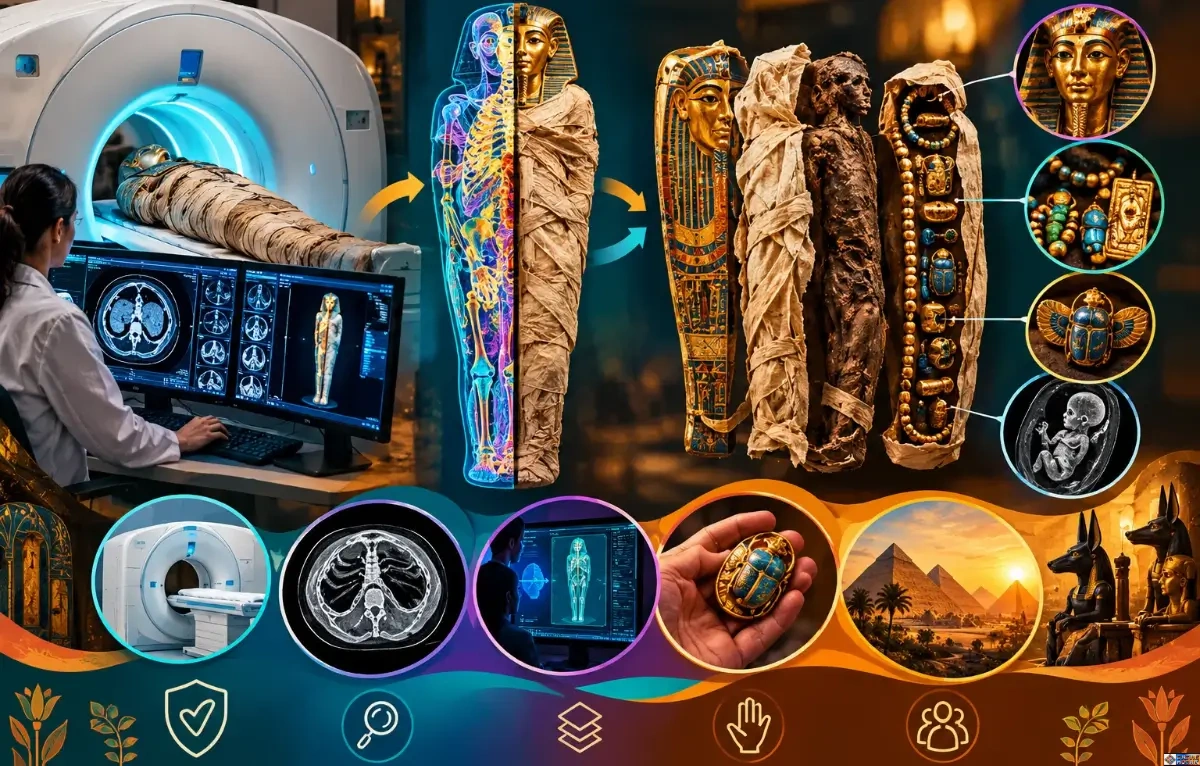
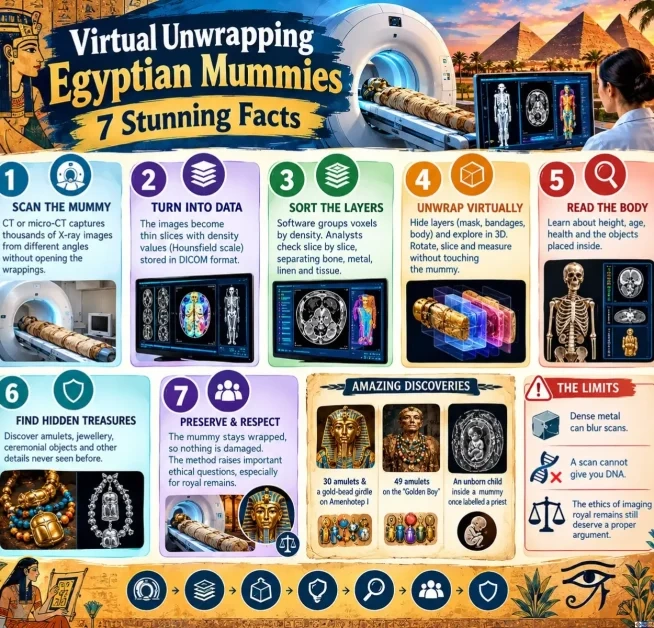
Virtual unwrapping Egyptian mummies means scanning a mummy with CT, then letting software hide its layers on screen one at a time: mask, linen, body, amulets. No bandage is touched. The method has shown 30 amulets and a gold-bead girdle on Amenhotep I, 49 amulets on the “Golden Boy,” and an unborn child inside a mummy once labelled a priest. It has limits. Dense metal blurs scans, a scan cannot give you DNA, and the ethics of imaging royal remains still deserve a proper argument. Below: how it works, what it has found, and where I think it falls short.
Picture a bundle of linen that has been sealed for 3,500 years. Somebody wants to know who is inside. For most of the last two centuries, every honest answer cost the mummy something.
The Victorian method was blunt. In the 1830s the surgeon Thomas Pettigrew unrolled mummies in front of paying audiences in London, then wrote up the results in his 1834 History of Egyptian Mummies. Knowledge gained. Linen lost. Once the bandages came off, nobody could put them back. If you have ever stood at a museum case wanting to see what lies beneath the wrappings, and felt slightly guilty for wanting it, I think you have the right instinct. Curiosity and respect pull in opposite directions here.
That is the problem virtual unwrapping Egyptian mummies was built to solve. Scan first. Peel later, on a screen, as often as you like. The mummy stays wrapped and the questions still get answered. If you want the groundwork first, my companion pieces What Is Mummy in History? and Ancient Egyptian mummification process history explain how these wrapped bodies came to exist at all. Everything below comes from published papers and press statements. I have not interviewed anyone for this piece, and I won’t dress up other people’s findings as mine.
1. Virtual Unwrapping Egyptian Mummies Replaced a Destructive Habit
The change came in stages. Radiographs first. In 1971, researchers used portable X-ray equipment on 29 royal mummies without moving them, and spotted signs of spinal inflammation in Amenhotep II, who ruled from about 1436 to 1413 BC. Useful, but flat. Everything overlapped, like holding a stack of transparencies up to a lamp.
CT changed that. Computed tomography was first used on a mummy in 1977, and portable scanners later let museums bring the machine to the collection rather than the other way round. Chicago’s Field Museum did exactly that in 2017.
Popular culture went somewhere else entirely. Universal’s 1932 film The Mummy gave us the bandage-trailing monster, and for most people the phrase “unwrapped mummy movie” still points to horror rather than radiology. If you search for unwrapped mummy pictures, you will find old engravings and photographs of bodies stripped of their linen. I would steer you to the scans instead. They show more, and nothing had to be ripped to make them.
It helps to remember where wrapping started. The earliest Egyptian burials were not wrapped at all; hot sand dried the bodies naturally, a story I tell in Where Were Ancient Egyptian Mummies First Buried? The linen came later, and with it the layers a CT scanner now has to sort out.
2. How Virtual Unwrapping Works, Step by Step
Think of a loaf of bread sliced very thin. Lay the slices in order and you know what the loaf holds without ever tearing the crust. That is CT in a sentence. Sahar Saleem, the Cairo University radiologist behind several landmark mummy studies, has used a similar bread comparison herself.
Step 1: Scan the mummy
A CT scanner sends X-rays through the body from many angles and measures how much each part absorbs. Hospital machines do the job. The Egyptian Museum in Cairo has had one in its own garden, where Saleem scanned royal mummies. Very small objects, such as an animal mummy or a single amulet, go into a micro-CT instead, which trades size for fine detail.
Step 2: Turn absorption into data
The scanner produces thousands of thin cross-sections. Each tiny block of the image, called a voxel, carries a density number on the Hounsfield scale: air at the bottom, water around zero, bone and metal far higher. Files are stored in the medical DICOM format, so the mummy can be shared and re-read by anyone with the right software. That sharing matters more than it sounds.
Step 3: Sort the layers
Software groups voxels by density. Metal and bone glow. Linen, resin and dried tissue sit in the murky middle and are harder to tell apart. Medical packages such as OsiriX and the free 3D Slicer do this kind of work, but I want to be straight about something: it is not one click. Analysts check the result slice by slice, because a wrong threshold can swallow a thin amulet or invent a crack.
Step 4: Unwrapping a mummy by mouse click
Now the satisfying part. The software rebuilds the stack as a 3D model, and you hide layers: the cartonnage mask first, then the bandages, then the body. Rotate it. Slice it at any angle. Measure it. Saleem described doing exactly this with Amenhotep I, studying him in what she called unprecedented detail without lifting a thread.
Step 5: Read the body
Bone length gives height. Dental wear and growth plates give age. Fractures, arthritis and embalming packs show up as shapes you can measure. For the “Golden Boy” study, Saleem 3D-printed a gold scarab amulet and held it in her hands. An odd, lovely end point for a process that begins with invisible X-rays.
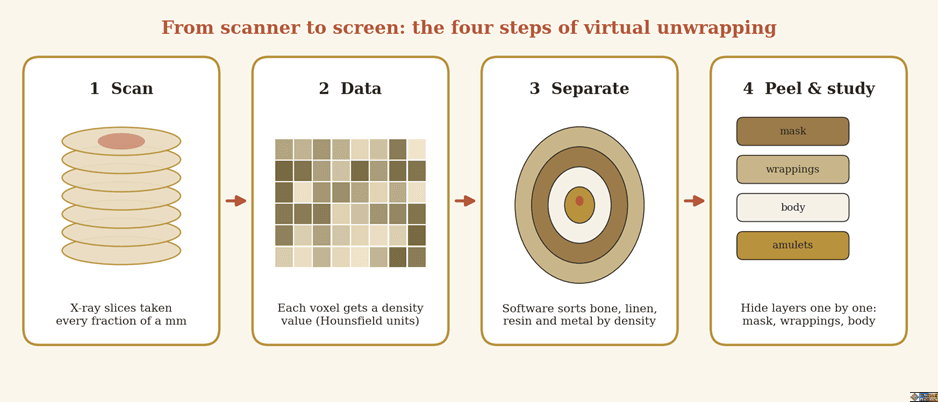
Figure 1. Original Culture Mosaic diagram: the four stages from scanner to screen.
What the scanner sees depends heavily on how the body was prepared, which is why my guide to Ancient Egyptian Mummies Preservation Techniques is worth keeping open in another tab. Resin-soaked linen behaves differently from dry linen, and the software knows nothing about that unless you tell it.
Table 1. Which imaging method does what
3. What Secrets Have These Scans Revealed?
More than anyone expected, and some of it wrong-footed the very people running the scans.
Amulets first. They hide between layers, exactly where a chisel would have wrecked them. Amenhotep I carried 30, including a girdle of gold-coloured beads. The “Golden Boy” carried 49 of 21 types, set out in three columns, with a gold tongue in his mouth and a gold heart scarab in his chest. That tongue is the detail I find most haunting; researchers link it to speech in the afterlife. For the beliefs behind such objects, see Ancient Egyptian burial customs.
Organs next. New Kingdom embalmers usually removed a king’s brain. Amenhotep I’s stayed put, and the 2021 study found no sign that his face had been padded out with packing to look lifelike. A rare omission, and a reminder that embalming was never one fixed recipe.
Then injuries. Tomb robbers damaged him. Centuries later, priests of the 21st Dynasty repaired the damage and kept the jewellery in place. Saleem had expected the opposite, priests stripping the king for spare parts, and said so in print when the scans proved her wrong. A physical unwrapping might have glimpsed those repairs, but it could never have let a second team check them afterwards.
Cause of death is where CT scan Egyptian mummies research both earns its keep and disappoints. Seqenenre Tao II, the 17th Dynasty king known as “the Brave,” has terrible head wounds, and the study suggests more than one attacker. Amenhotep I showed no visible disease or injury to explain his death. Silence in a scan is not innocence. It only means the cause left no mark on bone. For the best-known case of all, read How Did King Tut Die and Why.
And then Warsaw. For decades a museum label said priest. In 2016 researchers realised the body was female, and CT work showed a foetus of roughly 26 to 30 weeks, reported in the Journal of Archaeological Science in April 2021. It is still the only embalmed pregnant individual identified. The foetus had not been removed during mummification, and nobody yet knows why. The project’s co-director, Wojciech Ejsmond, has estimated that around one mummy in ten in museum collections may lie in the wrong coffin. If that is even roughly true, every museum label deserves a polite second look.
4. Which Mummies Have Been Digitally Unwrapped?
There is no official register, so treat any “complete list” with suspicion. These are the cases I consider best documented.
Table 2. Notable mummies studied by scanning
Amenhotep I: the mummy that made headlines
Amenhotep I ruled for about 21 years, roughly 1525 to 1504 BC. His mummy turned up in 1881 in the Deir el-Bahari cache, still fully wrapped, and for 140 years nobody dared open it because the delicate face mask is stuck to the head. Saleem and Zahi Hawass finally scanned it. The scans showed an oval face with a narrow chin, a small narrow nose, curly hair and slightly protruding upper teeth, features she said resembled his father’s. His right forearm was wrapped separately, which they read as the earliest known New Kingdom mummy with crossed arms. If your children want the quick version, BBC Newsround has an explainer on virtual unwrapping Egyptian mummies.
The Golden Boy: a teenager nobody had opened
He was found in 1916 at Nag el-Hassay in southern Egypt, in a cemetery used between about 332 and 30 BC, and then spent a century in storage. The scans revealed a high-status teenager of roughly 128 cm, sent into the afterlife with sandals that Saleem suggests were meant to let him walk out of his coffin. The museum moved him to its main hall, with CT images screened beside the display. To place a 2,300-year-old burial in the long run of Egyptian mummification, see How Old Are Most Egyptian Mummies?
Amenhotep II, Bashiri and the “best preserved mummy” question
Some of you search for “Ammonhotep II”; older books write Amenophis II. Either way, he is the king whose spine the 1971 X-rays flagged. Bashiri is a different sort of case. Popular accounts describe a mummy so intricately wrapped that nobody has opened it, with a pattern some compare to pyramid designs. I would handle those accounts carefully. They disagree about where he is kept, who found him and even how to read his name, and several lean on a single website rather than a published scan study. As for the best preserved mummy, no official ranking exists. Amenhotep I is often called unusually well preserved partly because nobody unwrapped him. That is a different claim from being the best. Untouched mummies attract curse stories too; the real history of that idea sits in Secrets of the Mummy’s Tomb.
The “pharaoh of Moses” mummy
People do search for it. The Bible does not name the king, and scholars have not settled on one. Kenneth Kitchen has argued for Ramesses II; Israel Finkelstein and Neil Asher Silberman doubt the story can be matched to the archaeology at all. Either way, no scan “proves” anything about Exodus. I would be wary of any headline that says otherwise.
5. How Science Unwraps Mummies Without Damaging Them
CT is only the start of virtual unwrapping Egyptian mummies. Ancient Egyptian mummy secrets and technology now overlap in some surprising places. Micro-CT and virtual-reality models gave detailed life histories for a mummified cat, bird and snake. Those animal bundles make ideal test subjects, because nobody wants to cut them open; I explore why Egyptians made them in Ancient Egyptian animal mummies. Scientists have also 3D-printed the vocal tract of Nesyamun, a priest dead for 3,000 years, to simulate the sound of his voice. Infrared scanners revealed tattoos on seven mummies from around the same period.
The cleverest cousin of all deals with scrolls. Brent Seales and colleagues virtually unwrapped the charred En-Gedi scroll in 2016 and read its text without unrolling it. Same logic, different object. Mummies and scrolls have both stopped being things you must destroy to understand.
Table 3. Physical unwrapping versus virtual unwrapping
Notice the honest row: samples. Virtual methods win on safety and repeatability, not on everything. That is why the answer to “how does science unwrap mummies without damaging them” is really “by choosing which questions need a physical sample, and asking only those.”
6. Is Virtual Unwrapping Entirely Ethical?
My honest answer on virtual unwrapping Egyptian mummies: it is the most respectful method we have, and it is still not entirely clean.
Start with consent. These people were wrapped on purpose, with ritual, to be left alone for eternity. No scan can ask permission. Then there is circulation. A CT render of a king’s face can ricochet round the internet in hours, stripped of context and sometimes turned into entertainment. I would rather we remembered that these were people with ordinary days, as I describe in What was everyday life in ancient Egypt, not content.
Then ownership. Who holds the scan, and who decides who may see it? Many of the landmark studies above came from Egyptian teams working on Egyptian remains, which I welcome. Data held in foreign institutions raises harder questions.
The face problem: 3D facial reconstruction Egyptian mummies ethics
A skull gives structure. It does not give skin tone, eye colour, hair or expression, and soft-tissue thickness is estimated from averages. Caroline Wilkinson’s standard text on forensic facial reconstruction is frank about that. The danger is false certainty: a polished face on a museum wall reads as fact. My rule is simple. Label every reconstruction as an interpretation, show the uncertainty, and never let it settle an argument about identity or ancestry.
Professional codes already point the right way. The UK’s 2005 Department for Culture, Media and Sport guidance on human remains in museums and the ICOM Code of Ethics for Museums both ask for care, justification and respect. My line: scan rather than unwrap, publish findings rather than gratuitous images, and treat the data as a loan from the dead.
7. What Virtual Unwrapping Still Cannot Do
I would be doing you a disservice if I only sold the miracle of virtual unwrapping Egyptian mummies. The limits are real:
- Dense metal, such as gold amulets, streaks the image and can hide fine detail nearby.
- Resin-soaked layers can look alike on screen, so linen and tissue are sometimes guesswork.
- A scan cannot supply DNA, a radiocarbon date or chemical analysis.
- “No visible cause of death” never means “no cause.”
- Access is limited by cost, scanner availability and who controls the data.
- Researchers arrive with hypotheses, and those can colour what they see, as Saleem’s own corrected expectation showed.
One more myth, since people ask. A real mummy alive? No. Embalming dried and preserved dead bodies, and no scan has ever found a pulse. The idea survives because of films, not archaeology.
Try It Yourself: Three Sensible Ways and One Strange One
Is there an app for virtual unwrapping Egyptian mummies? I could not verify one standard consumer app, and I would be sceptical of anything promising to “unwrap” your holiday photograph of a mummy. What genuinely exists is better.
- Read the open-access Frontiers in Medicine papers on Amenhotep I and the Golden Boy; the scan images are free to view.
- Visit museum displays that screen CT images beside the mummy, as Cairo’s Egyptian Museum does for the Golden Boy.
- Download the free 3D Slicer and practise on its sample medical datasets to see how layers separate by density.
- The strange one: join the Vesuvius Challenge, where volunteers use virtual unwrapping on carbonised Herculaneum scrolls and in 2024 read passages nobody had seen for nearly 2,000 years.
Amenhotep I has lain behind his mask for 3,500 years, and this time nobody had to break it. That is the part I keep coming back to.
Frequently Asked Questions
How does virtual unwrapping of Egyptian mummies work?
Virtual unwrapping Egyptian mummies starts with a CT scanner, which passes X-rays through the mummy from many angles and records thousands of thin cross-sections. Software assembles them into a 3D model and sorts materials by density, so bone, metal, linen and resin can be shown or hidden separately. Researchers then peel away the mask, bandages and body on screen, rotate the model and measure details. The mummy itself is never touched, and the same data can be re-examined by other teams later.
Which Egyptian mummies have been digitally unwrapped?
Well-documented cases include Amenhotep I (published 2021), the teenage “Golden Boy” (published 2023), Seqenenre Tao II (2021) and the Warsaw mummy, a pregnant woman identified by CT in 2021. Saleem’s team has also scanned many royal mummies in Cairo, including Amenhotep II. No complete public register exists, so beware lists that claim to be definitive. Bashiri is often mentioned, but accounts of his scans disagree.
Is virtual unwrapping entirely ethical?
Not entirely, though most specialists regard it as more respectful than physical unwrapping because nothing is damaged. Open questions remain: the dead cannot consent, scan images can be shared without context, and data ownership is contested. Facial reconstructions add another risk, because they mix evidence with educated guesswork. Museum guidance, including UK government advice and the ICOM code, asks for justification, care and respect.
Can virtual unwrapping show how a mummy died?
Sometimes. CT showed severe head wounds on Seqenenre Tao II and suggested several attackers. It found no visible cause of death for Amenhotep I, and nothing but natural causes for the Golden Boy. A scan only reveals what left a mark on bone or dense tissue, so illness, poison or infection often stay invisible. Treat “no cause found” as unsolved, not as proof of natural death.
Is there an app for virtual unwrapping Egyptian mummies?
I could not verify a single standard consumer app. Real tools include museum interactive displays and free medical viewers such as 3D Slicer, which can handle CT data, though you need genuine scan files to use it. Open-access research papers also show the images. Be cautious of apps that “unwrap” ordinary photographs; they are entertainment, not science.
Sources and Further Reading
- Saleem, S. N. & Hawass, Z. (2021). Digital unwrapping of the mummy of King Amenhotep I (1525–1504 BC) using CT. Frontiers in Medicine, 8, 778498. https://www.frontiersin.org/journals/medicine/articles/10.3389/fmed.2021.778498
- Frontiers (2021). Science news release on the digital unwrapping of Amenhotep I. https://www.frontiersin.org/news/2021/12/28/frontiers-medicine-pharaoh-amenhotep-mummy-digitally-unwrapped
- Saleem, S. N., Seddik, S. A. & el-Halwagy, M. (2023). The “Golden Boy” mummy, CT and 3D printing. Frontiers in Medicine. https://www.frontiersin.org/journals/medicine/articles/10.3389/fmed.2022.1028377/pdf
- EurekAlert (2023). “Golden boy” mummy was protected by 49 precious amulets, CT scans reveal. https://www.eurekalert.org/news-releases/977129
- AuntMinnie (2021). CT adds fuel to debate over pharaoh’s death in ancient Egypt (Seqenenre Taa II; Saleem’s scans of royal mummies). https://www.auntminnie.com/clinical-news/article/15627881/ct-adds-fuels-to-debate-over-pharaohs-death-in-ancient-egypt
- Ejsmond, W., Ożarek-Szilke, M. et al. (2021). A pregnant ancient Egyptian mummy from the 1st century BC. Journal of Archaeological Science. https://doi.org/10.1016/j.jas.2021.105371
- Science in Poland (2021). World’s first pregnant ancient Egyptian mummy identified in Warsaw. https://scienceinpoland.pl/en/node/87581
- CNN via KRDO (2021). First pregnant Egyptian mummy surprises researchers (Ejsmond on mislabelled coffins). https://krdo.com/?p=527958
- Science News (2021). 50 years ago, X-rays revealed what ancient Egyptians kept under wraps (1971 survey; micro-CT of animal mummies; Nesyamun; tattoos). https://www.sciencenews.org/?p=3104143
- Engadget (2021). Researchers used CT scans to virtually unwrap a pristine mummy (first mummy CT in 1977; Field Museum 2017). https://www.engadget.com/amenhotep-ct-scan-204504392.html
- NBC News via Telemundo (2021). Ancient pharaoh reveals secrets after his mummy is “digitally unwrapped.” https://www.telemundo.com/noticias/amp/rcna10154
- Discover Magazine (2025). Modern tech helps reveal mysteries of the 2,300-year-old Bashiri mummy. https://discovermagazine.com/the-sciences/modern-tech-helps-reveal-mysteries-of-the-2-300-year-old-bashiri-mummy
- Euronews (2025). The Bashiri mystery: a 2,300-year-old Egyptian mummy that no archaeologist dares to open. https://euronews.com/culture/2025/03/23/the-bashiri-mystery-a-2300-year-old-egyptian-mummy-that-no-archaeologist-dares-to-open
- Seales, W. B. et al. (2016). From damage to discovery via virtual unwrapping: reading the scroll from En-Gedi. Science Advances, 2(9), e1601247. https://doi.org/10.1126/sciadv.1601247
- Pettigrew, T. J. (1834). A History of Egyptian Mummies. London: Longman (primary historical source; no link supplied).
- Wilkinson, C. (2004). Forensic Facial Reconstruction. Cambridge University Press (no link supplied).
- Department for Culture, Media and Sport (2005). Guidance for the Care of Human Remains in Museums (UK government publication; no link supplied).
- ICOM. Code of Ethics for Museums, sections on human remains. https://icom.museum/en/resources/standards-guidelines/code-of-ethics/
- Kitchen, K. A. (2003). On the Reliability of the Old Testament. Eerdmans; Finkelstein, I. & Silberman, N. A. (2001). The Bible Unearthed. Free Press (no link supplied).
- 3D Slicer, free open-source medical image viewer. https://www.slicer.org/
- Vesuvius Challenge, open data and results on Herculaneum scrolls. https://scrollprize.org/
 Culture Expert