
 By Culture Expert
Quick Summary
- What it is: A Latino cultural festival is a public celebration of the music, dance, food, art and memory of Latin American communities and their diaspora. It is plural by design: many countries, many roots, one site.
- UK Scene: The UK Latino cultural festival calendar is anchored by Latino Life in the Park, which marked ten years in Ealing on 19 July 2026. Carnaval del Pueblo in Burgess Park, free to enter, is the other heavyweight. Smaller community-led events fill the gaps in Brixton, Birmingham and beyond.
- 2027 Outlook: Latino Life in the Park is listed for “July 2027” with the date, lineup and ticket release still to be announced. I found no confirmed Latino Fest dates for London in 2027.
- Planning: Representation and funding break more festivals than stages do. The plan for a Latino cultural festival below is built around that. You get a phased plan, a timeline and an authenticity checklist.
Search for a Latino cultural festival and the internet hands you a checkout page. Date, price, lineup, buy now. Useful, sure. But it answers the wrong question.
Most people typing those words want something else. They want to know what they are stepping into. Why does a single Latino cultural festival afternoon in a London park hold Colombian cumbia, Argentine jazz and Mexican folk dance side by side? Why do some of these days cost £56 while others cost nothing? And if you are the one organising, how do you build a Latino cultural festival without flattening twenty-odd countries into one sombrero and a salsa playlist?
That is the pain, and I think it is a real one. Audiences leave a good Latino cultural festival knowing nothing about it. Organisers burn out learning the lessons the hard way.
Here is my fix: seven facts that explain what a Latino cultural festival actually is, where the UK scene stands today, what is (and is not) confirmed for 2027, and a working plan for building a Latino cultural festival of your own. Everything is sourced. Where sources disagree, I say so. If you want more reporting in this vein, Culture mosaic keeps a running library of festival guides.
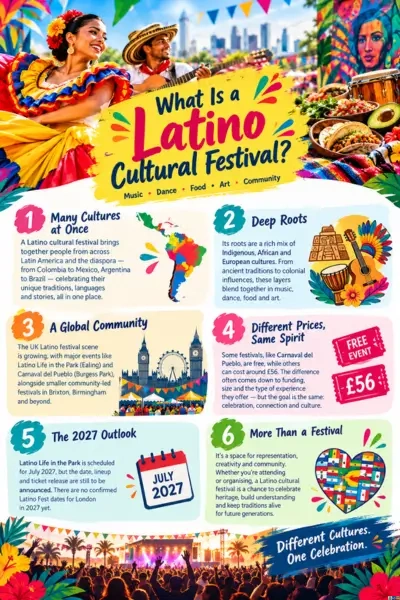
1. A Latino Cultural Festival Is Many Cultures at Once
Start with the word itself. “Latino” covers people with roots in Latin America, which includes Portuguese-speaking Brazil. “Hispanic” is narrower and points to the Spanish language. In Britain, most organisers say “Latin American”, and some younger activists write “Latinx”. The Latin x Brixton Festival, for instance, grew out of years of campaigning by the LatinXcluded collective and the theatre project My Uncle Is Not Pablo Escobar. Three labels, one community, and plenty of arguments about all of them. Whatever the label, a Latino cultural festival has to hold the whole group.
Scale matters too. The Carnaval del Pueblo Association says its purpose is to raise awareness of the heritage of 19 Latin American countries. Latino Life in the Park, per the Mayor of London’s event page, celebrates the contribution of London’s Latin American, Spanish and Portuguese communities to UK culture. And the Evening Standard, reporting on a new film festival, put the number of Latin Americans in London at an estimated 157,800.
So what is a Latino cultural festival? A public event where those communities and their neighbours share music, dance, food, craft, film and conversation, usually tied to a place, a date or a shared memory. Plural by design. A programme built around one country is not wrong. It is closer to a national day than a Latino cultural festival.
Researchers file all of this under a wider family. For the big picture, I would start with Ethno Cultural Festivals Heritage, widen out with the Global Cultural Festivals Guide, and finish with the oddballs in Unique cultural festivals.
2. The Roots of a Latino Cultural Festival Are Indigenous, African and European
Latin American festivals rarely have one origin. They stack. UNESCO’s entry on Mexico’s Day of the Dead is the cleanest example I know. It describes a fusion of pre-Hispanic rites and Catholic feasts, and it ties the observance to the end of the maize growing cycle. Two calendars, one table.
Carnival works the same way. Its season sits before Lent, a Christian marker. Yet in Barranquilla, the South China Morning Post describes a fusion of European, African and Indigenous folklore rooted in music and dance. A University of Bern journal paper adds that some traditional troupes reference conflicts between Indigenous peoples and Spaniards, and slave rebellions. Under the sequins, memory.
Here is the twist I find most useful. The same paper, Hybridization Dynamics and Patrimonialization, notes that many expressions changed after the UNESCO listing and questions how well safeguarding works. Protection can reshape the thing it protects. Anyone planning a Latino cultural festival should sit with that for a minute.
Ritual is the engine underneath every Latino cultural festival. If you like the deep-time view, read Ancient roots of modern festivals, then compare the sacred calendar in Religious Festivals in the World with the heritage framing in Traditional World Festivals Cultural Heritage. Anyone who has seen photographs of candles massed on a Day of the Dead altar will also recognise the logic behind cultural light festivals: fire as a way of calling people, and memories, together.
3. Latin America’s Giants Set the Template for Every Latino Cultural Festival
Every Latino cultural festival in Europe borrows from a handful of giants back home. Four are worth knowing.
| Festival | Where and when | What defines it | Heritage status |
|---|---|---|---|
| Rio Carnival | Rio de Janeiro, Brazil. 13 to 21 February in 2026 | Samba-school parades in the Sambódromo plus street parties called blocos | Widely called the region’s most famous festival |
| Carnaval de Barranquilla | Barranquilla, Colombia. Four days before Ash Wednesday | Folk troupes, the Battle of the Flowers parade, mixed Indigenous, African and European traditions | UNESCO: proclaimed 2003, listed 2008 |
| Día de los Muertos | Mexico. End of October to early November | Altars, remembrance of the dead, Indigenous and Catholic practice fused | UNESCO: proclaimed 2003, inscribed 2008 |
| Carnaval San Francisco | San Francisco, USA. 23 to 24 May in 2026 | Free diaspora festival with parade, five stages and 400 stalls | 48th annual edition in 2026 |
Sources: Universal Assistance, UNESCO, Le Petit Journal, City of San Francisco.
So which is biggest? Honestly, nobody keeps an official league table. Rio is the one the world knows; a Colombian outlet citing Booking.com’s list calls it the most popular festivity in the region. Barranquilla usually gets named next. Attendance claims there are slippery: the SCMP cites more than 2.3 million spectators, while Le Petit Journal expected around 500,000 participants in 2023. Treat any single figure with suspicion.
Money follows crowds. Universal Assistance notes that carnivals bring high hotel occupancy and intense multi-day programmes. If that angle interests you, What Is the Economic Impact of Music Festivals breaks down the numbers, and Top 20 Biggest Festivals in the World puts these giants in context.
4. The UK Latino Cultural Festival Scene Is Younger and More Fragile Than You’d Guess
Latino Life in the Park began in 2016 as a neighbourhood event at Hornsey Town Hall in North London, according to Complex. It then moved to The Scoop near Tower Bridge, on to Finsbury Park, and finally Walpole Park in Ealing. Its founders are Venezuelan-born José Luis Seijas and Argentina’s Amaranta Wright. Small team. Limited funding. Ten years later, it is billed as the UK’s biggest single-day Latin music festival.
Carnaval del Pueblo has the longer, bumpier story. Southwark News reported that it returned in 2022 after a twelve-year hiatus, and the comeback leaned on a crowdfunding appeal to close its funding gap. Twelve years. Gone, then back, because people wanted it back.
Here is how the main UK players in the Latino cultural festival circuit compare.
| Event | Where | Format | Entry | Worth knowing |
|---|---|---|---|---|
| Latino Life in the Park | Walpole Park, Ealing | One-day park festival, four stages, dance parade | Ticketed (£22.50 to £56.25 in 2026) | 10th anniversary 19 July 2026; partnered with the Mayor of London |
| Carnaval del Pueblo | Burgess Park, Southwark | Float parade plus park festival | Free in 2025 | Parade of dancers representing 19 countries; around 200 stalls in 2025 |
| Latin x Brixton Festival | Brixton House, Lambeth | Free community day: market, exhibition, talks, film, workshops | Free, booking needed for some sessions | Born from grassroots campaigning |
| London Latino Film Festival | Barbican opening, then venues such as The Garden Cinema | Screenings, Q&As, exhibition | Ticketed | BFI National Lottery support reported at launch |
| Latino Fest | Birmingham (Digbeth) and other cities | Music and party nights | Ticketed, low-priced per listings | Organiser says it is in its eighth year |
| MotionCITY | Eastside Rooms, Birmingham | Four-day dance festival | Pass-based | Workshops and socials, 7 to 10 August 2026 |
Details come from London.gov.uk, Irvin Leisure’s 2025 listing, Brixton House, Skiddle’s Latino Fest page and SalsaVida. Ticketing aggregators sometimes lag the organisers, so check the official source before you book.
Film deserves its own paragraph, because it is where British Latino identity is getting its sharpest on-screen airing. The London Latino Film Festival, founded by Cuban actress Ketty Rodriguez, opened at the Barbican with 60 films and Q&As with figures such as Carlos Acosta. Its screenings turned up at The Garden Cinema on 3 and 4 October 2026. Separately, Film Locos, led by British Latino filmmaker Victor Rios, programmes shorts by British Latin American filmmakers. One caution: launch coverage called LoLaFF London’s first Latino film festival, yet Goldsmiths lists a long-running London Latin American Film Festival in its 26th edition. Both exist. “First” is doing some work.
Compare all this with the folk circuit I mapped in Best UK Folk Festivals. Folk festivals have an established revival infrastructure behind them. Most Latin festivals have a handful of volunteers and one council relationship. That is exactly why a UK Latino cultural festival feels so alive, and so breakable.
5. Latino Life in the Park: Dates, Tickets and the 2027 Question
Let me answer the question plenty of people hunting for a Latino cultural festival in London are actually typing. Latino Life in the Park 2026 ran on Sunday 19 July, 12pm to 10pm, at Walpole Park, Mattock Lane, London W5 5EQ. The Mayor’s page lists tickets at £22.50 to £56.25. Time Out’s listing describes four stages, more than 20 Latin American food traders and a 500-person dance parade in ceremonial dress. Headliners named in Complex’s preview included Puerto Rican salsa figure Rafu Warner, Argentine jazz pianist Hernán Jacinto and Mexico’s Compañía Folklórica de Bernal.
Age rules shift between editions. Skiddle’s 2026 page says all ages are welcome until 7pm, when the event becomes 18+. Time Out’s 2025 offer page described that year’s event as 18+ only. Always check the current terms.
Now 2027. Skiddle’s current Latino Life in the Park listing says “July 2027, TBA”. That is it. No confirmed date, no lineup, no price. If a site claims to know the 2027 lineup today, I would be sceptical. The official programme lives at latinolifeinthepark.com, and I would sign up for announcements there instead of paying a reseller’s markup.
What about “Latino Fest London 2027”? I found no confirmed listing. Latino Fest’s 2026 events surfaced in Birmingham and Liverpool, so a London date may follow. May.
And the 2026 question, “is there a Latin music festival in London in 2026?” Yes. Latino Life in the Park in July, Carnaval del Pueblo in Burgess Park in August in 2025’s pattern, and film and community events in spring and autumn. As of 10 October 2026, most of the summer calendar is behind us, which means the next big dates to watch are 2027’s. Travelling in for it? Event-Centered Escapes covers how to build a trip around a single festival weekend.
6. Music, Dance and Food Carry Every Latino Cultural Festival
Strip a Latino cultural festival to its bones and you get three languages: sound, movement, taste.
Sound first. The Mayor’s page lists salsa, reggaeton, samba, jazz, fusion, folk, funk, bolero, tango and hip-hop on the Latino Life bill. Different countries, different stories: samba is Brazilian, bachata Dominican, cumbia Colombian, tango rooted in Argentina and Uruguay. London adds its own twist. Candela Records, which calls itself the UK’s first urban Latin record label, fuses reggaeton, grime, drill, dancehall and afrobeats. That hybrid is the sound of British Latino life, and I find it more exciting than any tribute act. For the wider map of traditions behind it, World Folk Music is the place to go next.
Then movement. A 500-strong parade in ceremonial dress is not decoration. It is a way of letting every community show up in its own body. The Latin x Brixton programme included a Mapalé workshop by Somos Chibchas and a Yurupari traditional dance session, which tells you the dance floor is also a classroom. Why does synchronised movement bind a crowd so quickly? Ancestral Somatic Rituals 2026 and The Somatic Architecture of Collective Ritual both explore that question.
Finally taste, the part nobody forgets. Carnaval del Pueblo’s older programmes advertised barbecued beef chusos, fried plantain and yucca, Colombian ice cream and Brazilian caipirinhas, and its 2025 edition counted roughly 200 stalls of food, drink and crafts. Art sits alongside: Latin x Brixton paired its market with an exhibition titled “Ni de aquí ni de allá”, and the film festival showed a collection of hand-printed Cuban film posters.
7. Authentic Representation Is the Hard Part of a Latino Cultural Festival
Here is where I take a stand. The stage is not the hardest part of a Latino cultural festival. Trust is.
Consider what Brixton Buzz reported in July 2025. A Latino street party planned for Atlantic Road was cancelled at the last minute. The organiser behind the account blamed council confusion, police objections and licensing problems, and complained that Latin American representatives had not been given the chance to showcase their culture. That is one side’s account, and I am not adjudicating it. But the pattern matters: when the community is not in the room early, a Latino cultural festival goes wrong late.
The funding picture is just as stark. Carnaval del Pueblo describes itself as run by volunteers. In 2025 it was supported by Arts Council England, and its founder said backing from several Latin American embassies was helping to break down barriers. Her framing of the carnival as a platform for London to learn from Latin America about community and joy is the best one-line brief for any organiser.
My view on access, since you asked for one: a free-entry carnival is civic infrastructure, and a £56 ticketed day is a business. Both can be authentic. But if you only ever run the second, you are quietly deciding who gets to see themselves celebrated. The idea of a festival as temporary public infrastructure is picked apart in Ephemeral Social Infrastructure, and it is the lens I would use to judge any Latino cultural festival.
The Blueprint: Planning a Latino Cultural Festival That Earns Its Name
Now the part for planners. Here is the sequence I would follow to plan a Latino cultural festival with a blank calendar and a modest budget.
Phase 1: Co-design Your Latino Cultural Festival (12 to 10 months out)
Build a community advisory circle before you book a single act for your Latino cultural festival. Include people from several countries, plus at least one voice from the Portuguese-speaking community, and pay them for their time. Decide the purpose in one sentence. Then pick a venue that carries meaning. Latino Life started in a town hall. Festivalle 2026 in Sicily turns an archaeological park into its stage. The lesson is the same: a place can be part of the programme.
Phase 2: Programme and Permissions for a Latino Cultural Festival (9 to 6 months out)
Build the Latino cultural festival programme around four pillars (music, dance, cuisine, art) and test each against the checklist below. Talk to the local authority early about your Latino cultural festival. In England, a Temporary Event Notice generally covers gatherings of fewer than 500 people, while larger events need a premises licence from the council; check GOV.UK for current rules, and use the Purple Guide for safety planning.
| Pillar | Authentic practice | Red flag |
|---|---|---|
| Music | Book artists from several countries and from the UK Latin scene, including hybrid acts | One genre standing in for a whole continent |
| Dance | Invite community dance groups to lead workshops, with a parade for visibility | Hired performers in costume with no community link |
| Cuisine | Reserve stalls for Latin American-run traders at fair rates, with regional dishes labelled by country | Generic “Latin street food” from non-Latin vendors |
| Art | Commission Latin American and British Latino artists, and credit them | Stock imagery of sombreros and skulls |
| Voice | Bilingual (Spanish, Portuguese, English) signage and MC | English-only programme |
Phase 3: Outreach for a Latino Cultural Festival (5 to 2 months out)
Go where the community already is: Latin American cafés and shops, churches, community radio, schools, embassies and consulates, and the organisations that run the film, theatre and dance events listed above. Embassies backed Carnaval del Pueblo in 2025, so ask. Communicate in Spanish, Portuguese and English from day one. Tell stories, not slogans.
Phase 4: Delivery (the final month)
Run safety, accessibility and welfare plans against the Purple Guide. Create a quiet space and a kids’ zone, because Latino Life’s own listing highlights a dedicated Kids Zone and daytime family programming. Train volunteers on the cultural context of what they are stewarding.
Phase 5: Afterwards
Clear the site responsibly after your Latino cultural festival. The post concert hangover lays out why festival waste is a reputational problem too, and Regenerative Festival Culture offers a better model. Then report back to the community: what you spent, what worked, what you will change.
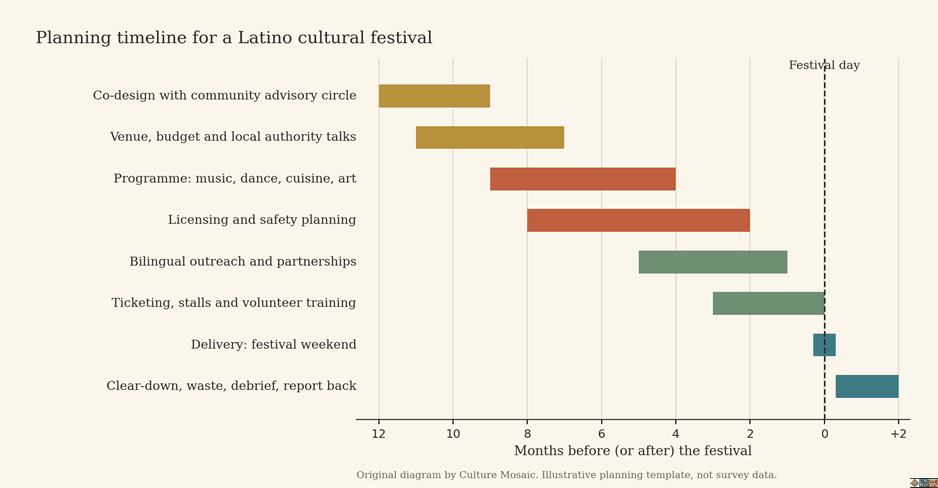
Figure 1. Planning timeline for a Latino cultural festival. Original diagram, illustrative template.
Wildcard time. For every three standard ideas, here is one odd one. The standard three: an advisory circle, bilingual signage, reserved stalls for Latin American traders. The odd one: a dominoes corner. Dominoes tables are a fixture of social life in much of the Caribbean and its diaspora, they cost almost nothing, and they put elders at the centre of the day rather than the edge of it.
How will you know your Latino cultural festival worked? Ask three questions at the exit: Did you see your own culture represented? Did you learn something about a culture that is not yours? Would you come back? Then publish the answers. Social proof earns its place when it is honest.
That is the real opportunity here. The next Latino cultural festival in your city does not exist yet, or it exists on a shoestring and needs your ticket, your volunteer shift or your sponsorship before 2027 dates are fixed. Any Latino cultural festival lives or dies on that early support. Dates are not out. Lineups are not out. This is the quiet window where communities and organisers can shape what comes next, and it will not stay open.
Frequently Asked Questions
What is a Latino festival?
A Latino festival, or Latino cultural festival, is a public celebration of the cultures of Latin America and its diaspora, usually built around music, dance, food, art and shared memory. Examples of a Latino cultural festival include Latino Life in the Park in London, Carnaval del Pueblo in Southwark and Mexico’s Day of the Dead observances. The word Latino includes Portuguese-speaking Brazil, so a good Latino cultural festival is usually plural, with many countries and traditions rather than just one.
Is there a Latin music festival in London in 2026?
Yes, a Latino cultural festival ran in London in 2026. Latino Life in the Park took place on Sunday 19 July 2026 at Walpole Park in Ealing, marking its tenth anniversary, with tickets listed at £22.50 to £56.25. Carnaval del Pueblo is a free Latin American carnival held in Burgess Park in August in recent years, and community events such as Latin x Brixton and the London Latino Film Festival add to the calendar. As of 10 October 2026, most of the summer events have passed, so check official sites for 2027.
What are some famous Hispanic festivals?
Mexico’s Day of the Dead, recognised by UNESCO in 2008, is among the best known. Colombia’s Carnaval de Barranquilla, proclaimed by UNESCO in 2003 and listed in 2008, is another. Rio’s Carnival is famous worldwide, though Brazil is Portuguese-speaking, so it is Latin American rather than strictly Hispanic. In diaspora cities, Carnaval del Pueblo in London and Carnaval San Francisco carry the tradition abroad.
What is the biggest festival in Latin America?
No official ranking exists. Rio de Janeiro’s Carnival is the most famous and is widely regarded as the region’s biggest festival, and Barranquilla’s carnival is often named as the next largest. Attendance estimates vary widely between sources, from roughly half a million to more than two million for Barranquilla, so treat any single number carefully.
Where can I get Latino Life in the Park 2027 tickets and the lineup?
As of 10 October 2026, Latino Life in the Park 2027 is listed as “July 2027, TBA” on Skiddle, with no confirmed date, venue or lineup. Watch the official programme at latinolifeinthepark.com and the Mayor of London’s events page for announcements, and buy from official or authorised sellers. The 2025 edition was listed as sold out at one point, so booking early when sales open is sensible.
Sources and Further Reading
1. UNESCO Intangible Cultural Heritage, “Indigenous festivity dedicated to the dead” (Mexico): https://ich.unesco.org/en/RL/indigenous-festivity-represented-by-the-dead-00054
2. Mayor of London, Latino Life in the Park 2026 event page: https://www.london.gov.uk/events/latino-life-park-2026
3. Complex, “LatinoLife In The Park To Celebrate 10 Years With Major London Festival”: https://www.complex.com/music/a/james-keith/latinolife-in-the-park-10-years-london-festival
4. Time Out, Latino Life in the Park 2026 ticket offer page: https://checkout.timeout.com/london/get-over-30-off-tickets-to-latino-life-in-the-park-2026-61681
5. Skiddle, Latino Life in the Park listing (“July 2027, TBA”): https://www.skiddle.com/whats-on/London/-Walpole-Park-Mattock-Lane-London-W5-5EQ-/Latino-Life-in-the-Park-2026/41269302/
6. Skiddle, Latino Life in the Park 2026 (age policy): https://www.skiddle.com/whats-on/London/Walpole-Park/Latino-Life-in-the-Park-2026/41269302/
7. Southwark News, Carnaval del Pueblo returns (2023, twelve-year hiatus): https://southwarknews.co.uk/area/southwark/carnaval-del-pueblo-returns-next-week-in-memory-of-local-mum-who-died-suddenly-aged-29/
8. Southwark News, Carnaval del Pueblo 2025 preview: https://southwarknews.co.uk/area/camberwell/carnaval-del-pueblo-returns-to-burgess-park-this-august-for-its-16th-year/
9. Irvin Leisure, Carnaval del Pueblo 2025 listing: https://irvinleisure.co.uk/upcoming-funfairs/carnaval-del-pueblo-festival
10. Community Southwark / Spacehive, Carnaval del Pueblo Comeback 2022: https://communitysouthwark.org/?p=4912
11. UCL Students’ Union, Carnaval del Pueblo volunteering listing: https://studentsunionucl.org/volunteering/opportunity/london-new-years-day-parade-volunteeer
12. Brixton House, Latin x Brixton Festival (April programme): https://brixtonhouse.co.uk/?p=71977
13. Brixton House, Latin x Brixton Festival (project background): https://brixtonhouse.co.uk/latin-x-brixton-festival
14. Brixton Buzz, Atlantic Road Latino street party cancellation (July 2025): https://www.brixtonbuzz.com/2025/07/todays-latino-brixton-street-party-in-atlantic-road-suffers-last-minute-cancellation/
15. Evening Standard via inkl, London Latino Film Festival launch: https://www.inkl.com/news/latin-american-film-festival-set-to-launch-in-london
16. Huck, “UK’s first ever Latino film festival is coming to London”: https://www.huckmag.com/article/latino-film-festival-london-first
17. The Garden Cinema, London Latino Film Festival screenings: https://www.thegardencinema.co.uk/?p=26897
18. Goldsmiths, University of London, London Latin American Film Festival listing: https://www.gold.ac.uk/calendar/?id=10319
19. Film Locos, British Latin American Film Take Over: https://ourfaveplaces.co.uk/whats-on/film-locos/
20. Skiddle, Latino Summer Music Festival 2026 (Birmingham): https://www.skiddle.com/whats-on/Birmingham/Luna-Springs-Digbeth-/Latino-Summer-Music-Festival-2026/42483522/
21. EventsList, Latino Fest Summer Rooftop Party Birmingham: https://eventslist.co.uk/birmingham/events/latino-fest-summer-rooftop-party-birmingham
22. EventsList, Latino Fest Liverpool 2026: https://eventslist.co.uk/liverpool/events/latino-fest-liverpool-2026
23. SalsaVida, MotionCITY 2026: https://www.salsavida.com/?p=63731
24. LatinoLife, LatinoLife x Lambeth Country Show (Candela Records): https://www.latinolife.co.uk/event/latinolife-x-lambeth-country-show
25. South China Morning Post, Barranquilla Carnival feature: https://scmp.com/magazines/post-magazine/travel/article/2186943/good-bad-and-ugly-sides-barranquilla-colombia-home
26. Bern Open Publishing (University of Bern), “Carnaval de Barranquilla: Hybridization Dynamics and Patrimonialization Process”: https://bop.unibe.ch/SJM/article/download/8227/12123
27. Universal Assistance, Carnaval 2026 in Latin America: https://www.universal-assistance.com/uablog/donde-celebrar-carnaval-2026-en-latinoamerica/
28. El Espectador, Barranquilla among the top three festivals in Latin America: https://www.elespectador.com/turismo/carnaval-de-barranquilla-uno-de-los-tres-festivales-mas-reconocidos-en-america-latina-article-905619/
29. Le Petit Journal, Carnaval de Barranquilla 2023: https://lepetitjournal.com/bogota/carnaval-de-barranquilla-samedi-18-jusquau-21-fevrier-2023-356278
30. City and County of San Francisco, Carnaval 2026: https://www.sf.gov/vi-vn/event-20260523-carnaval-2026-la-copa-del-pueblo-the-peoples-cup
31. GOV.UK, Temporary event notices: https://www.gov.uk/temporary-events-notice
32. The Purple Guide (Events Industry Forum): https://www.thepurpleguide.co.uk