
 By Dr. Julian Thorne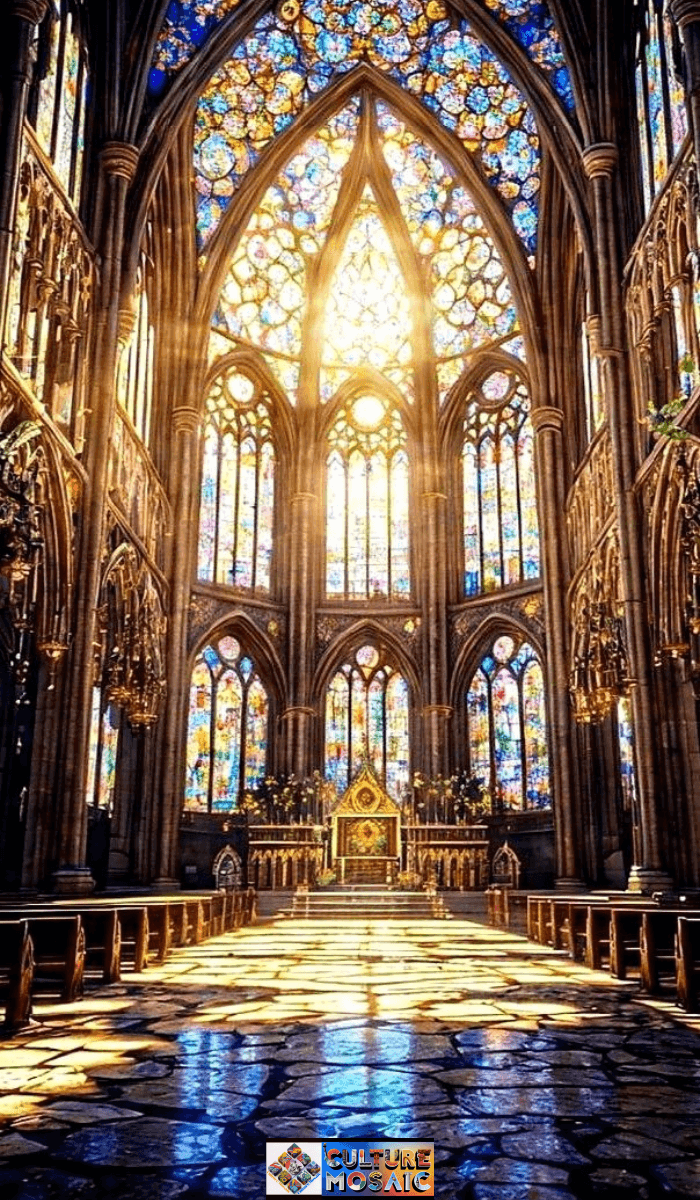
Gothic Stained Glass Windows History: How Light Transformed into the Church’s Most Compelling Storyteller
I still remember the first time I stood inside Chartres Cathedral at midday, watching cobalt light pool on the stone floor like spilled ink. It wasn’t decoration. It was theology made visible. That’s the thing about Gothic stained glass windows history that most people miss when they skim a textbook: this wasn’t an art form bolted onto architecture after the fact. It was the entire point of the building.
I want to walk you through how we got here, from the dim, thick-walled churches of the early medieval period to the soaring, light-drenched cathedrals that still stop visitors mid-sentence eight centuries later. This is a story about engineering as much as it is about art. You can’t separate the two.
What Came Before Gothic: The Romanesque Problem
Before I get into Gothic stained glass windows history proper, I have to explain why this chapter of architectural history couldn’t have happened earlier.
Romanesque churches, the dominant style across Europe through the eleventh and early twelfth centuries, were built like fortresses. Thick walls. Small windows. Rounded arches that pushed enormous structural loads straight down into massive masonry. There simply wasn’t room for large openings, because every wall was doing heavy structural work. Light came in thin, grudging shafts.
Monks and masons experimented with colored glass even in this earlier period, sure. Abbot Suger of Saint-Denis, working just outside Paris in the 1140s, inherited a tradition of glasswork that already existed. But what he did next changed everything.
The Birth of Gothic at Saint-Denis
Suger wanted his abbey church to feel like heaven on earth. He believed, following the writings attributed to Pseudo-Dionysius, that material light was a path toward divine light. So when his masons began rebuilding the choir at Saint-Denis around 1144, they reached for a structural toolkit that let walls do less and openings do more.
That toolkit included the pointed arch, the ribbed vault, and crucially, the flying buttress, which transferred roof thrust outward and downward to external supports instead of relying on thick interior walls. Suddenly walls were free. They didn’t need to hold the building up anymore. They could become glass.
This is the moment Gothic stained glass windows history really begins, not as an isolated craft tradition but as a direct architectural consequence. Take away the buttress, and you don’t get the windows.
I’ll be blunt about something most surveys gloss over: stained glass didn’t drive Gothic architecture forward. Structural engineering did, and the glass followed.
Once exterior buttressing absorbed the lateral thrust of stone vaults, builders could carve enormous openings into what used to be load-bearing walls. The clerestory, that upper tier of windows above the side aisles, expanded dramatically. So did the windows in the nave and choir. By the time builders reached Chartres in the 1190s and 1200s, window openings were approaching the full height of the wall itself.
If you want the structural backstory in more depth, I covered the engineering side of this in What Is Gothic Art and Architecture, where the buttress system gets a fuller technical treatment.
Chartres and the High Gothic Window
Chartres Cathedral, largely rebuilt after a fire in 1194, holds the most complete surviving collection of medieval glass anywhere in the world, and it’s the single best place to study Gothic stained glass windows history up close. Over 150 windows survive, many of them original.
Walking the ambulatory at Chartres, I’m always struck by how legible the glass remains, even eight hundred years on. Donor windows show the trades that paid for them: bakers, furriers, wheelwrights, stonemasons. Biblical windows tell entire narrative cycles in stacked roundels, reading bottom to top like a vertical comic strip designed for an illiterate congregation.
The blue at Chartres deserves its own paragraph, honestly. That cobalt, achieved through specific metal oxide formulas the glassmakers guarded closely, has never been fully replicated since. Modern conservators have tried. They’ve come close. Close isn’t the same as exact.
The Materials and Techniques Behind the Glow
So how did medieval glaziers actually make this stuff? Understanding the craft side of Gothic stained glass windows history matters just as much as the architecture, and the process was unforgiving and slow. I think people underestimate how much skilled labor went into a single window.
Glassmakers started with silica sand, mixed with wood ash for potash, melted at extreme heat. Metal oxides produced the colors: cobalt for blue, copper for ruby red and green, manganese for purple. The molten glass was blown into cylinders, cut open, flattened, and cooled.
Once the glaziers had colored sheets, the real artistry started.
- Cartoon drawing: A full-scale design, often on whitewashed boards, mapped every piece of glass and every lead line in advance.
- Glass cutting: Craftsmen scored and broke colored sheets to match the cartoon, piece by piece, with surprisingly little waste tolerance.
- Grisaille painting: Iron oxide paint, applied with a brush and fired in a kiln, added facial detail, drapery folds, and shading that colored glass alone couldn’t achieve.
- Leading: Strips of lead, shaped like an H in cross-section, held each piece of glass and were soldered into a rigid grid.
- Installation: The assembled panel was set into an iron armature built into the stone window frame, which braced the glass against wind load.
That iron armature mattered more than people realize. Without it, a window twenty or thirty feet tall would have buckled under its own weight or shattered in the first strong wind.
Symbolism: Why Blue, Why Red, Why That Story
Color in Gothic stained glass windows history was never arbitrary. Blue evoked heaven and the Virgin Mary. Red signified Christ’s blood and sacrifice, or sometimes royal authority. Gold and yellow stood in for divine light itself, a literal representation of glory.
The subject matter followed strict patterns too, though regional variation existed. Rose windows, those enormous circular compositions usually placed above the western entrance or transept ends, frequently depicted the Last Judgment or the glorification of the Virgin. Lancet windows along the nave typically ran biblical narrative cycles: the life of Christ, the lives of saints, Old Testament prefigurations of New Testament events.
I find the typological pairing fascinating, where an Old Testament scene sits beside its New Testament counterpart, visually arguing that scripture prophesied its own fulfillment. Medieval viewers, most of whom couldn’t read Latin or even vernacular text, absorbed complex theology this way. The window was the sermon.
Stylistic Evolution Across the Gothic Period
Gothic stained glass windows history doesn’t sit still for two centuries. It moves through distinct phases, each with its own visual signature.
Early and High Gothic (mid-1100s to mid-1300s)
Deep, saturated colors dominated the earliest phase. Compositions favored dense medallions packed with small figures, similar to manuscript illumination scaled up to architectural size. Saint-Denis and the earliest Chartres windows fall here.
As the style matured into the 1200s, windows grew taller and the glass grew lighter in places, with more grisaille work creating visual breathing room. Figures became more naturalistic, with attention to gesture and individual expression. Reims and Amiens both show this shift clearly.
Late Gothic and the Rise of Silver Stain
A genuinely transformative technique arrived around the early 1300s: silver stain, a solution applied to the surface of clear or pale glass that fired into a range of yellows and golds. For the first time, glaziers could paint two colors onto a single piece of glass without needing separate leaded sections. This gave Late Gothic windows a richness and pictorial freedom earlier generations simply didn’t have access to. Crowns, hair, halos, and architectural canopies all benefited.
Flamboyant Gothic and the Move Toward Pictorialism
By the 1400s, French Flamboyant and English Perpendicular styles pushed window tracery into elaborate, flame-like curves. Glass painting followed suit, becoming increasingly pictorial and almost painterly, anticipating Renaissance approaches to perspective and modeling, even before the Renaissance had fully arrived north of the Alps.
Regional Differences Worth Knowing
France gets most of the attention in Gothic stained glass windows history, fairly, given Saint-Denis and Chartres. But regional variation matters, and no honest account of Gothic stained glass windows history should treat France as the whole story.
English Gothic glass leaned toward grisaille and restrained color schemes earlier than French workshops, partly tied to Cistercian preferences for austerity. Canterbury Cathedral still holds remarkable early English narrative windows.
German and Central European workshops developed their own strong traditions, particularly around Cologne, with distinct approaches to figure proportion and architectural framing. Spanish Gothic glass, meanwhile, often shows Islamic-influenced geometric patterning layered beneath the figural scenes, a reminder that medieval Europe was never a sealed artistic bubble.
I think it’s also worth pausing on labor here, because the romantic image of a solitary master glazier doesn’t match the reality of Gothic stained glass windows history. Cathedral glazing was workshop production at industrial scale for its time. A master glazier oversaw a team that included glass blowers, cartoon designers, cutters, painters, and leading specialists. Workshops moved between cathedral sites as commissions opened, carrying techniques and stylistic habits with them, which is partly why scholars can trace stylistic fingerprints across supposedly unrelated buildings hundreds of miles apart.
Guild structures governed training, with apprenticeships running years before a glazier earned independent commission rights. This wasn’t casual craft work. It was a regulated profession with real economic stakes, since a single major window represented a significant capital investment by a cathedral chapter or a wealthy donor guild.
Damage, Loss, and the Fragile Survival of Medieval Glass
Here’s something that genuinely unsettles me every time I think about it: most medieval stained glass is gone, and the surviving record of Gothic stained glass windows history is thinner than people assume. Wars, iconoclasm during the Reformation and the French Revolution, weather, structural collapse, and plain neglect destroyed far more windows than survived.
Chartres survived partly through luck and partly through deliberate protection during both World Wars, when the windows were removed and stored offsite. Many other cathedrals weren’t so fortunate. Canterbury lost significant glass during periods of religious upheaval. Countless smaller parish churches across Europe lost their windows entirely, leaving only clear or Victorian replacement glass where medieval work once stood.
Restoration brings its own complications. Nineteenth century restorers sometimes “improved” damaged windows with invented details that have nothing to do with the medieval original, which means modern scholars have to carefully separate authentic medieval fragments from well-meaning Victorian guesswork.
I’m not a neutral observer on any of this, and I won’t pretend to be. Gothic stained glass windows history isn’t just an academic specialty to me. It represents one of the genuine peaks of human craftsmanship, full stop, and I think it deserves more attention than the comparatively flashy fame of Renaissance painting tends to allow.
These windows fused structural engineering, chemistry, theology, and visual storytelling into a single object, built by anonymous craftsmen whose names mostly didn’t survive, designed to be read by people who couldn’t read. That’s a staggering achievement by any measure.
If you want to go deeper into specific buildings and works from this period, I’d point you toward Medieval Gothic Masterpieces, which covers individual cathedral programs in more detail than I have room for here.
For readers who want a primary-source academic treatment, the Metropolitan Museum’s essay on Gothic stained glass windows history is worth your time too.
FAQs About Gothic Stained Glass Windows History
What is the oldest surviving example in Gothic stained glass windows history?
Some of the earliest surviving Gothic glass comes from the choir of Saint-Denis, rebuilt under Abbot Suger starting in 1144, though only fragments of the original glazing survive in their original context today. Chartres holds the largest substantially intact collection from the early Gothic period.
Best practices for understanding early Gothic glass:- Look for deep, jewel-toned color saturation, a hallmark of the earliest surviving windows.
- Note the small, densely packed medallion compositions typical of this period.
- Compare figure style to contemporary manuscript illumination for stylistic context.
- Check museum or cathedral documentation for which panels are original versus restored.
- Visit in person if possible; photographs flatten the depth that light gives the colors.
Why did medieval glaziers use lead to hold the glass pieces together?
Lead was soft enough to shape around irregular glass edges, strong enough to hold panels rigid once soldered, and cheap relative to alternative metals, making it the practical choice for assembling complex multi-piece windows.
Best practices for evaluating leadwork in historic windows:- Look at the thickness and regularity of lead lines, since later restorations often use noticeably different lead profiles.
- Note how lead lines double as outlines within the composition, not just structural joints.
- Ask whether an iron armature is visible supporting the panel from behind.
- Compare lead patterns across panels in the same window for workshop consistency.
- Consult conservation reports when available, since they typically document lead replacement history.
How does Gothic stained glass windows history connect to cathedral architecture more broadly?
The connection is structural, not just decorative. Innovations like the ribbed vault and flying buttress removed load-bearing responsibility from walls, which directly enabled the large glazed openings that define the Gothic style.
Best practices for reading the architecture-glass relationship:- Look up at the clerestory level first, since that’s where the structural story is most visible.
- Trace the buttress system on the building’s exterior before interpreting the interior glass.
- Compare an early Gothic nave to a High Gothic nave to see window size increase over time.
- Notice how tracery patterns become more elaborate as structural confidence increased.
- Read the windows in sequence, since narrative cycles usually follow a deliberate viewing order.
What does the symbolism in a typical rose window mean?
Rose windows typically depicted the Last Judgment, the glorification of the Virgin Mary, or cosmological themes representing divine order, with radiating tracery patterns reinforcing the sense of celestial structure.
Best practices for interpreting rose window symbolism:- Identify the central figure first, since it usually anchors the entire theological program.
- Work outward through the surrounding roundels in deliberate sequence.
- Note color symbolism, particularly blue for heaven and red for sacrifice or authority.
- Consider the window’s placement, since western rose windows often differ thematically from transept roses.
- Research the specific cathedral’s dedication, since local saints sometimes appear in unexpected places.
How has silver stain technique changed Gothic stained glass windows history?
Silver stain, introduced in the early 1300s, allowed glaziers to paint two colors onto a single piece of glass, eliminating the need for separate leaded sections of yellow glass and opening up much greater pictorial and decorative freedom.
Best practices for spotting silver stain in historic glass:- Look for warm yellow or gold tones applied within a larger piece of clear or pale glass, rather than as a separate leaded piece.
- Check decorative details like crowns, halos, and hair, common places glaziers applied the technique.
- Compare windows before and after the early 1300s in the same building to see the technique’s introduction.
- Note that silver stain appears as a surface application, distinct from pot-metal colored glass.
- Ask conservation staff or guides about documented silver stain use in a specific window if you’re uncertain.
Read more architectural history and Gothic art coverage at Culture Mosaic.