
 By Culture Expert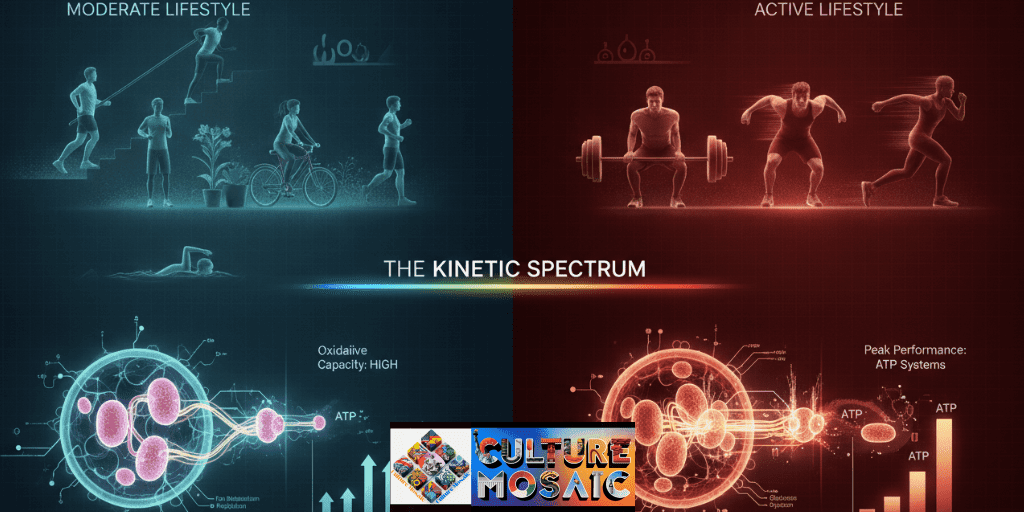
For years, public health guidelines have repeated the same baseline mantra: get 150 minutes of moderate-intensity exercise per week. If you achieve this, you are labeled “healthy.” But in modern metabolic science, we have realized this metric is far too simplistic.
There is a vast, unmapped chasm between a life that is merely protected from immediate cardiovascular decay and one that is optimized for biological longevity and peak performance. This is the real distinction when evaluating a moderate vs active lifestyle.
It is not simply a debate about whether you walk the dog or run marathons; it is about how your body handles energy substrate partitioning, how your muscles communicate with your brain via myokines, and how your daily habits physically reshape your cellular architecture.
To help you understand exactly where your own habits place you on this spectrum, use the metabolic calculator below to evaluate your daily physical output.
Interactive Metabolic & Activity Classifier
Input your real daily metrics below to determine your biological lifestyle classification, estimated metabolic rate scaling, and personalized physiological recommendations.
The Metabolic Divide: METs and Energy Substrate Partitioning
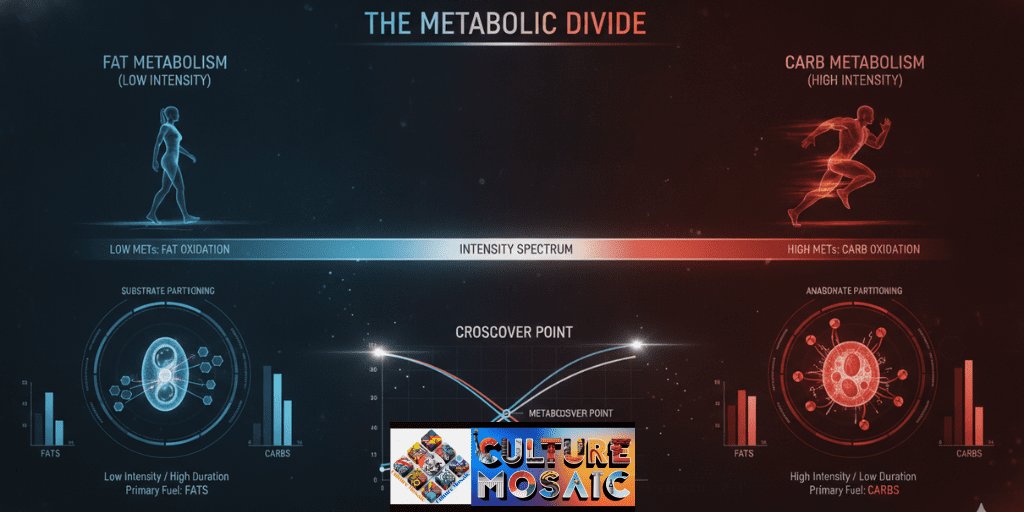
To understand why an active lifestyle acts as a drug for biological preservation, we must look at the concept of Metabolic Equivalents (METs). One MET corresponds to your resting metabolic rate—the energy expended while sitting quietly, consuming roughly $3.5\text{ mL of } O_2 \text{ per kilogram of body weight per minute}$.
- Moderate-intensity activities scale between 3.0 and 6.0 METs. This includes brisk walking ($4\text{ mph}$), light yard work, or casual cycling. At this level, your body primarily burns a balanced mix of circulating glucose and free fatty acids.
- Vigorous-intensity activities require 6.0 METs or more. This encompasses running, competitive sports, heavy strength training, or high-intensity interval training (HIIT).
This MET escalation is not a simple linear progression. It marks a profound biological threshold. When you cross the 6-MET barrier, your system transitions into high-rate glycolysis.
The resulting accumulation of blood lactate triggers the release of Human Growth Hormone (HGH) and Brain-Derived Neurotrophic Factor (BDNF), while simultaneously prompting mitochondrial biogenesis—the physical creation of new cellular powerhouses in your muscle tissue. A moderately active person prevents their mitochondria from degrading; an active person actively forces them to multiply.
The “Active Couch Potato” Syndrome: A Critical Modern Hazard
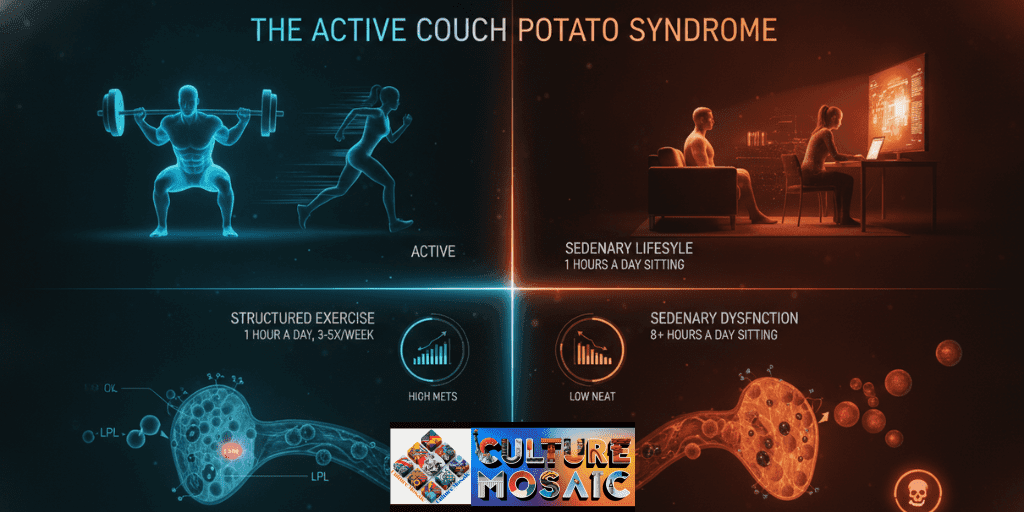
One of the most insidious errors of the modern wellness landscape is the assumption that a single, focused hour at the gym cancels out a day of complete stagnation. This is known in epidemiological circles as “Active Couch Potato Syndrome.”
If you sit at a desk for nine hours a day, the biological reality of your muscular tissue changes. Lipoprotein lipase (LPL)—an enzyme vital for capturing and burning circulating fats—drops by up to 90% within a few hours of physical inactivity. Your blood flow slows down, insulin resistance ticks upward, and chronic systemic inflammation increases.
[ 9 Hours of Sitting ] ➔ [ LPL Enzyme Drops 90% ] ➔ [ Systemic Inflammatory Markers Rise ] ➔ [ 1-Hour Workout Cannot Reverse ]
An individual who does not “exercise” in a structured way but walks, stands, and carries heavy loads continuously throughout the day (a high-NEAT, active lifestyle) frequently possesses far superior vascular and lipid profiles than an individual who sits still for ten hours but runs for thirty minutes on a treadmill.
Chronobiology and Hormonal Profiles: Cortisol vs. Myokines
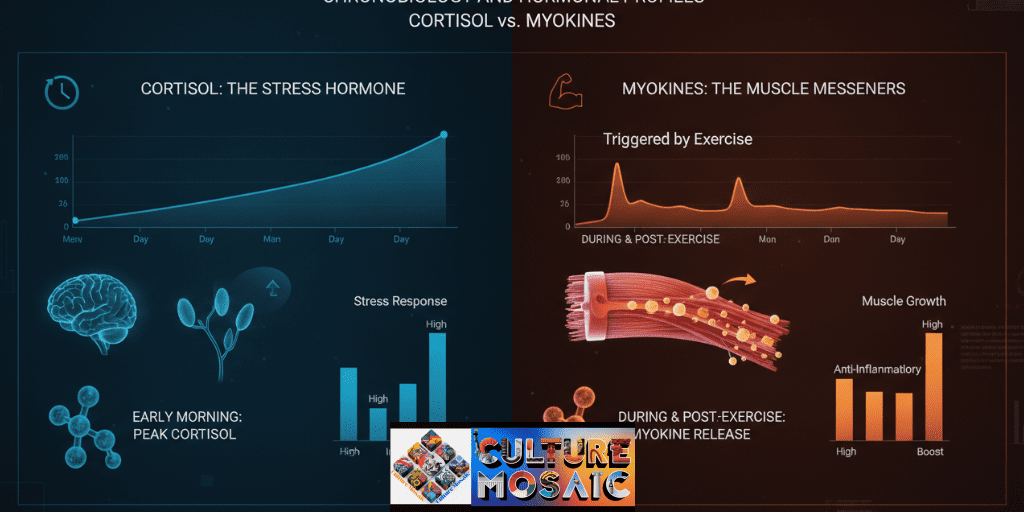
The choice between these two lifestyles has a profound, cascading impact on your endocrine system. When your physical exertion remains persistently moderate and low-impact, your endocrine system operates in a steady, homeostatic state.
However, introducing intense, active lifestyle protocols changes your systemic signaling:
- Myokine Release: Skeletal muscle is now recognized as a major endocrine organ. When subjected to the high-force contractions typical of an active lifestyle, muscles secrete myokines like irisin and IL-6. These molecules cross the blood-brain barrier, reducing systemic inflammation, enhancing hippocampal plasticity, and accelerating fat cell browning.
- Cortisol/Testosterone Ratio: Vigorous activity temporarily spikes cortisol, the primary stress hormone. However, when paired with appropriate recovery, this systemic shock prompts a rebound in testosterone and growth hormone production. This adaptation results in a lower resting stress response over time, protecting you from the anxious, low-grade burnout that sitting in a high-stress office environment induces.
- Insulin Sensitivity & GLUT4: An active lifestyle constantly stimulates GLUT4 glucose transporters to move to the cell membranes of your muscles, pulling sugar out of your bloodstream without relying on insulin. This mechanism protects you from insulin resistance far more effectively than moderate walking alone.