
 By Culture Expert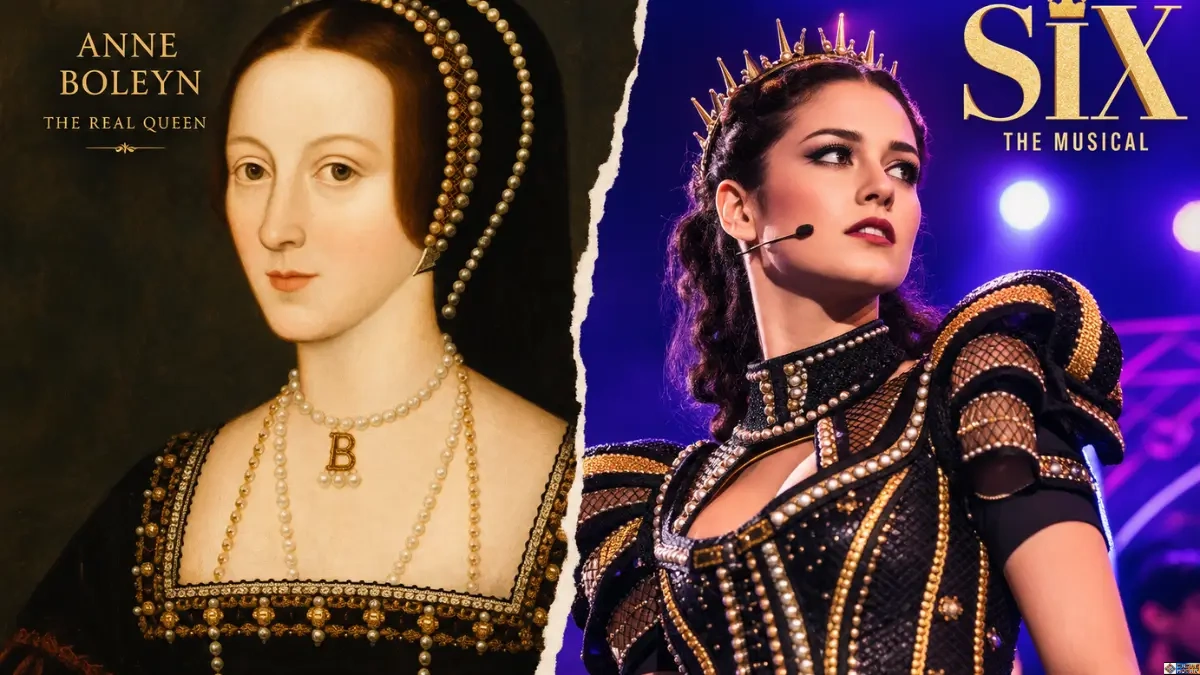
Anne Boleyn Six A Glimpse into History: Separating 16th-Century Tudor Fact from Modern Musical Fiction
Quick Summary: In the hit West End and Broadway musical SIX, Queen Anne Boleyn is reimagined as a bold, neon-green-clad pop queen singing the irreverent anthem “Don’t Lose Ur Head.” While the show captures her quick wit, intelligence, and sharp tongue, real 16th-century Tudor history reveals a far more complex figure: a devout reformer, a shrewd political strategist, and the tragic victim of a state-sanctioned judicial murder engineered by Henry VIII and Thomas Cromwell.
In May 1536, Anne Boleyn knelt upon a scaffold at the Tower of London, waiting for the swing of a French swordsman’s blade. Nearly five centuries later, she steps into a blinding spotlight, clad in a punk-rock green skirt and space buns, belting out: “Sorry, not sorry bout what I said!”
The contrast between the real Queen of England and her stage persona in SIX the Musical is staggering. Yet, the show’s explosive popularity has prompted millions to ask: Is Anne Boleyn in SIX historically accurate? By exploring Anne Boleyn Six A Glimpse into History, we uncover how 16th-century court politics, religious upheaval, and royal ambition were transformed into a modern pop legend.
Real Tudor History vs. SIX the Musical
While SIX distills Anne’s life into a four-minute pop song, the real history behind Henry VIII’s second wife was marked by intense intellect, religious passion, and court rivalry.
Deconstructing “Don’t Lose Ur Head” and the Green Dress
In the musical, Anne’s signature number, “Don’t Lose Ur Head,” draws heavy inspiration from modern pop icons like Avril Lavigne and Lily Allen. But behind the catchy beats lay subtle nods to historical truth and cultural mythology.
1526: Courtship Begins
   └── Refuses to be a Royal Mistress (Demands Marriage)
          ├── 1533: Secret Marriage & Coronation as Queen
          ├── 1533: Birth of Future Queen Elizabeth I
          └── 1536: Miscarriage of Male Heir & Factional Plot
                 └── MAY 19, 1536: Execution at Tower of London
The Meaning Behind the Song Lyrics
Lines like “Thought I might send a little reply, try to decide which guy…” play into the Tudor rumor mill. Historically, Anne was betrothed to Lord Henry Percy and courted by the poet Thomas Wyatt before King Henry VIII set his sights on her. However, far from being a lighthearted flirt, Anne knew the deadly stakes of royal favor. She refused to become Henry’s mistress, holding out for a legitimate crown—a decision that ultimately triggered the break with Rome and shaped European history, much like the wider historical shifts explored across Culture Mosaic.
The Symbolism of the Green Costume
Anne’s iconic green vinyl outfit in SIX is a direct nod to two historical elements:
- The “Greensleeves” Myth: Legend claims Henry VIII composed the famous folk song Greensleeves for Anne during their prolonged courtship when she resisted his advances.
- French Fashion Influence: Having served in the royal courts of the Netherlands and France in her youth, Anne brought sophisticated French gowns, high necklines, and French hoods to the English court, revolutionizing Tudor style.
The True Execution Facts: Did Anne Really Cheat?
One of the most persistent questions searched by history enthusiasts is: Did Anne Boleyn really cheat on Henry VIII?
The short answer from modern consensus among historians is no.
Tudor Trial Charges (May 1536) --------> Modern Historical Findings
Adultery with 5 Men       --------> Fabricated dates; 3 men weren't in same location
Incest with George Boleyn --------> Invented to destroy the Boleyn family faction
Plotting King's Death     --------> Legal necessity to fulfill High Treason charge
By 1536, Anne had failed to give Henry a living male heir, having suffered miscarriages while Jane Seymour waited in the wings. Henry’s chief minister, Thomas Cromwell, orchestrated Anne’s downfall by fabricating charges of adultery with five men—including her own brother, George Boleyn. Modern analysis reveals that on several dates listed in the official indictments, Anne was either under heavy guard or nowhere near the accused men.
Her trial was a political execution disguised as judicial process, a stark reminder of the fragile nature of royal power seen in other tragic royal accounts, such as the story of Lady Jane Grey Last Words.
Why Anne Boleyn’s Legacy Resonates Today
Anne Boleyn was far more than a footnote in Henry VIII’s quest for an heir. She was the mother of Queen Elizabeth I—one of England’s greatest rulers—and her marriage reshaped the religious and political map of Europe forever.
SIX the Musical succeeds not because it is a precise history textbook, but because it captures Anne’s enduring spirit: her refusal to be silenced, her sharp intellect, and her refusal to play the passive victim. Her story stands alongside other legendary historical narratives on Culture Mosaic, including Most Famous Historical Couples, Famous Historical Love Stories and Romances, and strange historical anomalies like What Is the Dancing Plague of 1518. Even modern cultural rituals examined in Victorian Wedding Traditions and Myths trace back to the royal precedents established in Tudor times.
Is Anne Boleyn in SIX historically accurate? +
SIX takes creative liberties by portraying Anne Boleyn as a cheeky modern pop star. While it accurately reflects her wit, intelligence, and the tragic nature of her execution, it simplifies the complex political, religious, and courtly realities of 16th-century Tudor England.
Why is Anne Boleyn important to history? +
Anne Boleyn is pivotal because Henry VIII’s desire to marry her led directly to England’s break with the Catholic Church, triggering the English Reformation. Furthermore, she gave birth to Queen Elizabeth I, who became one of England’s most successful monarchs.
Did Anne Boleyn really cheat on Henry VIII? +
No. Modern historians overwhelmingly agree that the charges of adultery, incest, and treason leveled against Anne Boleyn in 1536 were fabricated by Thomas Cromwell and Henry VIII to clear the way for Henry to marry Jane Seymour.
What happened to Anne Boleyn in Six? +
In the musical SIX, Anne Boleyn sings her signature solo “Don’t Lose Ur Head,” humorously detailing her rise, courtship, and execution, before joining the other five queens to reclaim her identity beyond her tragic death.
Is Anne Boleyn’s bloodline still alive today? +
Anne Boleyn’s direct bloodline ended with her daughter, Queen Elizabeth I, who died childless in 1603. However, descendants of her sister, Mary Boleyn, are alive today—including members of the British Royal Family through King Charles III.
Credible Historical Sources & Academic References
- Ives, Eric. The Life and Death of Anne Boleyn: ‘The Most Happy’. Blackwell Publishing, 2004.
- Starkey, David. Six Wives: The Queens of Henry VIII. HarperCollins, 2003.
- Historic Royal Palaces. “The Execution of Anne Boleyn,” Tower of London Historical Archives, 2022.
- Hever Castle Archives. “Anne Boleyn at Hever Castle,” Hever Castle Estate Historical Records.
 Dr. Marcus Hale