
 By Culture Expert
Quick Summary
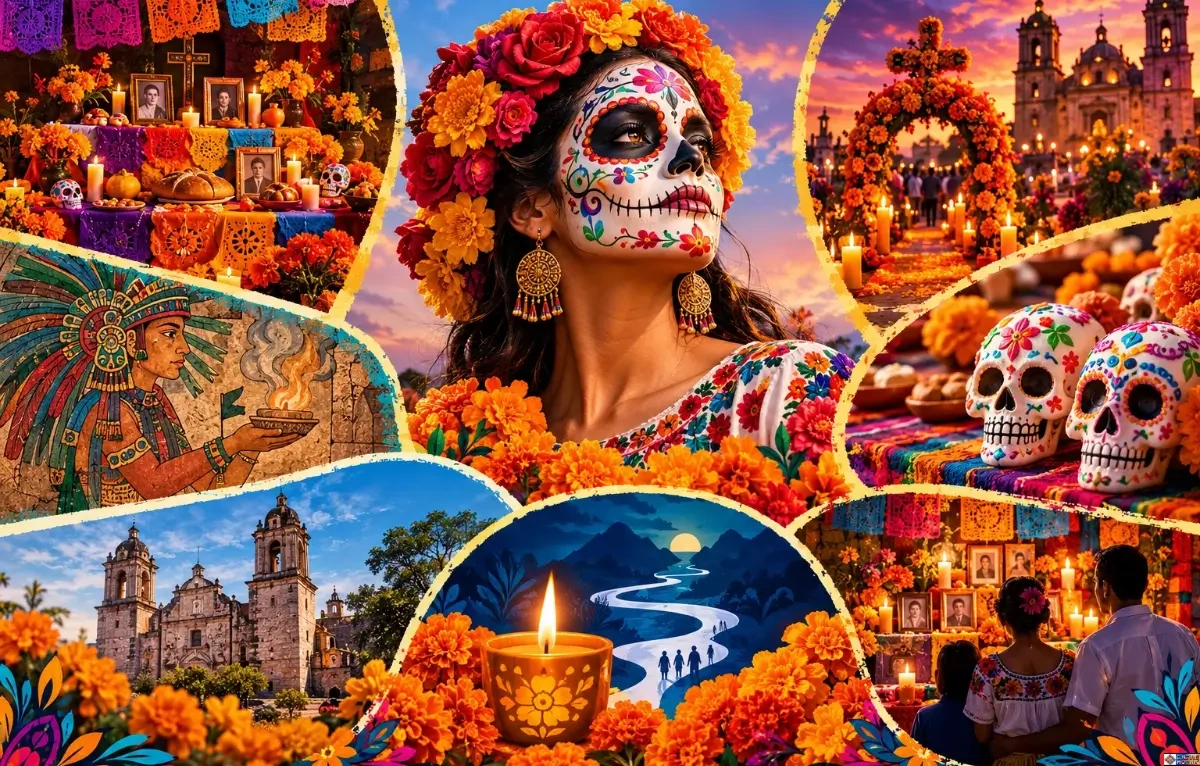
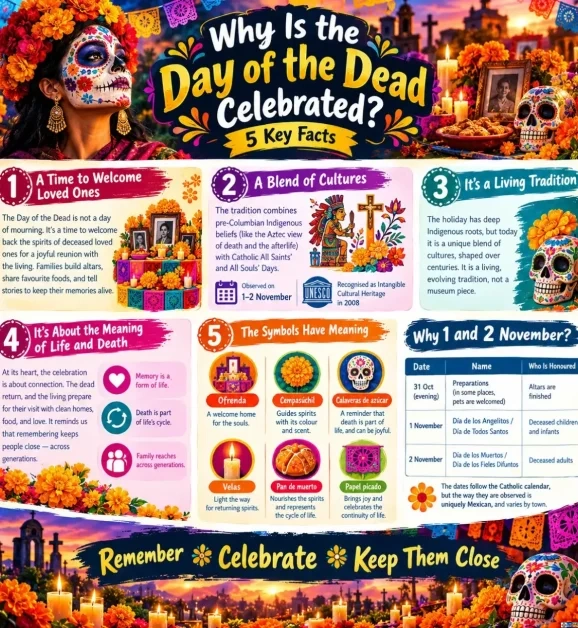
Why is the Day of the Dead celebrated? Día de los Muertos is celebrated to welcome back the spirits of deceased loved ones for a short, joyful reunion with the living. It is not a day of mourning. Families build altars, share favourite foods, and tell stories so that the dead are remembered. The holiday blends pre-Columbian Indigenous beliefs, including Aztec (Mexica) ideas about death and the afterlife, with Catholic All Saints’ and All Souls’ Days. It is observed on 1-2 November, and UNESCO recognised it as part of humanity’s Intangible Cultural Heritage in 2008.
The Misunderstanding That Starts Most Searches
Many people first meet the Day of the Dead through skulls, skeletons, and bright orange flowers. Understandably, they assume it is Mexico’s version of Halloween, or something dark and sorrowful.
It is neither.
If you have ever felt that grief has no place to go after a funeral, that people stop saying a loved one’s name too soon, the Day of the Dead offers a different idea. In this tradition, death does not end a relationship, and remembering is something you do together, with food, music, and laughter.
That is why it endures. Here is how it came to be.
Why Do We Celebrate the Day of the Dead? The Core Meaning
At its heart, the celebration rests on one belief: the dead return. Once a year, families believe, the souls of the departed cross back into the world of the living. The living prepare for the visit the way you would for any beloved guest, with a clean home, a place at the table, and the dishes they loved.
Three ideas sit underneath the tradition:
- Memory is a form of life. A person is truly gone only when no one remembers them.
- Death is part of life’s cycle. It is not hidden or feared, and it is often treated with humour and affection.
- Family reaches across generations. Children learn who their great-grandparents were by helping to build the altar.
That is the answer to “Why is Day of the Dead so special?” It turns grief into connection.
Day of the Dead History: Where Did It Come From?
Pre-Hispanic roots
Long before the Spanish arrived in the early 16th century, Indigenous peoples of Mesoamerica, including the Mexica (Aztecs), held complex beliefs about death. They did not picture a simple heaven or hell. According to Mexica belief, where a soul went depended largely on how a person died, not how they lived. Many souls were thought to travel to Mictlān, the underworld, on a long journey that took years.
Mictlān was ruled by Mictlāntecuhtli and his consort Mictēcacihuātl, often translated as “Lady of the Dead.” Spanish friars who recorded Aztec life, including Bernardino de Sahagún and Diego Durán, described festivals devoted to honouring the dead, held in the summer months of the Aztec calendar.
The Spanish conquest and the Catholic calendar
After the conquest of 1521, missionaries worked to convert Indigenous communities. The Catholic calendar already contained All Saints’ Day (1 November) and All Souls’ Day (2 November), a time to pray for the departed. The latter was formalised in the 10th-11th centuries, often credited to Abbot Odilo of Cluny.
Rather than one tradition replacing the other, the two merged. Indigenous communities’ practices of feeding and honouring the dead continued, now alongside Catholic observances, altars, and prayers.
A note on honesty
Popular articles sometimes claim that today’s holiday is a direct, unbroken continuation of an Aztec festival. Scholars are more cautious. Anthropologist Stanley Brandes, in Skulls to the Living, Bread to the Dead, argues that many features of the modern celebration took shape over centuries and were shaped by Mexican nationalism in the 20th century. It is best understood as a living, evolving tradition with Indigenous and European roots, not a museum piece.
Why Is the Day of the Dead Celebrated on 1 and 2 November?
| Date | Name | Who Is Honoured |
|---|---|---|
| 31 Oct (evening) | Preparations; in some places, spirits of pets are welcomed | Altars are finished |
| 1 November | Día de los Angelitos / Día de Todos Santos | Deceased children and infants |
| 2 November | Día de los Muertos / Día de los Fieles Difuntos | Deceased adults |
The dates follow the Catholic calendar, but the way they are observed is distinctively Mexican, and varies from town to town.
The Symbols: What Do They Actually Mean?
This is the question many readers really want answered. Here is what each element represents.
| Symbol | Spanish Name | Meaning |
|---|---|---|
| The altar | Ofrenda | A welcome home for the souls. It is not an object of worship. It is an offering of love. |
| Marigolds | Cempasúchil | Their bright colour and strong scent are said to guide spirits from the cemetery to the home. The name comes from Nahuatl. |
| Sugar skulls | Calaveras de azúcar | Playful, decorated skulls, often with a loved one’s name on the forehead. They show that death is something to face with colour, not dread. |
| Bread of the Dead | Pan de muerto | A sweet bread, often shaped with “bones” on top, shared with the living and left for the dead. |
| Paper banners | Papel picado | Delicately cut tissue paper. Its movement in the wind represents the fragile, fluttering link between life and death. |
| Candles and incense | Velas y copal | Light and fragrance to guide and welcome the souls. |
| Favourite foods and objects | — | Personal touches: a cigarette, a glass of tequila, a toy, a photograph. The altar is a portrait in objects. |
What about “La Catrina”?
The elegant skeleton in a feathered hat is not an ancient goddess. She grew from a satirical engraving by the printmaker José Guadalupe Posada in the early 20th century. Diego Rivera later made her famous in his mural Dream of a Sunday Afternoon in Alameda Central. She is a reminder that death comes for everyone, rich or poor.
Why Is the Day of the Dead Celebrated in Mexico, and Beyond?
In Mexico
Different regions have different customs. In Michoacán, particularly around Lake Pátzcuaro, families keep candlelit vigils at cemeteries through the night. In Oaxaca, comparsas (street processions), sand tapestries, and elaborate altars are common. In Mexico City, a large public parade is now held, partly inspired by the 2015 James Bond film Spectre, which depicted one before it existed.
What countries celebrate the Day of the Dead?
Mexico is the best-known home of Día de los Muertos, but remembering the dead in early November is widespread:
- Guatemala: giant, colourful kites are flown in Sumpango and Santiago Sacatepéquez to communicate with the dead.
- Ecuador: Día de los Difuntos, with colada morada (a spiced purple drink) and bread figures called guaguas de pan.
- Bolivia: Todos Santos, with bread dolls and visits to the cemetery.
- Brazil: Dia de Finados on 2 November, a public holiday.
- Philippines: Undas, when families gather at graves.
Not all of these are the same as the Mexican holiday, but they share the instinct to gather and remember.
Why is the Day of the Dead celebrated in America?
Day of the Dead is celebrated in the United States largely by Mexican American and wider Latino communities, who carried the tradition with them. Today, cities with large Latino populations hold public altars, parades, and exhibitions, and museums display community ofrendas. Pop culture has helped too: The Book of Life (2014) and Pixar’s Coco (2017), which earned over $800 million worldwide, introduced the holiday to millions of new viewers. If you enjoy exploring how festivals travel across borders, our guide to the Latino Cultural Festival is a good next read, and you can find more November events in our list of Festivals in November in USA.
Is the Day of the Dead Against Christianity?
This is among the most common questions, and the answer is nuanced.
- In Mexico, many people who celebrate it are practising Catholics. They attend Mass, pray for the dead, and build altars the same week.
- The holiday sits alongside All Saints’ and All Souls’ Days, which exist to remember and pray for the departed.
- Some Christians, especially in certain Protestant traditions, object to practices they see as veneration of the dead or tied to Indigenous religion. Others see it as cultural remembrance and family love.
- The Catholic Church has generally been accommodating of this blended heritage in Mexico.
So there is no single answer. The tradition is a fusion of faith and culture, and individuals relate to it differently. For more on how belief and tradition interact worldwide, see our overview of Religious Festivals in the World.
Day of the Dead vs Halloween: Not the Same Thing
| Aspect | Día de los Muertos | Halloween |
|---|---|---|
| Mood | Warm, loving, reunion | Spooky, playful, fear-focused |
| Purpose | Welcome and honour loved ones | Rooted in Samhain and All Hallows’ Eve; now largely costumes and sweets |
| Dates | 1–2 November | 31 October |
| Home focus | Family altar (Ofrenda) | Trick-or-treating, parties |
| Origins | Mesoamerican + Catholic | Celtic + Christian |
They share a season and an interest in death, but their spirit is quite different.
5 Facts About the Day of the Dead
- UNESCO recognised it in 2008 as an Intangible Cultural Heritage of Humanity.
- It is a two-day observance: children on 1 November, adults on 2 November.
- Marigolds are the “flower of the dead,” used to guide spirits home.
- The altar is for the dead, not a shrine to a god. It is a welcome table.
- It is not a Mexican Halloween. Its mood and meaning are different.
(For a deeper look at how old rituals survive in modern festivals, read Ancient Roots of Modern Festivals.)
The Day of the Dead in Spanish and on Screen
“Day of the Dead” in Spanish is Día de los Muertos (DEE-ah deh lohs MWEHR-tohs). You may also hear Día de Muertos.
If you want to see it before you visit, there are two good starting points. Coco (2017) gets the emotional heart of the holiday right: remembering is what keeps the dead alive. For a clear, short introduction aimed at younger readers, see the BBC Newsround explainer: Why is the Day of the Dead celebrated?.
How You Can Take Part Respectfully
You do not need to be Mexican to honour the dead, but approach it with care.
- Learn first. Read about it, as you are doing now.
- Build a small altar. Add a photo, a candle, a flower, and a favourite food of someone you miss.
- Say their name aloud. This is the simplest ofrenda.
- Support community events. Attend local celebrations hosted by the people whose tradition this is.
- Avoid costume stereotypes. Sugar-skull face paint worn as a party look can feel disrespectful without context.
If this tradition speaks to you, our Global Cultural Festivals Guide and the pieces on Traditional World Festivals Cultural Heritage and cultural light festivals will help you explore more, and Culture Mosaic has plenty more to discover. Our hub on Cultural Festivals Worldwide is a good place to plan your next cultural journey.
Frequently Asked Questions About Día de los Muertos
1. Why is the Day of the Dead celebrated? +
2. Who celebrates the Day of the Dead? +
3. Is the Day of the Dead the same as Halloween? +
4. What do marigolds, sugar skulls and altars mean? +
5. Is the Day of the Dead against Christianity? +
Sources and Further Reading
- UNESCO, Indigenous festivity dedicated to the dead (Intangible Cultural Heritage inscription, 2008): https://ich.unesco.org/en/RL/indigenous-festivity-dedicated-to-the-dead-00054
- Brandes, Stanley. Skulls to the Living, Bread to the Dead: The Day of the Dead in Mexico and Beyond. Blackwell, 2006.
- Carmichael, Elizabeth, and Chloë Sayer. The Skeleton at the Feast: The Day of the Dead in Mexico. British Museum Press, 1991.
- Lomnitz, Claudio. Death and the Idea of Mexico. Zone Books, 2005.
- Sahagún, Bernardino de. Florentine Codex (General History of the Things of New Spain), 16th century (primary source on Aztec festivals and beliefs).
- Durán, Diego. Book of the Gods and Rites and the Ancient Calendar, 16th century (primary source).
- León-Portilla, Miguel. Aztec Thought and Culture. University of Oklahoma Press, 1963.
- Paz, Octavio. The Labyrinth of Solitude, 1950 (essay on Mexican attitudes to death).
- National Museum of the American Indian (Smithsonian) and Library of Congress educational resources on Día de los Muertos.
- BBC Newsround, Why is the Day of the Dead celebrated?: https://www.bbc.co.uk/newsround/articles/c1l4rgve98do