
 By Marcus J. Holloway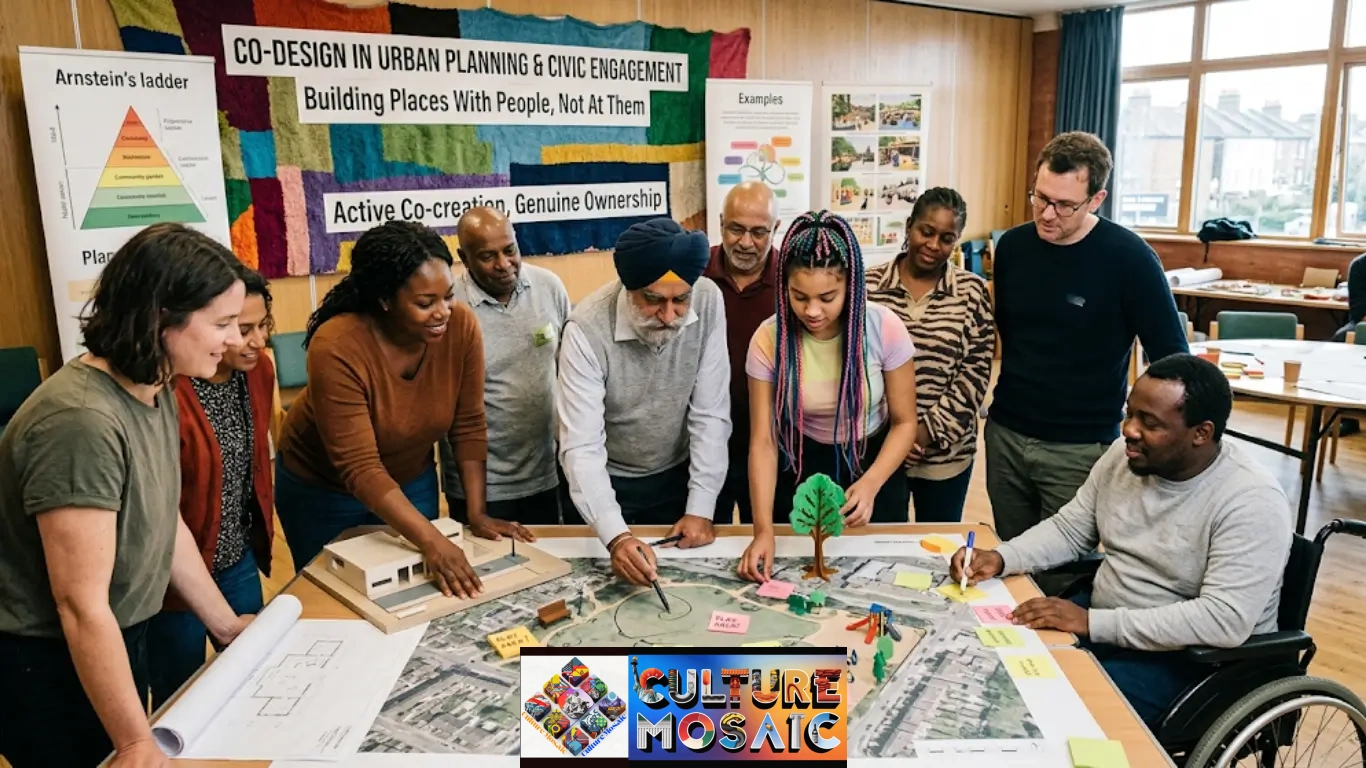
I’ve sat through consultation events where the plans were printed, laminated, and glued to the wall before a single resident walked in. I’ve also sat in rooms where residents held the pen. The difference in the room’s temperature is not subtle. One feels like a formality. The other feels like work getting done.
The Problem With “Tell Us What You Think”
Here’s the scene, and if you’ve been to a council consultation event, you already know it. Folding chairs. Squash in plastic cups. A row of foam boards showing a scheme that’s already been costed, tendered, and half-agreed with a planning committee. A council officer, tired but polite, walking you through boards you can’t really change. You’re invited to write your thoughts on a Post-it note and stick it to a board. Somewhere, that note goes into a spreadsheet. Somewhere else, it never comes out again.
This isn’t a failure of any one officer. Most of the planners I’ve worked alongside genuinely want good outcomes for the people they serve. The problem sits further up, in a process built around informing and consulting rather than sharing power. Why Public Consultation Is Important is a fair question people keep asking, and it’s fair because too many of them have sat through the version that changes nothing.
Sherry Arnstein named this back in 1969, and it still holds. Her “ladder of citizen participation” runs from manipulation and therapy at the bottom, through informing, consultation, and placation as forms of tokenism, up to partnership, delegated power, and citizen control at the top. Most public consultation in England still lives on rungs three and four. People are informed. People are consulted. Almost nobody gets a seat at the table where the actual decision gets made.
Empathy Break: Why This Wears People Down
Put yourself in a resident’s shoes for a second. You take an evening off, you turn up, you say something honest about a park, a junction, a community hall that’s falling apart. Nothing changes. Six months later there’s another consultation. You don’t go this time. Why would you?
Planners have a name for this: engagement fatigue. It’s not laziness on the resident’s part. It’s a rational response to being asked the same question over and over with no visible link between the asking and the doing. Every wasted consultation makes the next one harder to fill. That’s the real cost nobody puts in a report — not just cynicism, but a shrinking pool of people willing to show up at all.
What Co-Design Actually Means (And What It Doesn’t)
Co-design in urban planning and civic engagement is a working method, not a mood board. It means residents, designers, planners, and often local businesses and voluntary groups sit inside the process together, from problem-framing through to delivery, with genuine decision-making power distributed among them. Peer-reviewed research on the shift describes it plainly: traditional urban design followed a top-down approach where experts decided and communities were, at best, informed after the fact — Co-design in urban planning and civic engagement research now frames co-creation as the corrective, because it closes the gap between what gets designed and what a community actually needs.
That’s the theory. In practice, co-design usually means workshops where residents sketch layouts alongside architects, not after them. It means testing a park bench’s placement with the people who’ll actually sit on it, before the concrete gets poured. It means giving people a real vote on a real budget line, not a comment box.
What co-design is not: a longer survey, a fancier consultation evening, or a “co-creation workshop” where the brief was locked before anyone showed up. If the decision was already made, dressing it up in participatory language is placation with better branding. I’d rather call it what it is.
The Shift from Feedback to Partnership
The biggest change I’ve watched over the past few years isn’t technological. It’s a change in who’s allowed to hold the pen. Local Civic Engagement Strategies that used to stop at surveys and drop-in sessions are now building in shared budgets, resident panels with real veto power, and multi-month design partnerships rather than one-off events.
Part of the credit goes to organisations like Involve, the UK’s leading public participation charity, which has spent two decades pushing councils and public bodies past the “inform and consult” stage into genuine deliberation and shared decision-making. Their work, alongside academic frameworks built on Arnstein’s ladder, has given planning teams a vocabulary and a method for partnership that didn’t really exist a generation ago. It’s also visible in how people talk about their own role in local democracy — the language of Civic Voice has shifted from “having your say” to “having a stake.”
Here’s my honest take: partnership is harder than consultation. It takes longer, costs more upfront, and forces planners to sit with disagreement instead of averaging it into a report. It’s also the only version that actually produces places people fight to protect rather than places people merely tolerate.
The Main Phases of a Co-Design Project
Co-design projects vary by scale, but the ones that work well tend to move through the same rough arc. I’ve seen it broken into three, five, even seven stages depending on who’s writing the funding bid, but the bones are consistent:
- Framing and listening. Before anyone draws anything, the team maps who’s affected, who’s usually left out, and what the real problem is — not the problem the council thinks it is.
- Co-envisioning. Residents and designers generate options together. This is workshop-heavy: model-making, walking tours, mapping exercises, sometimes digital tools that let people drop pins on a live map.
- Prototyping and testing. Ideas get built cheap and fast — a temporary bench, a chalk-marked road layout, a pop-up market stall — so people can react to something real rather than a rendering.
- Co-delivery. The agreed design gets built, with community groups often holding a formal role in procurement, contracting, or direct labour.
- Stewardship. The project doesn’t end at the ribbon-cutting. Ongoing management — maintenance budgets, community trusts, resident-run programming — decides whether the thing survives its first winter.
Recent EU-aligned heritage work under the New European Bauhaus initiative uses almost exactly this structure, naming its stages co-recognition, co-envisioning, and co-implementation. It’s worth understanding this arc if you’re trying to build Civic Literacy into a community, because a resident who understands the phases can push back when a council skips straight from “listening” to “building” without the middle steps. That skip is where most so-called co-design quietly turns back into consultation. Grasping these phases is also a piece of Understanding Civic Duty at a neighbourhood level — knowing your role in the process is part of holding up your end of it.
Case Studies in Action
Theory is easy. Here’s where it’s actually worked.
In Barcelona, a project called EngAGE4Change brought care home residents, community-dwelling older adults, caregivers, and urban designers into the same room to reshape public space for physical activity and social connection. The published findings are blunt about what a co-creative process reveals: older adults have specific, often overlooked preferences for how public space supports healthy ageing, and those preferences only surfaced because the people affected were inside the design process, not surveyed after the fact.
In İzmir, Turkey, planning students and citizens used a digital participatory tool called Qua-Kit to redesign a leftover urban void — Küçük Park in Bornova — drawing directly on citizens’ spatial experience of a site that had effectively been abandoned by formal planning.
Closer to home, Helsinki’s decade-long study of the Herttoniemi neighbourhood tracked what the researchers call “expanded urban planning” — recognising and working with the self-organised activity that residents were already doing, rather than routing everything through a formal consultation process that ignored it.
And in England, the government’s own evaluation of the New Deal for Communities programme — 39 areas, ten years, resident-controlled priorities — found improvement in 32 of 36 core indicators, including crime reduction, education, and health, with the funded communities closing the gap against the national average. That’s not a soft “engagement” metric. That’s the ROI case in a government’s own numbers. You can see how this connects to the broader argument for Community Activism Strategies — organised, sustained resident involvement outperforms one-off consultation almost every time it’s been measured. It also mirrors what’s documented in work on How Public Feedback Shapes Local Policy, where sustained input, not a single comment period, is what actually bends a policy outcome.
Overcoming the “Loudest Voice” Problem
Every co-design process I’ve watched runs into the same early trap: the same eight people show up to every session. They’re organised, they’re retired or self-employed with flexible time, and they’re often already well-served by the system. Meanwhile the people most affected by a scheme — shift workers, parents with young kids, non-English speakers, teenagers, people who don’t trust the council after being burned before — stay home.
Fixing this isn’t about better flyers. It takes deliberate structural choices:
- Pay people for their time. A £20 voucher for two hours of a single parent’s evening isn’t a bribe. It’s respect for the fact that their time has a cost.
- Go to people, don’t wait for them. Pop-up sessions at the school gate, the food bank, the mosque, the bus stop — wherever people already are.
- Translate everything, properly. Not Google Translate on a leaflet. Actual bilingual facilitators in the room.
- Run small-group and one-to-one formats alongside big public meetings. Quiet people don’t speak up in a room of forty strangers. They will speak up over tea with two other people.
- The wildcard option: hand microphones to local teenagers and pay them to go interview their own neighbours, door to door, with three simple questions. Teenagers get answers adults on a council payroll never will — people are just more honest with a kid holding a clipboard than a stranger with a lanyard.
This is where Diverse Civic Harmony actually gets built — not through a single big meeting, but through dozens of small, low-stakes conversations that add up to a fuller picture than any town hall ever gives you. Training a rotating group of local residents as facilitators, through something like Volunteer for Civic Education Programs, also helps — people trust a neighbour holding the clipboard more than they trust the council.
The ROI of Community Ownership
Councils are, understandably, asking what this costs and what it buys them. The honest answer: co-design costs more time upfront and less money in rework, legal challenge, and vandalism repair downstream. Scotland’s participatory budgeting framework — a commitment that at least 1% of local government budgets go through resident-controlled decision-making — put over £78.3 million of public money directly under community control in the 2020/21 financial year alone. Dundee alone allocated close to £4 million through participatory budgeting in 2024/25.
Money handed to residents to spend on their own priorities tends to get spent well, because the people spending it live with the outcome. That’s the whole case for What is the Value of Civic Participation? in one sentence. It also shows up in softer numbers that matter just as much long-term: participatory budgeting is repeatedly linked to higher self-confidence, more volunteering, and stronger trust in local institutions — the connective tissue that makes the next project easier, not harder. If you’re tracking where this is heading, Civic Engagement Trends point the same direction: away from single consultation events and toward standing resident panels with recurring budget authority.
Community ownership also changes what happens after the ribbon-cutting. A park designed by the people who use it gets defended by the people who use it. A plan built with a neighbourhood forum, under England’s neighbourhood planning system, becomes part of the statutory development plan — it has real legal weight, and it was written by residents, not handed to them. If you want a lower-stakes way in first, look at 10 Civic Engagement Opportunities — most councils have a smaller, easier entry point than a full neighbourhood plan.
Co-Design in Urban Planning and Civic Engagement Examples
If you want to see the range this covers, here’s a quick spread pulled from current practice:
- Age-friendly public space redesign with older residents as co-designers (Barcelona)
- Reclaiming a leftover urban site using citizen-generated spatial data (İzmir)
- Heritage site reactivation through community-led co-recognition and co-envisioning stages (multiple EU pilot cities)
- Resident-controlled participatory budgeting for street repairs, green space, and community facilities (Scotland, multiple English boroughs)
- Neighbourhood development plans with statutory legal weight, built by resident forums under the Localism Act 2011 (England, ongoing)
- Multispecies co-design for urban green space, bringing ecological perspectives into planning alongside human ones (New York City)
Civic engagement doesn’t stop at planning, either — the same principle of genuine participation over passive consent runs through everything from Why Is Voting Important in Local Elections? to simply showing up on time, which is why dates like the Vote Early Day 2026 Date matter for the same reason a co-design session does: participation only works if people actually turn up for it.
When Should Co-Design Not Be Used?
I’ll say something a lot of participation advocates won’t: co-design isn’t always the right tool, and pretending otherwise does real damage.
Skip it, or scale it right down, when:
- The work is an emergency. A collapsed retaining wall or a burst water main doesn’t have time for a six-week co-envisioning phase. Fix it, then talk to residents about the permanent solution.
- There’s no real power to share. If a decision is genuinely locked — a statutory safety standard, a court order, a funding condition that leaves no room to move — running a co-design process anyway just teaches people that participation is theatre. Say so plainly instead.
- You don’t have the time or budget to do it properly. A rushed, underfunded co-design process is worse than an honest, well-run consultation. Half-measures here don’t split the difference. They just waste everyone’s evening.
Good judgement, not a rulebook, decides this. But I’d rather a council tell residents “this one’s not up for co-design, here’s why” than fake a process that was decided before the first workshop.
The Part Where I Ask You to Do Something
If you’re a resident: the door into this work is usually smaller than it looks. A neighbourhood forum meeting. A participatory budgeting vote. One evening with a clipboard. None of it requires being an expert. It requires showing up more than once.
If you’re a planner or councillor: the evidence isn’t close. Partnership outperforms consultation, on the numbers and on the outcomes people actually live in afterward. The next scheme on your desk is a chance to hand over one real decision instead of twelve fake ones.
At Culture Mosaic, we keep coming back to this same thread across culture, heritage, and civic life: places and traditions survive when the people who live them get to shape them, not just witness them.
Frequently Asked Questions
What is the difference between co-design and traditional public consultation?
Traditional consultation asks residents to react to a plan that’s already largely finished — comment on a drawing, tick a box, leave feedback that may or may not change anything. Co-design brings residents into the process from the start, with real influence over the framing, the options, and often the budget. On Arnstein’s ladder of participation, consultation sits in the tokenism band; co-design lives on the top rungs — partnership, delegated power, and citizen control — where the decision-making authority is actually shared, not just gathered.
When should co-design not be used?
Skip it for genuine emergencies, statutory works with no room to move, and any situation where the budget or timeline can’t support doing it properly. Running a token version of co-design when the real decision is already locked does more harm than an honest, straightforward consultation, because it teaches people that participation doesn’t actually change anything.
How do you get marginalized or quiet groups to participate?
Pay people for their time, go to where they already gather instead of waiting for them to come to you, provide proper translation and childcare, and mix small-group or one-to-one formats in alongside big public meetings. Training local residents — including teenagers — as peer facilitators tends to surface far more honest, varied input than a council officer with a clipboard ever will.
What are the main phases of a co-design project?
Most successful projects move through five stages: framing and listening, co-envisioning, prototyping and testing, co-delivery, and long-term stewardship. Skipping straight from listening to building, without the middle stages, is the most common way a co-design project quietly slides back into ordinary consultation.
How long does a co-design project usually take from start to finish?
It varies hugely by scale, but a genuine co-design process for something like a public space redesign or a neighbourhood plan typically runs from several months to a couple of years, including the stewardship phase after delivery. Rushing it to fit a single financial year is one of the most common reasons co-design projects underdeliver — the relationship-building and trust that make the process work simply can’t be compressed into a few weeks.
Sources
1. Arnstein, S. R. (1969). “A Ladder of Citizen Participation.” Journal of the American Planning Association, 85(1), 24-34.
2. Ministry of Housing, Communities and Local Government / GOV.UK. “Plan for Neighbourhoods: prospectus.” gov.uk/government/publications/plan-for-neighbourhoods-prospectus-and-tools
3. GOV.UK. “Neighbourhood planning” guidance. gov.uk/guidance/neighbourhood-planning–2
4. Ministry of Housing, Communities and Local Government. “Impacts of Neighbourhood Planning in England.” assets.publishing.service.gov.uk
5. COSLA. “Participatory Budgeting” — 1% framework and 2020/21 allocation figures. cosla.gov.uk
6. Dundee City Council. “Participatory Budgeting Report 2024-25.” dundeecity.gov.uk
7. Local Government Association. “Participatory Budgeting.” local.gov.uk
8. Health CASCADE / EngAGE4Change. “Exploring age-friendly urban design through co-creation.” Journal of Urban Design, published online 2025. tandfonline.com
9. “Co-designing of public space for urban design students using citizen-generated data.” CoDesign, Vol 21, No 3, 2025. tandfonline.com
10. “Unravelling the why: exploring the increasing recognition and adoption of co-creation in contemporary urban design.” CoDesign, published online 2025. tandfonline.com
11. “Co-design in urban planning and civic engagement” research. tandfonline.com/doi/full/10.1080/15710882.2024.2381792