
 By Culture Expert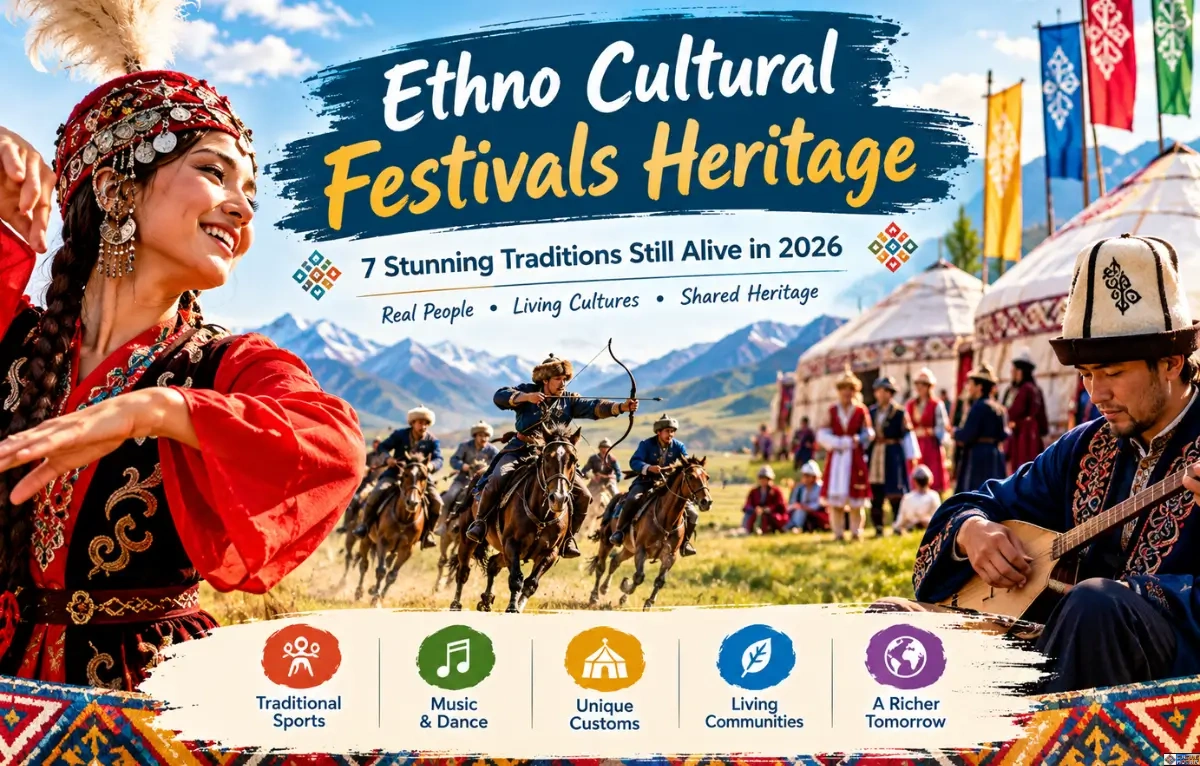
Discover how living ethno cultural festivals heritage keeps ancient sports, sacred rituals, and ancestral knowledge thriving across the globe today.
Quick Summary
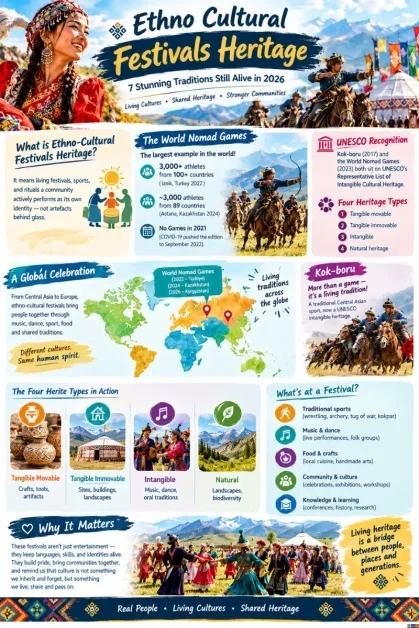
- . Ethno-cultural festivals heritage means living festivals, sports, and rituals a community actively performs as its own identity — not artefacts behind glass.
- . The World Nomad Games is the world’s largest example: 3,000+ athletes from 100+ countries at Iznik, Turkey in 2022; roughly 3,000 athletes from 89 countries at Astana, Kazakhstan in 2024.
- . No Games ran in 2021 — COVID-19 pushed the pandemic-delayed edition into September 2022, which is why that year turns up empty in searches.
- . UNESCO recognition: Kok-boru (2017) and the World Nomad Games itself (2023) both sit on UNESCO’s Representative List of Intangible Cultural Heritage.
- . Four heritage types: Tangible movable, tangible immovable, intangible, and natural heritage.
- . “Ethno-cultural background” is the official UK/Canadian census term for a person’s self-identified ethnic, linguistic, and ancestral identity.
The Problem: We’re Losing the Festivals That Made Us Who We Are
I’ll say it plainly. Most of what gets called “cultural heritage” online is dead heritage. It’s a plaque on a wall. A ruin behind a rope. A museum case with a laminated card explaining what a thing used to mean to people who are no longer alive to argue about it.
That’s not nothing. But it’s not the whole story, either.
Walk through any large UK city on a wet Tuesday and you’ll pass shopfronts, playlists, and school canteens that have quietly flattened into the same three or four templates. Convenient, yes. Also a little hollow. A 2024 dispatch from the Daily Yonder captured this tension well: reporters travelling to Kazakhstan’s Nomad Games kept meeting people who pushed back on the assumption that nomadic ways of life were simply “destined to fade” as the modern world caught up with them.¹ That assumption, it turns out, does a lot of quiet damage. It tells communities their traditions are a stage they’ve already passed through, rather than something worth defending.
I’ve spent years writing about wedding rites, festival calendars, and ancestral craft for readers who care about where things come from. And the question I get asked most is some version of: is any of this actually still alive, or am I just reading a eulogy?
Empathy: You’re Not Wrong to Feel the Loss
If you’ve ever stood in a “heritage village” built for tourists and felt the performance behind the smiles, you already understand the discomfort. Staged culture, wheeled out for a coach party and packed away by 5pm, can feel like watching someone’s grief turned into a gift shop.
I get it. I’ve felt it too, at more than one open-air museum with a fibreglass longhouse and a laminated script.
But here’s the turn, and it’s the whole reason I wanted to write this piece: somewhere between the plaque and the pantomime, there’s a third category. Living heritage. Practices a community still does, competitively, seriously, and often with real risk of losing, because the stakes are real to the people doing them. That’s what ethno cultural festivals heritage actually means, and once you’ve seen it, the museum-case version looks thin by comparison.
The Solution: What Ethno Cultural Festivals Heritage Actually Looks Like
The clearest, largest-scale example on the planet right now is the Ethno Cultural Festivals Heritage movement built around Central Asia’s World Nomad Games.
First proposed in 2012 at a summit of Turkic-speaking nations in Kyrgyzstan, the Games were built around a specific worry: that globalisation was smoothing away the folk sports, dress codes, and oral traditions of historically nomadic peoples faster than anyone could document them.² The first three editions ran in Cholpon-Ata, Kyrgyzstan, starting in 2014, on a two-year cycle. Delegations arrived from nearly every continent except Antarctica.³
Then came the interruption everyone remembers. The pandemic broke the rhythm, and the Games that should have landed in 2021 didn’t happen at all that year. The fourth edition finally took place in September 2022, in Iznik, Turkey — the first time the event left Kyrgyzstan. More than 3,000 athletes from over 100 countries competed across 40 traditional sports.⁴ Two years later, the fifth Games moved to Astana, Kazakhstan, drawing around 3,000 athletes from 89 countries into a purpose-built “ethno-village” of yurts, craft stalls, and folk cuisine.⁵,⁶ Kyrgyzstan is scheduled to host the Games again in 2026.⁷
What actually happens there is the part people underestimate. Wrestling, in its various Central Asian forms, draws the biggest crowds. There’s archery on horseback, tug of war, hunting with trained eagles and falcons, and a rugby-like horseback game called kokpar. There’s also, tucked between the sporting events, a full scientific and historical conference where scholars present research on nomadic nutrition and Central Asian history to the public, free of charge.⁸ That detail alone tells you this isn’t a costume party. It’s a working, funded effort to keep a body of ancestral sports knowledge from thinning out between generations.
And it’s paying off in ways that outlast the closing ceremony. In 2017, the horseback game kok-boru — the goat-carcass game that’s the Nomad Games’ signature event — was formally inscribed on UNESCO’s Representative List of the Intangible Cultural Heritage of Humanity.⁹ By 2023, the World Nomad Games as an institution had joined it on that same list, recognised under the heading “heritage revival, celebration of cultural diversity.”¹⁰ That’s a rare kind of validation. It means an international body of experts agreed the event itself, not just the individual game inside it, is a living practice worth protecting.
What Is Ethno Culture?
Here’s a definition I actually trust, built from how anthropologists and census statisticians use the term rather than how a dictionary flattens it.
Ethno culture is the bundle of customs, language, cuisine, dress, belief, and social practice that a specific ethnic or ancestral group carries forward and actively recognises as its own. It’s not a costume you put on for a festival. It’s the accumulated, still-evolving “how we do things” of a people — the version of a tradition that’s been argued over, adapted, and re-taught by every generation that inherited it.
The distinction that matters: ethno culture is practised, not just displayed. A wedding ritual passed down through a family, a horse game taught to a child by an uncle, a bread recipe soaked in milk the way shepherds have done it for generations¹¹ — these are ethno-cultural acts. A recreation performed once a year for a paying audience, with no daily-life counterpart, is something adjacent but thinner.
What Does “Ethno-Cultural Background” Mean?
You’ll see this exact phrase on official paperwork — census forms, hospital intake sheets, school enrolment documents — and it means something specific: the ethnic, religious, linguistic, and ancestral factors that shape a person’s upbringing and self-identification.
The UK’s Office for National Statistics collects this through its ethnic group question, offering respondents a detailed list of tick-box categories plus write-in options, because a single label rarely captures a real person’s background.¹² Canada’s 2021 census went further still, logging more than 450 distinct ethnic and cultural origins from respondents, a jump made possible by giving people a longer list of examples to recognise themselves in rather than a handful of broad boxes.¹³ The pattern in both countries is the same: ethno-cultural background isn’t assigned by an outsider. It’s self-reported, layered, and frequently made up of more than one origin at once.
What Are the Four Types of Heritage?
Heritage professionals generally sort cultural inheritance into four working categories. I’ll be honest — the boundaries blur constantly in practice, and UNESCO’s own scholars have criticised the neat split as a bit too tidy for how culture actually works.¹⁴ Still, it’s the framework you’ll meet everywhere, so it’s worth knowing cold:
- Tangible movable heritage — objects you can physically relocate: paintings, sculptures, manuscripts, textiles, musical instruments.
- Tangible immovable heritage — fixed-in-place structures: temples, castles, archaeological sites, entire historic town centres.
- Intangible cultural heritage — living, non-physical practice: oral traditions, performing arts, festivals and rituals, traditional craftsmanship, and the knowledge passed down through them. This is the category the World Nomad Games sits in.
- Natural heritage — culturally significant landscapes, biodiversity, and sacred natural sites, recognised because human meaning has become inseparable from a specific patch of the physical world.
UNESCO’s 2003 Convention for the Safeguarding of the Intangible Cultural Heritage was the document that formally cemented the third category, after decades of heritage protection focused almost entirely on stone and canvas.¹⁵
What Are Examples of Cultural Heritage?
To make the four categories concrete, a few honest examples across each:
- Tangible movable: a hand-woven Kyrgyz felt carpet, a Renaissance altarpiece, a family heirloom passed through four generations.
- Tangible immovable: the Sassi di Matera cave dwellings in Italy, inhabited more or less continuously for millennia and UNESCO-listed since 1993.¹⁶
- Intangible: the World Nomad Games, kok-boru, the art of Kyrgyz epic recitation, and — closer to home for many of our readers — the traditional world festivals and religious festivals still celebrated across Britain and beyond.
- Natural heritage: a sacred grove, a pilgrimage mountain, a river valley whose seasonal flooding still dictates a community’s farming calendar.
Why Living Cultural Traditions Matter More Than Ever
There’s a version of this argument that stays purely academic, and I don’t want to give you that version. Here’s the honest one.
Living cultural traditions are a form of insurance. Against homogenisation, obviously, but also against something quieter: the slow erosion of a community’s confidence that its own way of doing things is worth the effort. When Kyrgyz eagle hunters teach their sons the same falconry techniques their grandfathers used, they’re not performing nostalgia. They’re maintaining a functioning skill set that has no substitute if it’s ever lost. Once a transmission chain like that breaks, it doesn’t come back from a book.
Central Asian heritage, in particular, carries a weight most Western readers underestimate. This is a region where farming and nomadic ways of life split apart thousands of years ago, and where the nomadic path shaped everything from seasonal migration patterns between summer pastures and winter valleys to the games, food, and hospitality customs still practised today.¹⁷ Ancient sports festivals like the Nomad Games aren’t a revival act. They’re closer to a maintenance schedule for a way of seeing the world that’s still, quietly, in use.
How to Actually Experience This (Not Just Read About It)
If any of this has landed, here’s the honest advice: don’t stop at reading. Watching a wrestling bout decided in a Central Asian yurt village, or standing in a crowd while an eagle is loosed off a rider’s arm, changes how the whole idea of “heritage” sits in your head. It stops being a word on a plaque.
A few starting points, roughly in order of how accessible they are:
- Attend an ethno-village at a major festival. The Nomad Games’ yurt encampments are open to all visitors, not just ticket holders for the sporting events, and they’re genuinely the easiest entry point.
- Follow the cultural calendar, not just the sports calendar. Craft demonstrations, epic recitation, and folk cuisine contests often run alongside the headline events and get a fraction of the attention.
- Look closer to home first. Britain has its own dense calendar of traditional world festivals, from harvest customs to civic processions, plus events like the Latino Cultural Festival and the growing Festivalle 2026 programme, which apply the same living-heritage logic without requiring a flight to Kyrgyzstan.
- The wildcard option: track down a local diaspora community’s own festival calendar rather than the tourist-facing one. Community Facebook groups and cultural association newsletters routinely list gatherings that never make it onto a single tourism website, and they’re usually the most unfiltered version of the tradition you’ll find.
Readers who’ve gone down this path tend to report the same thing back to me: the sports and rituals themselves are only half the draw. The other half is the conversation with a stranger running a food stall who genuinely wants to explain what you’re eating and why. That exchange doesn’t happen in a museum.
Frequently Asked Questions
What is the difference between “cultural heritage” and “ethno cultural festivals heritage”? +
Why wasn’t there a World Nomad Games in 2021? +
What is ethno culture in simple terms? +
What are the four types of heritage recognised by heritage professionals? +
Is the World Nomad Games recognised by UNESCO? +
Sources
- Slepyan, A.P. “Still in the Saddle: World Nomad Games Spotlight the Nomadic Heritage of Central Asia.” The Daily Yonder, 15 November 2024. dailyyonder.com/still-in-the-saddle-world-nomad-games-spotlight-the-nomadic-heritage-of-central-asia/2024/11/15/
- “World Nomad Games 2026 in Kyrgyzstan: Ultimate Guide.” Entre Deux Pôles. entredeuxpoles.com/en/world-nomad-games-guide/
- “World Nomad Games 2026 – Kyrgyzstan’s Grandest Festival.” Advantour. advantour.com/kyrgyzstan/events/world-nomads-games.htm
- “World Nomad Games.” Wikipedia. en.wikipedia.org/wiki/World_Nomad_Games
- “World Nomad Games Highlight Central Asia’s Nomadic Heritage.” Caspian Post, 15 September 2024. caspianpost.com/stories/world-nomad-games-highlight-central-asias-nomadic-heritage
- “The World Nomad Games Guide with Tips and Highlights.” Rok Around The World, 21 June 2026. rokaroundtheworld.com/kazakhstan-the-world-nomad-games/
- “World Nomad Games 2026.” CultureRoad Travel. cultureroadtravel.com/world-nomad-games/
- “How to Go: World Nomad Games.” Lonely Planet. lonelyplanet.com/articles/how-to-go-world-nomad-games
- “Kok Boru, Traditional Horse Game.” UNESCO Intangible Cultural Heritage, inscribed 2017. ich.unesco.org/en/rl/kok-boru-traditional-horse-game-01294
- “Kok Boru, Ak Kalpak Making, World Nomad Games Included in UNESCO Representative List of Intangible Cultural Heritage.” AKIpress News Agency, 10 June 2023. akipress.com/news:713976
- “UNESCO List of Intangible Cultural Heritage of Humanity in Kyrgyzstan.” Advantour. advantour.com/kyrgyzstan/culture/intangible-cultural-heritage-unesco.htm
- “Ethnic Group (Detailed).” Census 2021 Dictionary, Office for National Statistics (UK). ons.gov.uk/census/census2021dictionary/variablesbytopic/ethnicgroupnationalidentitylanguageandreligionvariablescensus2021/ethnicgroupdetailed
- “2021 Census of Population: Ethnocultural and Religious Composition.” Statistics Canada, 26 October 2022. www150.statcan.gc.ca/n1/daily-quotidien/221026/dq221026b-eng.htm
- “Revisiting Definitions and Challenges of Intangible Cultural Heritage.” Tangible and Intangible Heritage in the Age of Globalisation, Open Book Publishers. books.openbookpublishers.com/10.11647/obp.0388/ch3.xhtml
- “Tangible and Intangible Heritage.” UNESCO Intangible Cultural Heritage. ich.unesco.org/en/tangible-and-intangible-heritage-00097
- “What Is Cultural Heritage? Definition, Types, and Why It Matters.” Cultural Heritage Online, 9 June 2026. culturalheritageonline.com/magazine/what-is-cultural-heritage/
- “World Nomad Games.” Eurasia.Travel. eurasia.travel/kyrgyzstan/festivals/world-nomad-games/
Written for Culture Mosaic — covering cultural heritage, living traditions, and world festivals.