
 By Marcus J. Holloway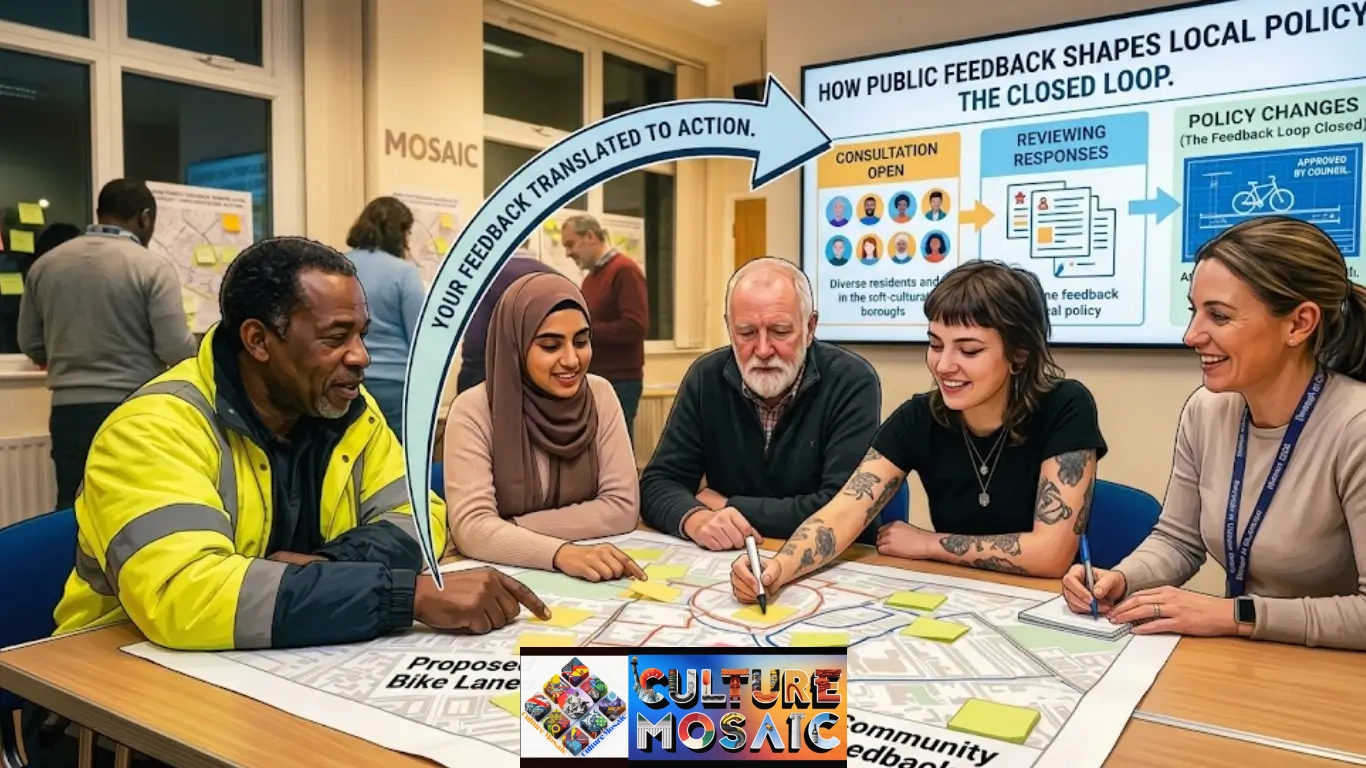
| QUICK SUMMARY: How public feedback shapes local policy comes down to five moving parts: a council identifies a problem, opens a consultation, collects and reads the responses, folds the strongest points into a revised plan, and reports back on what changed. When that loop actually closes, residents get bike lanes that fit the street they live on, budgets that fund the youth centre instead of a car park nobody asked for, and a council that trusts them enough to ask again next time. |
I’ve sat in enough town hall meetings to know the smell of a bad consultation. Stale coffee, a slide deck nobody reads, and a council officer who’s already decided the outcome before the first question is asked. I’ve also sat in the good ones — the ones where a retired bus driver’s comment about a blind corner gets a junction redesigned within six months. That difference, between theatre and real influence, is the whole story of how public feedback shapes local policy.
Ask ten different residents how public feedback shapes local policy and you’ll get ten different answers, most of them cynical. Ask ten council officers the same question and you’ll get a more hopeful, if occasionally self-serving, version. The truth sits somewhere between the two, and it’s more mechanical — and more learnable — than either group tends to admit.
This isn’t an abstract civics lesson. It’s the mechanism that decides whether your street gets a zebra crossing, whether your local library stays open on Saturdays, and whether the new housing estate down the road gets a park or another car park. I’ve spent years inside this process — reading consultation responses, writing the reports that go to committee, and watching what happens when residents are heard versus when they’re merely informed. Here’s what actually works, and what doesn’t.
The Problem: Consultations That Go Nowhere
Here’s the part nobody likes to admit. Most public consultations are badly designed, badly timed, or both. A council publishes a 40-page draft plan with three weeks to respond, buries the online form four clicks deep on its website, and holds the one in-person session on a Tuesday afternoon when anyone with a day job can’t attend. Then, six months later, the policy passes almost unchanged from the draft, and residents rightly conclude the whole exercise was for show.
I get why people are cynical about this. If you’ve ever filled out a survey and never heard another word about it, you’ve experienced what researchers call an open consultation loop — feedback goes in, nothing observable comes out, and trust erodes a little more each time it happens. Once that trust is gone, it’s brutally hard to win back. People stop showing up. Turnout at the next consultation drops. And a council that genuinely wants to do better finds itself shouting into a much emptier room.
That’s the pain point. Not that people don’t care about their local area — most do, fiercely — but that they’ve learned, through repeated experience, that caring loudly rarely changes anything. Understanding how public feedback shapes local policy starts with admitting that most of the time, in most towns, it currently doesn’t shape it much at all. Citizens’ confidence in and satisfaction with representative institutions has eroded over the last few decades, with declining voter turnout, party membership, and institutional trust all signalling that the traditional representative model is under pressure. Local government feels this most sharply, because it’s the layer of government closest to daily life — the bins, the roads, the parks, the planning applications next door.
The Solution: Closing the Consultation Loop
Here’s where how public feedback shapes local policy stops being theoretical and becomes a checklist you can actually hold a council to. The fix isn’t complicated in theory, even though it’s hard in practice. Closing the consultation loop means a council does four things every single time it asks the public for input: it explains clearly what’s being decided and why, it gives people enough time and enough channels to respond, it demonstrably reads and weighs what comes back, and — this is the step almost everyone skips — it publicly reports what changed as a result.
Under UK administrative law, this isn’t just good practice. It’s often a legal duty. Courts assess fair consultation using what’s known as the Gunning principles: the consultation has to happen while the proposal is still genuinely open to change, the council has to give enough information for an intelligent response, there has to be adequate time to respond, and — critically — the results have to be conscientiously taken into account when the final decision is made. Skip that last step and a council can find itself facing judicial review.
The UK Government’s own consultation principles reflect the same logic at national level. Guidance published by the Cabinet Office directs departments to consider what they’re actually trying to achieve before deciding when, how, and with whom to consult, rather than running the same generic 12-week exercise on autopilot every time. Local authorities carry a similar duty under the Local Government Act 1999, which requires councils to consult residents and other interested parties as part of their obligation to secure continuous improvement in how they deliver services.
I wrote more about the mechanics of this in Why Public Consultation Is Important, but the short version is this: consultation without a feedback report is just data collection. It’s the reporting-back step — the “here’s what you said, here’s what we’re doing about it, and here’s why we didn’t act on point four” — that actually builds the kind of trust that makes the next consultation worth running.
The Impact of Public Input on Governance: What the Research Actually Shows
I’ll be honest — I used to assume most residents wanted maximum control over local decisions. The research says otherwise, and it changed how I think about how public feedback shapes local policy in practice, not just in principle.
A How Public Feedback Shapes Local Policy study from Ghent University looked at exactly this question, examining what UK residents actually consider the ideal balance of power between citizens and local government across five separate studies. Using a sample of UK adults recruited through a research platform, participants consistently preferred a balanced model in which citizens and the local government are equally involved, rather than either side having full control. Only a tiny fraction of respondents wanted complete citizen control or complete government control — most people wanted a genuine partnership.
But the study also found something more textured than a single average. Roughly a third of the citizenry preferred government involvement to outweigh citizen involvement, close to 40 percent preferred an equal split, and just under a third preferred citizens to have more weight than government. In other words, there isn’t one “public” with one preference — there are at least three, and a council that treats consultation as one-size-fits-all is going to alienate someone no matter what it does.
Here’s the detail I found genuinely useful for practice: the subgroup that wanted citizens to have more say than government tended to skew younger, less formally educated, and more politically cynical — while the subgroup favouring government control skewed older and more male. That tells you something practical. If your consultation methods only reach engaged, older homeowners at a Tuesday-afternoon meeting, you’re systematically under-hearing from exactly the group most likely to want a bigger say and least likely to already trust the process. You have to go where they are — schools, colleges, community centres, online platforms, not just the parish hall noticeboard.
The takeaway for anyone running or watching a local consultation: aim for roughly equal weighting between resident input and professional judgement, not full public control and not a rubber-stamp exercise. That balance point is where legitimacy lives, and it’s backed by data, not vibes.
What Are the 5 Stages of the Public Policy Process?
If you want a precise answer to how public feedback shapes local policy, it helps to know exactly where your feedback lands in the machine. So let’s open it up. Political scientists — going back to Harold Lasswell’s work in the 1950s — generally break the public policy process into five connected stages, sometimes stretched to six.
- Problem identification and agenda setting. Someone — a resident, a councillor, a campaign group — flags an issue and it gets recognised as something the council should actually address. This is where public feedback has the single biggest leverage point, because a problem that never makes the agenda never gets solved.
- Policy formulation. Officers draft options. This is usually where consultation documents get built, and where the wording of the questions you’re asked quietly shapes the answers you’re allowed to give.
- Decision-making (legitimation). Elected councillors debate and formally adopt a course of action, often at a committee or full council meeting that’s open to the public.
- Implementation. The policy actually happens — the crossing gets built, the bylaw gets enforced, the grant gets distributed.
- Evaluation. The council checks whether the policy worked, gathers more public feedback on the results, and the whole cycle can start again.
Public input matters at every single stage, not just the consultation step in the middle. A well-organised residents’ group can force an issue onto the agenda in stage one. A sharply worded consultation response can reshape the options on the table in stage two. Public attendance at a planning committee can sway a vote in stage three. And complaints during stage five are often what kicks off the next cycle’s stage one. The process isn’t a straight line — it loops.
Participatory Planning Examples: What Real Change Looks Like
Theory is fine, but I’d rather show you how public feedback shapes local policy when it actually works, with real budgets and real votes attached.
Newham’s People Powered Places programme. Between 2021 and 2023, the London Borough of Newham handed £1.6 million from its Neighbourhood Community Infrastructure Levy directly to residents to allocate, funding 157 separate local projects chosen through public voting. This is participatory budgeting at genuine scale — not a suggestion box, an actual chequebook.
Scotland’s 1% Participatory Budgeting Agreement. Scottish local authorities agreed with the Scottish Government to route at least 1% of council budgets through participatory budgeting. Since 2021, more than 110,000 people have taken part and directly decided how roughly £154 million of council money gets spent, exceeding the original target.
Tower Hamlets’ “You Decide!” Back in 2009, this East London borough ran a participatory budgeting process giving residents direct decision-making power over £2.4 million of council spending across eight public events, covering everything from a zero-tolerance drugs operation to youth services.
The wildcard option: some councils have started running “citizens’ juries” — a randomly selected, demographically balanced panel of residents who spend several days being briefed by experts and then deliberate a genuinely hard question, like how a city hits net zero. Leeds ran one on climate change in 2019. It’s slower and more expensive than a survey, but for the kind of decision where a five-minute online poll produces shallow answers, a jury produces recommendations councillors actually respect, because the panel did its homework.
What connects all four examples, and what should tell you a lot about how public feedback shapes local policy when it’s done well, is specificity. Nobody asked residents “do you support community investment, yes or no.” They asked concrete questions — which 157 projects, which streets, which services — and gave people real budget lines to allocate. That’s the difference between consultation theatre and participatory planning that changes outcomes.
What Are the Main Influences on Public Opinion?
Before local feedback ever reaches a council, it’s already been shaped by forces well outside city hall — and those forces quietly determine how public feedback shapes local policy long before anyone opens a survey. Understanding these matters if you want to read consultation responses honestly rather than naively.
- Family and early political socialisation. Attitudes toward government, fairness, and civic duty take root young, at the dinner table long before anyone fills out a survey.
- Mass media and now social media. How an issue gets framed — as a crisis, an inconvenience, or a non-issue — shapes how people respond to it, sometimes more than the substance of the issue itself.
- Education and socioeconomic position. Higher levels of formal education correlate with higher rates of political engagement and consultation participation, which is exactly why under-represented groups need to be actively sought out rather than passively invited.
- Interest groups and political parties. Organised groups mobilise their members around specific issues and can generate a wave of near-identical consultation responses that look like broad public opinion but represent a narrower, more organised slice of it.
- Personal experience and local circumstance. Someone who was nearly hit crossing a road has a different, and often more credible, view on that junction than someone answering a general traffic survey from across town.
Reading feedback well means noticing which of these forces produced it. A hundred near-identical form-letter responses from a campaign group carry a different kind of weight than fifty individually written comments from people who live on the actual street in question. Good policy officers weigh both, but they don’t pretend they’re the same thing.
What Role Does Public Opinion Play in a Democracy?
At the risk of stating the obvious: public opinion is supposed to be the whole point. Representative democracy exists because direct votes on every planning application and bin collection schedule aren’t practical — so we elect people to translate our preferences into decisions on our behalf. Public feedback between elections is how that translation stays honest.
Local democracy is where this plays out most visibly, because the distance between a decision and its consequence is so short. If a national government changes a tax rate, you feel it eventually, abstractly, on a payslip. If your council changes a bus route, you feel it tomorrow morning, standing at a stop that no longer exists. That immediacy is exactly why local consultation carries such weight — and why getting it wrong burns trust faster than almost any other layer of government.
I’d also gently push back on a common assumption here: public opinion in a democracy isn’t there to be obeyed like a vending machine, where you put in a majority and a policy comes out. It’s there to be weighed, alongside expert advice, legal constraint, and the interests of people too young, too marginalised, or too future to have responded to the survey. A council that just does whatever the loudest 200 respondents want isn’t practising democracy well — it’s outsourcing judgement to whoever has the most free time to fill out a form.
How Does a Political Party Shape Public Opinion — and How Can It Be Shaped More Honestly?
Political parties shape public opinion primarily through framing: deciding which facts to emphasise, which words to use, and which comparisons to draw. A bypass gets called either “vital infrastructure” or “a concrete scar through green belt,” depending entirely on who’s talking, and both framings can be technically accurate while producing wildly different public reactions.
That’s not necessarily sinister — arguing for your position is normal politics — but it does mean residents reading consultation materials should ask who wrote the framing and what they left out. The honest version of shaping public opinion looks like the kind of transparent public commentary and consultation processes where all sides of an argument get equal airtime and the same facts. I covered what counts as legitimate public input, as opposed to astroturfed noise, in What Is Public Commentary, which is worth a read if you’re trying to judge whether a wave of feedback on a local issue is organic or organised.
One structural fix that keeps coming up in my work: civic education. Formal duties to consult exist where legislation requires it, where a department has promised to consult, where there’s an established practice of consulting in similar cases, or where not consulting would produce obvious unfairness — but almost none of the public knows any of that. I’ve written before about the Declining Civic Knowledge in US, and about how a Local Community College can help close that gap through short, practical courses on how local government actually works. People who understand the process are far better equipped to shape it honestly rather than just shouting louder than the next person.
Frequently Asked Questions
1. Explain how public feedback shapes local policy in simple terms.
A council identifies a problem, drafts options, asks residents what they think, reads and weighs the responses, and adjusts the final decision based on what it heard. The “shapes” part happens most visibly during the drafting and decision stages, when officer recommendations and councillor votes shift in response to what came back from consultation. Feedback that’s specific, well-timed, and tied to a real proposal has far more influence than a general complaint sent at the wrong moment.
2. How does public opinion influence law making at the local level?
Local byelaws, planning policies, and budget allocations typically go through a statutory or voluntary consultation stage before they’re adopted, and officers are legally required, under principles like the Gunning principles, to take the results into account before the final vote. Public opinion doesn’t write the law itself, but it narrows the range of politically viable options and can force a proposal to be redrafted, delayed, or dropped entirely if opposition is strong and well-evidenced.
3. What are the 5 stages of the public policy process?
Problem identification and agenda setting, policy formulation, decision-making (legitimation), implementation, and evaluation. Public feedback can enter at every stage, not only the formal consultation window most people associate with stage two, which is why staying engaged after a consultation closes still matters.
4. What are the main influences on public opinion, and how does that affect consultation results?
Family upbringing, media framing, education level, organised interest groups, and direct personal experience all shape how someone answers a consultation question before they’ve even opened the survey. Recognising these influences helps council officers weigh feedback fairly — distinguishing, for instance, a coordinated campaign response from an individually considered one — rather than treating every submission as equally representative of the wider community.
5. What role does public opinion play in a democracy, and can it ever be shaped unfairly?
Public opinion is meant to keep elected representatives accountable between elections, translating everyday preferences into policy direction. It can be shaped unfairly when framing, selective information, or coordinated campaigns crowd out genuinely representative feedback — which is exactly why transparent processes, clear reporting-back, and basic civic education matter as much as the consultation itself.
If there’s one thing worth taking from this: how public feedback shapes local policy only happens when the loop actually closes — when a council says, out loud, “you told us this, so we changed that.” Everything else, however well-intentioned, is just noise collection. Read your council’s next consultation not as a formality to skip, but as the one moment in the policy cycle where your specific street, your specific junction, your specific complaint has the best odds of actually landing. Miss that window and the decision gets made without you in the room.
Marcus J. Holloway writes on civic engagement and local governance for Culture Mosaic, covering how public consultation, participatory budgeting, and grassroots advocacy shape decisions at the local level. Questions or feedback on this piece can be sent through Culture Mosaic’s contact page.
Sources
- Haesevoets, T., Roets, A., Van Severen, R., Dierckx, K., & Verschuere, B. (2023). The public’s preferred level of involvement in local policy-making. Scientific Reports, 13, 7146. Read the study
- UK Cabinet Office. Consultation Principles: Guidance. GOV.UK. gov.uk/government/publications/consultation-principles-guidance
- House of Commons Library. Public Consultation (Research Briefing CBP-10190, 14 February 2025). researchbriefings.files.parliament.uk
- Local Government Association. Participatory Budgeting. local.gov.uk
- COSLA. Participatory Budgeting Milestone Reached (2023). cosla.gov.uk
- GoVocal. What Is Participatory Budgeting? (Newham case study). govocal.com
- Byarcadia. Public Policy Series: The Stages of the Policy Process. byarcadia.org
- Britannica. Public Opinion — Mass Media, Social Media, Influence. britannica.com
- Culture Mosaic. Why Public Consultation Is Important
- Culture Mosaic. What Is Public Commentary
- Culture Mosaic. Local Community College
- Culture Mosaic. Declining Civic Knowledge in US