
 By Culture Expert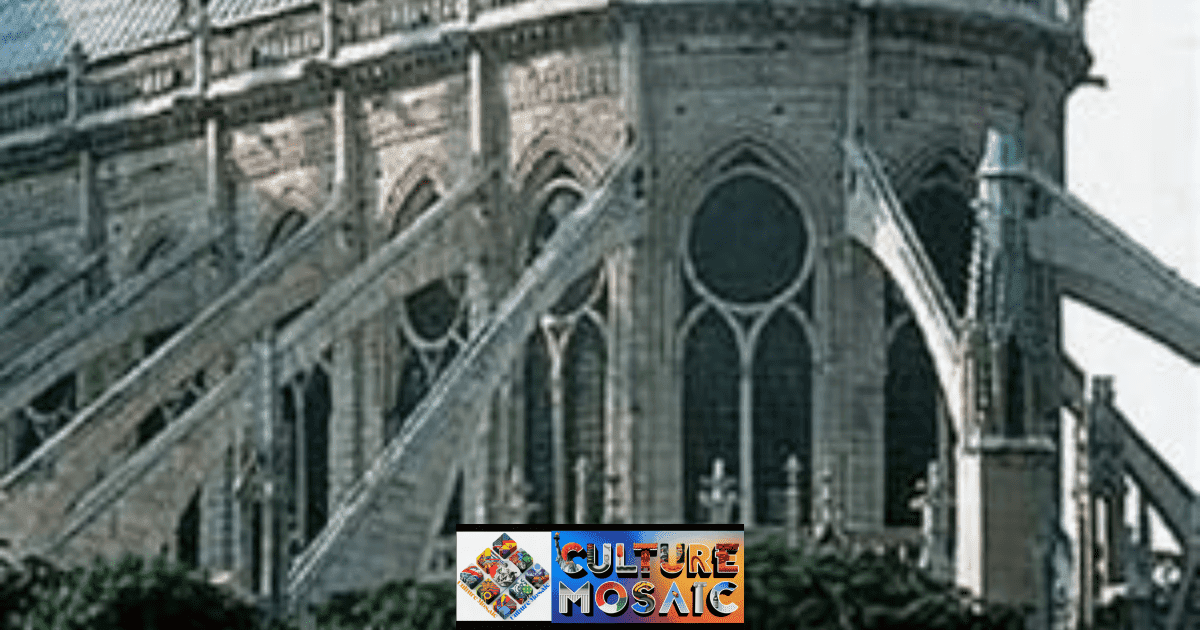
Gravity Diverted: The Flying Buttress Definition in Art and Architecture
By Dr. Catherine Moreau | Published on Culture Mosaic | Global Heritage Series
About the Author
Dr. Catherine Moreau
Dr. Catherine Moreau is an art historian specializing in medieval and Gothic architecture, with over $15\text{ years}$ of research focused on the structural and theological logic of European cathedrals. She has lectured on Gothic engineering at universities across France and the UK and writes for Culture Mosaic’s Art History and Architecture series.
I have stood under the flying buttresses at Chartres on a grey October morning, and I can tell you, no photograph prepares you for the scale of it. The exterior of a High Gothic cathedral looks like something built by an insect the size of a mountain. Stone ribs reach out into open air, lean against tall piers, and somehow hold an entire roof up without a single load-bearing wall in sight. It is not decoration. It is the visible skeleton of a building solving a physics problem that almost broke it.
So what is the actual flying buttress definition in art, and why does this one piece of engineering get credit for changing the entire look of medieval Europe? I want to walk through that here, plainly, the way I would explain it to a student standing in front of the real thing. The classic flying buttress definition in art is a good starting reference, though the full story is more interesting than any single line can capture.
The short version: the transition from the dark, heavy Romanesque churches to the soaring, glass-filled cathedrals of the High Middle Ages was not merely a style choice. It was a structural breakthrough. Builders figured out how to move the weight of the roof outside the building, and once they did that, stone started behaving like something closer to light. Understanding the flying buttress definition in art is really understanding that whole shift in one image. If you want broader context on the movement itself, What is Gothic art and architecture is worth a separate look.
Interactive Load Path Simulator
Toggle active forces and alter the flyer’s angle of incidence ($\theta$) to see how vector loads route safely into the earth.
What Is a Flying Buttress? A Working Definition
In art history terms, the flying buttress definition refers to a specific, two-part exterior masonry support system characteristic of Gothic architecture. Unlike a traditional Romanesque buttress, which is a solid block of masonry built flat against an exterior wall, a flying buttress consists of two distinct components:
- The Pier Buttress: A massive, solid stone column or pillar situated at a distance from the main building, often as thick as a small house.
- The Flyer (or Arch): A delicate, inclined stone arch that “flies” through open space, springing from the high, upper clerestory wall of the nave and bridging the gap to the external pier.
Look at it from a distance and the effect is almost unsettling. Heavy masonry construction is replaced by something that reads more like a structural diagram of vectors than a wall. You can actively see the gravity paths.
The Physics Behind the Flying Buttress Definition in Art
You cannot truly grasp the flying buttress definition in art without understanding the physics it was built to solve.
A stone vaulted ceiling is heavy. That weight does not just push straight down; it also pushes outward and sideways against the tops of the walls holding it up. Structural engineers call this horizontal thrust, and it is the reason early stone churches needed walls thick enough to double as fortresses.
The Vector Mathematics of Masonry
Picture a tall clerestory wall taking a lateral outward thrust ($F_{\text{lateral}}$) from the ribbed ceiling vaults. The flyer arch meets the wall at a specific angle of incidence ($\theta$) relative to the horizontal plane.
The diagonal compression force ($F_{\text{buttress}}$) traveling down through the stone flyer arch to bridge the gap is expressed as:
$$F_{\text{buttress}} = \frac{F_{\text{lateral}}}{\cos(\theta)}$$This diagonal force is then routed directly into the massive external pier buttress, which translates the load vertically downward into the earth:
$$F_{\text{pier}} = F_{\text{buttress}} \cdot \sin(\theta) + W_{\text{pier}}$$Where $W_{\text{pier}}$ is the massive static dead weight of the stone pier itself (often enhanced by a heavy stone spire or pinnacle on top). The added vertical weight of the pinnacle acts as a downward vector stabilizer, forcing the resultant diagonal load vector far more vertically down into the foundation, preventing the pier from tipping over.
Solid Buttress vs. Flying Buttress: A Direct Comparison
It helps to put the Romanesque and Gothic structural approaches side by side, because the contrast is where the aesthetic innovation really shows.
| Feature | Romanesque Solid Buttress | Gothic Flying Buttress |
|---|---|---|
| Position | Built flat and flush against the outer wall. | Detached, standing apart from the wall. |
| Visual Effect | Heavy, fortress-like, hidden structural bulk. | Open, skeletal, visibly dramatic, floating. |
| Wall Thickness | Thick, load-bearing stone. | Thin, non-structural skins of glass. |
| Interior Light | Limited, small defensive window slits. | Abundant, large stained glass expanses. |
| Height Achievable | Modest, limited by masonry wall strength. | Soaring, often exceeding $100\text{ feet}$. |
Historical Milestones of the Flying Buttress
The flying buttress did not arrive fully formed. It came together over decades of architectural trial, failure, and quiet, empirical adjustments:
- The Hidden Proto-Buttress (c. $1150$): Builders at Durham Cathedral and Saint-Remi in Reims designed arched supports tucked under the sloping roofs above the side aisles. These early arches did real structural work, but they were covered up, hiding the engineering before the visual style caught up.
- The Breakthrough at Notre-Dame de Paris (c. $1180$): To push the nave to a then-unheard-of height, builders designed long, single-span flying arches that crossed clear over the double side aisles in open air, proudly putting the structural skeleton on display.
- The High Gothic Peak at Chartres (c. $1200$): Rebuilt around the flying buttress as a starting principle, masons used three tiers of flyers connected by elegant stone wheels (tracery), making the nave walls almost completely non-structural.
The Theological Weight of Stone and Light
Medieval thinkers did not separate engineering from belief. Abbot Suger of Saint-Denis wrote about colored light as a path toward spiritual understanding—a concept known as Lux Nova (New Light).
By carrying the roof’s lateral weight outside the building, the flying buttress let architects remove thick load-bearing walls and replace them with stained glass windows that turned ordinary sunlight into a glowing visual sermon. The entire visual language of High Gothic art depends on this external support system.
Frequently Asked Questions About the Flying Buttress in Art
What is the simple definition of a flying buttress in art?
A flying buttress is an exterior stone support typical of Gothic architecture. An inclined arch (the flyer) carries outward force from a building’s high clerestory walls across open space above the side aisles and down into a solid, separate masonry pier.
Best Practices:- Treat the flying buttress as a structural feature first, decorative second.
- Note the active date range, roughly $1140$–$1500$, when studying examples.
- Observe the external skeleton effect when identifying one on site.
- Connect the structure’s purpose to the building’s overall height.
- Pair this definition with a look at the building’s interior wall thickness.
Why is it called a “flying” buttress?
The name comes from the flyer—the arched section that seems to leap or “fly” through open air between the high wall and the outer pier, rather than sitting flat against the building the way older buttress structures did.
Best Practices:- Remember that “flying” refers to the open physical gap, not the material.
- Compare it directly against a solid Romanesque buttress for structural contrast.
- The term “buttress” traces back to the Old French word boter, meaning to push.
- Observe how exposed the arch is to open air when judging authenticity.
- Study photographs from multiple angles, since the flying effect reads best in profile.
How does the flying buttress connect to the theology of light?
By moving structural weight outside the building, the flying buttress let architects remove thick load-bearing walls and replace them with large stained glass windows, fulfilling theological ideas about light as a path toward spiritual truth.
Best Practices:- Read a little on Abbot Suger’s philosophy of Lux Nova before visiting a cathedral with this lens.
- Notice how window size increases in buildings built later in the Gothic period.
- Treat stained glass and structural engineering as one connected story, not two.
- Ask how a building would look if it had no buttress system at all.
- Pay attention to how light changes the mood of the interior at different times of day.
What does the pinnacle on top of a flying buttress pier actually do?
The stone pinnacle adds heavy vertical weight directly above the pier, pushing the combined diagonal force vector from the flyer arch far more vertically downward to keep the pier stable on its foundation.
Best Practices:- Look up, literally, when touring a cathedral exterior to spot pinnacles.
- Notice the carved detail, since masons often used pinnacles as a decorative canvas.
- Connect the pinnacle’s weight to basic lever and vector principles.
- Compare piers with and without pinnacles where both exist on older buildings.
- The weight of the pinnacle acts as a downward anchor, preventing tipping.
 Dr. Julian Thorne