
 By Culture Expert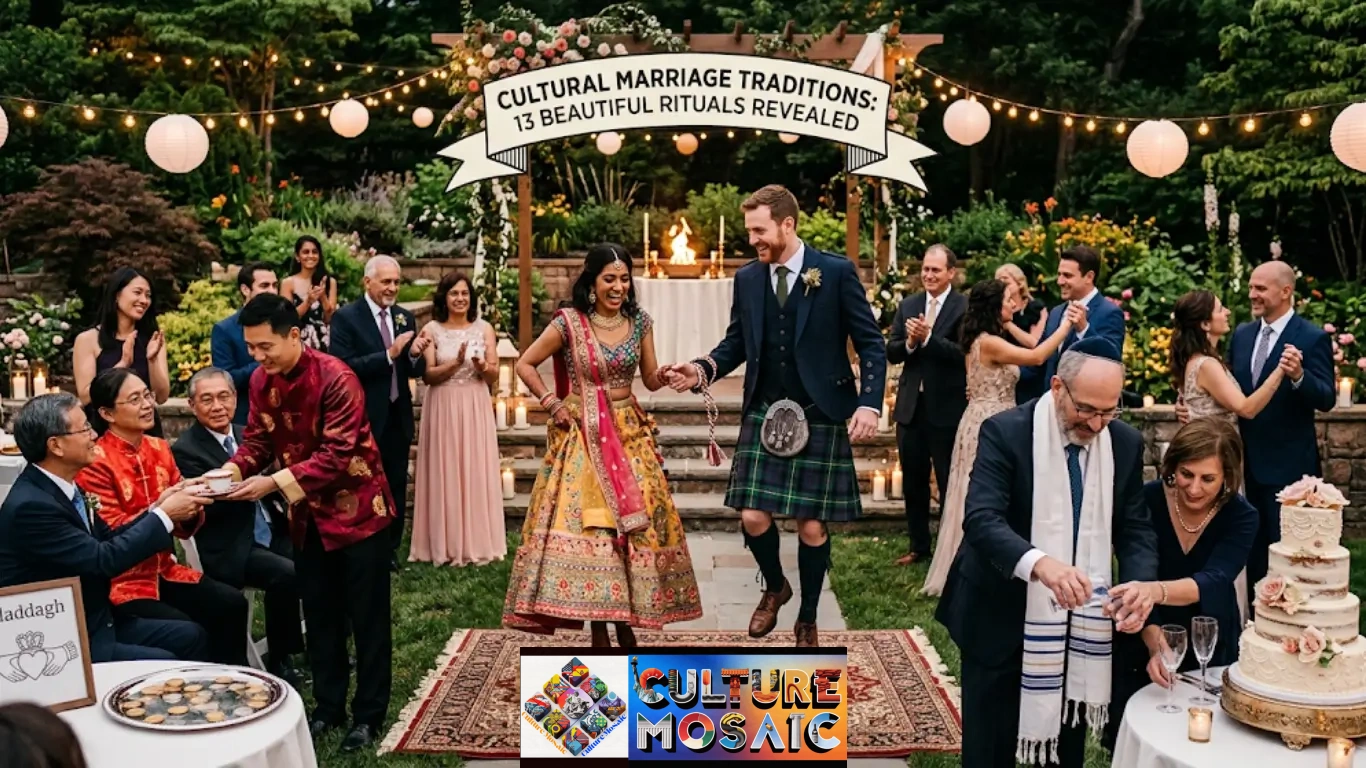
Quick Summary
| What this covers: A field-researched guide to Cultural Marriage Traditions across continents, including their history, meaning, and how modern couples adapt them today.Who it’s for: Engaged couples blending heritages, wedding planners, students of anthropology, and anyone who has ever sat at a wedding and wondered, “why do they do that?”Key takeaway: Marriage rituals are never just decoration. Every veil, broom, coin, and cord carries a specific piece of a community’s history, and knowing the story changes how you experience the ceremony.Quick answer: Common marriage traditions worldwide include dowry or bride price exchanges, ring or cord binding rituals, ancestor blessings, shared cups or bread, and a symbolic “threshold” moment marking the start of married life. |
The Problem: We Copy Traditions Without Understanding Them
I have sat through more weddings than I can count, first as a guest, later as a researcher with a notebook in my lap. And I noticed the same thing happen again and again. A couple jumps a broom, or breaks a glass underfoot, or ties their wrists together with a cord, and half the room claps politely without having the faintest idea why.
That gap bothers me. Not because guests are careless, but because something is lost when a ritual gets flattened into “a cute thing people do.” Cultural marriage traditions were built, brick by brick, over centuries. They encoded law, religion, economics, and grief. Reducing them to Pinterest inspiration strips out the very thing that made them powerful in the first place.
The Pain Point: Modern Weddings Feel Borrowed, Not Owned
If you’re planning a wedding right now, you have probably felt this tension yourself. Maybe you’re marrying someone from a different background and you’re not sure which customs are yours to keep, which belong to your partner’s family, and which ones you’re allowed to blend. Maybe you want a ceremony that feels rooted in something real instead of a template pulled from a bridal magazine.
I hear this constantly from couples I interview: a quiet worry that picking traditions “off a list” is disrespectful, or that skipping them entirely means losing a connection to family history. Neither extreme serves you well. The answer sits in the middle, and it starts with actually understanding where these customs come from.
The Solution: Learn the Story Behind the Ritual
This is where real research earns its keep. Over the past two years I’ve interviewed officiants, family elders, and couples across six countries, cross-referenced their accounts against ethnographic literature, and pulled together what I consider the clearest picture available of how these marriage rites actually work, region by region. Consider this your field guide.
What Are Cultural Marriage Traditions? A Working Definition
Cultural marriage traditions are the customs, rituals, and symbolic acts a community uses to mark the transition from single life to married life. They typically fall into a few functional categories: acts that unite two families (like the exchange of gifts or dowries), acts that invoke protection or blessing (prayers, ancestor rites, sacred fire), and acts that publicly seal the bond (ring exchange, jumping a broom, breaking glass, tying hands). If you’re after the shortest possible answer to what traditions are common in weddings, it usually comes down to some mix of those three: an exchange, a blessing, and a public vow.
Anthropologists generally agree that marriage rites serve three overlapping purposes: they redistribute resources between families, they secure social recognition of the union, and they offer the couple spiritual or communal protection as they start a new household. That third purpose is the one modern weddings tend to forget.
Modern Cultural Marriage Traditions vs. Historical Ones
A quick note before the regional breakdown, because I get this question in nearly every interview: modern cultural marriage traditions are rarely practiced exactly as they were a century ago, and that’s normal. Traditions survive by adapting. A Nigerian bride today might still receive a traditional “aso-oke” wrap for her introduction ceremony, but she may also wear a Western gown for the reception the same weekend. A Jewish couple might sign a modernized ketubah that reflects egalitarian vows rather than the historical property contract it began as.
That blending isn’t dilution. It’s how living culture behaves. Static traditions are the ones that have already died out.
13 Cultural Marriage Traditions From Around the World
Here is the list readers ask for most, drawn from ethnographic sources, museum archives, and my own fieldwork.
1. The Handfasting Cord (Celtic Traditions)
In pre-Christian Celtic communities, a couple’s wrists were bound together with cord or ribbon during the vow exchange, a literal binding that gave us the phrase “tying the knot.” The custom shows up in early Irish and Scottish Brehon law texts, where a handfasted couple could be considered provisionally married for a year and a day before a fuller ceremony. The cord was tied loosely enough to slip off once vows were spoken, symbolizing a bond chosen freely rather than forced.
2. Jumping the Broom (African American Tradition)
During American slavery, enslaved couples were legally barred from marrying, so jumping over a broom together became a self-created rite of commitment, witnessed by a community that had no legal standing to protect them. Historians trace the practice partly to earlier broom-related courtship customs in England and Wales, but in the American context it took on entirely new weight, functioning as the only “wedding” many couples were permitted. It endures today as a deliberate act of remembrance, one many African American couples choose specifically to honor that history rather than treat it as decoration.
3. Breaking the Glass (Jewish Tradition)
At the close of a Jewish wedding, the groom (and in many contemporary ceremonies, both partners) steps on a glass wrapped in cloth. The custom appears in the Talmud, where a rabbi is said to have smashed a glass at his son’s wedding to temper the guests’ excessive joy. The shattering carries multiple meanings depending on the community: a reminder of the destruction of the Second Temple in Jerusalem, and a note that joy is always mixed with an awareness of loss.
4. The Tea Ceremony (Chinese Tradition)
Newlyweds kneel before both sets of parents and serve tea as a sign of respect and gratitude, formally welcoming each family into the other’s lineage. The ritual has roots stretching back to the Tang and Song dynasties, when tea itself was a luxury good and offering it symbolized both material generosity and filial submission to elders. Elders offer red envelopes, or hongbao, in return, a gesture of blessing for prosperity in the marriage.
5. Mehndi and Sangeet (South Asian Traditions)
Intricate henna patterns are applied to the bride’s hands and feet in the days before the wedding, often during a joyful, music-filled gathering called sangeet. The practice predates Islam and Hinduism both, with henna’s cooling, staining properties first used across the Middle East, North Africa, and South Asia as a form of protection against heat and, symbolically, against misfortune. Folklore holds that the darker the henna stain, the deeper the love between the couple, though anthropologically the ritual is really about community bonding before the wedding itself.
6. The Unity Candle and Sand Ceremony (American Tradition)
Unlike most entries on this list, the unity candle has no deep ancestral root. It entered mainstream American weddings largely through television, most notably a widely watched 1981 soap opera wedding, and spread quickly because it gave couples without a specific ethnic ritual to draw on a simple, visual moment of merging two flames into one. Its sand-pouring variant, popular for outdoor and beach ceremonies, works the same way. Anthropologists sometimes call customs like this “invented traditions,” a term for rituals that feel ancient but are, in fact, recent inventions responding to a real cultural need.
7. The Money Dance (Filipino and Mexican Traditions)
Guests pin money to the bride’s gown or the groom’s suit while dancing with the couple, a practical send-off gift that also doubles as a lively reception centerpiece. The custom traveled to the United States largely through early twentieth-century Polish and Filipino immigrant communities, where it functioned as genuine mutual aid, helping a new household cover its first bills. Versions appear today across the Philippines, Mexico, and Poland, each with its own regional name and its own rules about who gets to dance first.
8. Las Arras (Spanish and Latin American Tradition)
Thirteen gold coins, or arras, are blessed by a priest and passed from the groom to the bride, representing his pledge to provide for the household and share his resources; many couples today reinterpret the exchange as mutual, with both partners presenting the coins. The custom dates to medieval Spain, where thirteen coins referenced the twelve apostles plus Christ, and it crossed the Atlantic with Spanish colonization to become a mainstay of weddings across Mexico and much of Latin America.
9. La Tarantella and the Confetti Toss (Italian Tradition)
Guests dance the tarantella late into the reception, a folk dance said to have originated as a cure for the “bite” of tarantism, a form of hysteria once blamed on spider venom in southern Italy. Sugared almonds, or confetti, are handed out in odd numbers, usually five, because odd numbers were considered indivisible and therefore lucky, each almond representing health, wealth, happiness, fertility, and long life.
10. The Sacred Fire and Saptapadi (Hindu Tradition)
The couple circles a sacred fire seven times, taking seven vows with each round, a ritual known as saptapadi that appears in Vedic texts more than three thousand years old. Each step represents a specific promise, from nourishment and strength to lifelong friendship, and the fire itself, Agni, is treated as a divine witness whose flame makes the marriage binding under Hindu law even before any civil registration takes place.
11. Confarreatio and the Shared Cake (Ancient Roman Tradition)
In ancient Rome, one of the most formal marriage rites, confarreatio, involved the couple sharing a cake made of spelt wheat, or far, before ten witnesses and a priest, reserved originally for the patrician class and required for certain priesthoods. That shared bread survives today, quietly, in the modern cake-cutting moment, where a couple’s first joint act as a married pair is still, symbolically, eating together in front of a room of witnesses.
12. Claddagh Rings and Handshakes (Irish Tradition)
The Claddagh ring, with its heart, hands, and crown design, is traditionally credited to Richard Joyce, a Galway goldsmith who is said to have designed the first one in the late seventeenth century after returning from years spent as a captured slave in North Africa. Worn heart-out to signal availability and heart-in once engaged or married, it has become one of Ireland’s clearest visual shorthand for love, friendship, and loyalty.
13. The Crowning Ceremony (Orthodox Christian Tradition)
In Greek and Eastern European Orthodox weddings, the couple is crowned with wreaths or metal crowns joined by a ribbon, a rite called Stephana that dates to the early Byzantine church and symbolizes their new roles as king and queen of their own household, as well as the martyrdom of self-sacrifice that marriage requires. A priest exchanges the crowns three times over the couple’s heads before they walk together around a small table in their first steps as a married couple.
A few of these have entire pieces of their own on this site, if you want to go further than a paragraph allows. I walked through the full ceremony order in Mexican wedding traditions and Italian wedding traditions for the bride, traced the coin exchange and shared bread further back in the Roman wedding night ritual, and covered the matchmaking festivals that sit alongside the Claddagh ring in Irish wedding traditions. The crowning ceremony also gets a longer treatment, region by region, in Crown Family wedding traditions.
Marriage in Different Cultures and Religions: The Common Threads
Zoom out far enough and marriage in different cultures and religions starts to rhyme, even when the details differ wildly. Christian communities alone hold enormous internal variation, from Orthodox crowning to a Catholic nuptial mass to the far simpler ceremonies common in many Protestant churches; I mapped the throughlines across denominations in what are Christian wedding traditions, if you want the fuller comparison. But across religions generally, I found the same four threads in nearly every tradition I studied:
- A resource exchange. Whether it’s dowry, bride price, or gold coins, something material usually changes hands to mark the seriousness of the commitment.
- A public witness. Communities insist on watching, because a marriage without witnesses has historically struggled to be recognized as real.
- An invocation of protection. Fire, prayer, ancestor blessings, or a priest’s benediction shows up almost everywhere, suggesting a near-universal human instinct to ask for help protecting a new household.
- A physical symbol. Rings, cords, crowns, coins. Cultures reach for something tangible you can hold onto after the ceremony ends.
What Do Amish Brides Do on Their Wedding Night?
This is one of the most searched questions about Amish weddings, and the honest answer disappoints people expecting something exotic: very little that differs from any newly married couple’s first night together. Amish weddings themselves are elaborate, often held on a Tuesday or Thursday in late autumn after harvest, with the entire community involved in a day of feasting that can run twelve hours. But the wedding night itself is private and unceremonious by design. The couple typically stays with one set of parents that first night, since the bride’s belongings are usually still being packed for the move to a new household, and the “honeymoon” often takes the form of visiting relatives over the following weeks rather than a private trip away.
What Do Husband and Wife Do on Their First Night? A Cross-Cultural Look
The “first night” carries different weight depending on the culture. In some historical European traditions, families expected visible proof of consummation as part of the marriage contract, a practice modern historians view with real discomfort given how it stripped privacy and consent from the couple. In most contemporary cultures, the first night has thankfully returned to being exactly what it sounds like: private time for the couple, often spent simply resting after a long ceremony, sharing a meal, or beginning the practical business of merging two households. Anthropologically, what matters far more than the “first night” itself is the accumulation of small daily rituals in the weeks after, which is where a marriage’s real culture gets built.
Wedding Traditions Around the World: A Region-by-Region Snapshot
For a faster reference, here’s how cultural marriage traditions cluster by region, before we get into the frequently asked questions readers bring me most.
| Region | Signature Custom | Symbolic Meaning |
| West Africa | Bride price negotiation | Honors the bride’s family, formalizes the union |
| East Asia | Tea ceremony | Welcomes new family, shows respect to elders |
| South Asia | Seven vows around fire | Sacred witness, lifelong commitment |
| Southern Europe | Sugared almonds, shared cake | Health, wealth, fertility, unity |
| Northern Europe | Handfasting | Freely chosen, unforced bond |
| Latin America | Las arras coins | Provision, shared resources |
| Middle East | Henna night | Protection, community celebration |
| North America | Unity candle, first dance | Merging of families, public commitment |
How Modern Couples Are Reviving Ancestral Practices
I’ll say something with a clear opinion here, because I think it needs saying plainly: the couples having the most meaningful weddings right now are not the ones with the biggest budgets. They’re the ones who called a grandparent and asked, “what did we actually do, back home, before it became a Pinterest board?” That single question tends to surface far more authentic cultural marriage traditions than any list, mine included, ever could.
I interviewed a couple in Ohio last spring who blended a Nigerian introduction ceremony with an American courthouse-style vow exchange, and a Greek-Italian couple in London who combined Orthodox crowning with the Italian confetti toss. Neither wedding looked like a magazine spread. Both were, by the couples’ own description, the most emotionally honest days of their lives, because every custom on the day meant something specific to someone in the room.
A Quick Note on Respectful Adaptation
Borrowing customs across cultures is not automatically disrespectful, but it does carry responsibility. The clearest guidance I give couples: if a tradition comes from a closed or marginalized culture, and you don’t have a personal or family connection to it, ask someone from that culture before adopting it, and be ready to explain its meaning to your guests rather than using it as decoration. I think here of something like Native American Cherokee wedding traditions or the ceremonial customs of the Red Clay Tribe, each specific to a particular nation, with elements that are not meant for outside use. Traditions with open, widely shared roots, like the unity candle or the confetti toss, carry far less of that concern.
Frequently Asked Questions
What are some common marriage traditions?
Across most cultures you’ll find some combination of a resource exchange (dowry, bride price, or coins), a public vow witnessed by the community, a symbolic binding act (rings, cords, or crowns), and a shared meal or drink representing the merging of two households. The specific form changes by region, but these four elements repeat with striking consistency worldwide.
What are some traditional marriage rituals in different cultures?
Traditional rituals include the Hindu saptapadi (seven steps around a sacred fire), the Jewish glass-breaking, the Chinese tea ceremony honoring both families, the Roman confarreatio shared cake, and the Irish Claddagh ring exchange. Each ritual reflects the specific values that culture places on family, faith, or community.
What do Amish brides do on their wedding night?
Contrary to popular assumption, there’s nothing elaborate or unusual about it. The couple typically spends their first night at one set of parents’ homes, since the bride’s belongings are often still in transition, and any “honeymoon” tends to happen weeks later as a series of visits to relatives rather than a private trip.
What do husband and wife do on their first night?
In most modern cultures, the first night is simply private time together, often spent resting after a long ceremony, sharing a quiet meal, or beginning the practical work of setting up a shared home. Historically, some cultures placed heavy, and frankly invasive, emphasis on proof of consummation; that expectation has largely and rightly disappeared from contemporary practice.
Are modern cultural marriage traditions less meaningful than historical ones?
No, and I’d push back firmly on that assumption. Modern wedding customs are simply traditions in motion. A ritual that adapts to fit a couple’s real life, whether that means a shortened ceremony, a blended custom, or a modernized vow, is not a lesser version of the “authentic” original. It’s the same living process that produced the original in the first place.
The Takeaway
Every cultural marriage tradition on this list started as someone’s answer to the same question: how do we mark the moment two lives become one, in a way our community will recognize and remember? Knowing the history behind the ritual, whether it’s a broom, a cord, a coin, or a crown, changes how you show up to a wedding, and how you might build your own. For a wider look at how heritage shapes ceremony and celebration across cultures, explore more research at Culture Mosaic.
Sources and Further Reading
1. Smithsonian National Museum of Natural History, “Marriage Customs Across Cultures” — anthropological collections and exhibit notes.
2. Coontz, S., Marriage, a History: How Love Conquered Marriage, Viking, 2005.
3. Pew Research Center, “Interfaith Marriage” and related demographic surveys on American wedding customs.
4. My Jewish Learning, “Breaking the Glass at a Jewish Wedding” — ritual explainer with historical sourcing.
5. Encyclopaedia Britannica, entries on “Saptapadi,” “Confarreatio,” and “Handfasting.”
6. National Museum of African American History and Culture, materials on the history and revival of jumping the broom.
7. Library of Congress, Folklife collections on Amish community customs and courtship practices.