
 By Culture Expert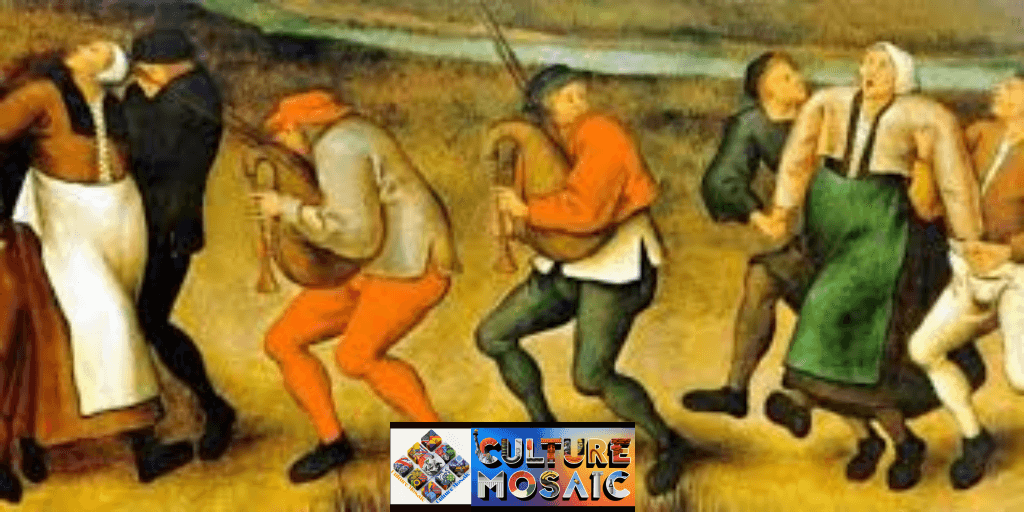
If you had stood on the cobblestones of Strasbourg in mid-July 1518, you might have seen something that stopped you cold. A woman, alone, moving in the narrow street without music, without company, without any apparent reason. She was not celebrating. She was not performing. She was simply, horrifyingly, dancing. And she could not stop.
Her name was Frau Troffea. She is the grim starting point of one of history’s strangest documented events. To understand what is the dancing plague of 1518, you have to start here, on this one woman’s street, before the city came apart.
One Woman, No Music: The Beginning of the 1518 Dancing Epidemic
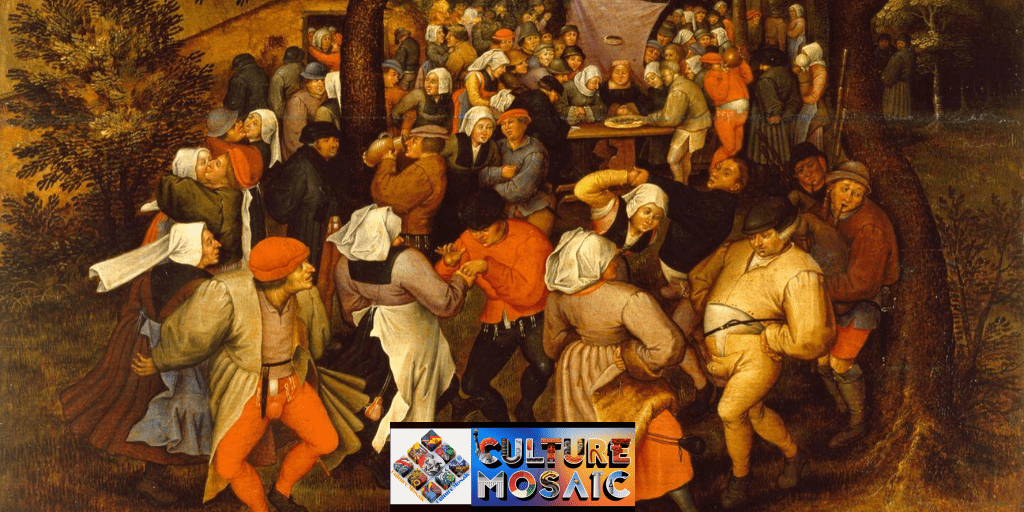
On July 14th, 1518, Frau Troffea boldly stepped into the street, captivated by an irresistible urge to dance, and began her solitary performance. There was no music. No festival. She danced for hours, then collapsed, then rose and danced again. Within four to six days, thirty more people had joined her. They were not performing together. Each one was trapped in the same involuntary loop.
Contemporary accounts describe bloodied feet, swollen joints, and glassy, unfocused eyes. These were not people in the grip of joy. They were suffering. And still they danced.
A City Comes Apart: How the Dancing Plague Spread Across Strasbourg
Within a month, the number of afflicted people in Strasbourg had climbed past four hundred. Chroniclers reported that fifteen people were dying each day from strokes, cardiac failure, and sheer physical collapse. The city’s guilds and civic leaders were watching an emergency unfold in real time, with no framework to understand it.
This was not the first time something like this had happened in medieval Europe. Episodes of what we now call choreomania had been recorded as far back as the thirteenth century, in communities along the Rhine. But none had been this large. None had claimed this many lives.
What the Doctors Said: The Overheated Blood Theory
The physicians summoned to examine the dancers reached a diagnosis rooted firmly in the humoral medicine of the time. They concluded that the victims were suffering from “hot blood.” The prescribed treatment, by this logic, was not rest or isolation. It was more movement.
City officials ordered a wooden stage to be constructed in the public square. Musicians were hired. The idea was that the dancers should be allowed to exhaust the condition out of their bodies. Instead, the crowds grew, the dancing spread, and the death toll climbed.
When the Music Was Finally Banned
When it became obvious that encouraging more dancing was only making things worse, Strasbourg’s authorities reversed course sharply. Music was banned throughout the city. Public dancing was prohibited. The infected were moved out of the city to a shrine dedicated to Saint Vitus, high in the Vosges mountains. The dancing, at last, slowed. But the deaths were already done.
The Curse of Saint Vitus: How Strasbourg Explained the Dancing Plague of 1518
To the people of 1518, the most intuitive explanation was also the most frightening. The dancing was understood as divine punishment, specifically a curse delivered by Saint Vitus. The saint had a longstanding association with involuntary movement disorders across the medieval world, which is why the condition was also called Saint Vitus’s Dance.
Pilgrimages to his shrine were the closest thing to a recognised cure. Whether by the physical distance, the change in environment, or the psychological relief of religious ritual, some victims did recover after making the journey. That does not tell us the cause. It tells us how desperate and searching the response was.
Modern Theories: What Really Caused the Dancing Plague of 1518?
Historians and scientists have been trying to explain this event for centuries. There is no consensus. But the three strongest theories each illuminate something real about that summer.
Theory 1: Ergotism — The Poison in the Bread
One persistent theory points to ergot, a fungus that grows on rye grain in damp, cold conditions. When consumed, ergot produces compounds chemically related to LSD. Ergotism was widespread in medieval Europe and could cause convulsions, hallucinations, and involuntary muscle spasms.
- Supports the theory: Ergotism was endemic in the Rhine valley. Crop failures had forced many to eat spoiled grain.
- Weakens the theory: Ergotism typically causes rigidity and burning sensations, not fluid dancing. Gangrene is also a hallmark — not reported prominently in 1518.
- Verdict: Appealing but incomplete. The symptoms do not closely match the historical record.
Theory 2: Mass Psychogenic Illness — The Most Convincing Case
The most widely accepted modern explanation comes from historian John Waller, who spent years combing through the primary sources. His argument is that what is the dancing plague of 1518 is best understood as a case of mass psychogenic illness, which was historically called mass hysteria.
Waller’s research places the epidemic in its social context. Strasbourg in 1518 was a city under severe psychological strain. The region had been devastated by famine, plague, and syphilis. Religious anxiety was extreme. These pressures connect directly to histories of mass displacement and collective trauma explored in Hidden Histories of Global Displacement and The Last Nomads on Culture Mosaic.
- Supports the theory: The episode began during acute regional famine. Mass psychogenic illness is well-documented in modern populations under extreme stress. The Saint Vitus theological framework provided a cultural script for the illness to follow.
- Weakens the theory: Some researchers argue the death toll is too high for purely psychogenic illness. The physical injury evidence is more severe than in typical psychogenic episodes.
- Verdict: The most persuasive and historically consistent explanation, accepted by the majority of scholars.
Theory 3: The Curse of Saint Vitus as Cultural Mechanism
This is less a competing theory and more a layer beneath the psychogenic one. The specific belief in Saint Vitus’s Dance as a real divine curse functioned as what Waller calls a “trance-inducing framework.” Communities that believed fervently in the curse were neurologically primed to enact it.
- Supports the theory: Dancing manias clustered specifically in regions with strong Saint Vitus devotion. The episodes vanish after the Reformation dismantles this framework.
- Weakens the theory: It does not explain the physical deaths. Belief alone rarely kills at this scale.
- Verdict: Best understood as the cultural accelerant, not the root cause.
Strasbourg in 1518: The World Behind the Dancing
The broader social context is inseparable from the question of what is the dancing plague of 1518. The city sat at the crossroads of trade routes that had also become plague routes. Harvests had failed across the Rhine valley. The poor were genuinely starving. Collective displacement and grief on this scale share structural patterns with documented historical ruptures, including those traced in The Second Exodus on Culture Mosaic.
People were praying to saints for relief, attributing disease to sin, and watching their neighbours die in numbers that had no modern parallel in peacetime. The dancing, in this light, reads less like madness and more like a body in total collapse.
Choreomania Through the Middle Ages: Was 1518 an Isolated Event?
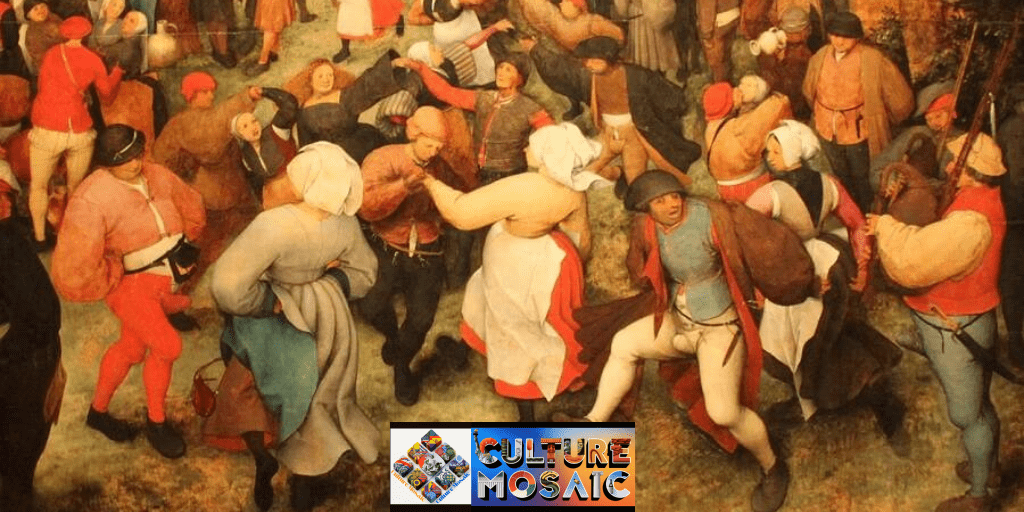
The 1518 Strasbourg outbreak was not the first episode of choreomania in European history. Dancing manias were recorded in the Rhine valley in 1374, in Echternach in Luxembourg, and in scattered communities across the fourteenth and fifteenth centuries.
What strikes me most, looking at these records alongside other episodes of collective social rupture, including The Boston Tea Party 1773, is how consistently mass events require a pre-existing social fracture. The dancing did not create the crisis. It revealed one that was already there.
The Role of Religious Belief in Mass Illness
Saint Vitus’s Dance was not just a diagnosis. It was a cultural script. Medieval communities had a shared belief system that included the real possibility of divine punishment manifesting in physical symptoms. When you believe, deeply and collectively, that a saint can curse you with uncontrolled movement, that belief itself becomes a kind of neurological vulnerability.
John Waller’s work argues that this is why dancing plagues were geographically specific. They clustered in regions with particular devotion to Saint Vitus, in communities where the theological framework made this kind of mass episode legible, and therefore possible.
Why Did the Dancing Plagues Stop After the Seventeenth Century?
After the seventeenth century, choreomania effectively disappears from the historical record. The question of why is as interesting as the question of what caused the dancing plague of 1518 in the first place.
The most persuasive answer is that the cultural conditions changed. The spread of Protestantism broke the specific Catholic folk-religious framework around Saint Vitus. Early state medicine gave communities different ways of interpreting and containing mass illness. The same civic restructuring forces that reshaped American Labor Heritage were, in an earlier form, beginning to rebuild European social infrastructure too.
Remove the theological script. Give people a different framework for understanding collective suffering. The dancing stops.
Frau Troffea: The Woman Who Triggered It All
We know almost nothing about Frau Troffea beyond the fact that she existed and that she was the first. Some historians have speculated about her domestic circumstances, suggesting she may have been under particular personal stress. But the record is thin.
What is not thin is the scale of what her episode triggered. Within weeks, hundreds of people were caught in the same loop. She was not orchestrating anything. She was, by every account we have, simply unable to stop. That is the detail that has stayed with me across years of research. Not the spectacle of the dancing. The helplessness of it.
What the Dancing Plague of 1518 Tells Us About Human Vulnerability
I have spent a long time with this story. What it tells me, ultimately, is something about the limits of what people can carry. Strasbourg in 1518 was a community that had absorbed too much loss, too fast, with too few resources to process it. The dancing was not irrational. It was the body doing something that language and ritual and community structures had failed to do.
Mass psychogenic illness is not a medieval curiosity. It is a documented feature of how human nervous systems respond to collective trauma. The factors that led to its emergence are still present. We have just found different containers for the same pressures.
The Medical Legacy of Choreomania
The 1518 outbreak helped push European physicians toward more systematic observation of epidemic illness, even if their conclusions were wrong at the time. The city’s written records became, centuries later, the foundation for modern scholarship on mass psychogenic illness. The suffering of Strasbourg’s population is now taught in medical schools and psychology departments as one of the earliest documented case studies in collective trauma response.
How Historians Study Events Like the Dancing Plague of 1518
The challenge with an event like the dancing plague of 1518 is that the primary sources are filtered through the assumptions of people who had no framework for psychogenic illness. Guild records, physician reports, and religious chronicles each interpret the event through a different lens.
Reading them together, triangulating across unreliable but overlapping accounts, is the method. It is the same discipline required when piecing together any suppressed or under-documented history. The 1518 records are unusually detailed by medieval standards, precisely because the scale of the crisis demanded documentation.
A Ghost in the Archive: The Mystery That Remains
Even with everything we know, the dancing plague of 1518 retains a quality that resists final explanation. The scale, the deaths, the city’s desperate response are all documented. But the precise neurological and social mechanism, the exact threshold that was crossed, remains just out of reach.
That is, I think, where it should stay. Some events are important not because we fully understand them, but because they force us to keep asking the right questions. What is the dancing plague of 1518? It is a mirror held up to a community at its breaking point. The reflection is uncomfortable. It should be.
FAQs: Understanding the Dancing Plague of 1518
What is the dancing plague of 1518?
The dancing plague of 1518 was a mass epidemic of involuntary dancing that struck Strasbourg in July 1518. Beginning with a single woman named Frau Troffea, it spread to over four hundred people within months. At its peak, report suggests up to fifteen people per day were dying from exhaustion, heart failure, and stroke. It remains one of the most thoroughly documented cases of choreomania in European history.
What caused the dancing plague of 1518?
The most widely accepted modern explanation is mass psychogenic illness, triggered by the extreme psychological stress of famine, disease, and religious anxiety. Historian John Waller argues that the cultural belief in Saint Vitus’s Dance created the framework for this collective breakdown. While ergotism (fungal poisoning) has been proposed, it does not closely match the historical symptoms reported at the time.
Who was Frau Troffea?
Frau Troffea was the first recorded victim of the 1518 epidemic. On July 14, 1518, she began dancing alone in a Strasbourg street and continued for several days without stopping. Her case triggered a cascade of similar episodes across the city, though little else is known regarding her personal background.
How did city officials respond to the dancing plague of 1518?
Initially, physicians believed the victims had “hot blood” and encouraged them to dance the condition out of their systems. Officials even built a wooden stage and hired musicians, which tragically worsened the epidemic. Eventually, authorities reversed course, banning music and public dancing entirely and sending the afflicted on a pilgrimage to the shrine of Saint Vitus.
Why did dancing plagues stop happening after the seventeenth century?
Historians link the disappearance of choreomania to the Reformation, which dismantled the theological framework surrounding Saint Vitus. Additionally, the gradual development of early public health institutions provided new ways to interpret and contain mass illness. Without the cultural infrastructure that made these episodes repeatable, the conditions for a dancing plague could no longer take hold.