
 By Culture Expert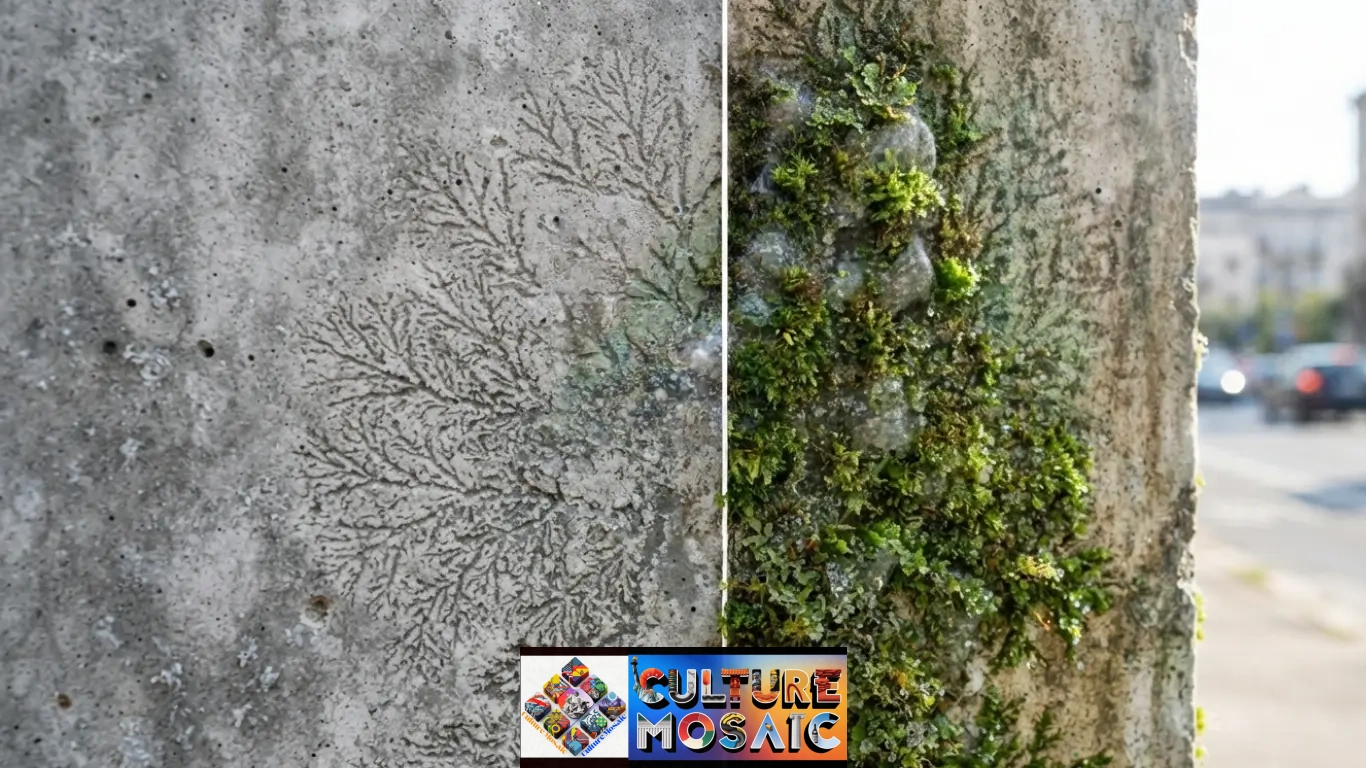
Quick Summary
Sustainable Urban Art Science merges urban ecology, bio-art infrastructure, and organic chemistry to turn dead urban surfaces into living ecosystems.
The Core Mechanism
Alkaline concrete (pH 12–13) starves urban flora. Applying acidic bio-emulsions (pH 4.8–5.2) chemically etches substrates, neutralizing surface alkalinity and creating micro-habitats.
Key Materials
- Air-purifying public murals: Utilizing photocatalytic paint to break down pollutants.
- Biophilic urban installations: Integrating living plant structures directly into architectural design.
- Moss slurries: Enriched with lactic acid and polysaccharides for optimal structural adhesion.
Impact
- Actively reduces the urban heat island effect
- Improves localized air quality
- Lowers street-level decibels
- Encourages community engagement through tactical urbanism
Last Tuesday, a city council member asked me to explain why there was green stuff growing on the side of the municipal building. I told her it was my fault—and that she should be grateful.
I’ve worked in Sustainable Urban Art Science for over a decade now. It started in a garage with a blender and some moss scraped off a damp retaining wall. Today, it involves consulting on large-scale living architecture, climate-responsive public art, and bio-art infrastructure across major metropolises. The science hasn’t changed, but our understanding of Sustainable Urban Art Science and what’s possible within ecological street art has exploded.
Most people look at moss graffiti or living installations and think it’s either pure aesthetics or hippie nonsense. It’s neither. It’s chemistry and tactical urban design. Specifically, it’s bio-emulsion chemistry applied to the challenge of keeping living organisms alive on surfaces designed to kill them.
What Is Sustainable Urban Art Science?
Sustainable Urban Art Science sits directly at the intersection of bio-art infrastructure, environmental science, and creative placemaking. When artists install living walls or air-purifying public murals (photocatalytic paint), they aren’t just decorating space. They are engineering micro-habitats.
The art is the vehicle; the biological system is the functional core.
Urban Environmental Stressors
(Concrete Alkalinity, Heat Islands, Exhaust)
Bio-Emulsion Chemical Neutralization
(Lactic Acid Etching + Polysaccharide Matrix)
Micro-Habitat Establishment
(Air Purification, Decibel Drop, Biophilic Aesthetics)
Cities are inherently hostile to biological life. Standard concrete leeches heavy alkalinity, dense high-rises create wind tunnels, and asphalt radiates intense heat. If you want to integrate living architectural installations (green walls, bio-sculptures) or biophilic urban installations into a downtown grid, you must understand substrate chemistry, micro-climates, and species resilience.
The Chemical Barrier: Substrate pH and Micro-Etching
Find a standard concrete wall in any major city. Fresh concrete sits at roughly pH 12 to 13 due to abundant calcium hydroxide—chemically comparable to household bleach. Natural moss and micro-flora thrive in mildly acidic environments between pH 4.5 and 5.5.
Substrate pH Spectrum
When un-treated moss is placed on raw concrete, the extreme alkalinity causes cellular damage before rhizoids can anchor. This is where chemical intervention becomes essential:
$$\text{Ca(OH)}_2 + 2\text{C}_3\text{H}_6\text{O}_3 \rightarrow \text{Ca(C}_3\text{H}_5\text{O}_3)_2 + 2\text{H}_2\text{O}$$
Lactic acid ($\text{C}_3\text{H}_6\text{O}_3$) neutralizes toxic calcium hydroxide ($\text{Ca(OH)}_2$) into calcium lactate ($\text{Ca(C}_3\text{H}_5\text{O}_3)_2$) and water ($\text{H}_2\text{O}$).
- Neutralization: The acidic solution reacts with the surface layer of calcium hydroxide, dropping the concrete’s localized pH from 12.8 down to a workable 7.0–7.5 within 24 hours.
- Nutrient Creation: The resulting byproduct, calcium lactate, acts as a bio-available mineral reserve for establishing flora.
- Micro-Etching: The acid creates microscopic pits across the smooth concrete surface, increasing physical surface area by 30% to 40% for rapid rhizoid attachment.
Emulsion Fluid Dynamics: Rheology and Nutrient Delivery
To apply biological mixtures to vertical urban structures, the mixture must act as a shear-thinning, non-Newtonian fluid.
Clings to Vertical Wall
Smoothly Spreads on Surface
Rheology & Viscosity Targets
Watery mixtures run down walls into street drains, while dense pastes choke spores. Achieving a target viscosity between 500 and 800 centipoise (cP) allows the mixture to flow under brush stress (shear deformation) and immediately solidify once applied to a vertical substrate.
The Role of Polysaccharides
Sucrose and complex starches form hydrogen bonds with water molecules to control drying times.
- Metabolic Support: Shredded moss tissue suffers temporary chloroplast damage during blending. Polysaccharides provide immediate glucose, raising establishment rates by over 60%.
- Structural Matrix: As water evaporates, sugar forms a temporary micro-crystalline lattice that anchors plant tissue until natural bio-adhesion takes over.
Dairy Emulsifiers vs. Synthetic Polymers
Buttermilk delivers amphiphilic casein and whey proteins. The hydrophobic tails bind to organic moss fragments, while hydrophilic heads interface with water. This wraps every biological fragment in a protective moisture shell, slowing drying rates by up to 40% on sun-exposed walls.
Comparing Living Art Frameworks
Integrating environmental science and art requires choosing the right medium for the specific urban environment:
| Feature / Metric | Organic Moss Slurries | Photocatalytic Murals | Living Bio-Reactors (Algae) |
| Primary Scientific Function | Micro-climate cooling & acoustic damping | $\text{NO}_x$ gas neutralisation via titanium dioxide ($\text{TiO}_2$) | High-yield carbon sequestration & oxygen production |
| Substrate Compatibility | Unsealed brick, porous concrete, soft stone | High-durability masonry, rendered walls, steel | Integrated glass, modular structural framing |
| Maintenance Requirements | High initial hydration; low long-term maintenance | Extremely low (activated by sunlight & rainfall) | High (system fluid monitoring & bio-harvesting) |
| Optimal Urban Location | Shaded north-facing walls, alleyways, subways | High-traffic highways, canyon-effect streets | Building facades, civic plazas, smart cities |
| Civic Engagement Potential | Hands-on, community-led placemaking | High visual awareness, educational graphics | Advanced interactive environmental monitoring |
Tactical Urbanism and Community Implementation
Artistic ecological interventions thrive when backed by public participation. Deploying kinetic environmental art structures or biophilic installations serves as an effective gateway for Tactical Urbanism in Community Civic Engagement.
When local residents participate in DIY Placemaking Community Engagement, neighborhood installations transform into shared civic hubs. Incorporating Co-design in urban planning and civic engagement ensures these projects meet immediate community needs—whether that means mitigating local air pollution or reducing urban heat islands.
Over time, small-scale Micro-Civic Interventions aggregate into larger shifts in public policy, shaping broader Civic Engagement Trends and encouraging cities to adopt sustainable designs natively. Explore broader cultural and public design frameworks at Culture Mosaic.
Working Bio-Emulsion Recipe
This baseline formulation is optimized for temperate urban microclimates on porous concrete or unsealed brick:
- 500 mL Full-fat cultured buttermilk (high lactic acid & protein content)
- 500 mL Filtered water (dechlorinated)
- 100 g Pure sucrose (white sugar matrix binder)
- 300 g Urban-harvested moss fragments (Bryum argenteum or Ceratodon purpureus)
- 1.5 g Xanthan gum powder (shear-thinning stabilizer)
Formulation Steps:
- Dissolve sucrose fully into the water-buttermilk mixture.
- Add urban moss fragments; blend on low speed for 30 seconds to preserve cell cluster integrity.
- Slowly dust in xanthan gum while stirring to establish target gel viscosity.
- Verify mixture pH with litmus strip or digital meter. Target range: 4.8 – 5.2. (Adjust upward with sodium bicarbonate or downward with lemon juice if necessary).
- Apply with natural bristle brushes using bottom-to-top strokes on pre-dampened surfaces.
Frequently Asked Questions
What does sustainable art mean?
What is sustainable urban design?
What are the five C’s of sustainability?
What defines urban art?
Is the art industry growing or declining?
The chemistry behind living murals is dependable and repeatable across diverse urban environments. However, successful Sustainable Urban Art Science relies on more than perfect pH balancing—it requires matching species selection to localized microclimates, timing applications appropriately, and cultivating long-term community stewardship. Balancing scientific precision with creative urban design turns static concrete walls into functional, living ecosystems.
Sources & Reference Foundations
- Urban Ecology & Bio-Art: Applied research on living infrastructure, tactical urbanism, and green micro-habitats in dense city environments.
- Material Chemistry: Chemical studies on concrete substrate neutralization, acid etching (lactic acid), and polysaccharide adhesion matrices for moss slurries.
- Environmental Engineering: Data on photocatalytic (air-purifying) paints, localized sound attenuation (decibel reduction), and urban heat island mitigation.
- Sustainable Urban Planning: Frameworks covering biophilic architecture, municipal sustainability mandates, and the 5 C’s of sustainability.
 Marcus J. Holloway