
 By Culture Expert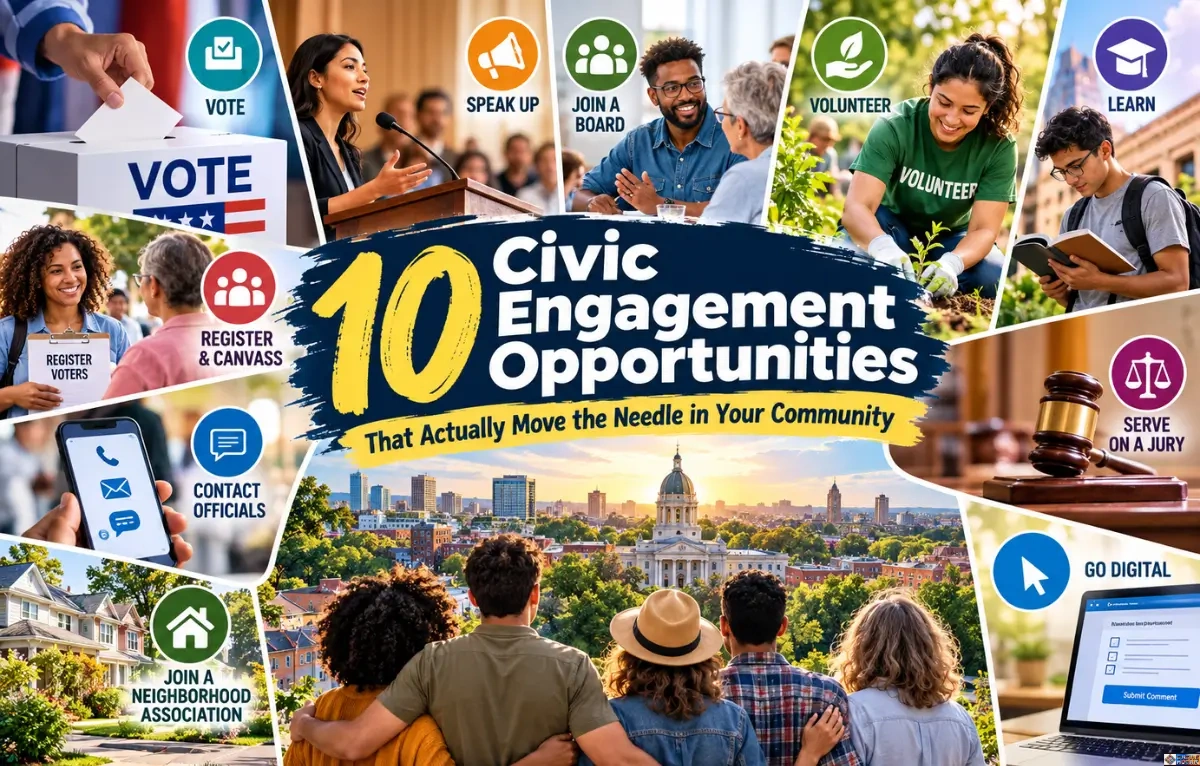
I’ve sat in more county council meetings than I can count. Folding chairs, bad coffee, a clerk reading minutes into a microphone that keeps cutting out. And every single time, I watch the same thing happen: two or three people speak, a decision gets made, and a room of a hundred thousand residents never even knew the meeting existed.
That’s the problem. Not apathy — access. Most people I talk to want to be involved. They just don’t know where the door is, or they knock on it once, get no answer, and give up. I’ve watched that discouragement curdle into “why bother.” I get it. I’ve felt it myself, standing outside a locked civic center at 6:58 p.m. for a meeting that supposedly started at 7.
So here’s what I’ve put together: 10 civic engagement opportunities that are real and doable — not vague encouragement to “get involved,” but the actual doors, the actual hours, the actual first sentence to say when you walk in. Some take five minutes. One takes a Tuesday off work every two years. Pick one. Start there.
Quick Summary
At a Glance ● Civic engagement means any action — voting, volunteering, showing up, speaking up — that shapes your community or government. It’s broader than politics alone. ● These 10 civic engagement opportunities span voting, public commentary, boards and commissions, volunteering, civic education, and digital advocacy — options for students, professionals, retirees, and newcomers alike. ● Nearly 50 million young Americans are eligible to vote in the 2026 midterms, and youth civic energy is trending upward, but turnout still lags — exactly why individual participation carries outsized weight right now. ● You don’t need a political science degree or a spare weekend. Most of these opportunities take under an hour to start. |
Why This List Exists (and Why It’s Different)
Most “civic engagement” listicles read like a syllabus. Vague verbs. “Get involved.” “Make your voice heard.” I’ve never found that useful, and honestly, I don’t think you have either.
What actually gets people through the door is specificity. So every entry below tells you what the activity looks like on a Tuesday night, who it’s realistically suited for, and what changes because you showed up. This list of 10 Civic Engagement Opportunities is built for real schedules, not brochures — and it covers everything from a five-minute ballot drop to a multi-year board seat, so there’s an entry point regardless of how much time you have.
1. Vote — Including Early, When You Can
I’ll say the unpopular thing first: voting is not the whole of civic life, but it’s still the floor everything else stands on. Skip it and the rest of this list gets a lot harder to justify.
The good news is that voting has gotten more flexible. In 47 states plus Washington, D.C., you can vote before Election Day for any reason at all — no excuse required. That’s roughly 97% of the voting-age population with a real early-voting option on the table. If you want a specific date to circle, Vote Early Day 2026 lands on Tuesday, October 24, 2026 — ten days ahead of the November 3 general election, timed for when most early voting locations are fully up and running.
For the 2026 midterms specifically, nearly 50 million young people between 18 and 29 are eligible to vote — about 8.5 million of whom will have aged into the electorate since the last presidential cycle. Youth turnout hit 47% in 2024, down slightly from 2020’s historic 50%, but CIRCLE’s 2026 pre-election polling found 56% of young people saying they’re extremely likely to vote — a number that would rival presidential-year engagement in a midterm, which almost never happens.
Best for: Everyone eligible. No exceptions. Of all 10 civic engagement opportunities on this list, this is the one with zero barrier to entry once you’re registered — and it’s where “civic engagement examples for college students” and “civic activities examples” for literally every other age group converge.
2. Speak at a Public Hearing or Submit Public Commentary
Here’s a fact that stuns most people the first time they hear it: local governments are often legally required to accept public comment before approving budgets, zoning changes, and ordinances — and most weeks, almost nobody shows up to give it.
I remember watching a retired schoolteacher stand up at a zoning hearing and, in about ninety seconds, get a proposed parking structure moved forty feet. Not because she yelled. Because she was the only person in the room who’d actually read the site plan.
You don’t need to be an expert. You need three minutes, a printed page of notes, and the willingness to stand up when your name gets called. Learn why public consultation is important and exactly what public commentary looks like in practice before your first meeting — it removes almost all the intimidation factor.
Best for: Homeowners, renters, small business owners, parents — anyone with a direct stake in a specific local decision.
3. Join a Citizen Advisory Board or Commission
Most cities and counties run a whole shadow government of volunteer boards — planning commissions, parks boards, library trustees, transit advisory councils — and a striking number of seats sit empty because nobody applied.
This is one of the highest-leverage items on this entire list. A single seat on a planning commission can shape zoning decisions for a decade. Applications are usually a one-page form and a short interview with a city clerk or council member. That’s it. No campaign required.
Researchers using the IAP2 Spectrum of Public Participation classify this kind of involvement at the “Collaborate” or even “Empower” level — the point where a government body actually places decision-making power in residents’ hands rather than just gathering feedback. It’s the deep end of the pool, and it’s more reachable than people assume.
Best for: Professionals with domain expertise (architects, nurses, teachers, accountants), retirees with time and institutional memory, and anyone tired of complaining about decisions they were never invited to shape.
4. Volunteer With an Established Civic Engagement Organization
If you want structure — a group that already knows the ropes, has a training pipeline, and won’t leave you improvising — this is the move. National and local civic engagement organizations exist specifically to lower the barrier for newcomers: think League of Women Voters chapters, community mediation centers, tenant unions, and nonpartisan voter registration groups.
Volunteerism has deep roots here — the tradition traces back at least to Benjamin Franklin’s first volunteer fire department in 1736, and it remains one of the two most common forms of civic participation worldwide, alongside advocacy. Globally, roughly 34.5% of the working-age population volunteers in a given month, according to recent international volunteerism data — a reminder that this instinct to pitch in isn’t a niche behavior. It’s close to universal.
Best for: Newcomers who want mentorship before independence, students building civic engagement project ideas for a resume or application, and anyone who learns better by doing than by reading a manual (like this one). If you’re searching for civic engagement examples for students specifically, a supervised volunteer placement through one of these groups is usually the cleanest starting point — structured hours, a supervisor who can write a reference, and real responsibility from week one.
5. Take a Civic Literacy Course at Your Local Community College
I’ll be blunt: most people can’t name all three branches of government off the top of their head under pressure, and that’s not a personal failing — it’s a curriculum gap. A single evening course fixes more of it than a decade of scrolling headlines.
Check your local community college catalog for continuing-education offerings on local government, constitutional law, or public policy — many run modestly priced for a semester and meet once a week in the evening. Building genuine civic literacy is, in my opinion, the single most underrated civic engagement activity on this entire list, because it makes every other item easier and less intimidating.
Best for: High schoolers looking for high school civics project ideas, career-changers, new citizens, and anyone who wants to walk into item #2 above without the knot in their stomach.
6. Register Voters or Canvass for a Nonpartisan Cause
There’s something almost physical about handing someone a clipboard and watching them register to vote for the first time. I’ve done it on a folding table outside a grocery store in July heat, and I still remember the guy who told me it was the first time anyone had ever asked him.
Voter registration drives, door-knocking for a ballot initiative, or phone-banking for a nonpartisan get-out-the-vote effort all count. You don’t need to align with a party — plenty of these efforts are strictly nonpartisan and focused purely on participation, not persuasion.
Best for: Students and young professionals building organizing experience, retirees with weekday availability, and anyone who wants tangible, countable results (I registered 40 people this month — that’s a number you can hold onto).
7. Write to, Call, or Meet With Your Elected Officials
A short, specific, handwritten letter to a city council member or state representative still gets read — often by the official personally, not just a staffer, especially at the local level where offices are small. Public feedback genuinely does shape decisions; it’s not theater. I’ve seen how public feedback shapes local policy firsthand, watching a stack of comment cards on a single agenda item delay a vote for further review.
Keep it to one issue, one page, one clear ask. “Please support/oppose [specific item] because [specific reason]” beats three paragraphs of general frustration every time.
Best for: Anyone with a single, specific issue — a pothole, a school policy, a proposed ordinance — who wants a direct, low-time-commitment channel to power.
8. Start or Join a Neighborhood Association
Neighborhood and tenant associations are civic engagement at its most granular — and, I’d argue, its most immediately rewarding. These are the groups that get a crosswalk painted, a streetlight fixed, a community garden approved.
If one doesn’t exist where you live, starting one takes shockingly little: a flyer, a borrowed room at the library, and five neighbors willing to show up. This is grassroots local civic engagement strategies in its purest form — no permission required, just initiative.
Best for: Homeowners and long-term renters, parents wanting safer streets for kids, and anyone who’s ever thought “someone should really fix this” and realized that someone could be them.
9. Serve on a Jury (and Take It Seriously)
I’ll admit this one doesn’t feel glamorous, and most people treat their jury summons like a parking ticket — something to dread and dodge. But jury service is one of the only forms of direct democratic power an ordinary citizen exercises with actual legal teeth. You’re not advising. You’re deciding.
Showing up, engaging honestly in deliberation, and taking the responsibility seriously is a civic engagement activity most lists skip entirely. It shouldn’t be skipped. It’s rare, it’s binding, and it matters enormously to the person whose case you’re hearing.
Best for: Every eligible citizen, whether you want to be there or not. This is one duty where “best for” is really just “everyone.”
10. Go Digital: Public Comment Periods, Participatory Budgeting, and Civic Tech
Not every opportunity requires leaving the house. Federal and local agencies increasingly run formal online public comment periods before adopting new rules — a genuinely underused channel where a well-written comment can and does shape final policy language.
Participatory budgeting is the wildcard entry on this list, and I mean that as a compliment: some cities now let residents directly vote on how to spend a slice of the municipal budget, often through an app or simple online ballot. It’s civic engagement that looks and feels more like a poll than a protest, and it’s spreading. If your city runs one, it’s ten minutes of your evening for a genuinely binding say in real public money.
Best for: People with limited mobility or time, night-shift workers, parents of young kids, and honestly, anyone who wants their civic engagement trends to include the twenty-first century.
Why This Matters More Right Now
I don’t think it’s an exaggeration to say the next few years are a genuine inflection point. CIRCLE’s research shows young people still value the basic practices of democracy — 63% say so directly — but plenty are also disengaged from actually acting on those values, caught between wanting change and not knowing which lever to pull. That gap between belief and action is exactly what this list is built to close.
At the same time, I want to be honest about something Gen Z civic engagement research keeps surfacing: young people without college experience have measurably less access to political information and civic infrastructure than their college-educated peers. Nearly half the youth electorate in 2026 falls into that non-college group. If you’re mentoring someone, organizing an event, or building out youth engagement strategy for a school or nonprofit, that’s the population to design for first, not last.
A Final Word
None of these 10 civic engagement opportunities require permission you don’t already have. You don’t need a title, a party affiliation, or a law degree. You need one evening, one form, or one folding chair in a room that’s usually far emptier than it should be. Treat this as a menu of civic engagement activities, not a checklist — pick the one that fits your week, not the one that looks best on paper.
I’ll leave you with what that retired schoolteacher told me after the zoning hearing, folding up her single page of notes: “I didn’t do anything special. I just read the packet and showed up.” That’s the whole list, honestly, compressed into one sentence.
This piece was brought to you by Culture Mosaic, where we cover the civic, cultural, and community traditions that hold places together.
Frequently Asked Questions
Still want the short version of these 10 civic engagement opportunities before you decide where to start? Skim the FAQ below, then jump back up to whichever number caught your eye.
What are 5 examples of civic engagement?
Five common examples: voting (including early voting), volunteering with a local nonprofit or civic organization, attending and speaking at a public hearing, serving on a citizen advisory board or commission, and contacting elected officials directly through letters, calls, or meetings. Each one sits at a different point on the time-commitment scale, from a five-minute ballot drop to an ongoing board appointment.
What are the 8 types of community engagement?
There’s no single universally agreed-upon list of exactly eight — most frameworks, including the widely used IAP2 Spectrum, actually describe five core levels: Inform, Consult, Involve, Collaborate, and Empower. That said, when people search for “8 types,” they’re usually asking about the range of activities across those levels, which commonly include: voting and elections, volunteering, public meetings and hearings, advisory boards and commissions, community organizing, civic education, digital and online advocacy, and direct action like protests or petitions.
What are 5 examples of civic value?
Civic values are the underlying principles that motivate civic engagement rather than the activities themselves. Five commonly cited ones: fairness, responsibility to the common good, respect for democratic process, informed participation, and accountability — both holding officials accountable and holding yourself accountable to follow through once you’ve shown up.
What are the three main types of civic engagement?
Most researchers group civic engagement into three broad categories: political engagement (voting, campaigning, contacting officials), civic and community engagement (volunteering, community service, neighborhood organizing), and public voice or advocacy (public commentary, protest, petitioning, advisory board service). Individual activities often blend more than one category — serving on a planning commission, for instance, is simultaneously civic and political.
What does “civic engagement” actually mean, and why does it matter right now?
Civic engagement means any individual or collective action aimed at identifying and addressing issues of public concern — everything from voting to volunteering to showing up at a town hall. It matters right now because nearly 50 million young Americans are newly or recently eligible to vote heading into the 2026 midterms, civic institutions are actively competing for public trust and attention, and — as every item on this list shows — the actual barrier to participation is almost always lower than it feels from the outside.
Sources
- Center for Information & Research on Civic Learning and Engagement (CIRCLE), Tufts University — youth voter eligibility, turnout, and 2026 midterm polling data
- Center for Election Innovation & Research — 2026 early in-person and mail voting dates by state
- Vote Early Day (voteearlyday.org) — official 2026 Vote Early Day date
- International Association for Public Participation (IAP2) — Spectrum of Public Participation
- S. Environmental Protection Agency — Public Participation Guide
- The Policy Circle — 2026 State of the World’s Volunteerism data summary
- eScribe Meetings — history of U.S. volunteerism and civic engagement forms
 Marcus J. Holloway