
 By admin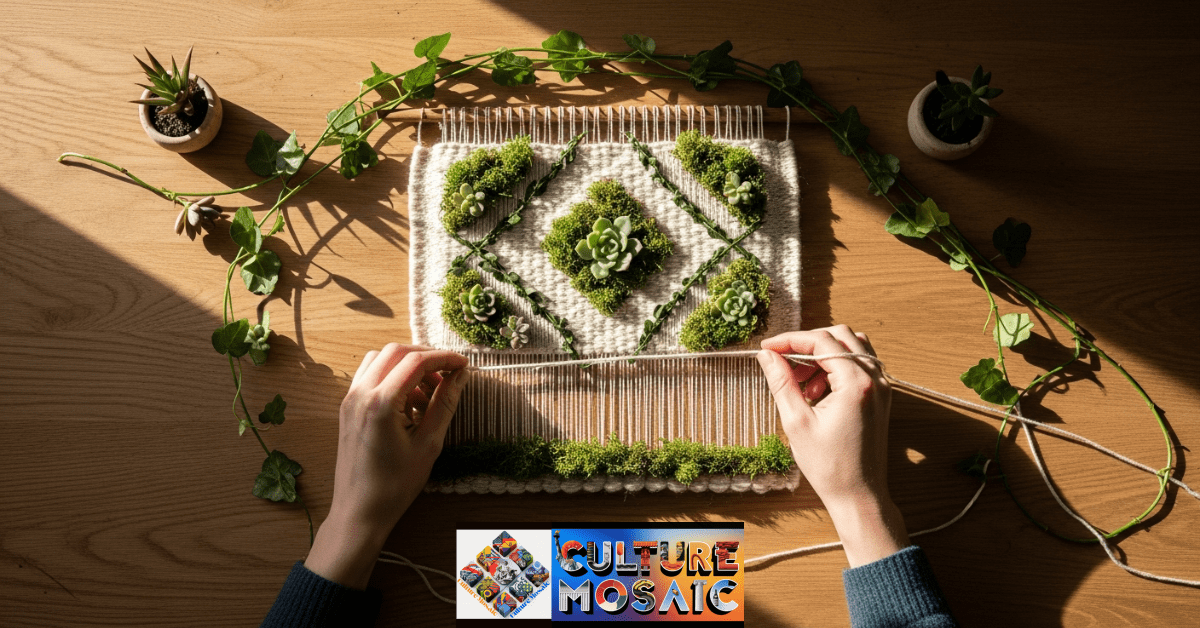
I’ve been noticing something lately. Walk through any design-forward café or gallery space, and you’ll spot it: traditional embroidery patterns filled with actual moss. Carved wooden frames hosting living air plants. Old folk motifs reimagined with materials that are still, well, alive.
This is biophilic folk art aesthetics, and it’s turning our understanding of traditional craft completely on its head.
What Actually Is This Thing?
Let me paint you a picture. Remember your grandmother’s embroidered tablecloth with those beautiful flower patterns? Now imagine if those flowers were made from actual preserved wildflowers and moss, woven right into the fabric. That’s the basic idea—taking the folk art traditions our ancestors practiced and literally bringing them to life with natural, often living, materials.
It’s not just slapping some leaves on a canvas and calling it a day. Biophilic folk art aesthetics is about understanding that traditional folk artists always worked with nature, using what was around them. We’re just taking that principle further, incorporating living moss into Norwegian rosemaling patterns or creating Mexican folk art sunbursts from actual flower petals.
Why This Matters Now
Here’s the thing about 2026—we’re all drowning in screens, and something in us is screaming for tactile, real, growing things. The biophilia hypothesis suggests we’re literally wired to connect with nature. When you combine that deep human need with the cultural richness of folk traditions, something clicks.
I visited a studio last month where an artist was working on a piece inspired by Scandinavian rosemaling. But instead of just painting the traditional scrollwork, she was embedding preserved botanicals and moss within the actual carved grooves. When you got close, you could smell the beeswax she’d used to seal it. You could feel the texture of real bark beneath your fingers.
That’s what sets biophilic folk art aesthetics apart—it engages all your senses, not just your eyes.
The Cultural Roots Run Deep

This movement pulls from folk traditions worldwide, and each brings something unique:
Scandinavian influence shows up in those flowing floral motifs, but now artists might use the actual flowers depicted in traditional Norwegian rosemaling as their medium. I’ve seen pieces where delicate carved patterns become tiny planters for succulents.
Slavic heritage contributes those bold, geometric embroidery patterns—except now some artists are “stitching” with flexible willow branches instead of thread, creating three-dimensional works that blur the line between textile and sculpture.
Mediterranean traditions inform ceramic pieces where ancient Greek pottery patterns meet local clay, with native herbs planted directly in the vessels.
The important part? Artists aren’t just copying these traditions. They’re honoring them while pushing them forward, asking: “What would my ancestors do with today’s understanding of ecosystems and sustainability?”
Actually Making This Work in Your Space

Okay, so you’re interested. How do you bring biophilic folk art aesthetics into your actual living room without it looking like you hoarded craft supplies?
Start simple. One statement piece makes a bigger impact than cluttering every surface. I’ve got a friend who commissioned a living textile—basically a tapestry with traditional geometric patterns where some sections are filled with preserved moss. It hangs in her minimalist apartment against an exposed concrete wall, and the contrast is stunning. The industrial meets the organic, and somehow it just works.
If you’re feeling ambitious, consider what I call the “ancestral link” approach. Got family heirlooms gathering dust? That embroidered piece from your grandmother could become the backing for a vertical garden. Your grandfather’s carved wooden tools could be mounted among air plants. You’re honoring your personal heritage while celebrating ongoing growth.
The walls matter too. Earth-pigment paints—made from actual minerals and local materials—create this sense of place that regular paint just doesn’t. Something is grounding about knowing your wall color comes from clay dug from a riverbed nearby rather than a factory-mixed chemical blend.
The Sensory Experience Changes Everything
I need to emphasize this because it’s easy to miss in photos: biophilic folk art aesthetics is fundamentally multisensory.
Touch: Run your hands over raw wool that still carries the subtle scent of lanolin. Feel bark that’s rough and authentic, not sanded into sterile smoothness. This tactile connection is the same one our ancestors experienced when creating functional beauty from their surroundings.
Smell: Walk past a piece incorporating beeswax and pine resin, and suddenly you’re transported. These aren’t just materials—they’re aromatic time capsules carrying olfactory memory.
Sound: There’s something meditative about craft sounds. The rhythmic clack of a loom, wood yielding to a carving knife, a potter’s wheel spinning steadily. Artists are actually recording these sounds now, sharing them as sonic meditations that ground us in thousands of years of human creativity.
Materials: What You’re Actually Working With

Let’s get practical. What materials define biophilic folk art aesthetics?
Living elements: Preserved moss is a game-changer—it maintains color and texture for years without any watering. Air plants (those trendy Tillandsia you see everywhere) need just weekly misting and can be incorporated into three-dimensional work. Some adventurous artists are even growing mycelium into specific shapes for sculptural pieces.
Preserved natural materials: Properly treated dried flowers, seed pods, bark, and leaves maintain their beauty indefinitely. This lets you work seasonal materials into permanent artwork.
Traditional techniques as foundation: Weaving, embroidery, woodcarving, pottery, painting—these remain the structural backbone. The innovation comes from what materials you use and what gets incorporated into the final piece.
The Wellness Angle (Because Of Course There Is One)
I was skeptical about wellness claims at first, but the research is actually solid. Exposure to nature—even indirect exposure through imagery—measurably reduces stress. Biophilic folk art aesthetics amplifies these benefits because you’re not just looking at a picture of nature; you’re physically interacting with natural materials.
Working with natural materials engages different cognitive processes than scrolling through Instagram. Wood grain is irregular. Plant forms vary. These variations require presence and adaptation, which naturally support mindfulness without the forced “be mindful!” pressure.
Plus, if you incorporate living plants, you’re literally improving air quality. Natural materials like wool and wood improve acoustic properties. There’s genuine temperature regulation from materials with natural insulating properties. Your space actually functions differently.
Want to Try It Yourself?
You don’t need art school credentials to explore biophilic folk art aesthetics. Honestly, the movement welcomes experimentation.
Start by collecting during walks. That interesting piece of bark? Keep it. Beautiful leaves? Press them. Seed pods? Add them to your growing palette. Experiment with simple preservation techniques—pressing flowers between book pages still works perfectly.
Then combine these materials with basic techniques you already know. Can you embroider? Try incorporating pressed flowers between your stitches. Can you arrange things in frames? Create a collage mixing traditional folk motifs cut from fabric with your foraged materials.
A word about cultural respect: If you’re drawing from folk traditions outside your heritage, do your homework. Understand which patterns carry sacred meaning versus which are purely decorative. When uncertain, let nature itself be your primary inspiration rather than appropriating specific cultural symbols.
Where This Movement Is Heading
As we move through 2026, biophilic folk art aesthetics keep evolving. Artists are experimenting with increasingly sophisticated ways to integrate living systems into artwork. I recently heard about a gallery hosting an exhibition in an actual greenhouse environment where the art changes as the plants grow.
Commercial spaces are commissioning pieces that function as both art and air purification. Community gardens are hosting folk art workshops where participants create using materials harvested on-site. The movement is democratizing—you don’t need expensive supplies when you can forage responsibly.
The broader alignment with regenerative design thinking matters too. We’re moving beyond sustainability (merely maintaining) toward restoration. Art that literally grows over time, that sequesters carbon through living plants, that provides habitat for beneficial insects—this represents regenerative principles in action.
The Questions Everyone Asks
What if I kill the living parts?
Start with preserved moss—it requires zero maintenance. If you want truly living elements, air plants are nearly indestructible with just weekly misting.
Isn’t this just… crafts?
The distinction between “craft” and “art” has always been artificial. Biophilic folk art aesthetics embraces both labels proudly. It’s functional beauty, just like folk art has always been.
Where do I even source these materials ethically?
Never take more than 10% from any wild location. Avoid rare species entirely. Prefer invasive plants when possible. Better yet, grow materials specifically for your work. Many artists maintain small gardens just for harvesting.
Will this work in my tiny apartment?
Absolutely. Small embroidery hoops with pressed flowers, miniature living wreaths, and single specimen displays—these provide the same nature connection benefits without requiring square footage.
Coming Full Circle
Here’s what strikes me most about biophilic folk art aesthetics: it’s simultaneously ancient and completely new. Our ancestors worked with what surrounded them because they had to. We’re choosing to work with what surrounds us because we need to—psychologically, emotionally, and environmentally.
There’s something profound about holding a piece of moss in your hands and thinking about the countless creators before you who also looked to the natural world for inspiration and material. Then pressing that moss into a traditional pattern and watching it become something your ancestors couldn’t have imagined but would absolutely recognize.
You don’t need to dive in completely. Start with one leaf. One pattern that speaks to your heritage or simply appeals to your eye. Let nature guide your hands the way it guided our predecessors.
The future of art is growing—and I mean that literally. In a world of digital everything, there’s something revolutionary about creating beauty that breathes, changes, ages, and lives. That’s biophilic folk art aesthetics in a nutshell: tradition meeting life itself, right in your hands.