
 By Culture Expert
Walk into a big shop in November and the Christmas aisle looks the same in every country. Same red. Same plastic. Same glitter shedding onto the carpet. I find that quietly sad, because somewhere along the way the things people once made by hand, from local straw or scrap tin or a winter’s worth of patience, were swapped for things nobody really made at all.
Christmas folk art traditions push back against that. They are still alive, still practised, and in a few places still fiercely competitive. Below is a tour of Christmas art around the world, minus the glitter, with the reasons each piece looks the way it does. If you want the wider map of customs first, our guide to Global Christmas Customs is the place to start. Here the focus is narrower: hands, materials, meaning. We cover that kind of story all year at Culture Mosaic, but objects say things that customs alone cannot.
What Counts as Christmas Folk Art Traditions?
Four tests. It is handmade. It grew out of a community rather than a catalogue. It uses whatever was cheap and close at hand. And the maker can tell you why it looks like that. A gold plastic star fails all four. A straw spider passes without trying.
Much of what feels ancient is younger than people assume, because the Victorians tidied up a great deal of it. I’ve laid out that timeline in When Did Modern Christmas Traditions Begin. Folk art often predates the tidying, though, and quietly survives outside it.
Christmas Folk Art Traditions in Scandinavia: Straw, Paper and the Long Dark
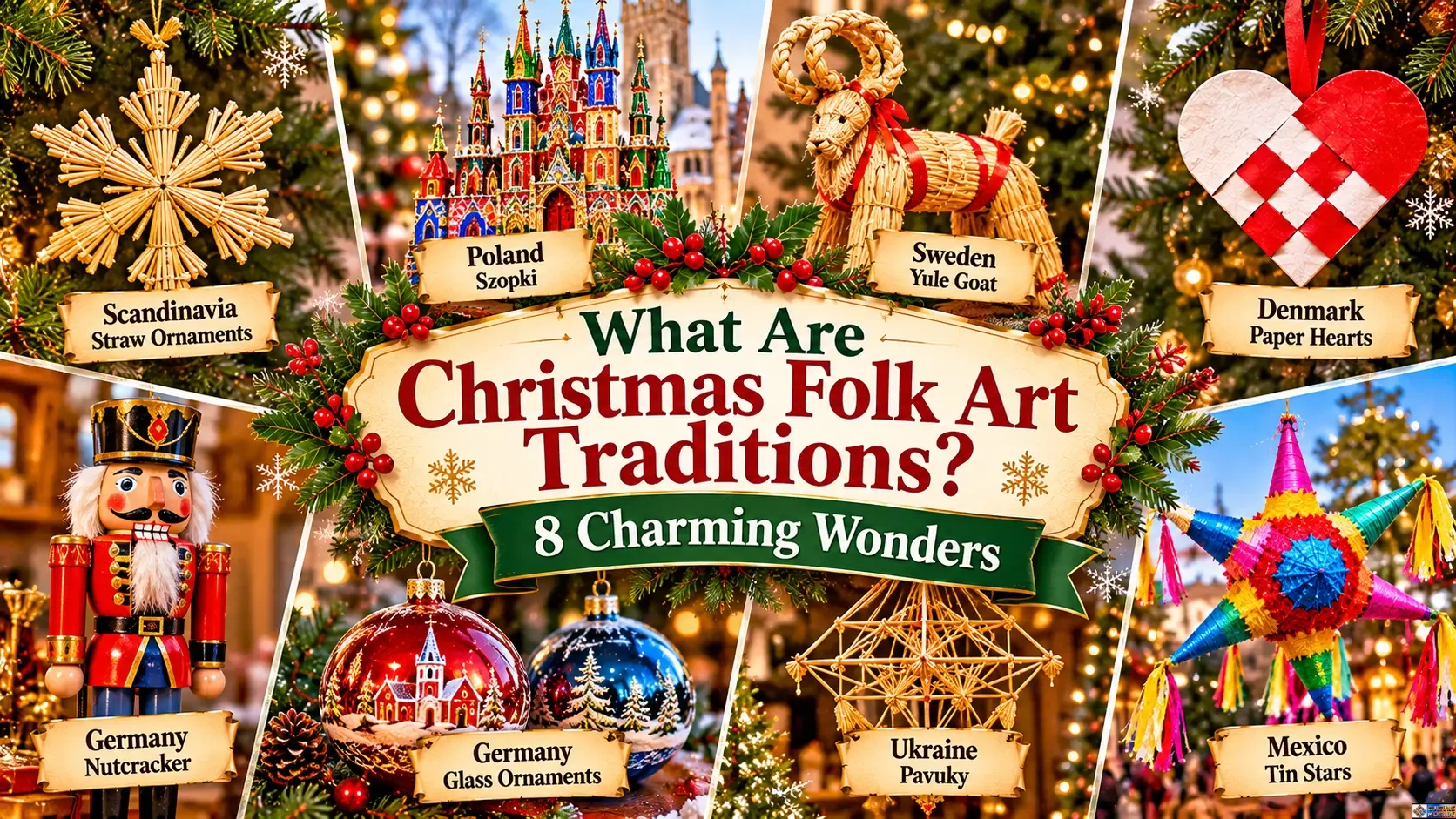
The Nordic winter is long and black, and the folk art answers it with what the farm had left: straw and paper. Sweden’s Yule goat, the julbock, is a straw figure bound with red ribbon. Folklore links the goat to older midwinter customs, although scholars still argue about the exact roots. The giant version in Gävle has stood in the town square since 1966, and it has been burned, kicked or otherwise wrecked on a depressingly regular basis. Possibly the toughest folk art review system in Europe.
In Denmark, children weave paper hearts (julehjerter) from two folded sheets, usually red and white, interlocked like a tiny basket. Tradition ties the first woven heart to Hans Christian Andersen, who cut paper shapes for the children he told stories to. I’d treat that as tradition rather than proven history.
Finland’s himmeli are the quiet masterpieces. Lengths of rye straw are threaded into geometric mobiles and hung over the dining table, where they turn in the warm air. Straw means harvest. A turning shape made of it says the harvest will come again.
Eastern Europe: Castles, Spiders and Straw
Polish Szopki Nativity Scenes
Kraków’s szopki look like castles because, in part, they are portraits of the city. From the 19th century, the city’s masons and carpenters, short of work in winter, built small nativities that borrow towers and spires from St Mary’s Basilica, Wawel Castle and the Cloth Hall. The Holy Family sits in the middle like a guest in a very ambitious building. Materials are humble: wood, card, coloured foil, tinfoil. UNESCO inscribed the tradition in 2018, and the city has run a competition beside the Mickiewicz monument since 1937. That makes it one of the finest examples of civic Christmas traditions in Europe.
Ukrainian Straw Christmas Ornaments (Pavuky)
Pavuky means spiders, and they are exactly that: mobiles of straw, paper, beads and thread hung above the table. The legend behind them tells of a poor widow with a bare Christmas tree, and of spiders that spun webs across it overnight. At sunrise the threads turned to silver and gold. Spiders, in this story, are luck. Of all the Christmas folk art traditions I know, this is the one that most rewards a slow look. Fine, pale straw segments are strung into diamonds and stars, then left to sway at the slightest breath. It is the sort of craft that makes you speak more quietly around it.
Christmas Folk Art Traditions in Germany and Austria: Wood, Glass and Candlelight
Germany’s Ore Mountains (the Erzgebirge) lost their silver-mining livelihoods and turned to the lathe. The town of Seiffen became a toy-making centre, and the region gave Christmas its carved pyramids, incense smokers, candle arches shaped like mine entrances, and the nutcracker. I think the nutcracker is the most misunderstood object in this whole guide. It is not a toy for children. It is a stern figure, a soldier or king or miner, built to crack hard things, and that mattered to a region that had spent centuries underground. The full story is in the FAQ below.
Then there is glass. In Lauscha, in Thuringia, local tradition credits the glassblower Hans Greiner with making glass fruit and nuts around 1847 for families who could not afford the real thing. How are traditional glass ornaments made? A blower heats a hollow glass tube over a flame, then blows the molten glass into a metal or clay mould. The inside is silvered with a reflective solution, then lacquered and painted by hand. The thinness is the whole trick. Hold one and you realise how little stands between it and the floor.
Further south, Tyrol and Bavaria carry their own tradition of carved nativity figures, and Alpine families still add to their crib scenes year after year.
Mexico and the Philippines: Tin Stars and Paper Lanterns
These two sit together for a reason. Both were Spanish colonies linked by the Manila galleons, and both inherited Spanish habits of lantern-lit processions, then rebuilt them in local materials. The devotional calendar behind both belongs to a larger family of observances I cover in Religious Festivals in the World.
Mexican Tin Christmas Ornaments (Hojalata)
In Mexico, hojalata means tinplate. Craftspeople cut, punch and emboss thin sheets of it into stars, angels, birds and nativity figures, then paint them in saturated colours. Hold a punched star near a candle and the holes throw tiny lights across the wall. Oaxaca is the name most often attached to Mexican tin work. During the posadas, from 16 to 24 December, communities re-enact Mary and Joseph’s search for lodging. The seven-pointed star piñata is often explained as the seven deadly sins, though that reading is tradition rather than documented history.
Filipino Parol Star Lantern Craft
The word parol comes from the Spanish farol, lantern. The earliest versions were bamboo frames covered in thin paper and lit by a candle, carried to guide worshippers to the dawn Masses of Simbang Gabi. Today the city of San Fernando in Pampanga, which calls itself the Christmas Capital of the Philippines, stages a Giant Lantern Festival where steel-framed lanterns flash with rotating lights. The scale changed. The idea did not. A star to follow in the dark. Filipino communities around the world still hang parols in their windows each December, a theme I explore in multicultural Christmas traditions.
The United States: What Makes Pennsylvania Dutch Folk Art Distinct?
Start with the name. “Dutch” is a drift from Deutsch. German-speaking settlers arrived in Pennsylvania in the 17th and 18th centuries and kept decorating everyday things with bold tulips, stars, hearts and birds in strict, bright colour. What makes the style distinct is its confidence. Pattern beats realism. Faith and household sit side by side. You see it in fraktur, the illuminated birth and baptism certificates; in tin cookie cutters; and in the Belsnickel, a fur-clad gift-bringer who arrived long before the modern Santa.
Among American Christmas folk art traditions, the Moravians of Bethlehem, Pennsylvania, added the Christmas putz, a miniature landscape of moss, bark and tiny figures arranged beneath the tree, and the many-pointed Moravian star. For the wider American picture, see our round-up of the Best Christmas Celebrations in US. The same kitchens that cut those tin shapes produced the cookies in our guide to Top US Christmas Foods.
Christmas Art Around the World at a Glance
Here are the eight traditions in one place, numbered for easy reference. The caganer sits outside the count as a bonus.
| Tradition | Region | Main Material | Meaning | Where to See It |
|---|---|---|---|---|
| 1. Kraków szopki | Poland | Wood, card, foil | Nativity set inside the city’s skyline | Kraków Main Square, first Thursday of December |
| 2. Pavuky | Ukraine | Straw, thread, beads | Luck, via the spider-web legend | Ukrainian craft fairs and museums |
| 3. Julbock, julehjerter, himmeli | Sweden, Denmark, Finland | Straw, paper | Harvest luck and light in the dark | Nordic Christmas markets |
| 4. Nutcrackers and pyramids | Erzgebirge, Germany | Turned wood | Strength; mining heritage | Seiffen and German Christmas markets |
| 5. Lauscha glass baubles | Thuringia, Germany | Blown, silvered glass | Festive abundance on a small budget | Lauscha workshops |
| 6. Hojalata | Mexico | Punched tinplate | Light and protection | Oaxaca and Mexican craft markets |
| 7. Parol | Philippines | Bamboo, paper, steel | Guiding star to Simbang Gabi | San Fernando, Pampanga |
| 8. Putz and Moravian star | Pennsylvania, USA | Moss, bark, paper | Nativity landscape; star of Bethlehem | Bethlehem, Pennsylvania |
What These Christmas Folk Art Traditions Share
Line them up and a pattern jumps out. Every one turns a cheap local material into light, luck or story. Straw for the harvest. Tin for candle-glint. Paper for a lantern to carry in the dark. Most are made to hang, glow or throw light, which is hardly surprising when Christmas falls at the darkest point of the northern year. I’d go further: the strongest pieces are never the most expensive ones. They are the ones where the material is plainly doing the work.
Explore and Support Christmas Folk Art Traditions
You don’t need a plane ticket to start. In the UK, the V&A’s collections can be searched online, and Britain has folk decoration of its own. The kissing bough, a hoop of evergreens, ribbon, apples and candles, was a fixture in English homes before the Christmas tree caught on, a story picked up in our piece on historic Christmas traditions UK. For something to attend, browse Classic Christmas Themed Events.
Abroad, the Museum of Kraków holds a major szopki collection, and the Toy Museum in Seiffen follows the Ore Mountains story. If you want to buy, choose makers’ cooperatives, look for sellers verified under the World Fair Trade Organization’s Guarantee System (it is the scheme that covers handmade goods), and ask who made the piece. Prefer giving to collecting? Our guide to UK community Christmas initiatives shows where that energy goes locally.
Christmas Folk Art Traditions FAQ: 5 Common Questions
1. Why is straw used so much in European Christmas art?
Three reasons stack up. First, the nativity story places the infant in a manger, and a manger means straw. Second, straw is harvest made visible, so it carries ideas of grain, bread and luck for the coming year. In Poland and Ukraine, straw or hay is traditionally placed under the Christmas Eve tablecloth for exactly that reason. Third, it is practical: cheap, light, and easy to cut, thread and bend into shapes. Himmeli and pavuky are the best examples.
2. What is the story behind German nutcrackers?
Nutcrackers come from the Erzgebirge, where wood-turners in towns like Seiffen replaced declining mining income with toys and decorations. The figure is usually a soldier, king or miner, someone in authority who “cracks” hard things. Wilhelm Fuchtner of Seiffen is often credited with the lathe-turned form that spread from the 1870s. E.T.A. Hoffmann’s 1816 tale and Tchaikovsky’s 1892 ballet then tied the nutcracker to Christmas worldwide, and American soldiers carried many home after the Second World War.
3. Why do Polish Kraków szopki look like castles?
Because the makers built Kraków into the nativity. In the 19th century the city’s masons and carpenters made small crib scenes in winter, and they borrowed towers and spires from landmarks such as St Mary’s Basilica and Wawel Castle. The Holy Family sits inside a miniature skyline, often several storeys high, covered in foil and colour. UNESCO added the tradition to its intangible heritage list in 2018.
4. How do you spot authentic handmade folk art?
Look for small irregularities. Hand-cut tin has slightly uneven punch marks, hand-woven straw has varied tension, hand-painted glass shows brushwork. Ask who made it and where. A real maker or cooperative can name themselves, their workshop and their method. Check that the material matches the claim, since straw should smell of straw. Finally, be wary of rock-bottom prices: hours of labour cost real money, and a price far below that usually means a factory made it.
5. Which folk crafts are easiest to make at home?
The friendliest starting points are Danish woven paper hearts, which need two folded sheets and ten minutes, and simple himmeli made from paper straws and thread. Basic pavuky, using cut straw segments on a long thread, are also manageable. Leave the szopka and blown glass to trained makers. Starting small is no insult to the tradition. It is how most of these crafts were passed on in the first place: a child at a kitchen table, copying an elder.
One Last Thought
People have always made things for midwinter. Not because they had to, and rarely because anyone paid them, but because the dark asks for an answer. Straw, tin, paper, glass. A candle behind a punched hole. I keep coming back to how modest the materials are and how large the intention. Somewhere tonight a person is threading straw into a spider, and the web will outlast the evening.
 Dr. Julian Thorne