Dr. Catherine Moreau
Medieval Art Historian & Lecturer
Dr. Catherine Moreau is a medieval art historian and lecturer specialising in Gothic visual culture, sacred architecture, and the iconographic programmes of high medieval France and England. She holds a PhD from the Courtauld Institute of Art and has published widely on the theology of stained glass and the structural logic of Gothic cathedral design. Her work sits at the intersection of architectural engineering and devotional purpose.
Sovereign Light and Soaring Stone: What Is Gothic Art and Architecture?
To step inside a high medieval cathedral is to experience a deliberate, calculated suspension of gravity. The Romanesque churches that came before were stout, heavy, fortress-like sanctuaries — thick walls, dim light, the world shut firmly out. The cathedrals of the High Middle Ages did something else entirely. They reached upward. And then they let the sky in.
But what is Gothic art and architecture, and why does it represent one of the most remarkable design revolutions in human history?
To understand it properly, we need to look past the modern pop-culture association with darkness and melancholy. In its genuine medieval context, Gothic design was an architecture of radiant light, hyper-advanced geometry, and a kind of structural optimism that still feels audacious eight hundred years later. This guide traces the historic genesis of the style, breaks down its mechanical secrets, and explores how its art and engineering worked in tandem to construct, quite literally, heaven on earth.
The Birth of a Style: Where Did What Is Gothic Art and Architecture Begin?

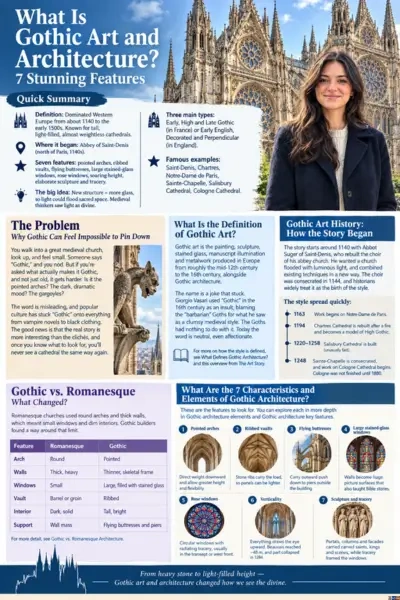
The Gothic style did not emerge from a grand manifesto. It grew out of a single, radical building project in the Ile-de-France region north of Paris, at the royal abbey of Saint-Denis.
In the 1130s, Abbot Suger was determined to rebuild his crumbling abbey church. He was not an engineer. He was a theologian and a politician — deeply literate, extraordinarily well-connected, and consumed by one central idea: that the beauty of the material world could function as a ladder to the divine. Physical light, he believed, was the closest earthly analogue to God’s own presence. His building programme, completed around 1144, became the world’s first Gothic structure.
By combining pointed arches, ribbed stone vaults, and large window openings into a single, unified design, Suger and his masons created something qualitatively new. The dark, fortress-like Romanesque sanctuary was suddenly flooded with coloured light. The building felt different. It felt, to its medieval congregation, like a genuine threshold between the earthly and the eternal.
The term ‘Gothic’ itself arrived later, and not kindly. The Italian Renaissance writer Giorgio Vasari coined it in the 16th century as a deliberate insult, attributing the medieval style to the Goths — the Germanic tribes who, in his view, had helped destroy classical Roman civilisation. The label stuck, long after the contempt behind it had faded.
The Physics of the Heavens: Gothic Engineering and What Is Gothic Architecture

Understanding what is Gothic art and architecture means recognising it, first and foremost, as a triumph of structural physics. The central challenge facing all medieval builders was gravity. Romanesque architects used semicircular arches, which distributed weight both downward and outward. That lateral thrust required incredibly thick walls to resist the arch collapsing sideways — which limited both height and window size.
The Gothic style solved this through three interlocked innovations.
The Pointed Arch
The pointed arch is the fundamental building block of Gothic architecture. By narrowing the crown of the curve, the vector of force is directed far more vertically than in a semicircular arch. Less horizontal thrust means less need for thick, heavy walls. The entire building can rise higher, and the walls can be opened up to light. It sounds simple. The structural consequences were revolutionary.
The Ribbed Vault
Rather than covering ceilings with heavy, solid barrel vaults, Gothic master masons invented the ribbed vault. By crossing pointed diagonal arches to form a skeletal stone framework, they created webbed vaults that were lightweight yet structurally formidable. Crucially, the weight of the roof was no longer spread evenly along every inch of the wall. It was funnelled downward into specific, localised points of support: the columns.
The Flying Buttress and Its Definition
Once roof loads were concentrated into specific columns, Gothic engineers needed a way to support those columns from the outside. Their solution — the flying buttress — is one of the most visually distinctive elements in architectural history.
A flying buttress is an exterior masonry arch that springs from the upper section of a cathedral wall and curves downward to a massive detached stone pier. This structural circuit diverted lateral wind loads and ceiling weight away from the cathedral’s core and safely into the ground. By externalising the support skeleton, masons liberated the main walls from their load-bearing role entirely. Walls were no longer structural barriers. They became thin, non-load-bearing skins of glass.
The flying buttress did not merely hold the cathedral up. It set the interior free.
By externalizing the structural support skeleton, medieval master masons freed interior walls from bearing heavy loads. Stone barriers were dissolved, giving birth to sweeping fields of holy stained glass.
Lux Nova: The Stained Glass Windows History and the Theology of Light
In the Gothic theological imagination, light was not merely a physical phenomenon. It was the closest material manifestation of God. This framework, articulated most powerfully by Abbot Suger, drew heavily on the writings of the 5th-century mystic Pseudo-Dionysius the Areopagite, who described divine light as the source of all beauty and truth.
By replacing solid stone walls with soaring stained glass windows, Gothic builders bathed their interiors in an ever-shifting kaleidoscope of saturated blues, deep reds, and shimmering golds. These windows did not merely let in light; they filtered and transformed it, signalling to medieval worshippers that they had left the mundane world and entered a celestial space.
“ “The dull mind rises to truth through that which is material, and, in seeing this light, is resurrected from its former submersion.” ”
The glass also functioned as a silent sermon. In a world where the vast majority of the congregation was illiterate, stained glass windows acted as highly detailed visual narratives depicting biblical stories, the lives of saints, and the histories of local guilds who funded the glasswork. Every pane was a page of theology made visible.
The technical achievement was considerable. Medieval glaziers ground metal oxides — cobalt for blue, copper for green, manganese for purple — into molten glass to create their colour. Lead came strips held the individual pieces together into larger compositions, their dark lines becoming part of the design rather than a constraint on it. The famous Bible Windows at Chartres Cathedral represent perhaps the finest surviving example of this tradition anywhere in the world.
Humanising the Divine: Gothic Art, Sculpture, and the Turn Toward Naturalism

While Gothic architecture soared toward the abstract, Gothic figurative art underwent a parallel, profound shift toward naturalism and human emotion. This evolution is most vividly visible in cathedral portals and sculptural programmes.
Romanesque sculpture treated the human figure as a symbol rather than an entity. Figures were flat, elongated, frontally rigid, and carved directly into the surface of columns. They communicated otherworldly judgment and divine authority. A Romanesque Christ was an icon of power — remote, geometrically perfect, barely human.
Gothic sculptors did something different. Their figures physically stepped forward from their columns. Drapery folded naturally around knees and hips. Weight shifted in classical contrapposto. Expressions softened to reveal grief, tenderness, and mercy. The Virgin Mary, who had been a formal, enthroned Queen of Heaven in Romanesque art, became in the Gothic era a young mother, her body inclining gently toward her child. She began, visually and emotionally, to resemble an actual person.
This naturalism extended outward into illuminated manuscripts and devotional panel paintings. The introduction of elegant looping borders, organic leaf patterns, and delicate gold-leaf backdrops reflected a growing theological conviction that the physical world — having been created by God — was beautiful, and therefore worthy of precise, attentive, realistic artistic study.
How to Distinguish the Eras: A Timeline of What Is Gothic Art and Architecture

Gothic design was not static. It evolved continuously across a span of roughly three centuries, shifting in ambition, decorative complexity, and regional character. When visiting European historic sites, these transitions are legible once you know what to look for.
- Early Gothic (c. 1140–1190). Retains some heavy Romanesque elements. Look for four-tiered wall elevations — nave arcade, gallery, triforium, and clerestory — and six-part ribbed vaulting. Structures feel ambitious but still earthbound.
- High Gothic (c. 1190–1230). The classic soaring height. Masons simplified interior elevations to three tiers and opened enormous clerestory stained glass windows. Chartres Cathedral is the canonical example.
- Rayonnant Gothic (c. 1230–1350). Characterised by radiant geometric rose windows and delicate stone tracery. The structural logic was pushed to its limit: stone becomes almost invisible behind glass. The Sainte-Chapelle in Paris, completed in 1248, is the definitive achievement of this phase.
- Flamboyant/Perpendicular Gothic (c. 1350–1500). Sinuous, flame-like window tracery in France (Flamboyant) or a dense grid of vertical panels and extraordinary fan vaults in England (Perpendicular). The latter reaches its apotheosis in King’s College Chapel, Cambridge.
Pointed Arches vs Semicircular: The Structural Argument That Changed Everything
The comparison between pointed arches and semicircular arches is not merely aesthetic. It is structural and mathematical. To grasp why this geometric shift mattered so profoundly, we need to follow the physics.
Every arch supporting a load generates two forces at its springing points — the places where it meets the supporting wall. The first is vertical, and the wall or column simply carries it downward into the ground. The second is horizontal, a lateral thrust that pushes outward and threatens to topple the supporting structure. In a Romanesque building, this horizontal thrust is substantial, and the only way to resist it is with massive, thick masonry. The wall itself must be heavy enough to stay put.
The critical measurement is the rise-to-span ratio of the arch — the relationship between how tall the arch is and how wide it spans. For a semicircular arch, this ratio is geometrically fixed:
r / s = 0.5 (semicircular arch — fixed)
The rise (r) can be no more than half the span (s). This immovable geometric constraint directly determines the lateral thrust (H) at the springing point. When we model the horizontal force exerted by an arch carrying a total load (W) across a span (s) with a rise (r), the relationship is approximately:
H = ( W * s ) / ( 8 * r )
For a semicircular arch, substituting r = s/2 gives:
H = ( W * s ) / ( 8 * s/2 ) = W / 4
A pointed arch breaks the geometric constraint on the rise. Builders could increase r relative to s by sharpening the point — effectively ‘stretching’ the arch vertically. In the extreme case of a very steeply pointed arch:
r / s > 0.5 (pointed arch — adjustable)
As r increases, the denominator (8 * r) in our thrust equation grows, and H decreases. A steeply pointed Gothic arch can reduce lateral thrust by thirty to fifty percent compared to a Romanesque semicircular arch of the same span. That is not an incremental improvement. It is a structural transformation.
The walls no longer need to be fortresses. They can be screens. And if they are screens, they can be filled with glass.
“ “Changing the angle of a single curve reduced lateral thrust by half — and transformed the interior of Western architecture for three hundred years.”
Romanesque builders were trapped by the geometry of the semicircle, which forced massive structural weight outward against support walls. By tapering the crown, Gothic architects unlocked vertical vectors that allowed stone boundaries to melt away into towering panes of light.
Architectural Preset Models
Interactive Thrust Vector Analysis
Drag the ratio controller below to point the arch and observe the structural load distribution
Ribbed Vaulting Engineering: The Stone Skeleton Above Your Head
Ribbed vaulting engineering is, in some ways, the Gothic revolution made architectural rather than decorative. The ribs were not ornamental additions to an existing ceiling. They were the ceiling’s load-bearing skeleton, and everything else — the infill panels between them, called webs or severies — was secondary.
The practical genius of the ribbed vault lay in its construction process. Medieval builders could erect the stone ribs first, using temporary wooden centring, and then fill in the much lighter panels between them. This phased approach made it possible to vault enormous spans without keeping the entire formwork in place for months or years. Speed, in a building project that might span multiple generations, was not a trivial consideration.
Structurally, the ribs channelled the weight of the vault down to specific points — the column capitals — rather than distributing it evenly along the wall surface. This is the direct structural precondition for the flying buttress. Without the ribbed vault concentrating loads, there would be no specific points to buttress.
Gothic Cathedral Features: A Field Guide to Reading Medieval Buildings
Understanding gothic cathedral features transforms a visit from passive appreciation to active reading. These buildings are legible, once you have the vocabulary.
- The West Front. The main ceremonial facade, typically featuring three portals — a large central one flanked by two smaller — above which sits a great rose window. The sculptural programme of the portals is typically elaborate and theologically complex, presenting a compressed visual summary of Christian salvation history.
- The Nave. The central longitudinal space of the interior, lined with columns and rising through multiple wall tiers to the vault above. In High Gothic buildings, the nave elevation typically shows three tiers: arcade, triforium, and clerestory.
- The Choir and Apse. The eastern end of the church, reserved for the clergy. The apse is the rounded, projecting end of the choir, often surrounded by an ambulatory and radiating chapels dedicated to individual saints.
- The Triforium. A narrow gallery at the middle height of the interior wall, between the nave arcade and the clerestory. In Rayonnant Gothic buildings, the triforium was glazed, turning it from a dark passage into another source of light.
- The Clerestory. The upper row of windows running along the nave above the triforium. In High Gothic cathedrals these dominate the interior luminosity and are the largest windows in the building.
Medieval Gothic Masterpieces: Five Buildings That Define the Style
The Gothic revolution began in northern France but radiated rapidly outward to England, Germany, Spain, and Italy, acquiring distinct regional characteristics wherever it landed. These five buildings represent the range and ambition of what is Gothic art and architecture at its most uncompromising.
- Basilica of Saint-Denis, France. The birthplace. Abbot Suger’s choir of 1144 combined pointed arches, ribbed vaults, and stained glass for the first time in a unified design. Every subsequent Gothic cathedral is, in a structural and conceptual sense, its descendant.
- Chartres Cathedral, France. The zenith of High Gothic. Its two surviving spires from different centuries bracket a west front of extraordinary sculptural richness. Its 13th-century stained glass — nearly intact, roughly 2,600 square metres of it — remains the largest and best-preserved medieval glazing programme in the world.
- Notre-Dame de Paris, France. Famous for its early-Gothic facade, its double-span flying buttresses, and its spectacular rose windows. Its partial destruction in the fire of 2019 and subsequent restoration have, paradoxically, renewed global attention to the technical virtuosity required to build and maintain these structures.
- Salisbury Cathedral, England. A masterpiece of the Early English Gothic style. Its spire, at 123 metres, remains the tallest in Britain. Its interior is characterised by a distinctively English taste for dark Purbeck marble shafting against pale limestone.
- Cologne Cathedral, Germany. Begun in 1248, not completed until 1880. For a brief period after completion it was the tallest structure on earth. Its facade is a feat of almost obsessive verticality, and its survival largely intact through two world wars is, in itself, close to miraculous.
Romanesque vs Gothic: The Contrast That Clarifies What Is Gothic Art and Architecture
The most efficient way to understand what is Gothic art and architecture is to place it directly against what it replaced. The table below maps the principal differences across seven structural and visual categories.
The Architecture of Transition
A direct structural comparison charting the evolutionary leap from the mass and enclosure of the Romanesque to the skeletal framework and luminosity of the Gothic style.
H2: Beyond Stone: What Is Gothic Art in Manuscripts, Panel Painting, and the Minor Arts
The Gothic revolution did not confine itself to buildings. It infused every medium it touched with the same formal qualities: verticality, linearity, a new attentiveness to natural form, and an intensified emotional directness.
The Illuminator
Working on delicate calfskin vellum, the painter utilizes rare ground minerals—cobalt, lapis lazuli, and beaten gold leaf—to confine cosmic truths within micro-tracery frames.
“In the Gothic workshop, the illuminator and the mason were solving the same problem — how to make the sacred feel immediate, physical, and unmistakably present.”
The Mason
Manipulating colossal limestone blocks and tracing geometry onto the lodge floor, the builder balances tons of dynamic structural gravity, converting mathematical curves into stone screens.
In illuminated manuscript production, the 13th and 14th centuries saw the emergence of the Court Style — delicate, elongated figures set against punched gold grounds, framed within architectural canopies that mirrored the tracery of contemporary stained glass windows. The Psalter of Saint Louis, produced around 1270 for King Louis IX of France, is one of the supreme examples of this tradition. The figures have the same attenuated grace you see in cathedral portal sculpture, the same slightly swaying posture, the same quality of divine courtesy.
Gothic panel painting, particularly in Italy, began to move away from the rigid, hierarchical formality of the Byzantine tradition toward something warmer and more spatially aware. The 13th-century Florentine painter Cimabue and, decisively, his successor Giotto di Bondone introduced figures with genuine physical weight, emotional expressiveness, and a nascent sense of three-dimensional space. Giotto’s Arena Chapel frescoes in Padua, completed around 1305, are widely regarded as the point where medieval Gothic art begins to tip irrevocably toward the Renaissance. You can feel the difference the moment you walk in: the sky is blue, not gold, and the grief on the faces of the mourners around the dead Christ is real grief, not liturgical gesture.
The minor arts — ivory carvings, embroidered vestments, enamelled reliquaries, and metalwork — also participated fully in the Gothic transformation. The same formal elegance, the same elongated grace and emotional refinement that characterised cathedral sculpture appeared in objects small enough to hold in one hand. Gothic ivories carved in Paris in the late 13th century are among the most exquisite small-scale sculptural objects ever made in Western art.
The English Tradition: What Is Gothic Art and Architecture in Britain
England’s version of what is Gothic art and architecture diverged significantly from the French model almost from the start, and the divergence tells us something interesting about how deeply architectural style is shaped by local culture, climate, and building patronage.
“ “Where French Gothic dissolved the wall into light, English Gothic lengthened the building into landscape.”
In northern France, the cathedral was a structural crusade toward the sky. Its height-to-width ratio often exceeded $3:1$, aiming to replace stone with pure illumination. In England, builders favored sprawling horizontal lengths of up to $170\text{m}$, letting their cathedrals stretch quietly across open grassy lawns called closes.
Comparative Design Logic
Vertical vs. Horizontal ProportionsWhere French Gothic prioritised soaring height and the dissolution of the wall into glass, English Gothic preferred horizontal length. English cathedrals — Durham, Salisbury, Lincoln, Canterbury — are long, low by French standards, and typically set within spacious cathedral closes rather than rising dramatically above a dense urban fabric. The English also retained a taste for thick walls, decorative dark stone detailing, and elaborate surface patterning that would have struck a French master mason as architecturally conservative.
The most distinctively English contribution to Gothic architecture is the Perpendicular style, which developed in the late 14th century and produced one of the most astonishing structural achievements in the history of building: the fan vault. In a fan vault, the ribbed vaulting that had been a structurally rational system in French Gothic became an almost riotously decorative one — an inverted stone forest of spreading concave cones, each one a geometric marvel. The fan vaults of King’s College Chapel, Cambridge, completed in 1515, and Henry VII’s Lady Chapel at Westminster Abbey remain among the most breathtaking interior spaces in Europe. They feel less like architecture and more like lacework made permanent in stone.
English Gothic also developed a rich tradition of painted wooden screens — rood screens, choir screens, parclose screens — that divided the interior liturgical spaces in ways that French Gothic rarely attempted. These have mostly been lost, but where they survive, as at Exeter Cathedral, they add a warm, intimate human scale to what might otherwise be an overwhelming spatial experience.
The Living Legacy: Why Understanding What Is Gothic Art and Architecture Still Matters
Gothic architecture never truly died. It was superseded, then ridiculed, then rediscovered, then revived with near-religious fervour. The Gothic Revival of the 18th and 19th centuries — driven in Britain by architects like Augustus Pugin and George Gilbert Scott, and in America by Richard Upjohn and James Renwick — produced some of the most iconic buildings on both sides of the Atlantic. The Palace of Westminster, the Natural History Museum in London, St Patrick’s Cathedral in New York: all are Gothic Revival buildings, their pointed arches and flying buttresses consciously referencing the medieval tradition.
Understanding what is Gothic art and architecture matters because these buildings are not historical relics. They are still in use, still actively maintained, and still generating emotional responses in people who have no formal training in architectural history. Salisbury Cathedral is still an active place of worship. Chartres still attracts hundreds of thousands of visitors per year. Notre-Dame de Paris, partially destroyed and now under reconstruction, sparked an international outpouring of grief that revealed just how deeply these structures are embedded in collective cultural memory.
We built them to reach heaven. Eight centuries later, they still make us look up.
Frequently Asked Questions About Gothic Art & Architecture
Delve deeper into the structural mechanics, historical lineages, and metaphysical dimensions that built the high medieval world.
Q$1$
What Is the Origin of Gothic Art and Architecture?
The Gothic style originated in northern France around $1144$, when Abbot Suger of Saint-Denis completed the reconstruction of the abbey choir, combining pointed arches, ribbed vaults, and stained glass into a unified design for the first time. The term ‘Gothic’ itself was coined later, during the Italian Renaissance, as a derogatory term attributing the style to the Goths who had helped bring down classical Roman civilisation. It was Giorgio Vasari’s insult that stuck.
- ✦ Begin with Abbot Suger’s own writings (De Administratione) for a primary-source account of his intentions and motivations.
- ✦ Visit Saint-Denis in context: its choir is qualitatively different in atmosphere from the Romanesque nave it adjoins — the contrast is instructive.
- ✦ Understand the theological framework of Lux Nova before examining the physical buildings — the theology illuminates the architecture.
- ✦ Trace the rapid dissemination of the style through the Île-de-France region in the two ($2$) decades after $1144$: Senlis, Noyon, Laon, Paris.
- ✦ Read John Harvey’s The Gothic World or Paul Frankl’s Gothic Architecture for solid scholarly overviews of the style’s development.
Q$2$
What Are the Main Features of Gothic Architecture?
The four ($4$) core structural features of Gothic architecture are: the pointed arch, which reduces lateral thrust and allows walls to be opened up; the ribbed vault, a lightweight skeletal stone ceiling that concentrates loads onto specific columns; the flying buttress, an exterior arch system that carries lateral loads away from the cathedral’s core; and large stained glass windows, which replace solid masonry with structured light. Every other characteristic of the style — verticality, luminosity, spatial drama — derives from these four ($4$) elements working together.
- ✦ Look up first: the vault type is the clearest single indicator of a building’s Gothic credentials and its period within the Gothic timeline.
- ✦ Examine the exterior buttressing: the presence and form of flying buttresses places the building precisely within the structural history of the style.
- ✦ Assess the window-to-wall ratio: the higher it is, the later and more developed the Gothic phase of the building.
- ✦ Identify the arch form at every scale: portal, nave arcade, triforium, window tracery. Pointed arches throughout indicate a fully committed Gothic building.
- ✦ Note the plan: French Gothic typically uses a chevet with ambulatory and radiating chapels; English Gothic more often has a square east end with a Lady Chapel projecting behind it.
Q$3$
What Is the Difference Between Romanesque and Gothic Architecture?
The fundamental difference is structural. Romanesque architecture relies on thick, load-bearing walls, semicircular arches, and heavy barrel or groin vaults. Gothic architecture replaces all three ($3$) with pointed arches, ribbed vaults, and flying buttresses, rendering thick walls structurally unnecessary. The visual consequences are dramatic: Romanesque interiors are low, dark, and heavy; Gothic interiors are tall, luminous, and, at their finest, weightless.
- ✦ Visit a building that incorporates both — Durham Cathedral’s nave (Romanesque) and its Galilee Chapel (Transitional) — to experience the shift in a single visit.
- ✦ Focus on the windows: the transformation from narrow Romanesque slits to Gothic fields of stained glass encapsulates the entire structural and theological difference.
- ✦ Examine the column profiles: Romanesque columns are typically heavy, cylindrical drums; Gothic piers are slender, compound clusters of shaft and moulding.
- ✦ Consider the emotional register: Romanesque interiors feel enclosed and fortress-like; Gothic interiors feel open, vertical, and aspirational.
- ✦ Study the Abbaye aux Hommes in Caen and Chartres Cathedral side by side as near-perfect specimens of each style.
Q$4$
Why Was Stained Glass So Important in Gothic Art?
Stained glass served simultaneously as structural element, theological statement, and educational tool. Structurally, the dissolution of the wall into glass was only possible because flying buttresses had made thick walls unnecessary — stained glass is, in this sense, the visible reward for the engineering of the flying buttress. Theologically, it embodied the Lux Nova doctrine: light filtered through coloured glass was understood as a physical analogue to divine illumination. Educationally, for a largely illiterate congregation, the narrative windows were the primary medium through which biblical and saintly stories were transmitted visually.
- ✦ Read windows from the bottom left upward and from left to right: this is the conventional narrative sequence in most medieval glazing programmes.
- ✦ Look for donor images in the lower register: guild members, bishops, and royal patrons were typically depicted in the lowest panels of windows they funded.
- ✦ Note the colour temperature: deep cobalt blue, achieved with cobalt oxide, was the signature colour of the great Gothic glaziers and remains the most technically demanding to produce.
- ✦ Examine the lead-line composition: in the finest windows, the lead came strips are structural elements of the design, not constraints on it.
- ✦ Compare the glass at Chartres (largely $13\text{th}$ century, saturated and jewel-like) with the glass at Canterbury (earlier, more narrative, more varied in quality) to understand the evolution of the medium.
Q$5$
Is Gothic Art the Same as the Goth Subculture?
No, and the confusion is worth clearing up. The medieval Gothic movement of the $12\text{th}$ to $15\text{th}$ centuries was an art of light, geometry, and religious devotion. Its aesthetic was aspirational and luminous. The modern Gothic subculture, which emerged from post-punk music scenes in Britain in the late $1970\text{s}$ and early $1980\text{s}$, drew its aesthetic vocabulary not from medieval Gothic art but from Gothic Revival literature of the $18\text{th}$ and $19\text{th}$ centuries — the novels of Horace Walpole, Ann Radcliffe, and Mary Shelley — which had appropriated Gothic imagery (ruins, crypts, pointed arches, moonlight) as scenery for stories about transgression, death, and the supernatural. The linguistic connection is real. The conceptual one is, to put it plainly, largely coincidental.
- ✦ Distinguish between three ($3$) distinct ‘Gothic’ traditions: medieval Gothic art ($1140$–$1500$), Gothic Revival literature and architecture ($1740$–$1900$), and modern Gothic subculture ($1978$–$\text{present}$).
- ✦ Read Horace Walpole’s The Castle of Otranto ($1764$) as the origin point of Gothic Revival literature’s aesthetic programme.
- ✦ Examine Augustus Pugin’s Contrasts ($1836$) to understand how the Gothic Revival used medieval architecture as a moral and social argument against industrial capitalism.
- ✦ Consider how Victorian Gothic Revival buildings — Westminster, the Rijksmuseum, Budapest Parliament — reused medieval formal vocabulary in entirely modern structural contexts.
- ✦ Approach the modern Gothic subculture on its own terms: its relationship to medieval Gothic is atmospheric and literary rather than art-historical.
Culture Mosaic • Art History & Architecture Series