
 By Culture Expert
Three years ago, I sat across from my 14-year-old daughter at dinner and realized I had no idea what was happening in her life. She was right there—physically present—but emotionally, she might as well have been on another planet. Her eyes stayed glued to her phone while I talked. My own phone sat beside my plate, lighting up every few minutes. We were eating together but existing in completely separate worlds.
That night changed everything. I’m a wellness coach who spends my days teaching other families about mindful living, yet somehow I’d let screens completely take over my own dinner table. The irony wasn’t lost on me. What started as one awkward experiment—putting our phones in a basket for just one meal—turned into the most important family ritual we’ve ever created.
This no-phone dinner guide comes from that personal journey and from working with over 200 families who’ve struggled with the same thing. I’m not going to pretend it’s easy or that your first attempt will be magical. Mine wasn’t. But I can promise you this: if you stick with it, you’ll remember why you wanted to have family dinners in the first place.
Why Your No-Phone Dinner Guide Starts With Understanding What You’ve Lost
Look, I get it. You’re busy. Everyone’s busy. Phones help us stay connected to work, friends, news, everything happening outside these four walls. Taking them away feels extreme, maybe even unnecessary.
But here’s what nobody talks about: we’re raising the first generation of kids who don’t know what undivided attention feels like. My daughter once told me she assumed everyone’s parents were always sort of listening but also doing other stuff. That gut-punch moment made me realize how normalized distraction had become in our home.
The research backs this up in ways that honestly scared me when I first dug into it. Harvard researchers found that teens who eat regular dinners with their families show dramatically lower rates of depression and anxiety. Sounds great, right? Except there’s a catch. The dinners only help when there’s actual engagement happening. Sitting together while everyone scrolls delivers almost zero benefit. You might as well eat in separate rooms.
Every no-phone dinner guide needs to start here, with the honest truth about what’s been lost. I watch parents in my practice describe their family dinners, and they use words like efficient or fine. Nobody says connected or meaningful. That should bother us more than it does.
Getting Your Family On Board Without Starting World War III

The Conversation That Changes Everything
Here’s how most no-phone dinner guide attempts crash and burn: parents announce the new rule at dinner, kids rebel, everyone’s miserable, the whole thing gets abandoned by week two. I’ve seen this exact pattern at least fifty times.
What works better? Vulnerability. Real, honest vulnerability about your own phone addiction. When I finally sat my family down—away from the dinner table, no phones out—I didn’t lecture. I confessed. I told them I’d realized I was checking my phone during conversations. That I couldn’t remember the last time I’d really listened to anyone’s full story. That I missed them even though we lived in the same house.
Then I asked if they’d noticed the same thing. My husband admitted he felt lonely at dinner sometimes. My daughter said she hated that we never just talked anymore. Once everyone acknowledged the problem existed, proposing a no-phone dinner guide didn’t feel like punishment. It felt like relief.
Frame it as a 30-day experiment, not a permanent life sentence. Tell them you’re struggling too and want to try something different together. Get their input on what day works best, what kind of food they’d enjoy, whether they want music playing. Making them collaborators instead of subjects completely changes the energy.
Picking Your Battle (And Your Day)
Don’t try to transform every meal overnight. That’s exhausting and sets you up to fail. Pick one dinner per week. Just one. I recommend Sunday nights because there’s something naturally reflective about Sundays—you’re wrapping up one week and looking ahead to the next.
But honestly? Choose whatever day actually works for your family’s schedule. If Wednesday is the only night everyone’s home together, Wednesday is your day. The no-phone dinner guide that actually succeeds is the one built around your real life, not some idealized version of family dinners.
Once you pick your day, protect it fiercely. Put it on the family calendar. Treat it like you’d treat any other important appointment. Because it is. You’re literally scheduling time to know your family.
The No-Phone Dinner Guide Protocol That Actually Works (Because I’ve Tested It)

After three years of refining this with my own family and tweaking it with clients, here’s what actually delivers results. Not perfect Instagram-worthy dinners, but real connection.
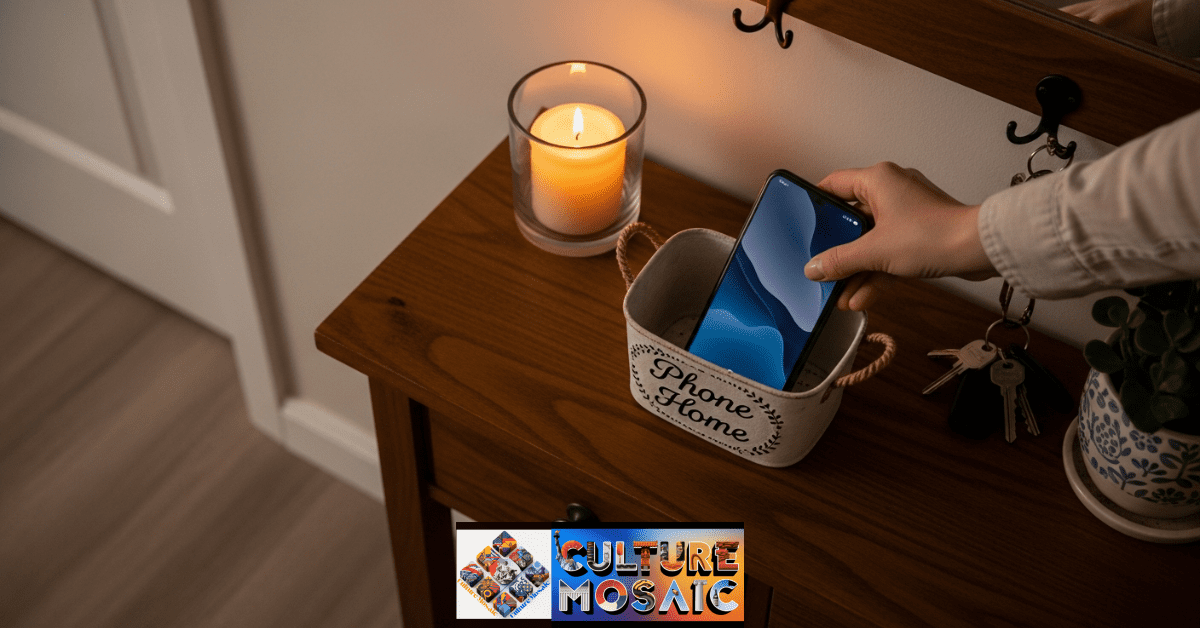
Step One: Create Your Phone Home. I keep a woven basket on our entry table. As people walk in the door—whether it’s family coming home or guests arriving—phones go in the basket. No negotiation, no just let me finish this text. The basket becomes a physical ritual, which matters more than you’d think. It signals the transition from the outside world to our intentional space.
Some families use fancy Faraday boxes that block signals. Others use a kitchen drawer. The container itself isn’t important. What matters is consistency and visibility. Everyone needs to see where phones live during dinner, and it needs to be the same spot every time.
Step Two: The Decompression Period. This is the part most no-phone dinner guide articles skip, and it’s crucial. Don’t go straight from arrival to sitting at the table. That transition is too abrupt. Your brain needs time to shift gears from work mode or school mode into present mode.
We spend 15 minutes just hanging out in the kitchen before dinner. Sometimes people help cook. Sometimes they pour drinks and snack on appetizers. The point is movement and casual conversation without the pressure of sitting down to a formal meal. This buffer zone makes everything that comes after feel more natural.
Step Three: Serve Family-Style, Always. I learned this one from my Italian neighbor: never plate individual servings. Put everything in bowls and platters in the middle of the table. Make people pass dishes to each other. This isn’t just about logistics.
When my daughter asks my husband to pass the potatoes, that’s a micro-connection. When someone offers to serve someone else’s plate, that’s care being expressed. When we’re debating whether the chicken needs more lemon, we’re engaging with the meal and each other. These tiny interactions add up. They keep hands busy and create natural reasons to interact.
Step Four: Stay Until It’s Actually Over. Phones stay in the basket until the meal is completely done. Not just eating, but the whole experience. Through dessert, through coffee, through that weird lull that happens after plates are cleared but nobody’s quite ready to leave the table yet.
That lull? That’s where the magic happens. That’s when my husband tells stories about his childhood. That’s when my daughter processes something that happened at school. That’s when we stop performing and start actually being together. Every no-phone dinner guide needs to emphasize this: don’t rush the ending.
What To Actually Talk About (Because Silence Freaks Everyone Out)
The biggest fear people have about starting a no-phone dinner guide? Running out of things to say. I felt this too. Turns out, we’re not bad at conversation—we’re just out of practice.
The Question That Saved Our Dinners
We do this thing called Rose, Thorn, and Highlight. Everyone shares the best part of their day (rose), the worst or most challenging part (thorn), and something that stood out—could be funny, weird, surprising, whatever (highlight).
Why does this work so well? Because it gives structure without being rigid. My daughter knows she’ll get to talk about her day, so she actually thinks about what to share. My husband, who’s naturally quiet, appreciates having a format. And the highlight category catches all the quirky little moments that would otherwise never get mentioned.
Some nights, someone’s thorn leads to a 20-minute conversation about how to handle a difficult situation. Other nights, we’re all laughing about the weird highlights. The point isn’t forcing deep conversation every time. The point is creating space for it to happen naturally.
Questions That Go Deeper Than How Was School?
I keep a running list of questions on index cards that we rotate through. Not every night, just when conversation needs a nudge. These work because they require actual thought:
· If you could go back and give your younger self one piece of advice, what would it be?
· What’s something you used to believe that you don’t believe anymore?
· If our family had a theme song, what should it be and why?
· What’s the most interesting thing you learned this week?
· If you could have dinner with anyone in history, what would you want to eat?
· What’s one thing you’re looking forward to in the next month?
Notice these aren’t yes-or-no questions. They can’t be answered with fine or nothing. Any solid no-phone dinner guide should include conversation prompts like these because they bypass the autopilot responses we’ve all trained ourselves to give.
The Power of Family Stories
Once you’re comfortable with the basics, start weaving in family history. My mom recently joined one of our Sunday dinners and told stories about my grandmother that I’d never heard. My daughter was riveted. She asked follow-up questions I didn’t even know to ask.
Kids need to know where they come from. They need to hear about the time great-grandpa immigrated with nothing. About how their parents met. About family traditions that have been passed down or maybe got lost somewhere along the way. These stories create identity and belonging in ways that nothing else can match.
When Your No-Phone Dinner Guide Meets Real Life (And How to Handle It)
Let me tell you about week three of our first attempt. My husband got called back to work for an emergency. My daughter complained that all her friends were at a party she was missing. I burned the main course. The whole thing felt like a disaster.
We almost quit. I’m being honest about this because the no-phone dinner guide path isn’t smooth. You’re going to hit obstacles. Here’s how to navigate the common ones without abandoning the whole thing.
The On-Call Problem
My husband’s a doctor. He can’t just ignore his phone for 90 minutes. Your situation might be different—maybe you’re a parent with a babysitter watching younger kids, or you’re expecting an important call, or you’re on call for work.
Build the exception into your system from day one. In our house, the rule is simple: if you need to check your phone, excuse yourself to another room. Handle whatever needs handling there. Come back when you’re done. We don’t stop the meal. We don’t all look down awkwardly. Life just continues.
What you’re teaching—and this is important—is that phones can exist in your life without dominating your dinner table. Most emergencies can wait 60 seconds while you step into the next room. The ones that can’t? Well, that’s why we built in the exception.
When Your Teenager Declares This The Dumbest Thing Ever
My daughter said exactly that in week two. She missed group chat banter. She felt left out of plans being made in real-time. She thought I was being unreasonable and controlling.
I didn’t argue. Instead, I asked her to help me understand what she was missing out on during that specific 90-minute window on Sunday nights. She pulled up her phone and showed me. It was memes and gossip and making plans for next weekend.
Then I asked if any of it would matter in a year. Would she remember that particular meme? Would those plans change if she responded 90 minutes later? She got quiet. Because the answer was no, and she knew it.
I told her I’d noticed how much I enjoyed actually talking to her during our no-phone dinners. That I’d learned things about her life I wouldn’t have otherwise known. That I missed her even though we lived together, and this was helping fix that.
She didn’t immediately cave. Teenagers don’t work that way. But she stopped fighting it quite so hard. And a few weeks later, she admitted it wasn’t as bad as she’d thought. Small victory, but I’ll take it. That’s how change happens with teens—slowly, grudgingly, and only when they feel respected rather than controlled.
The Silence That Makes Everyone Uncomfortable
About 30 minutes into your third or fourth no-phone dinner, this will happen: conversation dies. Nobody knows what to say. Someone shifts uncomfortably. The silence stretches out. Your hand will twitch toward your phone pocket even though your phone isn’t there.
Don’t panic. This is actually progress.
We’ve trained ourselves to fear boredom. Our brains have been conditioned to expect constant stimulation. What you’re experiencing in that silent moment is your nervous system recalibrating. You’re learning that you can survive a few minutes without input. Your family is learning the same thing.
I’ve watched this happen dozens of times. The family that pushes through the silence? They’re the ones who get to the deeper conversations. Because here’s what nobody tells you about implementing a no-phone dinner guide: the meaningful stuff often emerges after silence, not instead of it.
Sit with it. Let it be awkward. Maybe grab your conversation cards if the lull goes past five minutes. But don’t be afraid of quiet. Some of my favorite family moments have happened in the spaces between words.
Why This No-Phone Dinner Guide Actually Works (The Brain Science)
I’m not a neuroscientist, but I’ve read enough research to understand what’s happening in our brains during phone-free dinners. And honestly? It explains so much about why this practice feels so different.
Researchers at the University of Essex did this fascinating study. They had people have conversations with and without phones present. Even when the phones were just sitting on the table—face down, silent, not being touched—the quality of conversation dropped. People reported feeling less connected, less understood, less engaged.
Just the presence of the phone fragments your attention. Part of your brain is monitoring for that buzz, that light, that notification. You think you’re fully present, but you’re not. You’re in a state of continuous partial attention, which is basically the opposite of the deep presence that any good no-phone dinner guide is trying to create.
There’s also something called brain to brain synchrony that happens during engaged conversation. When you’re really connecting with someone, your brain patterns actually start to mirror each other. It’s wild. But it only happens when you’re genuinely present. Phones kill that synchrony completely.
The Family Dinner Project compiled data from something like 20 years of research. What they found: regular family dinners predict better grades, lower substance abuse rates, healthier eating habits, reduced depression, higher self-esteem. The list goes on. But—and this is the crucial part—those benefits only show up when the dinners involve actual engagement. Screen time during meals basically erases all the positive effects.
So when I tell you that committing to a no-phone dinner guide can change your family, I’m not being dramatic. I’m describing what the research shows happens when you consistently create space for undivided attention.
How to Make Your No-Phone Dinner Guide Stick Beyond the First Month
I’ve seen families enthusiastically start a no-phone dinner guide and completely abandon it by week six. I’ve also seen families integrate it so thoroughly that it becomes non-negotiable family culture. The difference? How they handle the transition from experiment to habit.
The First Month is Just Data Collection
Commit to four Sunday dinners. That’s it. One month. Frame it explicitly as an experiment you’re running together. This takes the pressure off perfection and gives everyone permission to figure it out as you go.
After dinner number four, have a family meeting. What worked? What felt forced? What would you change? My family decided we wanted music playing, but my husband hated choosing songs, so we created a rotating DJ system. My daughter requested that we always have dessert, even if it’s just fruit. These adjustments came from treating the first month as a learning phase.
Use what you learn to refine your approach. Maybe you discover 90 minutes is too long right now and 60 works better. Maybe you find that Thursday actually fits your schedule better than Sunday. Adapt. The no-phone dinner guide that survives is the one that fits your actual life, not some idealized version.
Create Rituals That Signal the Transition
I light the same two candles every Sunday night. That’s it. That’s the signal. My daughter knows when those candles are burning, phones stay in the basket. This tiny ritual eliminates decision fatigue and creates a clear boundary.
Other families I work with ring a small bell. Some play a specific album. Some have a particular tablecloth they only use for their phone-free dinner. The specific ritual matters less than its consistency.
What you’re doing is creating a Pavlovian response. Your brain learns: candles mean present time. Phone can wait. This association gets stronger every week until it becomes automatic. That’s when your no-phone dinner guide transitions from something you have to consciously enforce to something that just happens.
Let It Evolve and Expand
Once your weekly phone-free dinner feels natural, you might notice yourself wanting that quality of presence in other contexts. Saturday morning breakfast. The car ride to soccer practice. The first hour after everyone gets home from work and school.
Go ahead and experiment. The attention skills you’re building at the dinner table transfer everywhere. You’re literally retraining your brain to tolerate boredom, to stay with conversations, to be where you are instead of where you might be missing out.
My family now has phone-free Saturday mornings and Sunday dinners. It happened gradually, not all at once. We added the morning piece about six months after the dinners became established. Let your practice grow organically based on what your family actually wants, not what any no-phone dinner guide says you should do.
The Honest Truth About What Changes (And What Doesn’t)
I need to be realistic with you about what implementing a no-phone dinner guide will and won’t do for your family.
It won’t magically fix deep relationship problems. If you and your teenager haven’t connected in years, one phone-free dinner won’t repair everything. But it creates the conditions where repair becomes possible. It opens the door. What you do with that opening is up to you.
It won’t eliminate all conflict. My family still argues. My daughter still gets annoyed with me. My husband and I still disagree about parenting decisions. But now those conflicts happen in the context of deeper connection. We have more goodwill to draw from because we’ve been actually seeing each other.
What it will do: create one guaranteed weekly window where presence is prioritized. Where conversations can unfold at their own pace. Where someone can start talking about something small and, if given space, end up sharing something big.
My daughter told me about a situation with a friend that had been bothering her for weeks. It came up during a lull in conversation at dinner. If her phone had been available, she would have scrolled instead. If my phone had been there, I might have been half-listening while checking email. But neither of those things was true, so I heard the whole story. We talked through it. She felt better. That wouldn’t have happened without our no-phone dinner guide structure.
These moments accumulate. They build on each other. You start to notice that you actually know what’s happening in your family’s lives. You catch problems earlier. You celebrate wins more fully. You feel less like ships passing in the night and more like people who genuinely know each other.
Your Week-by-Week No-Phone Dinner Guide Roadmap
Here’s what to actually expect, week by week, based on my experience and the patterns I’ve seen with client families.
Week One: Awkward doesn’t begin to cover it. Someone will probably reach for their phone at least twice. Conversations feel stilted. You’ll wonder if you’ve made a huge mistake. This is completely normal. You’re breaking a powerful habit. Push through. Have your conversation cards ready. Don’t expect magic. Just get through the meal.
Week Two: Slightly less terrible. Maybe one genuine conversation happens. Maybe someone actually laughs. These are victories. Celebrate them. The discomfort is already starting to fade. You’re building the muscle of being present.
Week Three: This is often when resistance peaks. The novelty has worn off but the habit hasn’t formed yet. Someone might push back hard. My daughter chose week three to tell me this was pointless. Stay consistent. Remind everyone you committed to four weeks. You’re almost halfway.
Week Four: The shift happens here for most families. Something clicks. Maybe someone shares a story that surprises everyone. Maybe you realize you haven’t thought about work email in an hour. Maybe your spouse mentions how much they’ve enjoyed these dinners. This is when people start to believe the no-phone dinner guide might actually be worth the effort.
Week Five and Beyond: Decision time. Sit down together and evaluate. What’s working? What needs adjustment? Should you continue? In my experience, by week five, most families vote to keep going. The connection they’re experiencing feels too valuable to give up.
Advanced Strategies Once Your No-Phone Dinner Guide Becomes Second Nature
After you’ve got the basics down, here are some ways to deepen the practice.
The Gratitude Round: Before anyone eats, go around and share one thing you’re grateful for. Sounds cheesy. Actually works. Gratitude practice rewires your brain to notice positive experiences. Combined with your no-phone dinner guide, you’re stacking powerful wellness habits.
The Family Business Meeting: Use your Sunday dinner as a weekly family check-in. Discuss schedules, coordinate plans, address any family business that needs attention. When you bundle practical function with phone-free connection time, everyone sees the value more clearly.
The Learning Exchange: Each person comes prepared to teach the family something new they learned during the week. Could be anything—a historical fact, a scientific concept, a skill they’re developing. My husband taught us about quantum entanglement last month. My daughter explained TikTok trends I had no idea existed. These teaching moments make your no-phone dinner guide intellectually engaging, not just emotionally connecting.
Mistakes I Made (So You Don’t Have To)
I’ve coached enough families through this to have seen every possible way a no-phone dinner guide can go sideways. Here are the biggest mistakes to avoid.
Trying Too Hard: I tried to make our first no-phone dinner perfect. Elaborate menu, fancy table setting, the whole thing. It added stress and missed the point. Keep it simple. The magic comes from presence, not presentation.
Being Too Rigid: Early on, I wouldn’t let anyone check their phone for any reason. My husband missed an important call. A client family I worked with had a daughter miss news about a sick grandparent. Build in reasonable exceptions from day one. Rigidity kills the practice.
Breaking Your Own Rules: If you’re checking your phone during dinner, your no-phone dinner guide is already dead. You have to model the behavior you want to see. Your phone goes in the basket first. No exceptions for just work stuff. Your family is watching how you treat this practice.
Giving Up Too Soon: Week two was rough for us. I almost quit. Don’t. Commit to the full month. The shift happens around week three or four for most families. Quitting during the hard part means you never get to experience the good part.
Expecting Every Dinner to Be Profound: This isn’t about forcing deep, meaningful conversation every single week. Some dinners are just pleasant and ordinary. That’s fine. The point is creating space where connection can happen, not demanding that it always does.
What This No-Phone Dinner Guide Is Really Teaching Your Family
Three years in, I can see what our phone-free dinners have accomplished beyond just better conversations.
My daughter has learned that she can survive without her phone for 90 minutes. That might sound trivial, but it’s not. She’s developing a different relationship with technology than most of her peers. She knows devices are tools she controls, not necessities that control her.
My husband and I have rediscovered why we enjoy each other’s company. Somewhere in the chaos of careers and parenting, we’d forgotten to just talk. The no-phone dinner guide gave us back that simple pleasure.
Our family has a shared ritual that belongs only to us. In a world where every experience gets photographed and shared and performed for an audience, we have something that stays ours. Nobody posts about our Sunday dinners. We just live them.
Most importantly, we’re learning that being fully present is still possible. In a culture that tells us we should always be available, always connected, always consuming content, we’re choosing something different. We’re saying that some moments deserve our complete, undivided attention.
Your no-phone dinner guide does the same thing. It’s not really about phones. It’s about reclaiming your attention and using it to connect with the people who matter most.
Start This Week. Seriously.
You don’t need perfect conditions to begin your no-phone dinner guide. You don’t need a special basket or fancy recipes or ideal family dynamics. You just need to decide this matters enough to try.
Pick a day this week. Tell your family tonight. Find something to put phones in. Plan a simple meal that can be served family-style. Write down three conversation questions.
That’s it. That’s your entire preparation.
The first dinner will be awkward. Someone will complain. You might burn something. These are not reasons to quit. They’re proof that you’re trying something new and challenging.
What I know from three years of this work: the families who push through the awkward first month almost never regret it. They wish they’d started sooner. They notice the difference in their relationships. They feel less lonely in their own homes.
Your family deserves that. You deserve that.
The phones can wait. Your family can’t.
Questions People Actually Ask About This No-Phone Dinner Guide
What if someone has a real emergency and needs their phone?
Build exceptions into your system from the start. My husband’s a doctor, so he can’t just ignore his phone for 90 minutes. Our rule: if you need to check it, excuse yourself to another room. Take the call there. Come back when you’re done. The table doesn’t stop or wait. This teaches everyone that phones can be accessible without being omnipresent. Most things can wait 60 seconds while you step away from the table. The truly urgent ones justify the interruption. This balance works for almost every family situation I’ve encountered.
How do I get my teenager to actually participate?
Don’t make it a decree from on high. Sit down away from the dinner table and have an honest conversation. Share your own phone struggles. Ask if they’ve noticed how distracted everyone’s become. Frame it as a family experiment you want to try together for 30 days. Get their input on what day works, what food sounds good, what conversation topics interest them. When teens feel like collaborators instead of subjects being controlled, resistance drops dramatically. Also acknowledge that it will feel weird at first. That validation alone reduces pushback. My daughter fought it hard in week two, then admitted by week five that she actually looked forward to Sunday dinners.
What happens during those awkward silences when nobody knows what to say?
The silence is actually progress, not failure. We’ve conditioned ourselves to fear boredom and fill every gap with stimulation. When conversation naturally lulls during your no-phone dinner, you’re experiencing your collective nervous system recalibrating. Sit with it. Don’t rush to fill it immediately. Often, the most meaningful conversations emerge after someone’s had time to think in quiet. If the lull stretches past five minutes and feels uncomfortable, pull out your conversation cards. But give the silence some space first. Some of my favorite family moments have happened in those pauses between words.
How long should each no-phone dinner last?
We aim for 90 minutes total, including the 15-minute decompression period before sitting down. That might sound long, but you’re not just eating. You’re reconnecting, telling stories, being present together. If 90 minutes feels overwhelming to start, begin with 60. The key is staying phone-free through the entire experience—including dessert, coffee, and that weird lull after plates are cleared. That’s often when the best conversations happen. As your family gets comfortable with the practice, dinners often naturally extend because people genuinely want to stay. Trust the process and let the timing evolve based on what feels right for your specific family.
Can I take photos of our family dinner to document the experience?
Here’s my honest take: if documenting matters to you, take one photo before everyone sits down, then put the camera away. The problem with ongoing photography during dinner is that it maintains performance mode. You’re thinking about angles and lighting instead of being fully present. You’re curating the experience instead of living it.
That said, one quick photo at the beginning can reinforce that this time is special without fragmenting your attention throughout the meal. Just make it fast, make it intentional, and then let it go. I’ve found that the memories created through full presence end up being more valuable than any photos I didn’t take. The story your daughter tells during dinner matters more than the Instagram post about dinner.