
 By Marcus J. Holloway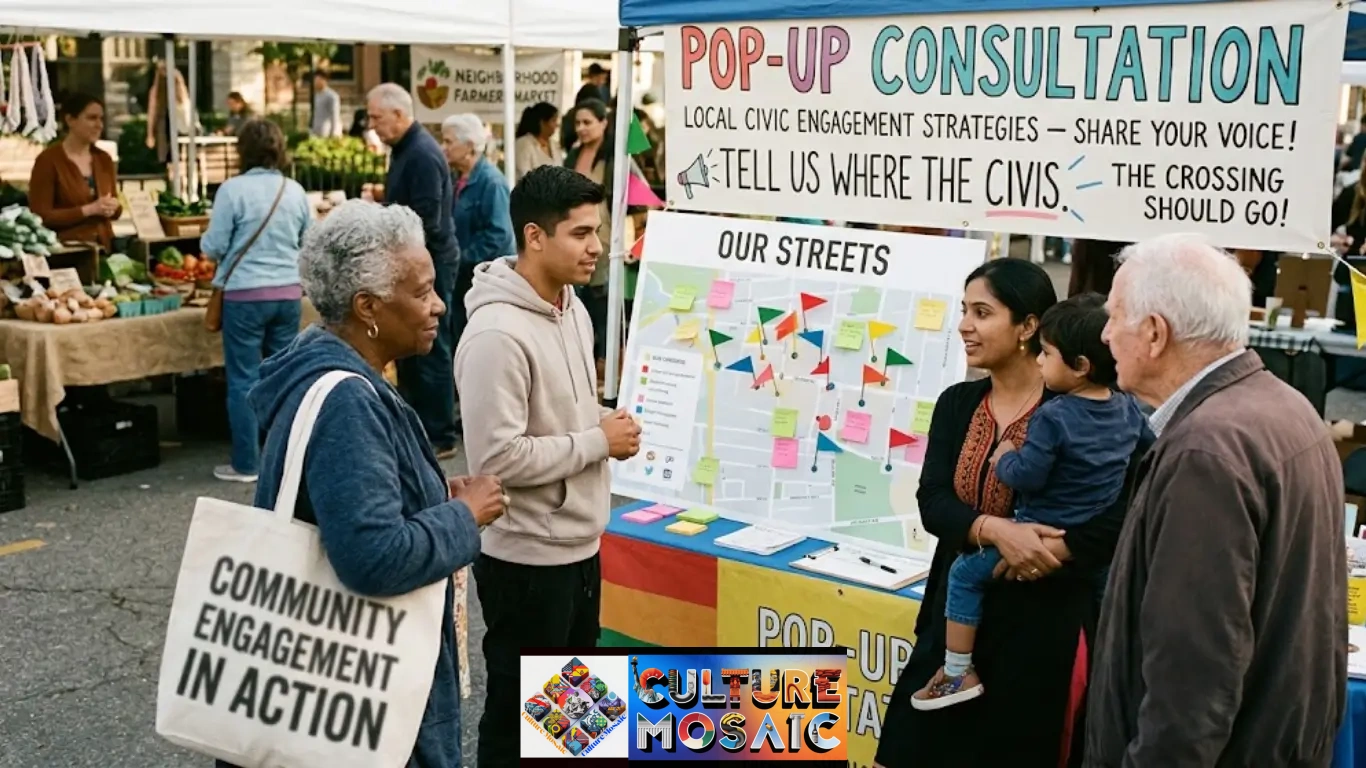
Quick Summary
- Local civic engagement means residents shaping the decisions on their own streets, not just voting once every four years.
- The strongest local civic engagement strategies blend in-person and digital tools:
- Don’t over-reach: most successful engagement happens at the Consult, Involve, and Collaborate levels of the IAP2 Spectrum, not full Empowerment.
- Fix the stakes, not just the format: turnout jumps when residents get a direct say over real resources, like participatory budgeting.
- Closing the loop is non-negotiable: publishing what residents said and showing what changed is what builds long-term trust.
-
Five quick examples of civic engagement:
- Voting locally
- Attending a town hall
- Joining a neighbourhood watch
- Sitting on a planning panel
- Volunteering for civic education
I’ve sat in enough half-empty council chambers to know the problem before anyone explains it to me. A notice goes up on a lamppost. A consultation page goes live on a council website nobody visits. Three residents show up, two of them are retired, and by the time the decision is made, half the street has no idea it happened. That’s not civic engagement. That’s a box being ticked.
And I get why people check out. Life is loud. Work, kids, rent, the school run — nobody has an evening to spare for a planning meeting that runs two hours over. But here’s the sting: the decisions made in that half-empty room decide whether your street gets a crossing, whether the local library stays open, whether the bins get collected on the day that actually works for your bin day. When residents disappear from the process, the people left in the room make the call for everyone else.
That’s what this guide is for. I’m going to walk through the Local Civic Engagement Strategies that genuinely pull people back into the room — the practical, tested, sometimes unglamorous methods that councils, community groups, and residents themselves are using right now to close that gap. At Culture Mosaic, I write about civic life because I think it’s one of the last places ordinary people still get real power over their own patch of ground. It’s worth fighting to keep it accessible.
What Local Civic Engagement Actually Means
Strip away the jargon and civic engagement is just this: the ways ordinary residents shape the decisions, spaces, and services around them. Voting is part of it. So is showing up to a planning meeting, signing a petition, joining a residents’ association, or emailing your councillor about a pothole that’s swallowed three prams. It’s broader than politics and smaller than activism — it’s the daily maintenance of a functioning neighbourhood.
I’d argue it starts with civic literacy — actually knowing how a council budget works, who sits on which committee, when the consultation window closes. Nobody shows up to argue for a zebra crossing if they don’t know the meeting exists. Pair that literacy with a clear sense of Understanding Civic Duty, and you get residents who don’t just know the system — they feel some ownership of it.
The Framework Behind Good Engagement: IAP2’s Five Levels
Most engagement plans that actually work borrow from a simple model developed by the International Association for Public Participation. It’s not complicated, and I think that’s exactly why it’s stuck around.
- Inform — give residents plain facts. A leaflet, a webpage, a short video. No decision-making power here, just clarity.
- Consult — ask for opinions through surveys, comment periods, or public meetings, and actually report back on what was said.
- Involve — work directly with residents throughout a project, not just at the start and end.
- Collaborate — bring residents in as partners on the actual recommendations, sitting at the table where trade-offs get made.
- Empower — hand the final decision to residents entirely, through citizen juries, participatory budgeting, or a binding local vote.
The mistake I see constantly is councils assuming they have to climb to “Empower” every time. They don’t, and honestly, chasing that top rung is where a lot of well-meaning plans go sideways. Full delegation of decision-making is rare, resource-heavy, and often not even legally straightforward for the authority in question. What matters more is picking the right level for the actual stakes involved, and then being honest with residents about which level you’re operating at. Nothing kills trust faster than a “consultation” that was really just an announcement. If you want to build your own voice into that process, our piece on Civic Voice breaks down how residents can push for a genuine seat at each stage.
Why the middle three levels do the heavy lifting
If I had to pick one lesson to hand a first-time engagement officer, it’s this: don’t over-reach. Consult, Involve, and Collaborate are where nearly all of the durable, well-attended, trust-building work actually happens. Consult gets you honest feedback without overpromising control. Involve keeps residents in the loop across the life of a project, not just at the bookends. Collaborate puts them at the table when trade-offs get made.
Empower, by contrast, is rare — usually reserved for referenda, citizen juries, or a genuinely delegated budget line — and reaching for it prematurely tends to backfire. Residents sense the gap between what was promised and what was actually delivered, and that gap is where cynicism sets in. Aim for the middle. Be precise about it. That’s the strategy, more than any single tool on this list.
The 5 Cs of Community Engagement
Alongside the IAP2 model, practitioners often lean on a shorthand — the 5 Cs — to sanity-check whether an engagement effort has any teeth. I’ve adapted the version I find most useful for local, street-level work:
- Capability — are residents actually equipped to weigh in? Do they have the information, the time slot, the accessible format?
- Commitment — is there mutual benefit, or is the council just extracting free labour and calling it engagement?
- Contribution — is there room for residents to volunteer, propose, and take a bit of risk, not just tick a survey box?
- Continuity — does the relationship outlast a single project, or does the council vanish once the ribbon’s cut?
- Collaboration — is there real interdependence, a shared vision, an environment built on trust rather than compliance?
9 Local Civic Engagement Strategies That Actually Work
Here’s the part I actually get excited to write. These are community engagement strategy examples I’ve watched succeed — some textbook, a couple of them wonderfully odd. For every few standard approaches, I’ve thrown in something a little more unusual, because the flyer-and-town-hall combo has been failing quietly for years.
1. Meet people where their feet already are
Pop-up consultation stalls at the farmers’ market, the school gate, or outside the train station during rush hour reach residents who’ll never open a council PDF. Bring a map, some sticky dots, and thirty seconds is often all it takes. This is one of the more creative community engagement moves precisely because it costs almost nothing and meets an unmet need — people’s actual time.
2. Run a proper community and engagement survey
A well-built survey, distributed through post, text, and in-person tablets (not just a link buried in a newsletter), catches residents who are digitally excluded. Keep it under five minutes. Ask what people actually want changed, not just whether they’re “satisfied.”
3. Build a resident advisory panel
A standing group of residents — rotated every year or two so it doesn’t calcify into the same six voices — that reviews proposals before they go public. This sits at the “Collaborate” level of the spectrum and tends to produce far fewer surprises at final vote.
4. Participatory budgeting
Hand residents a real, if modest, pot of council money and let them vote on how it’s spent — a new bench here, a lighting upgrade there. This is genuinely one of the more effective 10 Civic Engagement Opportunities because people who’ve never voted in anything local suddenly show up when it’s their money and their street.
And that’s really the lesson buried inside this whole strategy: it isn’t the format that pulls people in. It’s the stakes. Swap a glossy meeting for a shabby church hall and turnout barely moves. Swap a symbolic comment box for an actual budget line, and the same residents who ignored three newsletters will show up on a wet Tuesday. Format is decoration. Stakes are the engine.
5. Digital open doors, not just digital surveys
An always-on comment portal on planning applications, paired with a monthly livestreamed Q&A, keeps the conversation moving between big meetings. This is one of the newer types of community engagement, and it works especially well for residents who work shifts and can’t make a 7pm meeting.
6. The wildcard: a “decision fair” instead of a meeting
Rather than one podium and rows of chairs, set up several stations around a hall — each staffed by a different council team, each covering one issue. Residents wander, ask questions one-on-one, and leave a sticky note of feedback at each stop. It’s chaotic in the best way, and it removes the fear of public speaking that keeps a lot of residents silent in a traditional meeting.
7. Door-knocking and phone banking, done respectfully
Old-fashioned, yes. Still among the most persuasive tools going, especially in neighbourhoods where trust in institutions runs low. This overlaps heavily with Community Activism Strategies, and it works best paired with training so volunteers listen more than they pitch.
8. Civic education partnerships with schools and libraries
Bring the next generation of engaged residents in early. Mock council votes, youth panels, and library workshops build the habit long before anyone’s old enough to vote. If you’re looking to get hands-on, our guide on how to Volunteer for Civic Education Programs is a solid place to start.
9. Translate everything, and I mean everything
If your borough speaks six languages at home, your consultation materials should too — not as an afterthought, but from the first draft. This single change does more for equity than almost any other item on this list, and it’s central to what we mean by Diverse Civic Harmony in practice, not just in a mission statement.
Real Results: Community Engagement Case Studies
Chicago’s My CHI. My Future. programme is a good example of what happens when a city stops broadcasting at young residents and starts aggregating what’s already happening across the community into one accessible hub. Participation climbed because the barrier to finding something worth showing up for finally dropped close to zero.
Closer to home, UK councils running participatory budgeting pilots have reported the same pattern over and over: turnout among residents who’d never engaged with a council before jumps sharply once real money and a real vote are on the table. It isn’t the meeting format that was broken. It was the stakes.
Australian local authorities running structured feedback loops — publishing plain-language summaries of what residents said and what changed as a result — have found the same residents return to the next consultation instead of assuming, as so many people do, that nothing they say ever lands anywhere. That loop-closing step is, in my experience, the single most underrated of all local civic engagement strategies. For a longer look at where all this is heading, see our roundup of Civic Engagement Trends.
Closing the Loop Isn’t Optional
I want to sit on this one a moment longer, because it’s the piece that gets cut first when a project runs out of time and money — and it’s the piece that matters most.
Every strategy on this page collects something from residents: an opinion, a vote, an evening of their time. What happens after that collection is where trust is actually built or actually destroyed.
A council that runs a survey, quietly folds the results into a report nobody reads, and moves on has taught its residents a lesson far more durable than any leaflet could: don’t bother next time. That lesson sticks. It’s why the same handful of names turn up at every meeting while everyone else has long since stopped opening the envelope.
Closing the loop means three concrete things, not a vague promise of “we’re listening”:
- Publish what was said — a plain-language summary, not a 200-page appendix nobody will open.
- State what changed, specifically, and just as importantly, state what didn’t change and why.
- Tell people when the next chance to weigh in is coming, so the relationship doesn’t go quiet again.
Do that consistently, and residents start treating engagement as a habit worth keeping rather than a one-off favour. Skip it, and no amount of pop-up stalls or slick surveys will save the turnout numbers next time round.
Community Engagement Planning: A Simple Starting Sequence
If you’re building a plan from nothing, resist the urge to design the perfect survey first. Sequence matters more than polish.
- Define the actual decision at stake — vague plans produce vague turnout.
- Pick your IAP2 level honestly, based on how much influence residents will truly have.
- Choose two or three channels from the list above, mixing digital and in-person.
- Set a reporting-back date before you launch, and hold yourself to it.
- Close the loop publicly — show what changed because people spoke up.
Frequently Asked Questions
What are 5 examples of civic engagement?
Voting in local and national elections, attending a town hall or council meeting, joining a neighbourhood watch or residents’ association, serving on a planning or advisory committee, and volunteering for civic education or get-out-the-vote efforts. Each sits at a different level of commitment, which is exactly why a good strategy offers more than one entry point.
What are the 5 C’s of community engagement?
Capability, Commitment, Contribution, Continuity, and Collaboration. Together they act less like a checklist and more like a diagnostic — if an engagement effort is failing, it’s usually because one of these five is missing, most often Continuity, when a council disappears the moment a project wraps.
What are some examples of community engagement strategies?
Pop-up consultation stalls, resident advisory panels, participatory budgeting, always-on digital comment portals, door-knocking campaigns, school and library civic education partnerships, and fully translated consultation materials. The strongest plans layer several of these rather than leaning on just one.
What are some examples of engagement strategies?
Beyond the civic sphere, the same principles show up in workplaces, schools, and nonprofits: regular feedback surveys, town-hall-style all-hands meetings, mentorship or ambassador programmes, and recognition schemes that close the loop on contributions.
The through-line is the same one that runs through every strategy on this page — people stay engaged when they can see their input actually land somewhere. To understand why that matters so much at the local level specifically, it’s worth reading about the What is the Value of Civic Participation? question directly.
Why is voting still worth it if local turnout is already low?
Because low turnout means each individual vote carries more weight, not less — local elections are frequently decided by a few hundred ballots, sometimes fewer. If you want the full argument, including the numbers, we’ve laid it out in Why Is Voting Important in Local Elections?.
None of this works if it stays theoretical. Pick one strategy from this list, one this month, and try it on your own street. I’d genuinely like to know what happens when you do.
Sources
- International Association for Public Participation (IAP2) — Spectrum of Public Participation, iap2.org
- U.S. Environmental Protection Agency — Public Participation Guide, epa.gov
- Hansard Society — Audit of Political Engagement research series, hansardsociety.org.uk
- Qualtrics — Community Engagement Strategies in Government, qualtrics.com
- CivicPlus — Resident Engagement Initiatives Local Governments Are Using Today, civicplus.com
- GoodParty.org — Community Engagement Strategies for Local Governments, goodparty.org
- Penn State Center for Economic and Community Development — The Six Cs of Successful Community Engagement, aese.psu.edu